Skip to content

The best mini oven for baking

Liters are a volume; a tin is a diameter. This guide is ordered by which maker closes that gap, and by who publishes a temperature range rather than a ceiling.

The one that tells you what fits

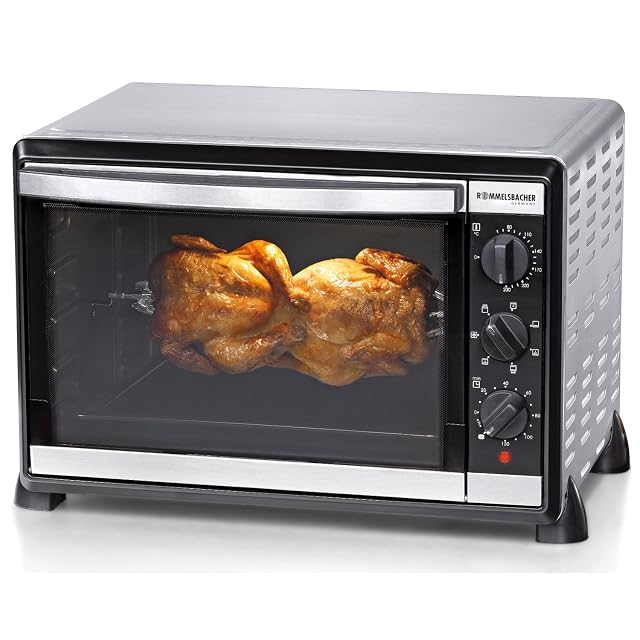
The Rommelsbacher BG 1805/E publishes the maximum baking tin diameter — 31.5 cm (12.4 in) — which nothing else on this site does. It adds stepless 80 to 230 °C (446 °F), seven heating modes including each with the fan, four shelf levels, a 120-minute timer with a continuous setting, and a door that dismantles for cleaning.

It is the most expensive mini oven here, and it is the only one you can plan around.

When a whole chicken is the job

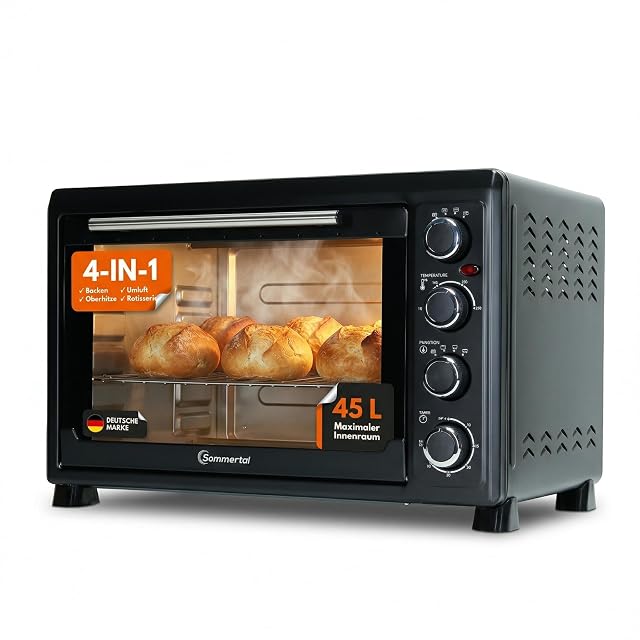
The Sommertal 45 L publishes a full range — 100 to 230 °C (212 to 446 °F) — 2,000 W, a rotisserie spit, convection, four separate dials and an interior light. Forty-five liters is the largest cavity here.

It publishes no internal dimensions, and its 100 °C (212 °F) floor is 20 degrees above the Rommelsbacher’s.

The compact convection option

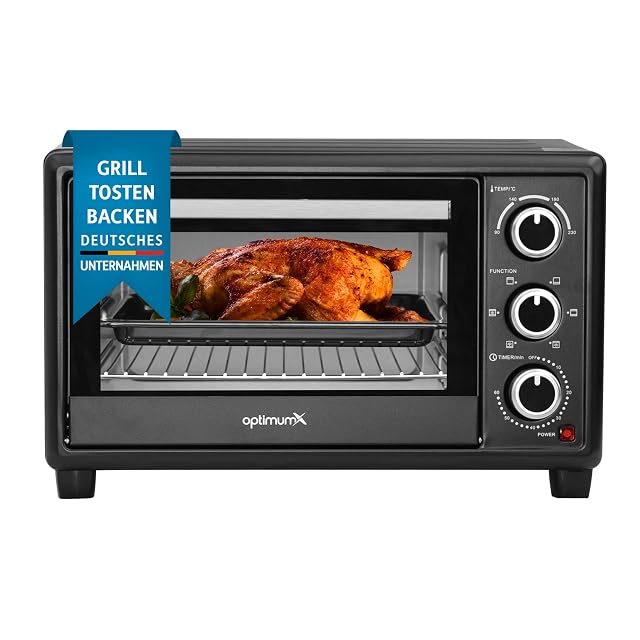
The OptimumX 20 L brings a fan, three shelf positions and a timer that switches the oven off rather than only sounding, at half the price.

It publishes no temperature figure whatsoever — not a ceiling, not a floor. That is the one absence you cannot work around when comparing on paper.

What we would not do

Buy a mini oven for baking without an internal width or a tin diameter. It is the single most avoidable disappointment in this family.

Which appliance earns its place?

You want to bake cakes and bread
Look for even heat and a real thermostat, not for the maximum temperature printed on the front.
You have no built-in oven
A mini oven becomes the main oven, and internal dimensions matter more than anything else.
You bake small quantities
That is where the format wins: it heats fast and a full-size oven is wasteful for one tray.
You mainly reheat and grill
A simpler model is enough, and convection matters less.

Picking by what you make

Cakes and small bakes

The demanding use: even heat and a stable temperature matter more than power.

Bread

Possible in a mini oven, but the small cavity loses heat fast when the door opens, and rise suffers.

Gratins and reheating

The everyday use, and the one that justifies the appliance sitting on the countertop.

Grilling

The element is close to the food in a small cavity, which grills well and burns quickly. It is a matter of watching, not of setting.

The handful of figures that count

Internal dimensions, not liters
What matters is whether your tin fits with air around it. A tall narrow cavity and a wide flat one of the same volume bake very differently.
Convection or static heat
A fan evens out a small cavity where hot spots are severe. For baking, that is the single most useful feature.
Thermostat accuracy and drift
Small ovens overshoot and undershoot more than large ones. An oven thermometer inside is the honest way to know your machine.
Door and outer temperature
A single-glazed door on a countertop appliance gets very hot, and it sits at hand height. Insulation is a safety criterion here, not a comfort one.
The rack positions
In a small cavity, one rack level up or down changes a bake completely. Two or three real positions matter.

Which figure for which kitchen

What you bakeWhat it needsThe limit
CakesConvection, stable thermostatHot spots in a small cavity
BreadRetained heatHeat lost when the door opens
GratinsTop heatNothing particular
Several traysA full-size ovenOne tray at a time here

The common slips

Buying on liters
The quoted volume says nothing about whether your tin fits with clearance. Measure the cavity, and measure your usual tin.
Trusting the dial
Small ovens drift more than large ones. A cheap oven thermometer inside tells you what the dial does not, once and for all.
Pushing it under a wall unit
These appliances vent hot air upwards and get very hot outside. Clearance above is a requirement, not advice.
Filling the cavity
Air has to circulate around a tin. A dish touching the walls bakes on one side and stays raw on the other.

By the household you cook for

The kitchen without an oven
A larger model with convection, treated as the main oven. Dimensions decide everything.
The small household
A compact oven that heats fast: for one tray it beats a full-size oven on both time and energy.
The occasional baker
A simple model is enough; convection is the one upgrade genuinely worth having.

Cleaning, parts and working life

A mini oven is cleaned mostly through its crumb tray and its door glass. Grease baked onto the element is what produces smoke on the next use, and in a small cavity that reaches the food quickly.

  • Empty the crumb tray after every use: it is where smoke starts.
  • Clean the walls while barely warm, when residue still lifts.
  • Wipe the door glass on both sides: a coated glass loses its insulation when dirty.
  • Do not line the base with foil unless the maker allows it: it traps heat against the element.

Safety

A very hot appliance at countertop height, often within reach of children.

  • Leave the maker's stated clearance above and around, never under a wall unit.
  • Treat the outer shell and door as hot: many models have no cool-touch glass.
  • Use a dedicated socket: these appliances draw a lot for a plug-in device.
  • Never put a sealed container or a closed jar inside.

Our choices, and what justifies them

  1. Rommelsbacher BG 1805/E

    42 L · 80–230 °C (176 to 446 °F) · 7 modes · tins to 31.5 cm (12.4 in)

    The only mini oven on this site that publishes what will actually fit inside it: baking tins up to 31.5 cm (12.4 in) in diameter. Forty-two liters, four stainless elements, stepless 80 to 230 °C (176 to 446 °F), seven heating modes, a motorized spit rated for two chickens, a 120-minute timer with a continuous setting, four shelf levels and a door that comes apart for cleaning.

    Best for: Baking, in a household that owns tins and wants to know they will go in.
    8.4/10

  2. Sommertal Minibackofen 45L

    45 L · 2,000 W · 100–230 °C (212 to 446 °F) · rotisserie

    Forty-five liters and 2,000 W with a rotisserie spit, convection, and a published range of 100 to 230 °C (212 to 446 °F) on a 60-minute timer. Four functions — bake, grill, convection and rotisserie — on four rotary dials, with an interior light, a double tempered glass door, stainless elements and a zinc-lined cavity.

    Best for: A whole chicken, in a household that does not want to heat a full-size oven for it.

    7.8/10

  3. OptimumX opt-20lt-black

    20 L · 1,380 W · convection · 3 shelf positions

    A 20-liter convection mini oven at 1,380 W, with three shelf positions, an adjustable 60-minute timer that switches the oven off at the end, and a high-strength double-glazed door. OptimumX names pizza, cake, chicken wings and roast chicken among its intended uses.

    Best for: A second oven for pizza and roasting, where a fan matters more than a dial with degrees on it.

    7.8/10

What readers want to know

Will my baking tin fit?

One maker on this site answers that: Rommelsbacher publishes a maximum tin diameter of 31.5 cm (12.4 in). Everyone else publishes liters, and two ovens of the same liters can differ by several centimeters of usable width.

How low does a mini oven need to go?

Lower than most publish. Rommelsbacher states 80 °C (176 °F), Sommertal 100 °C (212 °F), Cecotec publishes only a 230 °C (446 °F) ceiling and OptimumX publishes no temperature figure at all.

Can a mini oven really bake a cake?

Yes, and convection helps a great deal by evening out a small cavity. The limits are tin size and the hot spots inherent to a small volume.

Is it cheaper to run than a full-size oven?

For one tray, generally yes: there is far less air and metal to heat. For a full load, a large oven used properly is more efficient.

Why does everything brown on top?

In a small cavity the top element is close to the food. Moving down a rack position, or covering with foil, fixes most of it.

Do I need to preheat?

For baking, yes: putting a cake into a cold cavity changes its rise. These ovens preheat fast, so it costs little.

Can I put a tin directly on the base?

Usually not: the lower element is right beneath and will scorch the base. Use a rack unless the manual says otherwise.

How accurate is the thermostat?

Small ovens drift more than built-in ones. An oven thermometer inside is the only honest way to know what yours actually does.

Each appliance, and the kitchen it earns its space in

Rommelsbacher BG 1805/E

Fits: Baking, in a household that owns tins and wants to know they will go in.
Main asset: Publishes the maximum baking tin diameter — 31.5 cm (12.4 in) — which nothing else here does

Main drawback: The most expensive mini oven here, by 60 € over the Sommertal

Read the full review →

Sommertal Minibackofen 45L

Fits: A whole chicken, in a household that does not want to heat a full-size oven for it.

Main asset: Publishes a full temperature range: 100–230 °C (212 to 446 °F)

Main drawback: No manufacturer part number published

Read the full review →

OptimumX opt-20lt-black

Fits: A second oven for pizza and roasting, where a fan matters more than a dial with degrees on it.

Main asset: Convection at twice the capacity of the Cecotec, for about twice the price

Main drawback: No temperature range published at all — neither floor nor ceiling

Read the full review →

What each slice of budget covers

What goes with one of these

Baskets, liners and spares from the same aisle, at the price we recorded. Check they fit the appliance you pick before ordering: it depends on the capacity and the part number, which the product page states.

If you only read one line

Pairings worth reading

Two appliances compared directly, where that page already exists in this guide or this aisle.

How this order was decided

The appliances here are from the catalog of this site. Specifications are what the maker publishes and what the Amazon listing shows; prices are the Keepa figure on the date below, and both change. Ranking uses declared specifications, the balance of stated strengths and stated limits, and price. Nothing on this site has been cooked with, and no page here says otherwise.

Last checked on

Prices quoted in these summaries are dated readings. The live price is shown next to each product.

The tool we use ourselves

Chosen your tool? Now buy it at the right price.

Stand mixers and air fryers swing by fifty dollars or more across the year, and the biggest "discounts" often land at prices the same model sold for six weeks earlier. UniverTrack tracks the real price history across retailers, spots fake reductions, and alerts you when it is genuinely the moment to buy.

Real price historyBuy-now alertsAI buying assistant
Try free for 14 days →
No commitment · Cancel in one click · 5 languages