What the maker puts in writing
- “5-IN–1 MULTIFUNCTIONAL COOKING- Enjoy versatile cooking with Air Fry, Bake, Broil, Toast, and Keep Warm settings.”
- “HEALTHY AIR FRYING TECHNOLOGY – Cook crispy, delicious meals with little to no oil using advanced air frying technology.”
- “EVENTOAST TECHNOLOGY FOR PERFECT TOAST – Achieve evenly toasted bread, bagels, and more… ensuring consistent results every time with no hot spots.”
- “COMPACT YET SPACIOUS INTERIOR – Fits up to a 9-inch pizza or 4 slices of bread”
- “USER-FRIENDLY CONTROLS & 7 ACCESSORIES – 30-minute timer with removable crumb/drip tray, bake pan, air fry mesh tray, and wire rack for easy cleanup. Use drip tray when cooking and keep food clear of heating element.”
- Description: “Air Fry Technology, which uses high intensity hot air to bake, brown, and crisp your favorite fried foods with little to no oil. The included air fry mesh tray allows hot air to surround food for fast, crisp results. Two control knobs… Even Toast Technology evenly distributes heat”
- Reference TO1787SS-RF · Catalog: 292 × 394 × 208 mm (11.5 × 15.5 × 8.19 in)
The mesh tray is the air fryer
“The included air fry mesh tray allows hot air to surround food for fast, crisp results.”
Crispness needs dry heat reaching every surface at once. On a solid pan, the underside of a chip sits in its own moisture and steams — so you get a crisp top and a soft bottom, which is the usual disappointment of “oven chips”.
A mesh tray lets the hot air underneath, and that is the whole mechanism. The element arrangement supplies the speed; the mesh supplies the access.
Which means an air fryer and an air-fry toaster oven differ mainly in shape. A dedicated basket is deeper and shakes easily; a toaster oven is wider and takes a tray — and a tray in a single layer is what crisps properly either way.
Only one other machine on this shelf has it. The Hamilton Beach at $59.95 ships a “metal air-fry basket” and names the mechanism directly: a “convection function circulates air around food as it cooks”, under the name “Sure-Crisp”.
And the most expensive oven here does not have it at all. The Breville at $159.95 publishes eight cooking functions — Toast, Bagel, Bake, Broil, Pizza, Roast, Cookies, Reheat — and air fry is not among them.
So on this shelf, air frying is a $56-to-$60 feature rather than a premium one.
The drip tray instruction, which nothing else here gives
“Use drip tray when cooking and keep food clear of heating element.”
Air frying renders fat, and that fat drips. On a mesh tray it goes straight through — which is the point of the mesh, and exactly why a tray must sit underneath.
Fat landing on a glowing element smokes immediately and can flare. That is the one real hazard of air frying in an open cavity, and this is the only page on this shelf to address it.
The second half of the instruction matters as much: a chicken wing touching the top element burns on contact, and in a cavity this size the gap is small.
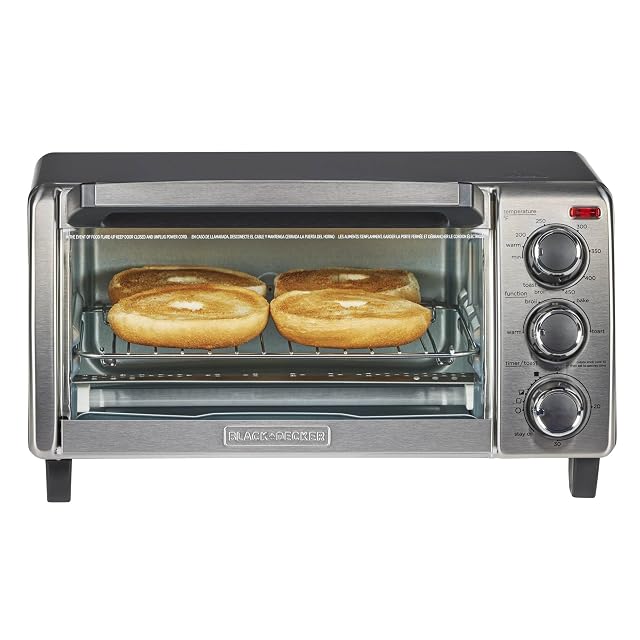
Its own stablemate publishes the figure. The BLACK+DECKER toaster at $59.99 says to keep “food and bakeware at least 1½ inches from the top heating elements and fully contained within the tray” — and that is the number to use here, since both are compact BLACK+DECKER cavities.
No other page on this shelf gives either instruction, and the Hamilton Beach — the only other air fryer here — says nothing about drips at all.
The habit: mesh tray with the drip tray directly below, food in a single layer, nothing touching the top.
Five functions, seven accessories, and a nine-inch pizza
Five functions — Air Fry, Bake, Broil, Toast, Keep Warm — puts this third on the shelf:
Breville — 8 (Toast, Bagel, Bake, Broil, Pizza, Roast, Cookies, Reheat)
NutriChef — 7, plus two hot plates and a rotisserie
this — 5 · Elite Gourmet ETO2530M — 5
BLACK+DECKER toaster — 4 · Elite Gourmet ETO449X — 4 · Hamilton Beach — 4
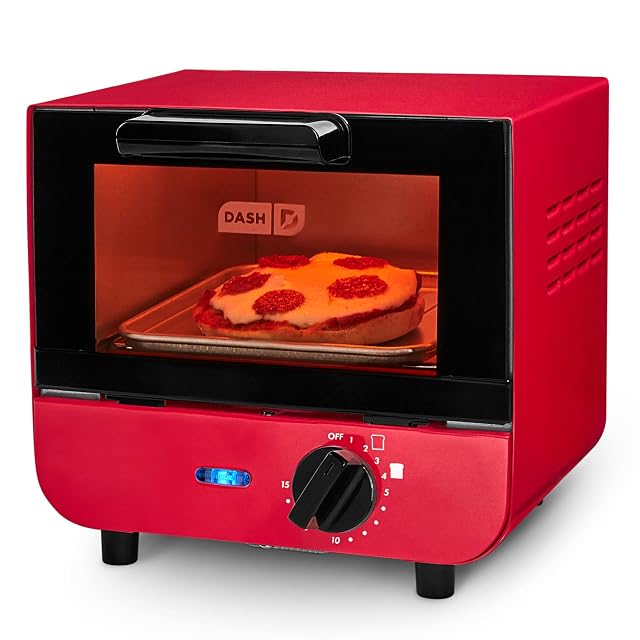
Dash — 1
Seven accessories is the second-highest count here, and four are named: a removable crumb/drip tray, a bake pan, an air fry mesh tray and a wire rack.
The crumb tray doubling as the drip tray is the sensible economy, and it is the feature that decides whether a toaster oven stays usable: crumbs fall to the cavity floor, sit near the lower element and burn, which is the smell of an old toaster oven and the reason one eventually sets off a smoke alarm. Every machine on this shelf has some version of it — the one point of complete agreement here.
A 9-inch pizza or 4 slices is the shelf’s common capacity statement. Five machines use it: this, the BLACK+DECKER toaster (also 9-inch), the Hamilton Beach (9-inch, plus “a 3 lb. chicken in an 8” x 8” pan or a 9” x 5” loaf pan”), the Elite Gourmet ETO449X (“small pizzas”), and the Breville (“4 toast slices… and 11 inch pizzas”).
The outliers are the two large ovens: the Elite Gourmet ETO2530M at $84.99 takes 6 slices and a 12-inch pizza in 25 liters, and the NutriChef at $149.99 publishes 30 quarts — about 28 liters.
Two knobs is the whole interface: a timer and a function selector. Which is the right amount for five functions, and the opposite of the Breville’s LCD with eight programs. A dial survives a power cut and can be read across a kitchen; it costs precision, since there is no numeric temperature at all on this page.
EvenToast, and what a hot spot actually is
“EvenToast technology, ensuring consistent results every time with no hot spots.”
A hot spot is a place where the element is closer to the bread than elsewhere, or where the element’s own coils are denser. In a small cavity, four slices across the width will not all sit the same distance from the same part of the element — so one corner darkens first, which is the characteristic uneven toast of a cheap toaster oven.
Even distribution is a matter of element layout rather than power, which is why it is a design claim and not a wattage claim — and why its stablemate, the BLACK+DECKER toaster, makes the identical claim: “our exclusive EvenToast Technology optimizes heat distribution to toast bread evenly.”
The Breville attacks the same problem with hardware instead, and it is the most interesting engineering claim on the shelf: “Using 5 independent quartz elements, smart algorithms steer small oven’s power where and when it’s needed.” Five elements that can be driven separately is a different solution from one element shaped well.
And the Elite Gourmet ETO449X gives the third approach — quartz elements, which radiate almost immediately rather than warming a steel sheath first, so they respond faster when the thermostat calls.
Nothing on this page says what kind of element it has.
A 30-minute timer puts this in the shelf’s middle group:
Dash — 15 minutes · this, BLACK+DECKER toaster, Elite Gourmet ETO449X — 30 · Elite Gourmet ETO2530M, NutriChef — 60 · Breville, Hamilton Beach — not published
On ovens of this kind the timer is the on-switch, so the longest unattended cook is the dial’s travel. Thirty minutes takes chips, wings, cookies, a pizza and four slices. A roast needs resetting — and the two 60-minute machines on this shelf are the two large ones.
And then three figures are missing that four machines here publish.
No wattage. Breville 1800 W — exactly 15 amps at 120 volts, the full capacity of a standard American circuit — Elite ETO2530M 1500 W, NutriChef 1400 W, Elite ETO449X 800 W. This, its stablemate, the Hamilton Beach and the Dash publish none. On an air fryer that is the figure that governs how fast it crisps.
No temperature ceiling. Five machines publish 450 °F, three of them as a range from 200 °F. The Dash publishes 400 °F. Air frying wants the top of the range, and this page gives no number at all.
No weight. Five machines publish one, from the Dash’s 1451 g to the NutriChef’s 10297 g. The catalog box here is 292 × 394 × 208 mm, which is the same order as the Hamilton Beach’s and the BLACK+DECKER toaster’s.
What is not published
No wattage, no temperature, no weight, as above.
No warranty. Only the Breville at $159.95 (“1 Year Limited”) and the Dash at $24.99 (“a 1-year warranty, or double it by registering”) publish a term. Six of eight publish nothing.
No convection or fan. “High intensity hot air” is the claim, and whether a fan drives it is not stated — where the Hamilton Beach says plainly that its convection function “circulates air” and the BLACK+DECKER toaster specifies “natural convection airflow”, which is the air moving because it is hot rather than because a fan pushes it. On an air fryer, a fan is the usual means and it is not claimed here.
No rack positions, where the Breville and the Elite ETO2530M both publish three and the Elite ETO449X publishes two.
No preheat guidance, which two machines here give as ten minutes: the BLACK+DECKER toaster and the Elite ETO449X, the latter adding “at 450°F”. A thermostat measures air, and air heats in two minutes; the walls and the tray take ten — and it is the mass that cooks a pizza base. Ten minutes is the right habit here too.
No non-stick cavity, which only the Breville publishes.
No interior dimensions, where the Breville gives 11 × 10 × 4 inches and the Elite ETO2530M 13.25 × 13.50 × 8.95.
No model identity confusion, at least — which is worth one line, because its stablemate has three: the BLACK+DECKER toaster carries TO1313SBD in its title, TO1756SB as its catalog reference, 15.47 inches in its title and 14.5 inches in bullet five.
Availability
Read on the day this page was built: $56 at the American Amazon shop.
Read from Keepa on the day this page was last revised; stock and price both move without notice.
Prices quoted in this text were read on 2026-10-05. The live price is at the top of the page.