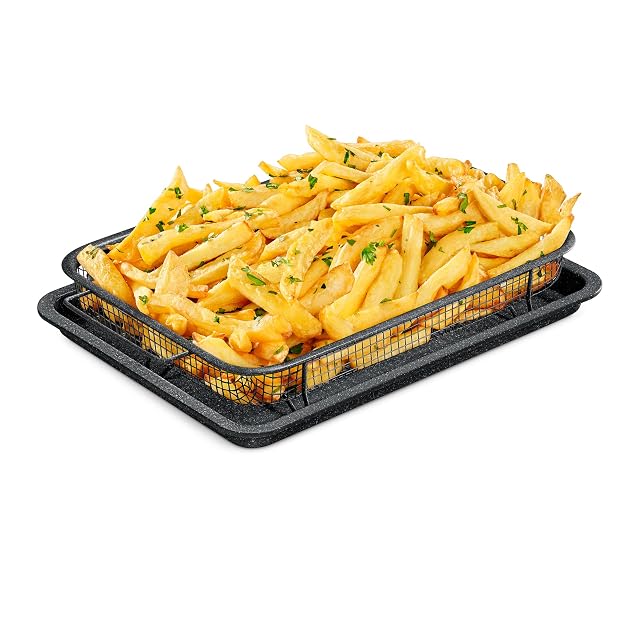
A basket inside a tray, and PTFE free
Bakken-Swiss Crisper Tray and Basket Set
A two-piece crisper set — a carbon steel baking tray and a removable basket — in a grey stone non-stick coating, dishwasher safe and PTFE free.
Specifications
- Two pieces
- A baking tray and a removable basket
- Air all round
- The basket lifts food off the tray — unique on this shelf
- Material
- Carbon steel with a grey stone non-stick coating
- Chemistry
- PFOA, PFOS and PTFE free, stated
- Dishwasher
- Stated safe
- Named uses
- Chips, bacon, chicken, pizza, some cookies
- Weight
- 680 g (24 oz)
- Catalog
- 350 × 225 × 55 mm (13.8 × 8.86 × 2.17 in)
- Reference
- BAKCRIPGRY
- Temperature limit
- Not published — four items on this shelf publish 450 °F
- Basket mesh or hole size
- Not published
- Steel thickness
- Not published
- Handles
- None mentioned
- Warranty
- Not published
- Amazon reference
- B0CNB5L2JH
- EAN
- 0850053769238
The plus side, and the minus
Strengths
- A basket that lifts food clear of the tray, which nothing else here does
- PFOA, PFOS and PTFE free, where one item on this shelf states it uses PTFE
- Twelve dollars fifty-nine, the cheapest item on this shelf
Compromises
- No temperature limit published at all, on a coated steel pan
- No mesh or hole size, which is the specification of a crisper
- No steel thickness and no handles
What the maker puts in writing
- “DELICIOUS CRISPY FOOD - achieve perfectly crispy results with our 2-piece crisper tray set, consisting of a durable baking tray and a removable basket. Say goodbye to greasy, fatty foods”
- “DURABLE AND RELIABLE - crafted from high-quality carbon steel and featuring a durable non-stick gray stone coating”
- “EFFORTLESS CLEANING - our crisper tray oven pan is dishwasher safe… such as chicken, homemade potato chips, pizza’s, coated chicken, bacon and more”
- “VERSATILE COOKING - suitable for making chips and even some cookies”
- “SAFETY FIRST - our crisper tray can be used as a pizza crisper pan among other things and is PFOA, PFOS, and PTFE-free”
- From the name: “2-Piece Set – Gray Marble”, “for Healthier Cooking in Regular Ovens”
- Reference BAKCRIPGRY · Catalog: 680 g (24 oz), 350 × 225 × 55 mm (13.8 × 8.86 × 2.17 in)
A basket above a tray, which nothing else on this shelf does
“a 2-piece crisper tray set, consisting of a durable baking tray and a removable basket”
The two designs on this shelf.
A perforated tray has holes and the food sits on the metal: air reaches the underside through the holes, and the parts touching metal conduct heat and brown. Six items here are perforated — the Emporio Kitchen at $15.43, the BAKKENMASTER pizza pan at $15.99, both GoodCook pans at $18.99 and $25.19, the Breville at $19.95, and the perforated sheet in the NutriChef set at $36.99.
A basket sits above the tray, so air circulates underneath the food rather than only through the holes beneath it — and the tray below catches the fat.
Which is why the page frames it as the healthier option: “Say goodbye to greasy, fatty foods.” The fat drains out of the basket instead of sitting under what is cooking in it.
Where each design wins.
A pizza wants contact. A perforated pizza pan touches the dough across most of its area and vents the steam through the holes, which is how you get a browned base rather than a dried one. A chip, a rasher of bacon or a piece of coated chicken wants air. Anything that renders fat or releases a lot of water crisps better suspended than seated.
So this is the one item on this shelf designed for the second job, and the page is honest that pizza is secondary: “can be used as a pizza crisper pan among other things”.
What is not published is the mesh. The gap size in a crisper basket decides what falls through — and chips, which bullet three names, are exactly the food that does. The only hole figure anywhere on this shelf is on the Breville at $19.95: “1/3 inch crisper holes”.
The catalog footprint is 350 × 225 × 55 mm — about 13.8 × 8.9 × 2.2 inches — which is a rectangular tray rather than a round pizza pan, and 55 mm of depth is consistent with a basket sitting inside a tray with a gap below it.
No temperature limit, where four items here publish the same one
The published limits on this shelf:
450 °F (230 °C) — the Emporio Kitchen at $15.43, the BAKKENMASTER pizza pan at $15.99, the Moss & Stone set at $23.99, the NutriChef set at $36.99 Nothing — this, both GoodCook pans, the Breville at $19.95, the BAKKENMASTER 18-piece set at $57.99
Four items, one figure.
Why 450 °F is the number to notice. A commercial pizza oven runs 700 to 900 °F. Most home pizza recipes call for 475 to 550 °F — the highest a domestic oven goes — because a crust needs the floor hot enough to set the base before the top overcooks.
So a coated steel pan rated to 450 °F is rated below the temperature the recipe asks for.
That is not a fault of this tray. It is the limit of a coating. A non-stick film degrades above its rated range; the steel underneath does not care.
Which is where the three stones on this shelf live in a different world.
Unicook, $33.99 — cordierite, “heat-resistant up to 1,450°F (787°C)” Ritual Life, $36.95 — cordierite, “up to 1500°F (815°C)” Emile Henry, $109.95 — “up to 900 degrees F” on gas, charcoal and wood grills, and “Can be used in all types of ovens and under the broiler”
A thousand degrees of difference, because a stone has no coating to lose.
The practical reading for this tray: treat 450 °F as the ceiling whether or not the page says so, and keep it out from under a grill element. For chips and bacon at 400 to 425 °F it is in its proper range, and that is what it is for.
PFOA, PFOS and PTFE free — and one item here says the opposite
“is PFOA, PFOS, and PTFE-free, ensuring your meals are safe and healthy”
The three named.
PTFE — sold as Teflon — is the standard non-stick film on bakeware, and the one that matters here: a coating free of PTFE is a ceramic or sol-gel film instead, which is what “gray stone coating” in bullet two describes. PFOA is a per- and polyfluoroalkyl substance historically used as a processing aid in making PTFE, phased out of that use years ago. PFOS is another member of the same family, used in other applications.
The shelf, on chemistry:
PFOA, PFOS and PTFE free — this, the Emporio Kitchen at $15.43, the BAKKENMASTER pizza pan at $15.99 PFOA, PFOS, PTFE and BPA free — the NutriChef set at $36.99, the only one to add BPA “PFOA-Free” alone, in the title — the BAKKENMASTER 18-piece set at $57.99 “Nonstick coating”, with no chemistry — both GoodCook pans and the Breville at $19.95 And one that states its coating is PTFE — the Moss & Stone 5-piece set at $23.99, whose title reads “Carbon Steel Non-Stick PTFE Coating” and whose bullets add “BPA-free metal”
So one item on this shelf declares a fluoropolymer coating and four declare the absence of one.
What a ceramic coating buys and gives up. No fluoropolymer, and better scratch resistance than a sprayed non-stick. What it gives up is longevity: a ceramic film loses slipperiness with use, where PTFE stays slippery until it is damaged.
And the three stones on this shelf have no coating at all. Bare cordierite or ceramic, which is why they tolerate 1450 °F — and also why two of the three forbid soap: the Unicook at $33.99 says “Do not use detergent” and the Ritual Life at $36.95 says “no soap needed”, because a porous stone absorbs it.
The dishwasher claim here is the straightforward one. “our crisper tray oven pan is dishwasher safe.” Seven items on this shelf claim it. One caveat worth importing from the stones: a dishwasher cycle is hot, alkaline and abrasive, and a coating is what it wears over years. Hand washing a ceramic-coated pan lasts longer, whatever the bullet says.
Carbon steel with a stone coating, and no thickness
“crafted from high-quality carbon steel and featuring a durable non-stick gray stone coating… designed for long-lasting performance”
One item on this shelf publishes a steel thickness. The Emporio Kitchen at $15.43: “Built with 0.5mm thick carbon steel… delivers even heating and serious strength that resists warping over time.”
And 0.5 mm is at the thin end. Heavy-gauge bakeware runs 0.8 to 1.0 mm, so the one published figure on this shelf is a modest one being used as a durability claim.
Nobody else gives a number — including this page, the two GoodCook pans (“premium-grade construction that resists warping”), the BAKKENMASTER pizza pan at $15.99 (“sturdy construction… Say goodbye to warping”) and the BAKKENMASTER 18-piece set at $57.99 (“commercial-grade carbon steel”).
Four pages promising against warping, and one thickness between them.
What warping actually is, since it is the shelf’s favorite promise. A thin sheet heats unevenly, the hot part expands against the cool part, and past the yield point it takes a permanent set. Once a tray rocks, fat runs to one end — and on a crisper that is the difference between even browning and a greasy corner.
The two causes are thinness and thermal shock. No page here publishes a thickness, and the shock is in your hands: let a hot tray cool before it meets water.
At 680 grams this is mid-shelf among the steel. Breville 408 g (the lightest item here) · BAKKENMASTER pizza pan 621 g for two · this 680 g · GoodCook 16-inch 680 g · Emporio Kitchen 1,085 g for two · GoodCook set 1,247 g for two · NutriChef set 1,538 g for six pieces.
And then the stones. Unicook 2,950 g · Emile Henry 3,311 g · Ritual Life 3,402 g. The heaviest item on this shelf is 8.3 times the lightest — and that mass is the whole point of a stone: thermal ballast that does not drop in temperature when cold dough lands on it.
What is not published
No temperature limit, as above.
No mesh or hole size, as above — and on a crisper that is the specification. The Breville at $19.95 is the only item on this shelf to publish one: “1/3 inch crisper holes”.
No steel thickness, as above.
No handles. Two steel items on this shelf publish silicone handles: the Emporio Kitchen at $15.43 (“a wide, oversized handle wrapped in silicone… no mitt fumbles”) and the BAKKENMASTER 18-piece set at $57.99 (“gray silicone handles… stay cool to the touch”). Two stones have handles: the Ritual Life at $36.95 (plus a detachable carrying tray) and the Emile Henry at $109.95 (“Handles make it easy to use and carry”).
On a two-piece set the question is sharper than usual: a hot basket has to come out of a hot tray, and the page does not say what you lift it by.
No feet. Both GoodCook pans publish them: “the bottom of the round oven pan also has feet to keep the hot pan elevated and off the countertop, preventing heat damage.” On a tray that catches rendered fat, feet are the thing that stops it marking a countertop.
No basket depth or gap, which is what decides how much fat the tray below can hold before it reaches the food.
No warranty. Two items on this shelf publish one: the Emile Henry at $109.95 — a 10 year Guarantee, with its terms stated: “covers any production fault or quality problem… when used in a normal domestic environment, and respecting the care and use instructions” — and the Moss & Stone set at $23.99 (“1-year warranty”). The Ritual Life at $36.95 offers support rather than a term: “A member of our team will respond within 24 hours.” Nine publish nothing.
No country of manufacture, which no item on this shelf publishes.
Availability
Read on the day this page was built: $13 at the American Amazon shop.
Read from Keepa on the day this page was last revised; stock and price both move without notice.
Prices quoted in this text were read on 2026-10-17. The live price is at the top of the page.
What readers want to know
What does the basket do that a perforated tray does not?
It lifts the food clear of the metal, which is the difference between crisp and half-crisp — and no other item on this shelf works that way. Bullet one: "our 2-piece crisper tray set, consisting of a durable baking tray and a removable basket." The two designs on this shelf. A perforated tray has holes in it and the food sits on the metal: air reaches the underside through the holes, and the parts touching the metal conduct heat and brown. Six items here are perforated — the Emporio Kitchen at $15.43, the BAKKENMASTER pizza pan at $15.99, both GoodCook pans at $18.99 and $25.19, the Breville at $19.95 and the perforated sheet in the NutriChef set at $36.99. A basket sits above the tray, so air circulates underneath the food rather than only through holes beneath it — and the tray below catches the fat. Which is why the page frames it as the healthier option: "Say goodbye to greasy, fatty foods." The fat drains out of the basket instead of sitting under the food. Where each wins. A pizza wants contact. A perforated pizza pan touches the dough across most of its area and vents the steam through the holes — which is how you get a browned base rather than a dried one. A chip, a rasher of bacon or a piece of coated chicken wants air. Anything that renders fat or releases a lot of water crisps better suspended than seated. So this is the one item on this shelf designed for the second job, and the page is honest that pizza is a secondary use: "can be used as a pizza crisper pan among other things". What is not published is the mesh. The gap size in a crisper basket decides what falls through — and chips, which bullet three names, are exactly the food that does.
Why does no temperature limit matter?
Because the four items on this shelf that do publish one all say the same number, and it is lower than most pizza recipes ask for. The published limits: 450 °F (230 °C) — the Emporio Kitchen at $15.43, the BAKKENMASTER pizza pan at $15.99, the Moss & Stone set at $23.99, the NutriChef set at $36.99. Four items, one figure. And five coated steel items publish nothing at all: this, both GoodCook pans, the Breville at $19.95 and the BAKKENMASTER 18-piece set at $57.99. Why 450 °F is the number to notice. A commercial pizza oven runs 700 to 900 °F. Most home pizza recipes call for 475 to 550 °F — the highest a domestic oven will go — because a crust needs the oven floor hot enough to set the base before the top overcooks. So a steel pan rated to 450 °F is rated below the temperature the recipe asks for. That is not this page’s fault — it is the limit of a coated pan, and the coating is what the rating protects: a non-stick film degrades above its rated range, and the steel does not care. Which is exactly where the three stones on this shelf sit in a different world. The Unicook at $33.99: cordierite, "heat-resistant up to 1,450°F (787°C)". The Ritual Life at $36.95: cordierite, "up to 1500°F (815°C)". The Emile Henry at $109.95: "up to 900 degrees F" on gas, charcoal and wood grills, and "Can be used in all types of ovens and under the broiler". A thousand degrees of difference. The practical reading for this tray: treat 450 °F as the ceiling whether or not the page says so, and do not put it under a grill element. For chips and bacon at 400 to 425 °F it is in its proper range.
What does "PFOA, PFOS, and PTFE-free" rule out?
Fluoropolymers, and this shelf contains one item that says the opposite. Bullet five: "our crisper tray... is PFOA, PFOS, and PTFE-free, ensuring your meals are safe and healthy." The three named. PTFE — sold as Teflon — is the standard non-stick film on bakeware, and the one that matters here: a coating free of PTFE is a ceramic or sol-gel film instead, which is what "grey stone coating" in bullet two describes. PFOA is a per- and polyfluoroalkyl substance historically used as a processing aid in making PTFE, phased out of that use years ago. PFOS is another member of the same family, used in other applications. The shelf, on chemistry: PFOA, PFOS and PTFE free — this, the Emporio Kitchen at $15.43, the BAKKENMASTER pizza pan at $15.99 · PFOA, PFOS, PTFE and BPA free — the NutriChef set at $36.99, the only one to add BPA · "PFOA-Free" alone, in the title — the BAKKENMASTER 18-piece set at $57.99 · "nonstick coating" with no chemistry — both GoodCook pans and the Breville at $19.95 · and one that states its coating IS PTFE: the Moss & Stone 5-piece set at $23.99, whose title reads "Carbon Steel Non-Stick PTFE Coating" and whose bullets add "BPA-free metal". So one item on this shelf declares a fluoropolymer coating and four declare the absence of one. What a ceramic coating buys and gives up. No fluoropolymer, and better scratch resistance than a sprayed non-stick. What it gives up is longevity: a ceramic film loses slipperiness with use, where PTFE stays slippery until it is damaged. And the three stones on this shelf have no coating at all — bare cordierite or ceramic, which is why they tolerate 1450 °F.
More trays & pizza stones
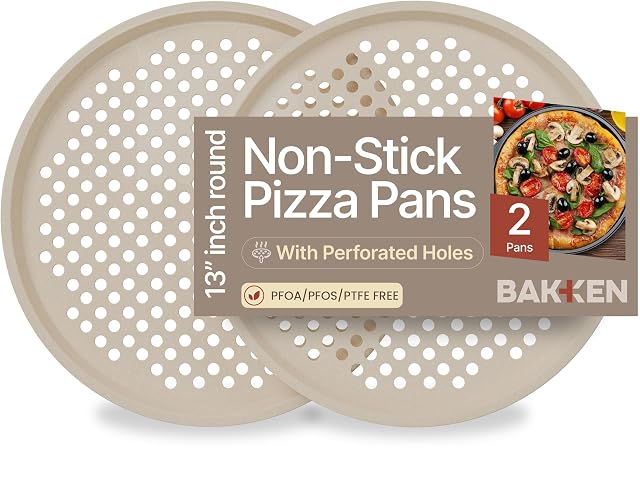
BAKKENMASTER Perforated 13 in Pizza Pans, 2-Pack
Two perforated carbon steel pizza trays of 13 × 13 × 0.78 inches with a white marble non-stick coating, dishwasher safe, rated to 450 °F and free of PFOA, PFOS and PTFE.
- Dimensions
- 13 × 13 × 0.78 inches each, published
- Quantity
- Two trays
- Perforated
- Strategically placed holes; size not given
- Temperature
- Up to 450 °F (230 °C)
- Coating
- White marble non-stick
- Chemistry
- Free from PFOA, PFOS and PTFE
- Dishwasher
- Stated safe
- Weight
- 621 g (21.9 oz) for the pair — 311 g (11 oz) each
- Catalog
- 330 × 330 × 20 mm (13 × 13 × 0.79 in)
- Reference
- BAKPIZWHT32
- Price per pan
- $8.00 — 28 cents above the cheapest pizza pan on this shelf
- Handles
- None mentioned
- Feet
- None; both GoodCook pans have them
- Steel thickness
- Not published; only the Emporio Kitchen gives one
- Amazon reference
- B0DCCK2MZ6
- EAN
- 0850059994283
- Eight dollars a pan, 28 cents above the cheapest pizza pan on this shelf
- The dimensions published to the hundredth of an inch, and the catalog agrees
- 450 °F is below what most pizza recipes ask for
Best for: Two thirteen-inch pizzas at a time, at the lowest price per pan here
≈ $16Check price on Amazon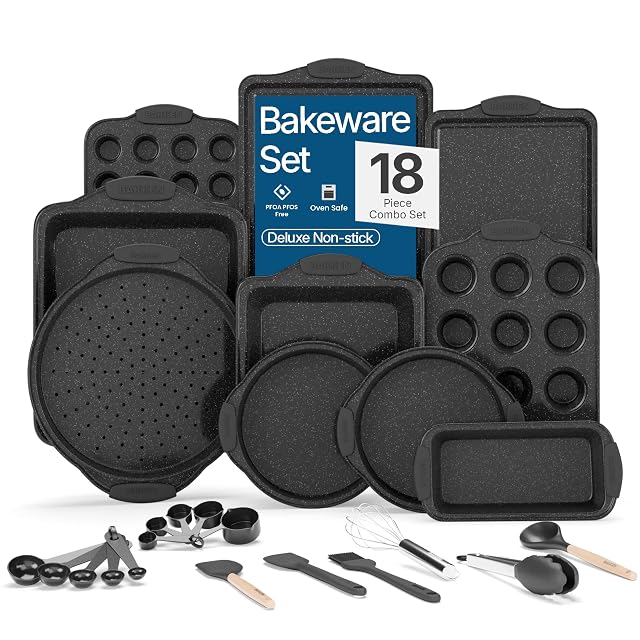
BAKKENMASTER 18-Piece Carbon Steel Baking Set
An eighteen-piece carbon steel baking set with a gray marble non-stick coating inside and out, silicone handles, dishwasher safe and rated for oven, fridge and freezer.
- Pieces
- Eighteen, and none of them named
- Silicone handles
- Published, stated to stay cool to the touch
- Coating
- Grey marble non-stick, inside and outside
- Freezer
- Stated suitable for oven, refrigerator and freezer — unique here
- Material
- Commercial-grade carbon steel
- Dishwasher
- Stated safe
- Chemistry
- PFOA-free, from the title; PTFE not addressed
- Reference
- BKBSGRYMAR18
- Price per piece
- $3.22 — the cheapest per piece on this shelf
- Piece list
- None published
- Piece dimensions
- None published
- Weight
- Not published
- Temperature limit
- Not published; four items here publish 450 °F
- Stackable
- Not claimed, on eighteen pieces
- Amazon reference
- B0CX4BRK3F
- EAN
- 0850059994092
- Three dollars twenty-two a piece, the cheapest per piece on this shelf
- Silicone handles stated to stay cool, which only one other item here has
- Eighteen pieces and not one of them named
Best for: Furnishing a kitchen from nothing, if you can see the photograph
≈ $58Check price on Amazon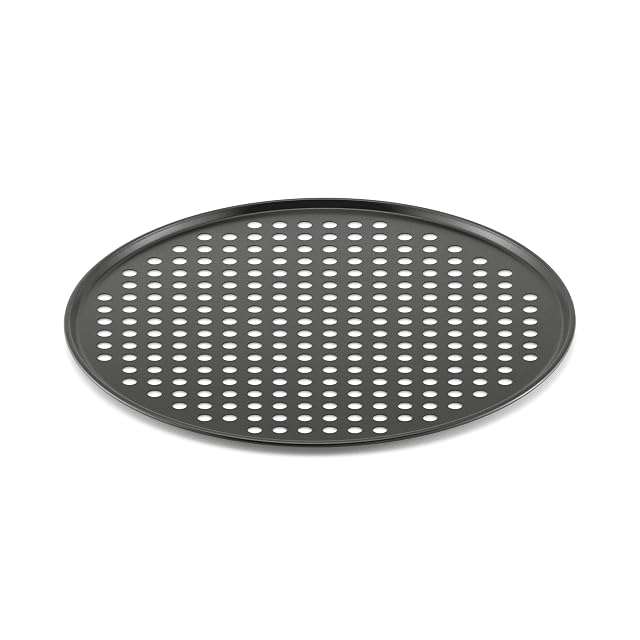
Breville BOV800PC 13-Inch Pizza Crisper Pan
A 13-inch non-stick pizza crisper with 1/3 inch crisper holes, designed for four named Breville Smart Ovens and usable in a conventional wall oven.
- Hole size
- 1/3 inch — the only hole figure on this shelf
- Size
- 13 inch
- Designed for
- Breville BOV800XL, BOV810BSS, BOV845BSS, BOV900BSS
- Also usable in
- Traditional household wall ovens, stated
- Coating
- Non-stick; chemistry not published
- Color
- Black
- Weight
- 14.4 oz (408 g) — the lightest item on this shelf
- Catalog
- 13 × 13 × 0.98 in (330 × 330 × 25 mm)
- Reference
- BOV800PC13
- Bullets published
- Four — the fewest on this shelf
- Temperature limit
- Not published
- Dishwasher
- Not published — "easy cleanup" is the whole of it
- Handles or feet
- None mentioned
- Warranty
- Not published
- Amazon reference
- B002SR31H2
- EAN
- 0021614053121
- A published hole diameter, which none of the other eleven items sold on Amazon.com gives
- Four named ovens it is designed for, and a statement that it works in others
- Four bullets, the thinnest page on this shelf
Best for: A Breville Smart Oven, where the pan is sized to the cavity
≈ $20Check price on Amazon
Elsewhere in the kitchen drawer
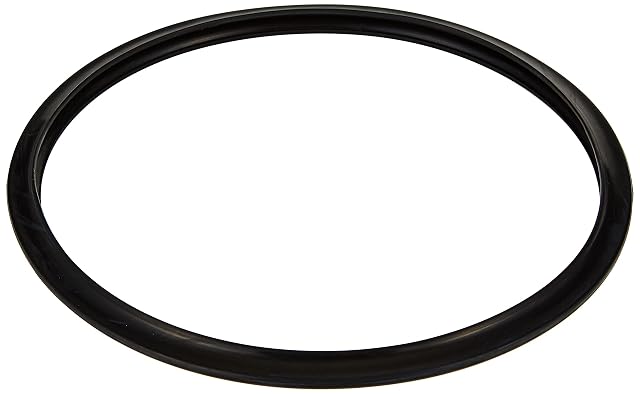
Prestige Senior and Deluxe Sealing Ring, 10.5 in
A 10.5-inch Prestige rubber gasket for Senior, Ultimate and Popular Deluxe cookers from 7.5 liters up.
- Diameter
- 10.5 inches — the only diameter published on this shelf
- Catalog confirms it
- 10.5 in (267 mm), which is 10.5 inches exactly
- Capacities in the title
- 7.5, 8.5, 10 and 12 liters, plus a 7.5 liter Deluxe+
- Capacities in bullet two
- 7.5, 10 and 12 liters — no 8.5
- Capacities in bullet four
- 7.5, 8.5, 10, 11, 12 and 13 liters
- Ranges named
- Senior Pressure, Ultimate, Popular Deluxe, Deluxe Plus, Senior Pressure Pans, Jumbo Pan
- Finishes
- Aluminum and hard anodized
- Material
- Rubber, described as self compensating
- Taste and odor
- Stated not to impart color, taste or odor to the food
- Weight
- 70 g (2.5 oz) — the heaviest here, level with the T-fal Clipso
- Cost per gram
- About 23 cents
- Reference
- 881314862252
- Genuine part
- Not claimed, where two rivals here claim it
- Replacement interval
- Not published, as on at least six of the eight listings here
- Amazon reference
- B00RCLOEAM
- EAN
- 0881314862252
- The only published diameter on this shelf, and the catalog confirms it exactly
- Covers both aluminum and hard anodized bodies, and the pressure pans as well
- Three different capacity lists across one page — the union is six sizes, the intersection three
Best for: A large Prestige — Senior, Ultimate, Deluxe or a pressure pan — measured at ten and a half inches
≈ $16Check price on Amazon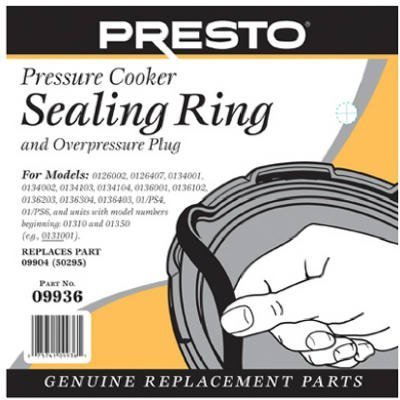
Presto 09936 Sealing Ring with Air Vent, 6 Quart
A 6-quart Presto sealing ring with an integrated automatic air vent, for models 01260, 01340 and 01360.
- Integrated air vent
- An automatic air vent is part of the ring — unique on this shelf
- Fits
- Presto models 01260, 01340 and 01360
- Capacity
- 6 quarts
- Dishwasher
- Stated: not dishwasher safe — the only answer on this shelf
- Operation mode
- Stated as automatic
- Color
- Black
- Weight
- 45 g (1.6 oz)
- Cost per gram
- About 43 cents — second only to the Hawkins
- Reference
- 09936
- Material
- Not published
- Diameter
- Not published; the catalog footprint is rectangular, so the ring is boxed
- Genuine part
- Sold as an Amazon Brand Presto! item
- Country of manufacture
- Not published
- Replacement interval
- Not published, as on at least six of the eight listings here
- Amazon reference
- B00GVJ9ULE
- EAN
- 0075741099361
- The air vent comes with the ring, so a safety part is renewed at the same time
- The only listing on this shelf that answers the dishwasher question
- $19.28, and about 43 cents a gram — the second most expensive per gram here
Best for: A Presto 01260, 01340 or 01360, where the vent needs renewing with the seal
≈ $19Check price on Amazon
T-fal Secure 5 Gasket X9010103, 6.3 and 8.5 Quart
A Secure 5 replacement gasket for the T-fal P2510737 6.3-quart and P2514437 8.5-quart pressure cookers.
- Fits
- T-fal P2510737 at 6.3 quarts and P2514437 at 8.5 quarts
- Machine numbers with sizes
- Both given, which no other listing here manages
- Part number
- X9010103
- Range
- T-fal Secure 5
- Durability
- Claimed, with no figure
- Price
- $23.15 — the second most expensive on this shelf, after its Clipso sibling
- Reference
- 32406049772
- Weight
- Not published — the only listing here without one
- Material
- Not published, where its Clipso sibling publishes silicone
- Diameter
- Not published; the catalog footprint is rectangular, so the ring is boxed
- Country of manufacture
- Not published
- Dishwasher
- Not stated — only the Presto states it, and says no
- Replacement interval
- Not published, as on at least six of the eight listings here
- Amazon reference
- B00G6LLMIQ
- EAN
- 0032406049772
- Names both cookers with their quart capacities, which nothing else here does
- One ring covers two cooker sizes, so the Secure 5 range is served by a single part
- $23.15, three times the cheapest ring on this shelf
Best for: A T-fal Secure 5 at 6.3 or 8.5 quarts, where the part number is already known
≈ $23Check price on Amazon