What the maker puts in writing
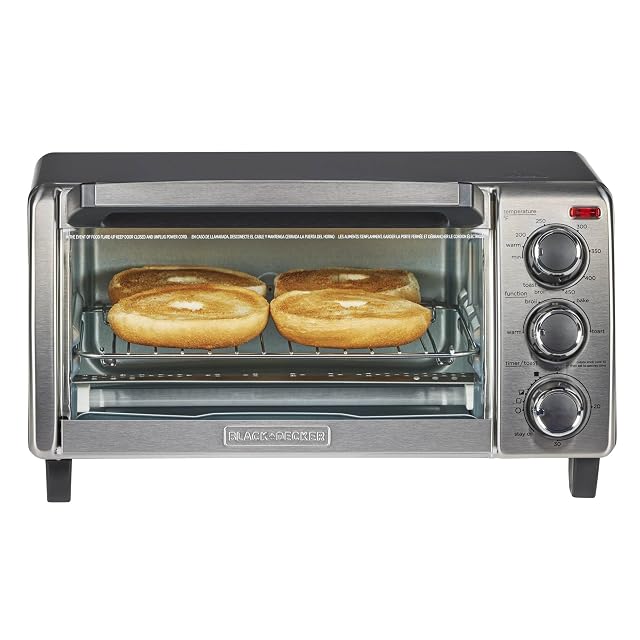
- “COMPACT & SPACE-SAVING (9.5Qt / 4-SLICE): Fits 4 slices of bread, small pizzas, muffins, or snacks. Sleek matte finish, cool-touch stainless-steel handle, and tempered glass door”
- “EASY-TO-USE ANALOG CONTROLS: Dual dials for temperature (200–450°F) and 30-minute timer with auto shutoff bell. Simple, intuitive operation, no digital learning curve.”
- “FAST QUARTZ HEATING (800W): Dual quartz elements heat quickly and evenly for toasting, baking, and broiling. For best results, preheat at 450°F for ~10 minutes before baking.”
- “4 COOKING FUNCTIONS IN 1: Bake, broil, toast, and keep warm.”
- “INCLUDES ESSENTIAL ACCESSORIES: Comes with a bake pan, wire rack (two slide positions for flexible cooking), and drop-down crumb tray”
- Reference ETO449X · Catalog: 2409 g (85 oz), 365 × 275 × 200 mm (14.4 × 10.8 × 7.87 in)
More cavity than the oven at four and a half times the price
9.5 quarts is about 9 liters.
The Breville at $159.95 publishes its interior as “11 x 10 x 4 inch” — which is 440 cubic inches, or 7.2 liters.
So this $34.99 oven has roughly a quarter more cavity than the $159.95 one.
That is not obvious from the shelf, because capacity is published in four different units here:
Slices — four on this, both BLACK+DECKER ovens, the Hamilton Beach and the Breville; six on the Elite ETO2530M
Quarts — 9.5 here, 30 on the NutriChef
Liters — 25 on the Elite ETO2530M
Cubic feet — 0.9 on the same machine
Interior inches — 11 × 10 × 4 on the Breville, 13.25 × 13.50 × 8.95 on the ETO2530M
Two of those check out against each other. The ETO2530M’s 13.25 × 13.50 × 8.95 inches is 1,601 cubic inches — which is 0.926 cubic feet, matching its claimed “0.9cuft”, and 26.2 liters, within 5% of its claimed “25L”. So that page’s three figures are consistent.
The honest ladder, converted: Breville 7.2 L · this ~9 L · Elite ETO2530M ~26 L · NutriChef ~28 L.
What the Breville buys instead of space is real and it is elsewhere: five independent quartz elements with an adaptive control system, eight cooking functions, an LCD, a non-stick cavity, 1800 W and a published one-year warranty.
What capacity buys here is what bullet one claims: “4 slices of bread, small pizzas, muffins, or snacks”. Nine liters takes a 9-inch pizza or a small tray of muffins — which is most of what a second oven is for.
Eight hundred watts of quartz, and what quartz is for
“Dual quartz elements heat quickly and evenly for toasting, baking, and broiling.”
A conventional element is a resistance wire in a steel sheath: it warms the sheath, the sheath radiates, and the whole assembly takes time to come up and time to cool.
A quartz element is a wire inside a glass tube, which radiates almost immediately — so it reaches working output in seconds rather than minutes and responds faster when the thermostat calls for heat.
That matters most on toast, which is radiant cooking rather than convection. And it is why quartz appears on the two machines here that publish their element type: this and the Breville, which uses “5 independent quartz elements”.
Where 800 W costs you is sustained baking. The shelf:
Breville — 1800 W, which at 120 volts is exactly 15 amps: the full capacity of a standard American circuit
Elite Gourmet ETO2530M — 1500 W
NutriChef — 1400 W in bullet three and 1500 W in its own title
this — 800 W
BLACK+DECKER air fry, BLACK+DECKER toaster, Hamilton Beach, Dash — no figure at all
So this is the lowest published power on the shelf, and the practical consequence is recovery: open the door mid-bake and it takes longer to come back to temperature than a 1500 W oven would.
Which is exactly why the preheat instruction below matters more here than elsewhere.
200 to 450 °F published as a range is the other thing done properly. Five machines on this shelf reach 450 °F; three of them — this, the Hamilton Beach and the Elite ETO2530M — publish the bottom of the range as well, which is the figure that tells you whether a machine can hold a low temperature for keeping warm or proving dough. The Dash at $24.99 is the only machine here that stops at 400 °F.
Ten minutes of preheat, which only one other machine admits
“For best results, preheat at 450°F for ~10 minutes before baking.”
A thermostat measures the air in the cavity, and air heats in a minute or two. What takes ten minutes is the mass — the walls, the rack, the tray — and that mass is what cooks the underside of a pizza or sets the base of a pastry.
Put food into an oven whose air is at 450 and whose metal is at 200, and the top browns while the bottom stays pale.
So the instruction is the difference between a crisp base and a soggy one, and it is more necessary at 800 W than at 1800 because less power soaks the mass more slowly.
Only one other machine on this shelf publishes it: the BLACK+DECKER toaster at $59.99 — “Natural convection airflow circulates heat throughout the oven—preheat for 10 minutes to ensure consistent cooking and crisp results.”
The Breville takes the opposite line and sells the speed: “Fast 1800 Watt preheat gets meals on the kitchen table faster” — with no time published.
Ten minutes at the temperature you intend to cook at is the right habit on several of the twelve machines here.
Analog dials, which is a defensible choice
“Dual dials for temperature and 30-minute timer with auto shutoff bell. Simple, intuitive operation, no digital learning curve.”
Two knobs against the alternative, and the alternative on this shelf is the Breville’s LCD with eight programs.
What a dial gives you is a setting that survives a power cut, no menu, no button sequence, and a position you can see across a kitchen. What it costs is precision: a dial marked 200 to 450 over a quarter turn has about fifty degrees between marks, so “375” is an estimate.
The bell is the detail worth keeping. An auto shutoff that rings tells you the cook has ended; one that merely stops does not, and food left in a cooling oven keeps cooking. The Dash at $24.99 has an indicator light instead; the Elite ETO2530M has a bell too; the NutriChef has “Auto Shutoff after 60 minutes”.
Thirty minutes is the shelf’s middle timer: Dash 15 · this, BLACK+DECKER air fry, BLACK+DECKER toaster — 30 · Elite ETO2530M, NutriChef — 60 · Breville, Hamilton Beach — not published.
And thirty minutes is a real limit on a roast. The timer is the on-switch on machines of this kind, so the longest unattended cook is the dial’s travel. Cookies, pizza, a tray of vegetables and four slices all fit; a chicken does not.
A cool-touch handle and a tempered glass door are the two safety details, and both are worth having on a machine whose outer surfaces get hot — which the BLACK+DECKER toaster is the only page here to warn about: “Outer surfaces become hot during use—always use oven mitts and allow space for proper ventilation.”
Two rack positions, a bake pan and a drop-down tray
“a bake pan, wire rack (two slide positions for flexible cooking), and drop-down crumb tray.”
Three pieces, and the rack positions are the one to notice. Two positions means you can put the rack near the top element for browning and grilling, or lower for baking — which covers the two things the functions list claims.
Two machines here publish three positions: the Breville and the Elite ETO2530M, the latter adding that three positions “allow you to cook multiple dishes at once”.
The drop-down crumb tray is the feature that decides whether a toaster oven stays usable. Crumbs fall to the cavity floor, sit near the lower element and burn — which is the smell of an old toaster oven and the reason one eventually sets off a smoke alarm. Every machine on this shelf has some version of it, which is the one point of complete agreement here.
No machine on this shelf claims dishwasher-safe parts, so hand washing is the norm rather than a limitation.
What is not published
No warranty. Only two machines here publish one: the Breville at $159.95 with “1 Year Limited”, and — oddly — the Dash at $24.99 with “a 1-year warranty, or double it by registering”. Six of eight publish nothing, including this.
No air fry. Two machines on this shelf have it: the BLACK+DECKER TO1787SS at $55.99, with an air-fry mesh tray, and the Hamilton Beach at $59.95, with a metal basket and “Sure-Crisp” circulation. Worth noting that the $159.95 Breville does not have it either, despite eight functions.
No convection. The Hamilton Beach sells a “convection function” that “circulates air around food”, and the BLACK+DECKER toaster claims “natural convection airflow”, which is a different thing — natural convection is the air moving because it is hot, not because a fan drives it. Nothing here is claimed either way.
No non-stick cavity, which only the Breville publishes — “inside walls feature a non stick coating for easy cleaning” — and which is the thing that makes any of these bearable to clean.
No interior dimensions, where the Breville and the Elite ETO2530M both publish them. Nine and a half quarts tells you volume and not shape, and shape is what decides whether a 9-inch pizza fits.
No clearance warning, which the BLACK+DECKER toaster gives twice: keep food “at least 1½ inches from the top heating elements”, and allow space “for proper ventilation”.
No bake pan dimensions, which the Breville publishes as a “10 x 10 inch Enamel Baking Pan”.
Availability
Read on the day this page was built: $35 at the American Amazon shop.
Read from Keepa on the day this page was last revised; stock and price both move without notice.
Prices quoted in this text were read on 2026-10-05. The live price is at the top of the page.