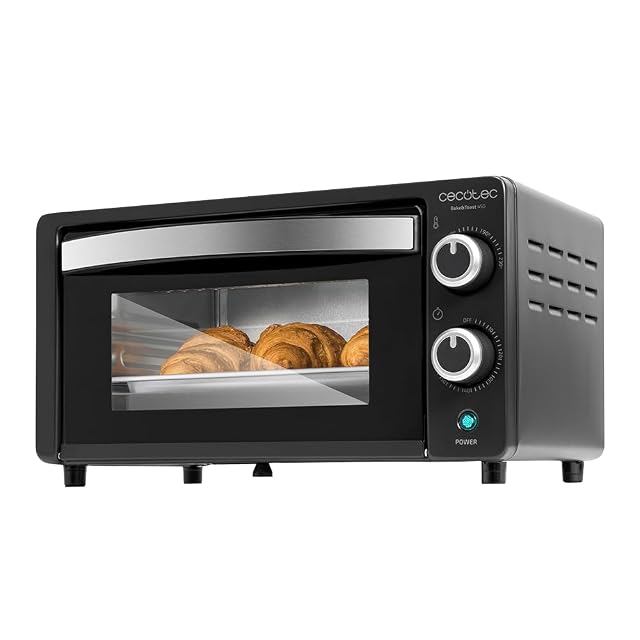
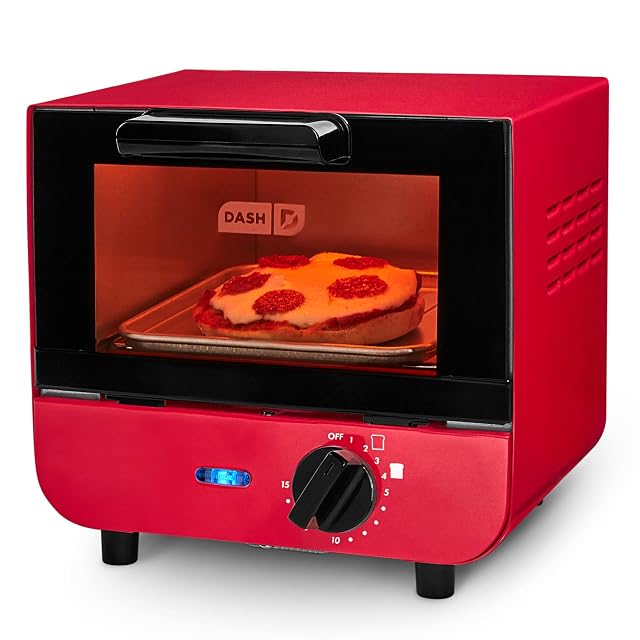
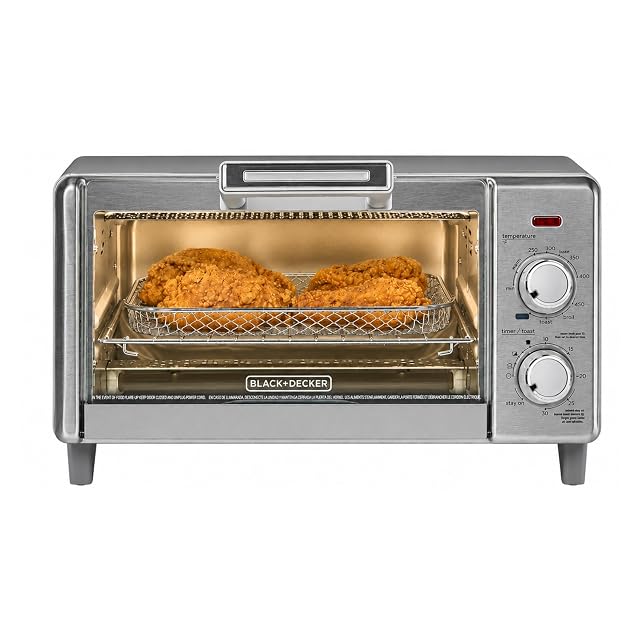
What the maker puts in writing
- “ACCOMMODATES 9-INCH PIZZA OR 4 SLICES OF BREAD – …the curved interior fits a 9-inch pizza or 4 slices of bread.”
- “FOUR VERSATILE COOKING FUNCTIONS – Select from baking, broiling, toasting, or keeping food warm. Natural convection airflow circulates heat throughout the oven—preheat for 10 minutes to ensure consistent cooking and crisp results.”
- “PRECISION 30-MINUTE TIMER WITH STAY-ON OPTION – …clearly marked toast settings and a stay-on function. Oven will not operate unless timer is set or stay-on is selected”
- “CONVENIENT REMOVABLE CRUMB TRAY – …To prevent spills and overheating, keep food and bakeware at least 1½ inches from the top heating elements and fully contained within the tray.”
- “COMPACT AND CONTEMPORARY DESIGN – Measuring 14.5” x 10.8” x 8.8”… Outer surfaces become hot during use—always use oven mitts and allow space for proper ventilation.”
- Description: “bakes, broils, toasts, and keeps food warm, at up to 450°F. It comes with a baking and broiler pan… our exclusive EvenToast Technology optimizes heat distribution”
- Title: “TO1313SBD… 15.47 Inch” · Reference TO1756SB · Catalog: 3016 g (106.4 oz), 274 × 368 × 224 mm (10.8 × 14.5 × 8.82 in)
Three identities on one page
The title: “BLACK+DECKER TO1313SBD Toaster Oven, 15.47 Inch.”
The catalog reference: TO1756SB.
Bullet five: “Measuring 14.5” x 10.8” x 8.8”.”
Two model numbers and two widths.
The catalog dimensions settle the width. They record 274 × 368 × 224 mm, and 368 mm is 14.5 inches — which matches bullet five, not the title.
So the machine is 14.5 inches wide, 10.8 deep, 8.8 high, and the title’s 15.47 is the figure to ignore.
The model number cannot be resolved from the page. Quote the catalog reference, TO1756SB, and check it against the plate on the underside when it arrives — because a toaster oven’s replacement pans and racks are model-specific, and a pan for the wrong model does not fit a curved interior.
It is not the only identity problem on this shelf. The NutriChef at $149.99 publishes:
1500 W in its title and 1400 W in bullet three
28 lbs in bullet five against a catalog weight of 10297 g, which is 22.7 lb
“30 Quart” in its title against “30L” in its description — and those are not the same quantity: 30 quarts is 28.4 liters, 30 liters is 31.7 quarts
“To prevent spills and overheating, keep food and bakeware at least 1½ inches from the top heating elements and fully contained within the tray.”
The top element in a compact toaster oven is a few inches above the rack, and it glows. Anything within an inch of it burns on contact while the inside stays cold — which is how a cheese topping blackens over a raw base, and why a tall loaf tin or a stacked tray is a bad idea in a cavity this size.
The second half is about fat. “Fully contained within the tray” means nothing should overhang, because what runs off the edge lands on the element below — and fat on a glowing element smokes immediately and can flare.
That applies with more force to the two air fryers on this shelf, which render fat through an open basket or mesh. Only one of them mentions it: the BLACK+DECKER air fry at $55.99, with “Use drip tray when cooking and keep food clear of heating element”. The 1½ inches here is the figure to borrow for that machine too, since both are compact BLACK+DECKER cavities. The Hamilton Beach at $59.95, the other air fryer, says nothing about drips at all.
And the third warning is one no other page on this shelf gives:
“Outer surfaces become hot during use—always use oven mitts and allow space for proper ventilation.”
A toaster oven pushed back against a wall or under a cabinet has nowhere to send its heat. The cabinet above a 450 °F appliance with no clearance is the thing that scorches, and the side panels are hot enough to burn a hand reaching past.
This is the most careful page on the shelf, and the care is in the right places.
The timer interlock, which is a safety feature disguised as a timer
“Oven will not operate unless timer is set or stay-on is selected.”
So there is no way to leave it energized by accident. Switching it on is an act — a dial turned to a duration, or a deliberate choice of stay-on — rather than a flick of a switch that could be knocked.
And the stay-on option is the other half of the thought. A 30-minute dial is the on-switch on a machine of this kind, so without stay-on the longest unattended cook is the dial’s travel. With it, you can run a 45-minute bake — at the cost of remembering to stop it.
The shelf, by timer:
Dash $24.99 — 15 minutes, indicator light, auto shutoff
this, BLACK+DECKER air fry $55.99, Elite Gourmet ETO449X $34.99 — 30 minutes; the ETO449X adds an auto shutoff bell, this adds stay-on
Elite Gourmet ETO2530M $84.99, NutriChef $149.99 — 60 minutes
Breville $159.95, Hamilton Beach $59.95 — not published
“Clearly marked toast settings” is the small thing that makes a dial usable: a shade scale rather than minutes, so you learn one position and return to it.
Natural convection, used honestly
“Natural convection airflow circulates heat throughout the oven—preheat for 10 minutes to ensure consistent cooking and crisp results.”
Natural convection is air moving because it is hot. Warm air rises, cool air falls, and a circulation sets up on its own. Every oven ever built has it, including a gas one with no electricity.
Forced convection is a fan, and it is a different machine: a fan strips away the insulating layer of cooled, moistened air that sits against food, so heat arrives faster and moisture leaves faster. That is crisping.
Two machines on this shelf do that. The Hamilton Beach at $59.95 says so plainly — its “convection function circulates air around food as it cooks”, under the name “Sure-Crisp” — and the BLACK+DECKER air fry at $55.99 calls it “high intensity hot air” and supplies a mesh tray so the air reaches underneath.
So the claim on this page is accurate and modest, which is the point: it is a radiant toaster oven with ordinary airflow, and it says so.
Its own answer to even cooking is elsewhere. EvenToast Technology — “optimizes heat distribution to toast bread evenly” — is an element-layout claim, and its stablemate makes the same one. The Breville at $159.95 attacks the problem with hardware instead, and it is the most interesting engineering claim on the shelf: “Using 5 independent quartz elements, smart algorithms steer small oven’s power where and when it’s needed.”
Which is the right answer for what this is. Toast is radiant cooking, not convection — and a fan does nothing for a slice of bread.
Ten minutes of preheat, which only one other machine admits
“preheat for 10 minutes to ensure consistent cooking and crisp results.”
A thermostat measures the air in the cavity, and air heats in a minute or two. What takes ten minutes is the mass — the walls, the rack, the pan — and that mass is what cooks the underside of a pizza or sets the base of a pastry.
Put food into an oven whose air is at 450 and whose metal is at 200, and the top browns while the bottom stays pale.
The only other machine here to publish it is the Elite Gourmet ETO449X at $34.99: “preheat at 450°F for ~10 minutes before baking.”
The Breville takes the opposite line and sells the speed: “Fast 1800 Watt preheat gets meals on the kitchen table faster” — with no time published.
Ten minutes at the temperature you intend to cook at is the right habit on several of the twelve machines here.
Up to 450 °F is the ceiling, from the description. Five machines on this shelf reach it; the Dash at $24.99 stops at 400 °F, and the BLACK+DECKER air fry and the Breville publish no ceiling at all.
A curved interior, a 9-inch pizza, and a pan that fits it
“the curved interior fits a 9-inch pizza or 4 slices of bread” — and the description adds that the pan “fits perfectly into the small toaster oven interior.”
A curved cavity is a real design decision and it cuts both ways. It puts the walls closer to the food at the corners, which helps even heating in a small box; it also means a square tin does not fit the corners, and the pan you get is shaped for this oven and this oven only.
Which is why the model-number confusion above matters. A replacement pan for the wrong BLACK+DECKER model will not sit in a curved interior.
The capacity statement is the shelf’s standard one, and five machines use it: this, the BLACK+DECKER air fry (also 9-inch), the Hamilton Beach (9-inch), the Elite Gourmet ETO449X (“small pizzas”), and the Breville (“11 inch pizzas”).
The Hamilton Beach publishes the most useful version of it, and it is worth borrowing as a comparison: “4 slices of toast… a 9” pizza, a 3 lb. chicken in an 8” x 8” pan or a 9” x 5” loaf pan.” A slice count tells you the width of a cavity and nothing about its height — and whether a loaf tin stands up is what decides whether you can bake bread.
3016 grams puts this third lightest here: Dash 1451 g · Elite ETO449X 2409 g · this 3016 g · Hamilton Beach 3765 g · Breville 4853 g · NutriChef 10297 g.
The slide-out crumb tray is the feature every machine on this shelf has, and the reason is universal: crumbs fall to the cavity floor, sit near the lower element and burn. That is the smell of an old toaster oven and the reason one eventually sets off a smoke alarm.
What is not published
No wattage. The shelf: Breville 1800 W — exactly 15 amps at 120 volts, the full capacity of a standard American circuit — Elite ETO2530M 1500 W, NutriChef 1400 W, Elite ETO449X 800 W. This, the BLACK+DECKER air fry, the Hamilton Beach and the Dash publish none.
No element type, where the Elite ETO449X and the Breville both publish quartz.
No rack positions, where the Breville and the Elite ETO2530M publish three and the ETO449X publishes two. On a machine with a curved interior and one pan, how many heights are available is the practical question.
No interior dimensions. The 14.5 × 10.8 × 8.8 inches in bullet five is the outside, which the catalog confirms. The Breville publishes its interior as 11 × 10 × 4 inches and the Elite ETO2530M as 13.25 × 13.50 × 8.95.
No air fry, which the two machines at $55.99 and $59.95 have — and which the $159.95 Breville does not either.
No non-stick cavity, which only the Breville publishes — and which is the thing that makes any of these bearable to clean.
No warranty. Only the Breville (“1 Year Limited”) and the Dash at $24.99 (“a 1-year warranty, or double it by registering”) publish a term. Six of eight publish nothing, including this — which on the most safety-conscious page here is the odd omission.
Availability
Read on the day this page was built: $60 at the American Amazon shop.
Read from Keepa on the day this page was last revised; stock and price both move without notice.
Prices quoted in this text were read on 2026-10-05. The live price is at the top of the page.