What the maker puts in writing
- “25L XL CAPACITY: Fits 6 slices of toast and cooks up to an 11lb roast. Three rack positions plus 0.9cuft capacity can fit up to a 12” pizza with interior dimensions of 13.25”x 13.50”x 8.95”.”
- “FRENCH DUAL DOOR DESIGN allows you to open one or both doors at a time saving precious counter space. Three rack positions allow you to cook multiple dishes at once.”
- “PRECISION COOKING CONTROL: The built-in heat selector switch allows you to select numerous cooking features for Baking, Broiling, Toasting, Pizza and Keep Warm.”
- “ADJUSTABLE TIMER: The oven includes a 60-Minute timer with indicator bell and toast shade settings.”
- “1500 WATTS OF POWER: …an adjustable thermostat from 200°F to 450°F and 1500 watts of cooking power”
- Description: “The spacious interior boasts 3 rack positions so you can bake a 12” Pizza, warm dinner rolls, and broil a casserole”
- Reference ETO2530M · Catalog: 635 × 254 × 381 mm (25 × 10 × 15 in)
Bullet one publishes three: “25L… plus 0.9cuft capacity… with interior dimensions of 13.25” x 13.50” x 8.95”.”
Check them. 13.25 × 13.50 × 8.95 = 1,601 cubic inches. A cubic foot is 1,728 cubic inches, so that is 0.926 cubic feet — matching the claimed 0.9. And 1,601 cubic inches is 26.2 liters, within 5 per cent of the claimed 25.
Three figures, three units, all consistent. On this shelf that is unusual.
The NutriChef at $149.99 publishes “30 Quart” in its title and “30L” in its description — not the same quantity, since 30 quarts is 28.4 liters and 30 liters is 31.7 quarts. It also publishes 1500 W in its title against 1400 W in bullet three, and “28 lbs” against a catalog weight of 10297 g, which is 22.7 lb.
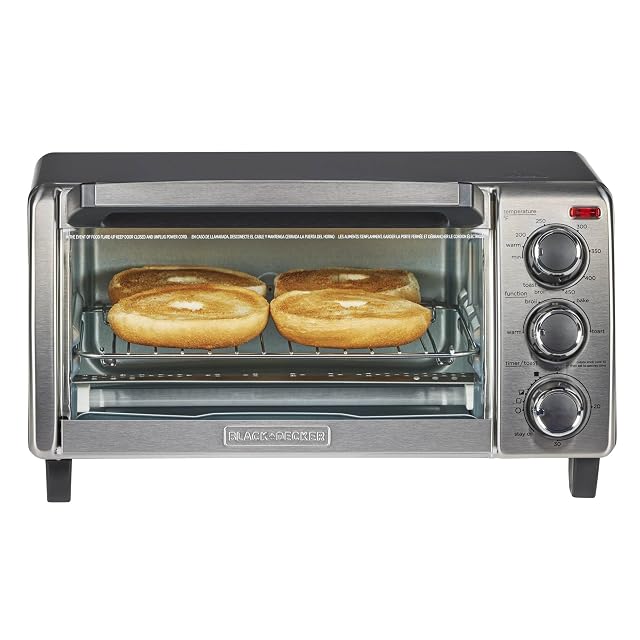
The BLACK+DECKER toaster at $59.99 carries TO1313SBD in its title and TO1756SB at the catalog, with 15.47 inches in the title and 14.5 in bullet five.
And the interior dimensions are the most useful of the three figures here, because they give shape as well as volume. 13.25 inches wide is what takes a 12-inch pizza. 8.95 inches high is what takes a standing loaf tin. A liter figure reveals neither.
The shelf, converted to one unit: Breville 7.2 L (11 × 10 × 4 in) · Elite Gourmet ETO449X ~9 L (9.5 qt) · this ~26 L · NutriChef ~28 L (30 qt). The four smaller machines publish only a slice count.
Which makes this the second largest cavity here, and it takes 6 slices, a 12-inch pizza and an 11 lb roast — against the Hamilton Beach at $59.95, whose best capacity statement is “a 3 lb. chicken in an 8” x 8” pan”. Nearly four times the roast, for $25 more.
Two doors, and what they save is the counter in front
“FRENCH DUAL DOOR DESIGN allows you to open one or both doors at a time saving precious counter space.”
A conventional toaster oven has a single door hinged at the bottom that drops forward, so it needs clear countertop in front of it equal to the door’s height — on a machine this size, eight or nine inches of counter you cannot put anything on.
Two doors hinged at the sides swing outward, which needs clearance to the sides and none in front. So the oven sits at the back of a countertop with a chopping board directly in front of it.
And opening one door at a time is the second advantage, and it is about heat. Reaching in for one dish while the other half stays shut loses far less temperature — which matters on a 25-liter cavity at 1500 W, because a large cavity takes time to come back.
Which is exactly what the three rack positions are for. Bullet two finishes: “Three rack positions allow you to cook multiple dishes at once”, and the description gives the example — “bake a 12” Pizza, warm dinner rolls, and broil a casserole.”
Nothing else on this shelf has either feature. Only this and the Breville at $159.95 publish three rack positions; the Elite Gourmet ETO449X publishes two; and every other door on the shelf is a single drop-down.
The catalog box is 635 × 254 × 381 mm, which is the widest footprint here after the NutriChef’s 498 mm — though a box is not a machine, and no weight is published, which is the gap on a cavity this size.
1500 W over 25 liters is about 60 watts per liter.
The shelf, on power density:
Breville — 1800 W into 7.2 liters, about 250 W per liter
Elite Gourmet ETO449X — 800 W into 9 liters, about 89 W per liter
this — 1500 W into 26 liters, about 60 W per liter
NutriChef — 1400 W into 28 liters, about 50 W per liter
BLACK+DECKER air fry, BLACK+DECKER toaster, Hamilton Beach, Dash — no wattage published at all
Power per liter governs how fast an oven comes up and how fast it recovers when the door opens. A dense little cavity like the Breville’s is quick; a large one at 1500 W is not — which is why the 60-minute timer here is the right length, and why the French doors earn their place.
And 1500 W is comfortably inside a domestic circuit. At 120 volts it draws 12.5 amps, with room to spare on a standard 15-amp supply. The Breville’s 1800 W is exactly 15 amps — the full capacity of that circuit. And the NutriChef is the cautionary case: its oven element plus both hot plates come to 3000 W, which is 25 amps, more than even a 20-amp circuit supplies.
So nothing here is under-powered; it is a question of how long you preheat. Two pages on this shelf publish ten minutes — the BLACK+DECKER toaster and the Elite Gourmet ETO449X, the latter specifying 450 °F — and ten minutes at the temperature you intend to cook at is the right habit on a cavity this size, where the walls and racks are what cook a pizza base.
200 to 450 °F published as a range is the other thing done properly. Five machines here reach 450; three publish the bottom too — this, the ETO449X and the Hamilton Beach, all at 200 °F. The bottom of the range is the figure people ignore, and it decides whether an oven can hold food warm or prove dough. The Dash at $24.99 stops at 400 °F and is the only machine here below the shelf ceiling.
Five functions by switch, and a sixty-minute bell
“The built-in heat selector switch allows you to select numerous cooking features for Baking, Broiling, Toasting, Pizza and Keep Warm.”
Five functions, which ties with the BLACK+DECKER air fry at $55.99. The shelf: Breville 8 · NutriChef 7 · this 5 · BLACK+DECKER air fry 5 · BLACK+DECKER toaster 4 · Elite ETO449X 4 · Hamilton Beach 4 · Dash 1.
A pizza setting on a 12-inch cavity is worth having, and the reason is in the preheat discussion above: pizza needs heat from below to set the base before the topping overcooks, which usually means biasing the elements downward. A machine with a 12-inch cavity and a pizza setting is making that claim.
A heat selector switch is a simpler control than it sounds — a rotary that picks which elements are energized, rather than a program. Which is the right amount of interface for five functions, and the opposite of the Breville’s LCD with eight.
The 60-minute timer is the other reason this reads as a real oven. The shelf:
Dash — 15 minutes · BLACK+DECKER air fry, BLACK+DECKER toaster, Elite ETO449X — 30 · this, NutriChef — 60 · Breville, Hamilton Beach — not published
On machines of this kind the timer is the on-switch, so its travel is the longest unattended cook. An 11 lb roast needs more than 30 minutes, and only the two 60-minute machines on this shelf can take one without resetting.
The indicator bell matters for the same reason an auto shutoff does: a timer that rings tells you the cook has ended, and food left in a cooling oven keeps cooking. The Elite ETO449X has a bell too; the Dash has an indicator light; the NutriChef has “Auto Shutoff after 60 minutes”.
And “toast shade settings” is the small usability detail — a shade scale rather than minutes, so you learn one position and return to it. Both BLACK+DECKER ovens offer the same, the toaster as “clearly marked toast settings”.
What is not published
No weight, which on the second largest cavity here is the figure that decides where it can live. Five machines publish one: Dash 1451 g · Elite ETO449X 2409 g · BLACK+DECKER toaster 3016 g · Hamilton Beach 3765 g · Breville 4853 g · NutriChef 10297 g. This and the BLACK+DECKER air fry do not.
No air fry, which two machines here have: the BLACK+DECKER TO1787SS at $55.99 with a mesh tray, and the Hamilton Beach at $59.95 with a metal basket. Worth noting the $159.95 Breville does not have it either.
No convection fan. Nothing is claimed either way — where the Hamilton Beach says plainly that its convection function “circulates air around food”, the BLACK+DECKER toaster specifies “natural convection airflow” (which is air moving because it is hot, not a fan), and the description here calls the machine a “dual door convection oven” without saying which kind. On 26 liters a fan would matter, because a large cavity heats less evenly than a small one.
No element type, where the Elite ETO449X and the Breville both publish quartz — which radiates almost immediately rather than warming a steel sheath first.
No non-stick cavity, which only the Breville publishes — “inside walls feature a non stick coating for easy cleaning” — and which on 26 liters of enamel matters more, not less.
No crumb tray mentioned, which is the one feature every other machine on this shelf publishes: both BLACK+DECKER ovens, the Breville, the ETO449X (“drop-down crumb tray”), the Hamilton Beach, the NutriChef and the Dash. Crumbs fall to the cavity floor, sit near the lower element and burn — and on a six-slice machine there will be more of them.
No preheat guidance, as above.
No warranty. Only the Breville (“1 Year Limited”) and the Dash at $24.99 (“a 1-year warranty, or double it by registering”) publish a term. Six of eight publish nothing.
No clearance or ventilation warning, which the BLACK+DECKER toaster gives twice and which applies here with more force: a 1500 W cavity in a 635 mm body generates real heat, and the sides are where two French doors swing.
Availability
Read on the day this page was built: $85 at the American Amazon shop.
Read from Keepa on the day this page was last revised; stock and price both move without notice.
Prices quoted in this text were read on 2026-10-05. The live price is at the top of the page.