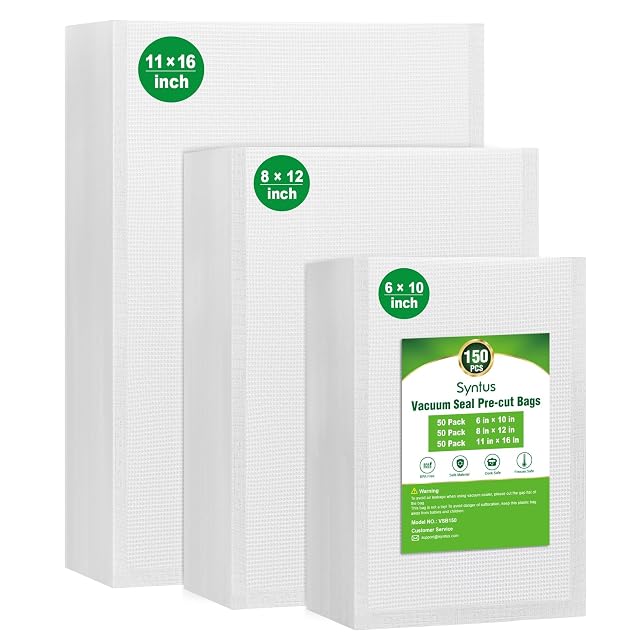
Best for: Portioning in quantity on a desktop sealer, where speed beats a custom fit
≈ $23
Check price on Amazon The only published thickness here, and the only stated incompatibility
A hundred and fifty 4-mil pre-cut bags in gallon, quart and pint sizes, textured for suction, with no air valve.
Best for: Portioning in quantity on a desktop sealer, where speed beats a custom fit
A mil is a thousandth of an inch, so 4 mil is about 0.1 mm — roughly twice a heavy freezer bag, and the usual standard for vacuum film.
It matters because of what actually goes wrong. Vacuum bags rarely fail at the seal. They fail by puncture, and they fail at the moment you vacuum them, because the film is being pulled tight onto whatever is inside. A rib bone, a fish fin, a frozen edge or a shard of shell goes straight through.
Bullet three names it — “prevent bone punctures” — and the Wevac at $20.99 names the other answer: a separate “Bone Guard Included” in the box.
The habit either way: wrap a sharp bone in a fold of kitchen paper before sealing.
What the rest of the shelf offers in place of a number: the xinbaolong at $16.99 claims “puncture prevention technology”; the FoodSaver at $29.89 “Prevents Food Damage”; the Wevac “HEAVY DUTY AND PUNCTURE PREVENTION”. Three claims, no figures.
So a published 4 mil is real information, and it is the figure to check against your own machine — a sealer has a maximum thickness it can melt through, and a film too heavy for it will not seal at all.
“(Note: These bags do not feature an air valve and are not compatible with handheld vacuum sealers.)”
No other listing on this shelf states an incompatibility, and this one is the single most useful sentence here, because the shelf contains two entirely different products.
A desktop sealer clamps the open mouth of the bag, draws air out through it, then melts the film shut with a heated wire. The bag is single use. There is no valve, because the seal is the closure.
A handheld pump has nothing to melt. It docks onto a one-way valve molded into the bag wall, draws air through it, and the bag closes with a zipper.
The Wonzlling at $27.99 is that second kind, and says so: “The built-in air valve helps remove excess air… close the double zipper, and use a compatible vacuum pump or vacuum device to remove air through the valve.”
The other three — the xinbaolong, the Wevac and the FoodSaver — are heat-seal film like this one, and all three assume you know.
Check which machine you own before buying anything on this shelf.
“a single-side textured dot pattern, these bags enhance suction.”
This is not decoration, and it is why a smooth bag will not work.
A suction sealer pulls air out through the open mouth. With smooth film, the two walls collapse against each other at the mouth within a second and seal off the air behind them — the pump keeps running and nothing more comes out. You end up with a tight neck and a bubble of air around the food.
The texture holds the walls apart so air keeps flowing from the far end of the bag.
“Single-side” is the detail worth noticing: only one face needs it, and that face goes against the other.
The Wevac is the only other listing to say it, with “embossed channels to increase suction”. The xinbaolong and the FoodSaver say nothing — and both sell for suction machines, so both are textured by necessity and simply do not publish it.
Smooth film works only in a chamber sealer, which evacuates the whole box rather than the bag and is a commercial machine.
Three sizes, fifty of each:
11” × 16” — gallon, 176 in² each 8” × 12” — quart, 96 in² each 6” × 10” — pint, 60 in² each
50 × 176 + 50 × 96 + 50 × 60 = 16,600 square inches, which is the most total film on this shelf — and at $20.99 that is 0.126 cents a square inch.
The shelf:
xinbaolong, $16.99 — 0.124¢/in², 13,680 in² in six rolls this — 0.126¢, 16,600 in² Wevac, $20.99 — 0.159¢, 13,200 in² FoodSaver, $29.89 — 0.294¢, 10,176 in² Wonzlling, $27.99 — 0.380¢, 7,368 in², but reusable
So this is level with the cheapest roll on the shelf and gives more total film than any of them — which is the opposite of what you would expect from a pre-cut pack, and the main reason to prefer it.
The three sizes cover the common cases well. Gallon for a chicken or a rack of ribs; quart for a steak, a fillet or a portion of stew; pint for herbs, nuts, spices or a single piece of fish. And having fifty of each rather than a hundred of one is the right distribution for a household.
The limit is the sixteen inches. Nothing here is longer, so a side of salmon, a long rack or a baguette needs a roll — and a roll has no maximum length.
“Suitable for microwave oven, cabinet, fridge, or freezer storage, in addition to boiling, sous vide cooking, and more.”
The boiling and sous-vide claims are the ones that go beyond storage, and they matter on this site: the sous-vide shelf carries fourteen immersion circulators, from the Anova Nano 2.0 to the Breville Joule Turbo and five KitchenBoss models. Every one of them needs a bag that will sit at 55 to 85 °C (131 to 185 °F) for hours without delaminating or leaching, and a sealed bag is the normal way to run one.
4 mil is the right weight for that job, because a long immersion softens film and a thin bag can creep at the seal.
Microwave matters for the other half of the cycle: reheating a portion in the bag it was frozen in, which is most of the point of portioning in the first place.
The one condition nobody on this shelf publishes is a temperature limit. “Boiling” implies 100 °C and sous vide runs well below it, so the claim is comfortable — but no listing here gives a figure, and none says whether the bag may be opened and resealed.
And the application list is the oddest part of the page: “vegetables, seafood, ribs, beans, and pills”. Pills is an unusual inclusion and a legitimate one — vacuum film keeps moisture out of anything, which is why the Wevac description extends its own list to “gardening, tea leaves, documents and electronics”.
No country of manufacture, where the FoodSaver says “Proudly manufactured in the United States” and the Wevac says “made in China to US quality standards” — a candour worth noting in both directions.
No named machines. “All traditional desktop vacuum sealer machines” is a category rather than a list. The Wevac names six: “Food Saver, Seal a meal, Nesco, Weston, Cabela’s, Ziploc”. The FoodSaver names its own systems.
No maximum seal width stated, which is the figure that decides whether the 11 inch bags fit your machine. Eleven inches is the common domestic maximum, so most sealers will take them — but a narrower one will not, and then a third of this pack is unusable.
No temperature limit, as above.
No reusability claim. These are single-use bags, which is the honest position for heat-seal film: the Wonzlling is the only reusable product on this shelf, and its cost per use is the figure that eventually beats everything here.
No guarantee, where the Wevac offers a “no questions return policy”.
No bone guard, where the Wevac includes one — and this page names bone punctures as the risk.
Read on the day this page was built: $21 at the American Amazon shop.
Read from Keepa on the day this page was last revised; stock and price both move without notice.
Prices quoted in this text were read on 2026-10-05. The live price is at the top of the page.
It is the film thickness, and this is the only listing on the shelf that publishes one. A mil is a thousandth of an inch, so 4 mil is about 0.1 mm (0.004 in) — roughly twice a heavy freezer bag and the usual standard for vacuum film. It matters because of the actual failure mode. Vacuum bags do not usually fail at the seal; they fail by puncture, and they fail at the moment you vacuum them, because the film is being pulled tight onto whatever is inside. A rib bone, a fish fin, a frozen edge or a shard of shell goes straight through. Bullet three names exactly that — "prevent bone punctures" — and the Wevac at $20.99 names the other answer, a separate "Bone Guard" included in the box. The practical habit either way: wrap a sharp bone in a fold of kitchen paper before sealing. What the rest of the shelf says instead of a number: the xinbaolong at $16.99 claims "puncture prevention technology", the FoodSaver at $29.89 "Prevents Food Damage", the Wevac "HEAVY DUTY AND PUNCTURE PREVENTION". Three claims, no figures. So a published 4 mil is a real piece of information, and on a shelf of unstated films it is the one you can check against your own machine, which will have a maximum thickness it can seal through.
Because there are two entirely different ways to get air out of a bag, and this shelf contains both. Bullet one is unusually careful: "designed to work with all traditional desktop vacuum sealer machines... (Note: These bags do not feature an air valve and are not compatible with handheld vacuum sealers.)" A desktop sealer clamps the open mouth of the bag, sucks air out through it, then melts the film shut with a heated wire. The bag is single use and has no valve — the seal is the closure. A handheld pump has nothing to melt. It docks onto a one-way valve in the bag wall and draws air through it, and the bag closes with a zipper. The Wonzlling at $27.99 is that kind: "The built-in air valve helps remove excess air... close the double zipper, and use a compatible vacuum pump or vacuum device." So the two halves of this shelf do not substitute for each other at all — and this is the only listing that says so. The other three — the xinbaolong, the Wevac and the FoodSaver — are all heat-seal film like this one, and all three simply assume you know. Check which machine you own before buying anything on this shelf.
Film against minutes, and the arithmetic is closer than it looks. Pre-cut, here: 150 bags in three sizes, "Just pull one out and start sealing, no cutting or pre-sealing required". One seal per bag, no measuring. Rolls — the xinbaolong at $16.99, the Wevac at $20.99, the FoodSaver at $29.89 — cut to any length, which means two seals per bag: one to close the end you cut, one to close it after filling. On cost per square inch the two formats are level here: this 0.126 cents against the xinbaolong’s 0.124, then Wevac 0.159 and FoodSaver 0.294. So the roll is not meaningfully cheaper per inch of film; what it saves is the waste of sealing a small item in a bag sized for a larger one. Where each wins. Pre-cut wins on repetition: portioning a week of meals into quart bags is far faster when there is nothing to cut or pre-seal. Rolls win on anything unusual: a side of salmon, a long rack of ribs, a baguette — there is no maximum length on a roll, where nothing here is longer than 16 inches. And the three sizes supplied cover the common cases well: gallon for a chicken, quart for a steak or a portion, pint for herbs, nuts or a single fillet.
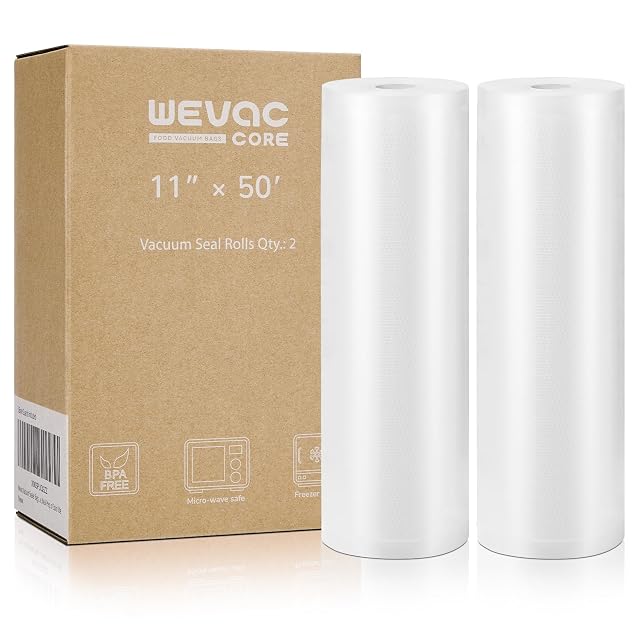
Two 11-inch by 50-foot embossed rolls with a bone guard, named compatible with six machine brands.
Best for: Large or awkward items on any suction machine, where a bone guard earns its place
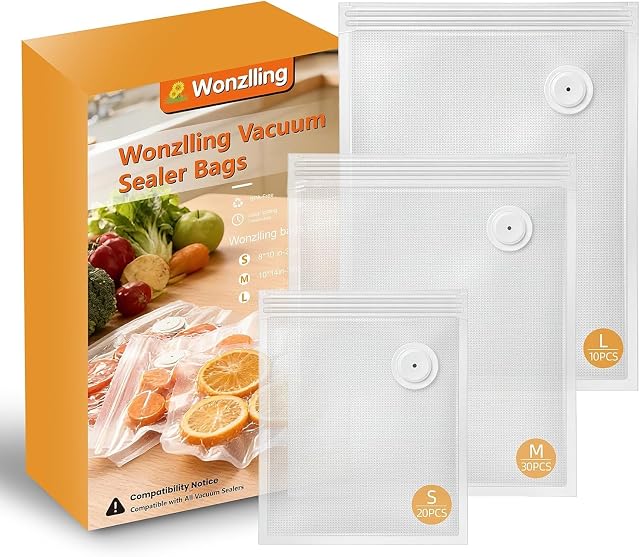
Sixty reusable zipper bags with an air valve in three sizes, for a vacuum pump rather than a heat sealer.
Best for: Meal prep with a handheld pump, where reopening a bag matters more than a permanent seal
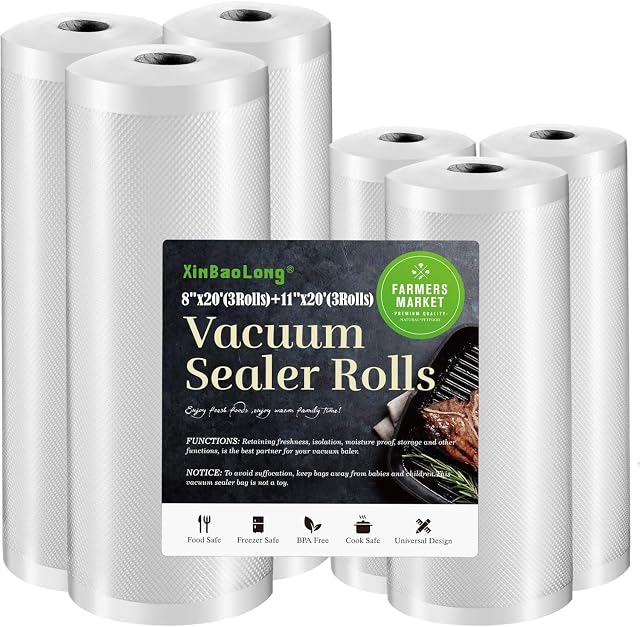
Six heat-seal rolls — three 8 inch and three 11 inch, each 20 feet — cut to length, BPA free, boil and microwave safe.
Best for: Bulk sealing at the lowest cost per bag, on any suction machine
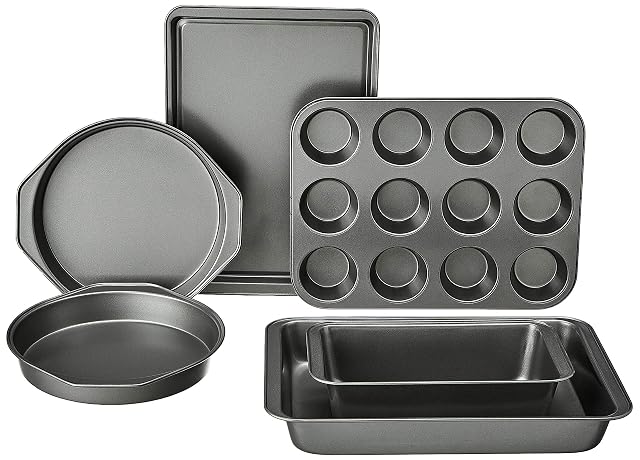
Six nonstick carbon steel pans — a 9 × 5 loaf, two 9-inch rounds, a 12-cup muffin, a 13 × 9 roast pan and a 13 × 9 sheet — oven safe to 428 °F.
Best for: Furnishing a kitchen from nothing, at the lowest price per pan here
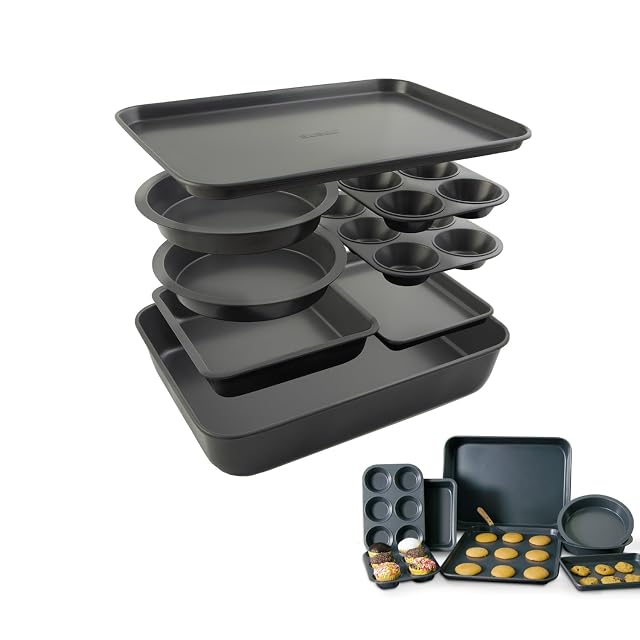
Eight nesting nonstick pans — a roaster, two oven trays, two 8-inch rounds, a square pan and muffin cups — stacking to 17.63 × 13.11 × 3.58 inches.
Best for: A small kitchen that needs eight pans and has one shelf for them
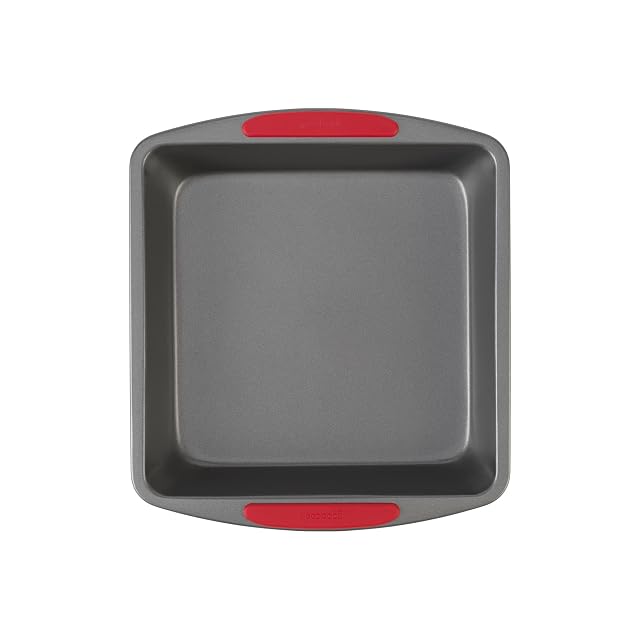
An 8 × 8 inch heavy-gauge steel square pan with ergonomic silicone grips on both handles, a scratch-resistant non-stick coating and a dishwasher-safe finish.
Best for: Brownies and half-batch cakes, lifted out of a hot oven without fumbling