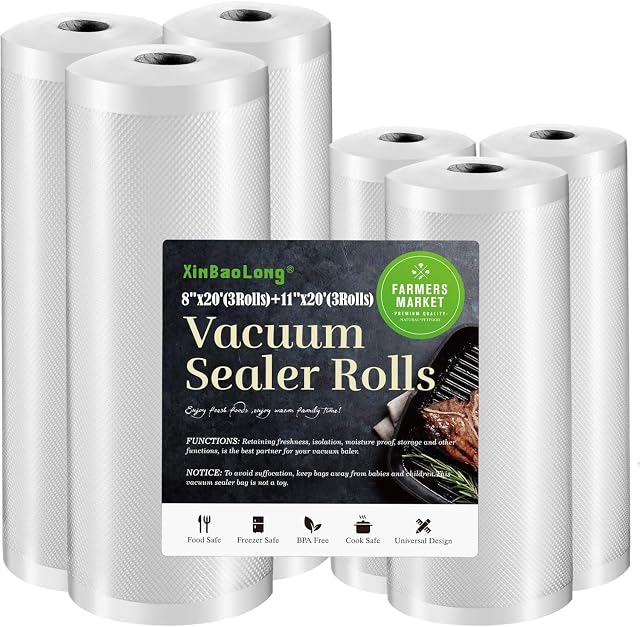
Best for: Bulk sealing at the lowest cost per bag, on any suction machine
≈ $15
Check price on Amazon The cheapest film here, about a tenth of a cent a square inch
Six heat-seal rolls — three 8 inch and three 11 inch, each 20 feet — cut to length, BPA free, boil and microwave safe.
Best for: Bulk sealing at the lowest cost per bag, on any suction machine
Film is sold in different widths and lengths and formats, so the only honest comparison is square inches.
This: 3 × (8” × 20 ft) + 3 × (11” × 20 ft). Twenty feet is 240 inches, so 3 × 8 × 240 = 5,760 plus 3 × 11 × 240 = 7,920 — 13,680 square inches for $14.52.
0.106 cents a square inch. The shelf:
this — 0.106¢/in², 120 feet of film Syntus, $22.99 — 0.139¢, 150 pre-cut bags, 16,600 in² Wevac, $20.99 — 0.159¢, 2 rolls of 11” × 50 ft, 13,200 in² FoodSaver, $29.99 — 0.295¢, 10,176 in² Wonzlling, $27.99 — 0.380¢, 7,368 in², but reusable, so its cost per use falls with every wash
So the FoodSaver costs 2.8 times what this does per square inch, and what that buys is “Made in USA” and certainty with FoodSaver machines.
One honest adjustment the other way. A roll needs two seals per bag — one to close the cut end, one to close it after filling. A pre-cut bag needs one. So the Syntus wastes slightly less film than its figure suggests, and costs less time at the machine.
And the two widths are the real argument here. Eight inches suits a steak, a fillet or a portion of vegetables; eleven suits a chicken, a rack of ribs or a loaf. A pack of one width means either wasting film on small items or not fitting large ones — and this is the cheapest roll pack on the shelf that gives both. The Wevac is 11 inch only; the FoodSaver gives both but at 2.8× the price.
“Suitable for all suction vacuum heat sealing machines.”
That claim only holds if the film is embossed, and the page never says so.
Here is the mechanism. A suction sealer pulls air out through the open mouth of the bag. With smooth film, the two walls collapse against each other at the mouth within a second and seal off the air behind them — the pump keeps running and nothing more comes out. You get a bag with a tight neck and a bubble of air around the food.
Embossing — raised dots or channels on one face — holds the walls apart so air keeps flowing from the far end.
Two listings on this shelf say it outright:
Wevac — “embossed channels to increase suction” Syntus — “single-side textured dot pattern, these bags enhance suction”
Smooth film works only in a chamber sealer, which evacuates the whole box rather than the bag, and which is a commercial machine.
So a roll sold for “all suction machines” is embossed by necessity. It is simply not published here — and on a shelf where two rivals make it a selling point, that is an omission rather than a feature.
What to check before ordering is your machine’s maximum bag width. Eleven inches is the common domestic maximum; a narrower sealer will take the 8 inch rolls and not the 11.
“Customize the length to fit any food you store… no more wasted materials or unstable incomplete fit situations.”
A roll is the flexible format and the cheaper one. You cut a sleeve to the size of what you are sealing, seal one end, fill it, seal the other.
The pre-cut alternative — the Syntus at $22.99 — ships 150 bags in three fixed sizes: 50 gallon (11” × 16”), 50 quart (8” × 12”) and 50 pint (6” × 10”). Its argument is time: “Just pull one out and start sealing, no cutting or pre-sealing required.”
The honest trade is film against minutes. A roll fits anything and costs an extra seal and twenty seconds per bag. A pre-cut bag is instant and wastes the space between your food and the bag’s fixed edges.
Which matters most depends on volume. Sealing a whole animal’s worth of cuts rewards the roll. Portioning a week of lunches rewards the pre-cut.
And the roll has one capability the pre-cut does not: there is no maximum length. A side of salmon or a long rack goes in a sleeve cut to measure, where no 11” × 16” bag will take it.
“BPA free materials for food storage. It can safely store raw and cooked food, and can also be used in freezers, refrigerators, microwaves, and boiling.”
Four conditions, and the last two are the ones that matter beyond storage.
Boiling is what makes this usable for sous vide, and bullet three names it — “SOUS VIDE BAGS ROLLS”. That connects straight to the sous-vide shelf on this site, which carries fourteen immersion circulators from the Anova Nano 2.0 to the Breville Joule Turbo. Every one of them needs a bag that will sit at 130 to 185 °F (130 to 185 °F (55 to 85 °C)) for hours without delaminating or leaching, and a sealed bag is the normal way to run one.
Microwave matters for reheating a portion in the bag it was frozen in, which is most of the point of portioning.
What is not claimed is dishwasher safety, which only the FoodSaver claims — and which is relevant only to the reusable end of the shelf anyway.
And the comparison that frames the whole shelf: the Wonzlling at $27.99 is a different product. It is a reusable zipper bag with an air valve, and its own bullet says you need “a compatible vacuum pump or vacuum device to remove air through the valve.” The Syntus states the rule from the other side: “These bags do not feature an air valve and are not compatible with handheld vacuum sealers.”
The two halves of this shelf do not substitute for each other. Heat-seal film needs a sealing machine; valve bags need a pump.
No thickness. Only the Syntus publishes one — “4 mil high-tenacity material” — and thickness is what resists the actual failure mode. “Puncture prevention technology” in bullet six is the claim without the number.
And puncture is the real failure, not seal failure. A rib bone, a fish fin, a frozen edge or a shard of shell will go through film at the moment you vacuum it, because the film is being pulled tight onto the food. The Wevac description names the answer — a “Bone Guard Included” — and the Syntus names the risk — “prevent bone punctures”. Neither appears here. Wrap sharp bones in a fold of kitchen paper before sealing.
No named machines. The Wevac lists six — “Food Saver, Seal a meal, Nesco, Weston, Cabela’s, Ziploc” — the FoodSaver names its own systems, and the Syntus names the category and the exclusion. “All suction vacuum heat sealing machines” is the loosest statement here.
No embossing, as above.
No reference. The catalog field reads 8”x20’ +11”x20’ 6Rolls — the product description rather than a part number. The Wonzlling does the same with “Won-bags 60pcs”. The Syntus carries VSB150, the FoodSaver FSFSBF0746-000, the Wevac White-11.
No country of manufacture, where the FoodSaver says “Proudly manufactured in the United States” and the Wevac says, unusually plainly, “made in China to US quality standards”.
No guarantee, where the Wevac offers a “no questions return policy”.
Read on the day this page was built: $14.52 at the American Amazon shop.
Read from Keepa on the day this page was last revised; stock and price both move without notice.
Prices quoted in this text were read on 2026-10-17. The live price is at the top of the page.
Almost certainly, and the reason is a feature it does not mention. Bullet four says "Suitable for all suction vacuum heat sealing machines", and that claim only holds if the film is embossed — which the page never says. Here is why. A suction sealer pulls air out through the open mouth of the bag. With smooth film, the two walls collapse against each other at the mouth within a second and seal off the air behind them, so the pump keeps running and nothing more comes out. Embossing — a pattern of raised dots or channels on one face — holds the walls apart so air keeps flowing all the way from the far end. Two listings on this shelf say so outright: the Wevac at $20.99 has "embossed channels to increase suction", and the Syntus at $22.99 a "single-side textured dot pattern... enhance suction". Smooth film works only in a chamber sealer, which is a commercial machine that evacuates the whole box rather than the bag. So a roll sold for "all suction machines" is embossed by necessity. The one thing to check before ordering: your machine’s maximum bag width. This pack gives 8 inch and 11 inch rolls, and 11 inch is the common domestic maximum — a narrower sealer will take the 8 inch rolls and not the 11.
More than anything else here, and the comparison needs square inches rather than feet because the widths differ. This: 3 × (8" × 20 ft) + 3 × (11" × 20 ft). Twenty feet is 240 inches, so 3 × 8 × 240 = 5,760 plus 3 × 11 × 240 = 7,920 — 13,680 square inches for $14.52, which is 0.106 cents a square inch. The shelf: this 0.106¢ · Syntus 0.139¢ (150 pre-cut bags, 16,600 in²) · Wevac 0.159¢ (2 rolls of 11" × 50 ft, 13,200 in²) · FoodSaver 0.295¢ (10,176 in²) · Wonzlling 0.380¢ (7,368 in², but reusable, so its cost per use falls with every wash). So the FoodSaver at $29.99 costs 2.8 times what this does per square inch, and what it buys is "Made in USA" and guaranteed compatibility with FoodSaver machines. One honest adjustment in the other direction: a roll needs two seals per bag — one to close the end you cut, one to close it after filling — where a pre-cut bag needs only one. The Syntus therefore wastes slightly less film than its square-inch figure suggests, and you spend less time at the machine.
It is the shelf consensus and none of the listings qualifies it. This says "Extend the shelf life of food by 3-6 times"; the Wevac says "3-6 times longer food shelf life" — the same figure, independently; and the FoodSaver at $29.99 says "5x longer than other storage methods" and "fresh for weeks, not days". What none of them states is the condition, and the condition is everything: three to six times what, at what temperature, for which food. Vacuum sealing does two separate things, and they have different time scales. In a freezer it prevents freezer burn — the dehydration that happens when ice sublimes off an exposed surface — and there the multiple is real and large, because the mechanism is simply the absence of air. In a fridge it slows oxidation and the growth of aerobic organisms, but it does nothing to anaerobic ones, which is why vacuum packing is not a substitute for refrigeration and why the fridge multiple is far smaller. So read the claim as a freezer claim. The jobs this film is genuinely good at are freezer storage, sous vide — the sous-vide shelf on this site has fourteen cookers, all of which need a bag that tolerates 140 °F (60 °C) for hours — and keeping dry goods out of the air.
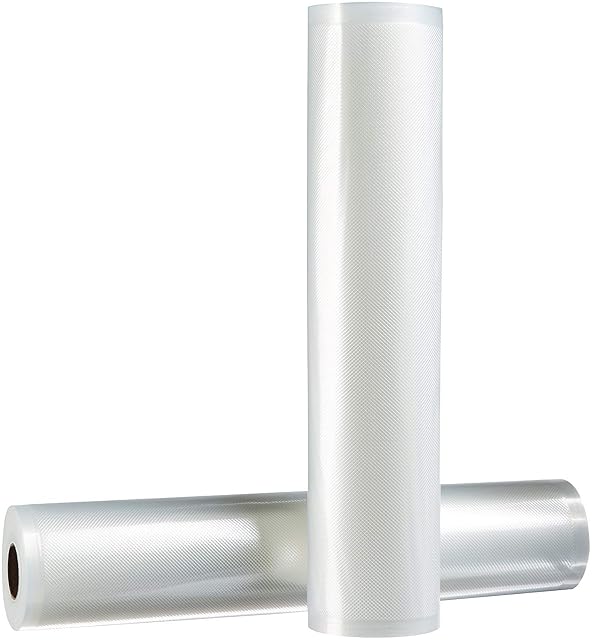
Two rolls of vacuum film, each 11.8 inches wide and 19.7 feet long (30 × 600 cm) — about 39 feet in all. Amazon states BPA-free, tear-resistant material suitable for sous-vide, microwave-safe and boilable, for handheld and common bar sealers. On Amazon.com the reference opens the German listing, currently unavailable.
Best for: A first roll, and anyone who seals odd-shaped things.
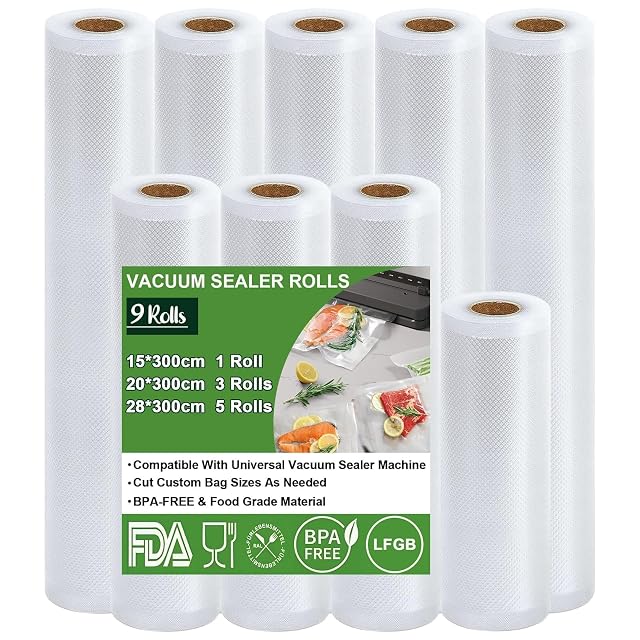
Nine rolls across three widths — 5.9, 7.9 and 11 in (15, 20 and 28 cm), each 9.8 feet — with a published thickness of 190 microns from a seven-layer coextruded film. Omtofo states BPA-free, reusable material suitable for the microwave and for sous-vide.
Best for: A kitchen that seals a lot of small things and hates wasting wide film.
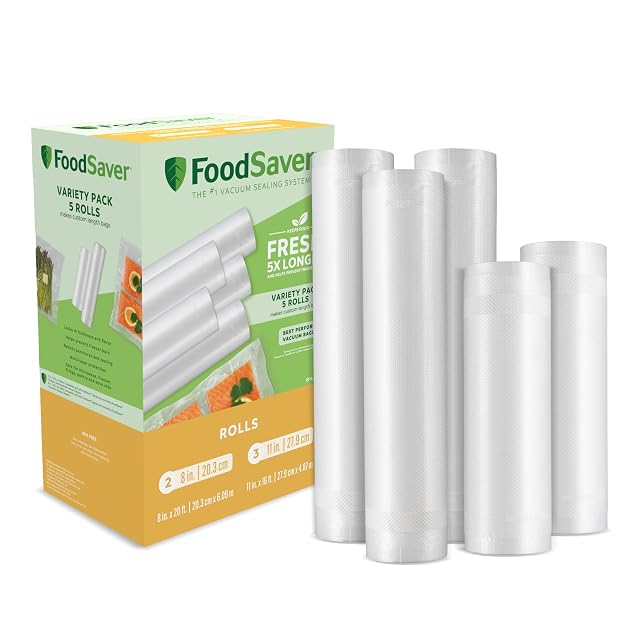
Five heat-seal rolls, two 8 inch and three 11 inch, made in the USA for FoodSaver systems, cut to length.
Best for: A FoodSaver machine, where certainty and a heavier film are worth the premium
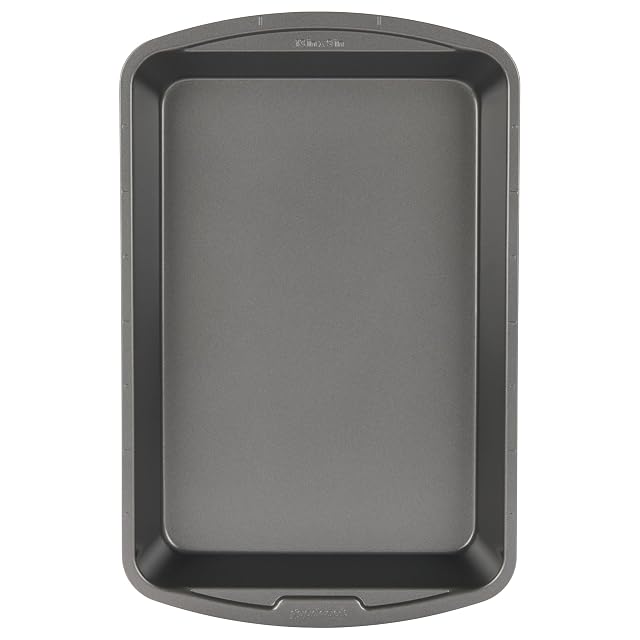
A 13 × 9 × 2 inch heavy-gauge steel bake and roast pan with a scratch-resistant metal-utensil safe non-stick coating and wide rims.
Best for: A box cake, a lasagne or a roast chicken, in one 13 × 9 pan
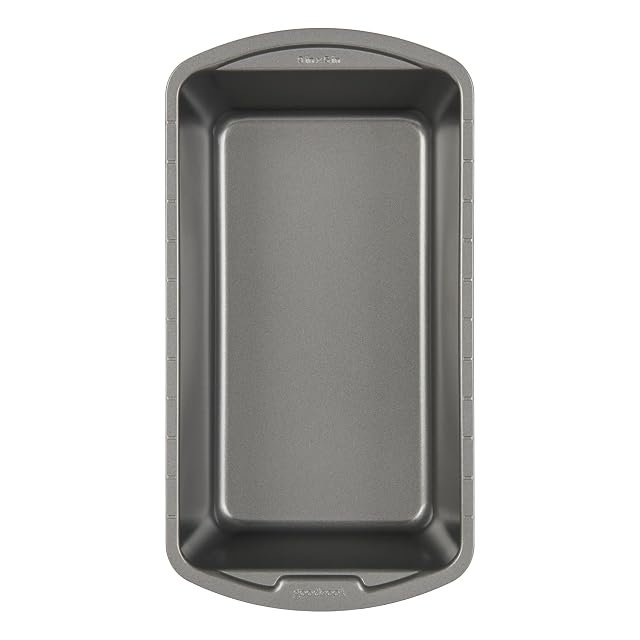
A standard 9 × 5 inch carbon steel loaf pan with a scratch-resistant non-stick coating, metal-spatula safe and dishwasher safe.
Best for: One standard loaf, at the lowest price on the shelf
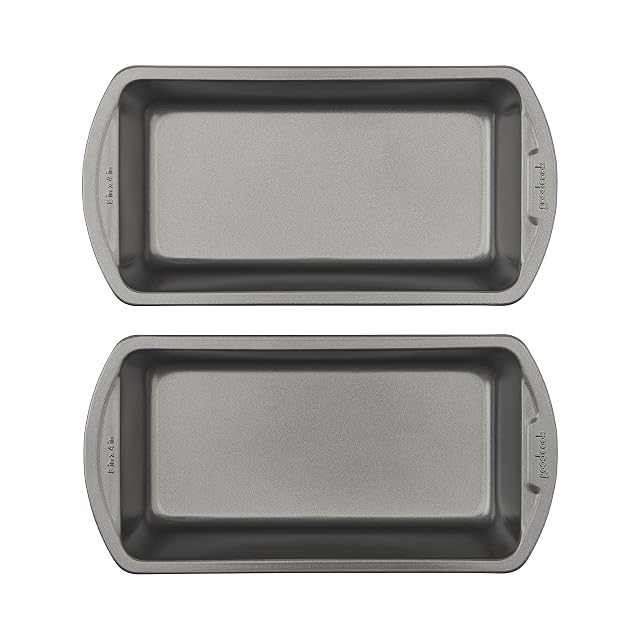
Two 8 × 4 inch medium carbon steel loaf pans with scratch-resistant metal-spatula safe non-stick coating, oven and dishwasher safe.
Best for: Two medium loaves at once, or a recipe halved into matching pans