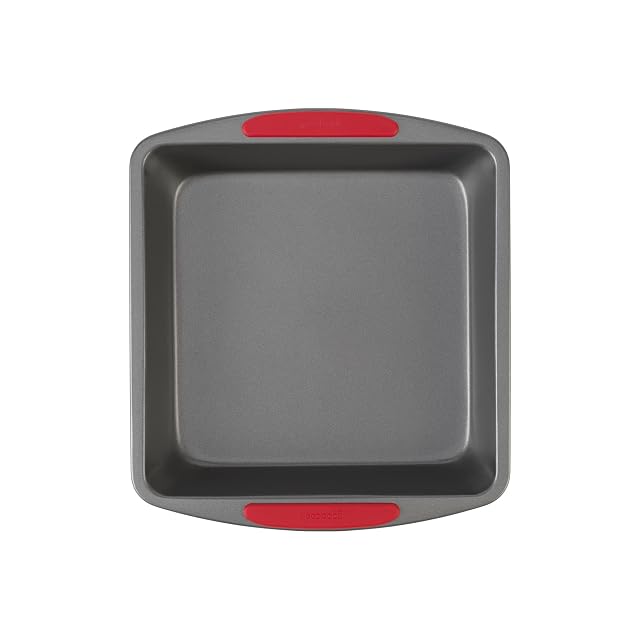
Best for: Brownies and half-batch cakes, lifted out of a hot oven without fumbling
≈ $10
Check price on Amazon The only silicone grips on this shelf
An 8 × 8 inch heavy-gauge steel square pan with ergonomic silicone grips on both handles, a scratch-resistant non-stick coating and a dishwasher-safe finish.
Best for: Brownies and half-batch cakes, lifted out of a hot oven without fumbling
“ergonomic silicone grips on both handles… make it easier to place in and take out of the oven”
An 8 × 8 is the awkward pan to get out of an oven, and this is why.
A 13 × 9 has long sides you can get two hands under — the GoodCook 13 × 9 at $9.99 sells precisely that: “wide-rim sides make the pan easy to take in and out of the oven, even while wearing oven mitts.” A loaf pan is narrow enough to grip across its width.
An 8 × 8 is a compact heavy square with a thin rolled edge on all four sides. In oven mitts you have no finger precision — a mitt grips by friction and pressure, and a thin lip gives you neither.
Three items on this shelf address handling, and only this one gives you something to hold:
this — silicone grips on both handles GoodCook 13 × 9, $9.99 — wide rims KitchenAid, both pans — “extended handles”, which is reach rather than grip: “a secure grip for easy transport… even when wearing pot holders”
The other eight items say nothing about getting the pan out of the oven.
What is missing is a heat rating for the silicone. Food-grade silicone is generally serviceable to around 220 °C, which is the same region as the only two oven limits on this shelf — 428 °F (exactly 220 °C) on the Amazon Basics set and 420 °F on the Elbee. This page publishes no limit for the pan and none for the silicone, and on the one item here with a polymer part inside the oven that is the figure to want.
And the handle projection is not published either. The catalog plan is 203 × 203 mm — exactly 8.0 × 8.0 inches, which is the pan and not the pan plus handles. The grips stick out and by how much is not stated, which on a 22-inch oven shelf is the difference between two of these side by side and one.
The catalog reads 203 × 203 mm — 8.0 × 8.0 inches. Exact.
The flat pans on this shelf all behave like this. The GoodCook 13 × 9 at $9.99 catalogs at 330 × 229 × 51 mm = 13.0 × 9.0 × 2.0 inches, exactly its published figure.
The loaf pans do not. The GoodCook 9 × 5 at $5.99 and the KitchenAid 9 × 5 at $14.99 both catalog at 279 × 152 mm — 11.0 × 6.0 inches, two inches over in each direction. A loaf pan is tapered and measured at the base; a shallow square has near-vertical walls and measures what it says.
The depth is the figure this page omits. The catalog says 49 mm — about 1.9 inches. An 8 × 8 is conventionally 2 inches deep, and nothing on the page states it. A batter filled to a two-inch assumption in a 1.9-inch pan is the one that goes over the side.
An 8 × 8 is 64 square inches. A 13 × 9 is 117.
So this is 55 percent of the rectangle — and a boxed mix written for a 13 × 9 baked in this comes out roughly twice as deep.
That is the reason to own one, not a compromise. Depth changes the ratio of crust to center, which is the whole argument about brownies, and the edge pieces of an 8 × 8 are a smaller fraction of the total than in a 13 × 9.
The shelf, by area:
8 × 8 — 64 in², this 9 inch round — 63.6 in², two of them in the Amazon Basics set at $31.99: within half a square inch of this pan, which is why box mixes offer the two interchangeably 9 × 5 loaf — 45 in² at the base, three of them here 13 × 9 — 117 in², the GoodCook at $9.99, ten cents cheaper than this 8 × 4 loaf — 32 in², two of them in the GoodCook set at $11.99 “one square tin” in the Elbee eight-piece at $59.99, size not stated
And this pan is the heaviest-for-its-size of the GoodCook four. 310 grams on 64 square inches against 268 grams on a 9 × 5 and 204 grams each for the 8 × 4 pair. Some of the 310 is the handles and the silicone, so it is not a clean gauge comparison — but it is the only weight signal the shelf offers, since no item here publishes a thickness.
Its three sister pans all claim it:
9 × 5 loaf, $5.99 — “It is also metal spatula safe” 13 × 9, $9.99 — “METAL-SPATULA SAFE: Safe for use with metal utensils”, and in the product name 8 × 4 set of two, $11.99 — “is metal spatula safe so you can serve your baked goods right out of the pans”
This page says “scratch-resistant nonstick coating”, twice, and stops.
Which is the conspicuous gap, because of what an 8 × 8 is for. Bullet one names brownies. Brownies are cut in the pan and lifted out in squares — a point load dragged across a non-stick film, which is the single most destructive thing you can do to one.
One cut and batter works under the edge, food sticks there permanently, and the break spreads from that point every time something scrapes past.
Two readings, and the page supports neither over the other. It may be the same coating as the sister pans with the bullet simply unwritten — all four are GoodCook, all four say “scratch-resistant”, all four describe heavy steel. Or the coating is genuinely different.
On the evidence published, treat it as not metal-safe. Line it with parchment for anything you intend to cut, which also lets you lift the whole slab out in one piece and cut it on a board.
And note that this is the shelf’s normal state, not an outlier. No other item here claims metal safety at all — not Sur La Table, not either KitchenAid, not Amazon Basics, not Elbee. GoodCook’s other three pans are the exception on this shelf, and this is the rule.
“made from heavy-gauge steel” · “The heavy-duty steel oven pan ensures long-lasting durability and even heat distribution”
Gauge is a number, and no item on this shelf publishes one.
The shelf’s vocabulary for thickness: “heavy-duty gauge steel” (GoodCook, three pans) · “heavy-gauge steel” (this) · “heavy-weight steel construction” (Amazon Basics) · “heavy-duty aluminized steel” and a “uniquely designed rim to prevent warping” (KitchenAid, two pans) · “carbon steel” with no adjective (Sur La Table) · “rust resistant” and no material at all (Elbee).
Four phrases, zero numbers.
“Even heat distribution” is the other claim without a figure, and it is asserted on at least nine of the thirteen items here. What actually governs it is thickness and conductivity: a thicker pan spreads a hot spot before the batter sees it, and aluminum conducts about three times better than steel — which is why the KitchenAid pans’ aluminized steel is a material difference and not a finish. Nobody publishes either number.
One thing an 8 × 8 does have in its favor on heat. A compact square has less edge per unit area than a 13 × 9, so proportionally less of the batter is next to a hot wall — which is why an 8 × 8 bake browns more gently at the sides and takes longer in the middle. Nothing on the page says so.
“dishwasher safe for easy cleanup after use. Hand washing is recommended for longer-lasting use”
Both halves are true and they describe different time scales. A dishwasher will not destroy the pan today. Over years the hot alkaline cycle attacks the coating, and carbon steel rusts wherever the coating is broken — which on a pan you cut brownies in it eventually will be.
GoodCook publishes this line verbatim on three pans here. The 13 × 9 publishes nothing about washing at all.
The rest of the shelf: KitchenAid publishes “DISHWASHER SAFE: for easy cleanup” on both pans with no caveat; Amazon Basics publishes only “Hand wash for best results” on a $31.99 set; Elbee publishes “Dishwasher safe and rust resistant”, the shelf’s only mention of rust; Sur La Table says nothing.
One extra reason to hand wash this one in particular. It is the only metal pan here with a silicone part, and silicone picks up grease and odor over repeated hot cycles. It is also the part you will be holding while carrying a hot pan, which is a reason to keep it clean rather than merely nice.
The habit that matters more than any bullet: wash it warm, dry it immediately, and never leave a carbon steel pan to drain.
No metal-utensil claim, as above, uniquely among the four GoodCook pans here.
No depth. The catalog says 49 mm, about 1.9 inches, and the page gives nothing.
No heat rating for the silicone, on the one item on this shelf with a polymer part inside the oven.
No handle projection, so the 8 × 8 figure understates what the pan occupies.
No oven temperature limit, as with at least nine of the thirteen items here. Only the Amazon Basics set (428 °F, exactly 220 °C) and the Elbee set (420 °F, plus convection) publish one.
No gauge or thickness, as above.
No coating composition. “Scratch-resistant nonstick” is a property, not a material. Only the Sur La Table at $11.70 states what its coating is free of — “PFOA, PFAS, PTFE Free” — and only by negation.
No color named in the bullets, where the product name gives it for the other three GoodCook pans. All four are gray, and a dark pan absorbs more radiant heat and browns faster than a light one — a real baking variable that no page on this shelf mentions, including the one that sells color as a feature.
No warranty and no country of manufacture, which no item on this shelf publishes.
Read on the day this page was built: $10 at the American Amazon shop.
Read from Keepa on the day this page was last revised; stock and price both move without notice.
Prices quoted in this text were read on 2026-10-17. The live price is at the top of the page.
Getting a square pan out of an oven, which is harder than it sounds and which nothing else on this shelf addresses with a grip. Bullet three: "This square pan features ergonomic silicone grips on both handles, providing a comfortable and secure hold. These grips make it easier to place in and take out of the oven." Why an 8 × 8 is the awkward one. A 13 × 9 has long sides you can get two hands under — the GoodCook 13 × 9 at $9.99 sells exactly that, "wide-rim sides... easy to take in and out of the oven, even while wearing oven mitts". A loaf pan is narrow enough to grip across. An 8 × 8 is a compact heavy square with a thin rolled edge on every side, and in oven mitts you have no finger precision at all — a mitt grips by friction and pressure, and a thin lip gives neither. Three items on this shelf address handling and only this one gives you something to hold. The KitchenAid pans publish "extended handles... a secure grip for easy transport... even when wearing pot holders", which is reach rather than grip; the GoodCook 13 × 9 publishes wide rims. Eight items say nothing. What is missing is the silicone’s heat rating. Food-grade silicone is generally serviceable to around 220 °C (428 °F), which is in the same region as the only two oven limits published on this shelf — 428 °F (220 °C) on the Amazon Basics set and 420 °F on the Elbee. This page publishes no limit for the pan and none for the silicone, and on the one item here with a polymer part inside the oven, that is the figure to want.
It is, and across four sister pans that is a conspicuous silence. The three others all claim it. The 9 × 5 loaf at $5.99 — "It is also metal spatula safe". The 13 × 9 at $9.99 — "METAL-SPATULA SAFE: Safe for use with metal utensils", and it is in the product name too. The 8 × 4 set of two at $11.99 — "is metal spatula safe so you can serve your baked goods right out of the pans". This page says only "scratch-resistant nonstick coating", twice, and stops. Which is the gap that matters most on an 8 × 8, because of what an 8 × 8 is for: brownies. Bullet one names them. Brownies are cut in the pan and lifted out in squares, and a point load dragged across a non-stick film is the single most destructive thing you can do to it. One cut, and batter works under the edge, food sticks there permanently, and the break spreads from that point. There are two honest readings and the page supports neither over the other. It may be the same coating as its sister pans and the bullet was simply not written — all four are GoodCook, all four say "scratch-resistant", and the three that claim metal also say "heavy-duty gauge steel" as this one says "heavy-gauge steel". Or the coating is genuinely different. On the evidence published, treat it as not metal-safe: line it with parchment for anything you intend to cut, which also lifts the whole slab out in one piece. No other pan on this shelf claims metal safety either, so this is the shelf’s normal state and GoodCook’s other three are the exception.
It is a different pan with a different output, and the arithmetic is the clearest on this shelf. An 8 × 8 is 64 square inches. A 13 × 9 is 117. So the square pan is 55 percent of the rectangle, and a boxed mix written for a 13 × 9 baked in this comes out roughly twice as deep. That is the whole point of the size, not a compromise. A deep brownie and a thin tray bake are different things: depth changes the ratio of crust to center, which is exactly what people argue about with brownies, and the edge pieces of an 8 × 8 are a smaller fraction of the total. The bullets name the right uses: "breads, cakes, brownies". What the shelf gives you for comparison. The GoodCook 13 × 9 at $9.99 is the one-full-box pan and costs ten cents less than this. The Amazon Basics six-piece set at $31.99 contains two 9-inch round cake pans — a 9-inch round is 63.6 square inches, within half a square inch of this pan, so an 8 × 8 and a 9-inch round are interchangeable by volume and that is why box mixes offer both. The Elbee eight-piece at $59.99 includes "one square tin" and does not say what size. One depth caution. The catalog figure for this pan is 49 mm (1.93 in) — about 1.9 inches — and the page publishes no depth at all. An 8 × 8 is conventionally 2 inches deep, and a shallower pan with a deep batter in it is the one that overflows.
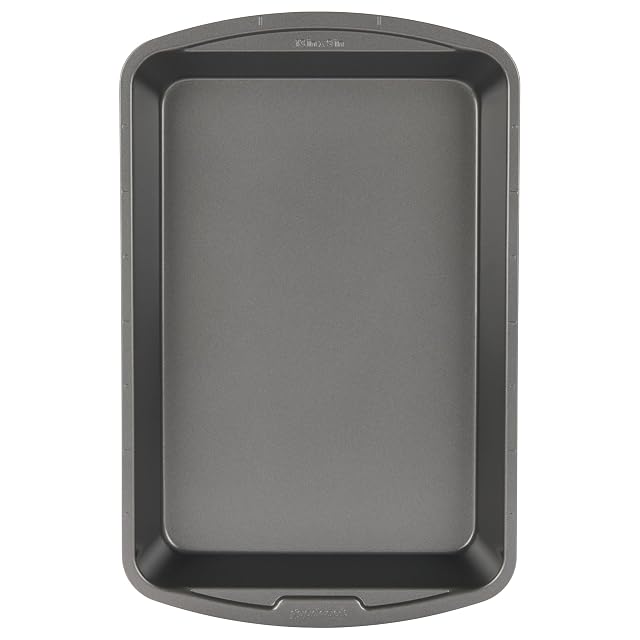
A 13 × 9 × 2 inch heavy-gauge steel bake and roast pan with a scratch-resistant metal-utensil safe non-stick coating and wide rims.
Best for: A box cake, a lasagne or a roast chicken, in one 13 × 9 pan
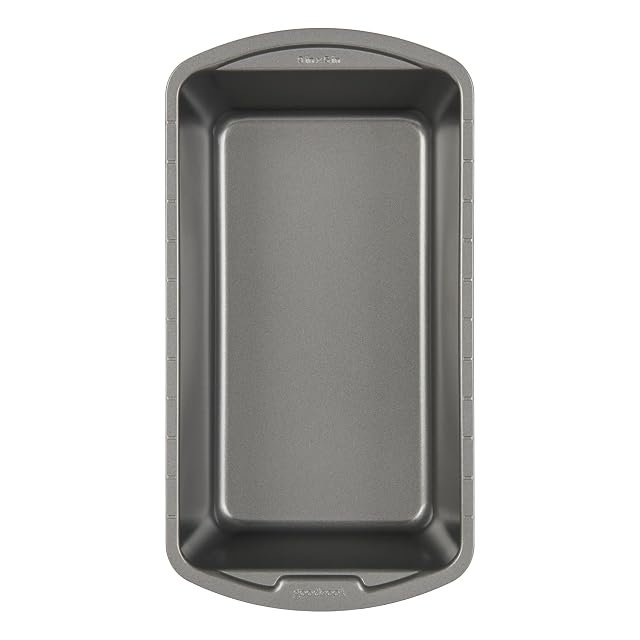
A standard 9 × 5 inch carbon steel loaf pan with a scratch-resistant non-stick coating, metal-spatula safe and dishwasher safe.
Best for: One standard loaf, at the lowest price on the shelf
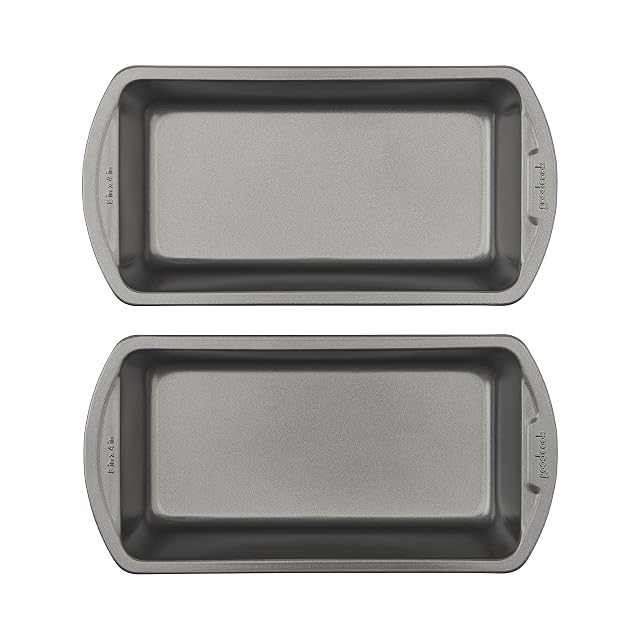
Two 8 × 4 inch medium carbon steel loaf pans with scratch-resistant metal-spatula safe non-stick coating, oven and dishwasher safe.
Best for: Two medium loaves at once, or a recipe halved into matching pans
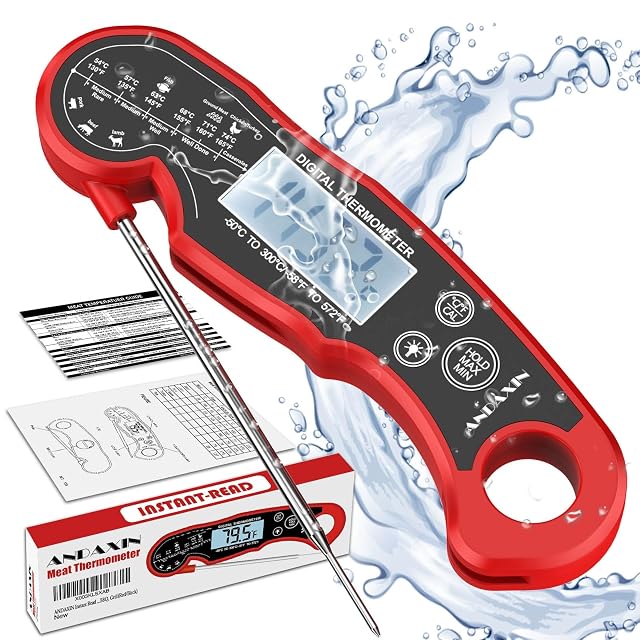
A three-second instant-read thermometer accurate within 1 °F, IP65 waterproof, with calibration, a temperature lock, a backlit LCD and a one-year warranty.
Best for: A nine-dollar thermometer you can check, correct and claim against
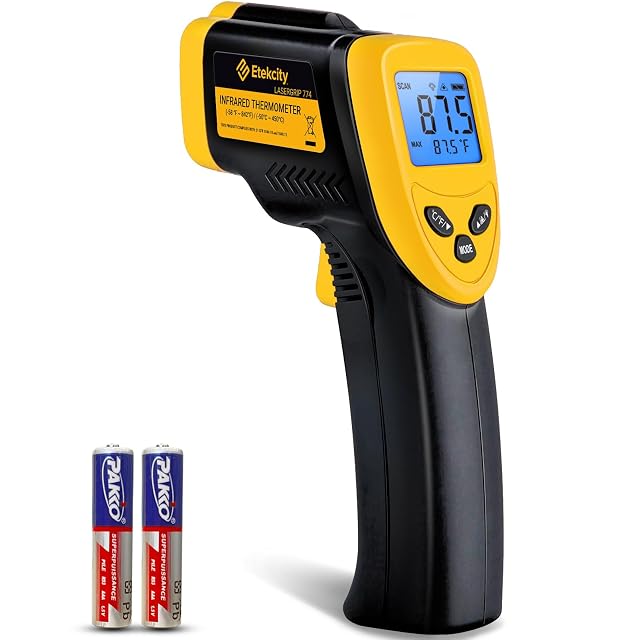
An infrared surface thermometer reading −58 to 842 °F in under half a second, with a 12:1 distance-to-spot ratio, a backlit LCD and a maximum display.
Best for: Pans, pizza stones, griddles and oil — the surfaces a probe cannot read
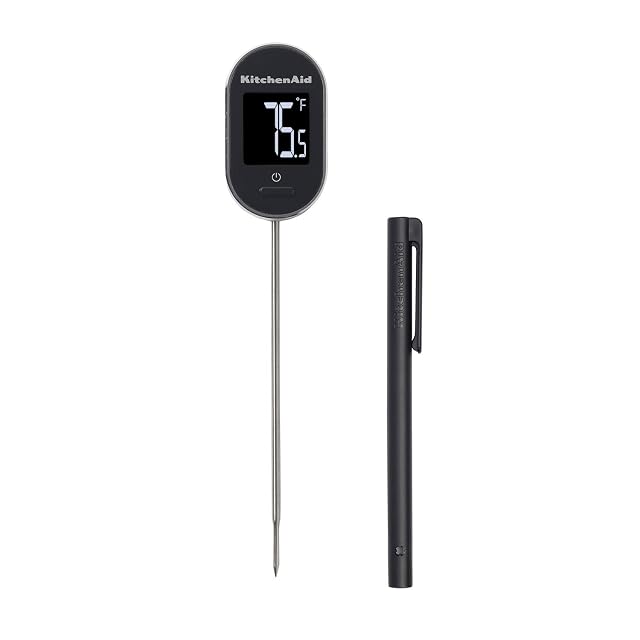
A digital thermistor thermometer reading in under six seconds from −40 to 482 °F, with an oversized pivoting backlit display and a battery included.
Best for: A reader who needs the display legible from any angle more than a fast reading