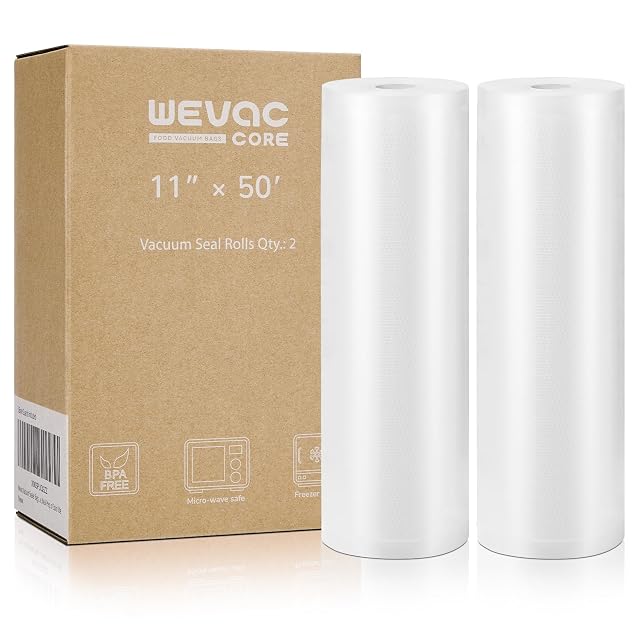
Best for: Large or awkward items on any suction machine, where a bone guard earns its place
≈ $21
Check price on Amazon Embossed channels named, a bone guard included, and six machines listed
Two 11-inch by 50-foot embossed rolls with a bone guard, named compatible with six machine brands.
Best for: Large or awkward items on any suction machine, where a bone guard earns its place
“2 pack of 11 inch by 50 feet rolls with embossed channels to increase suction”, and in the description, “Embossed micro-channel design for airtight and watertight seals”.
This is the condition a suction sealer needs, and only two listings on this shelf publish it.
A suction sealer pulls air out through the open mouth of the bag. With smooth film, the two walls collapse against each other at the mouth within a second and seal off the air behind them — the pump keeps running and nothing more comes out. You get a tight neck and a bubble of air around the food.
Embossing holds the walls apart so air keeps flowing from the far end.
The other listing to say it is the Syntus at $22.99, with a “single-side textured dot pattern… enhance suction”. The xinbaolong at $14.52 and the FoodSaver at $29.99 say nothing — and both sell for suction machines, so both are embossed by necessity and simply decline to publish it.
Smooth film works only in a chamber sealer, which evacuates the whole box rather than the bag and is a commercial machine.
“Watertight” in the description is the useful second half: a seal that holds water is what makes a bag safe for sous vide, where it sits submerged for hours.
“Bone Guard Included: Protects bags from sharp food items like bones, ideal for various cooking methods.”
Vacuum bags rarely fail at the seal. They fail by puncture — and they fail at the moment you vacuum them, because the film is being pulled hard onto whatever is inside. A rib bone, a fish fin, a frozen edge or a shard of shell goes straight through, the bag loses its vacuum overnight, and the food freezer-burns anyway.
Three listings on this shelf claim puncture resistance and none quantifies it:
this — “HEAVY DUTY AND PUNCTURE PREVENTION” xinbaolong — “puncture prevention technology” FoodSaver — “Prevents Food Damage: Thwarts freezer burn and spoilage”
Only the Syntus publishes the figure that governs it — “4 mil high-tenacity material” — and names the risk, “prevent bone punctures”.
And this is the only listing that ships a part instead of a claim.
The free version, which works with any film on this shelf: fold a piece of kitchen paper over the bone before you seal. Two seconds, and it does what the guard does.
“work with all suction vac heat sealer, such as Food Saver, Seal a meal, Nesco, Weston, Cabela’s, Ziploc etc.”
The shelf, on compatibility:
this — six brands named Syntus — “all traditional desktop vacuum sealer machines”, plus the exclusion: “not compatible with handheld vacuum sealers” xinbaolong — “all suction vacuum heat sealing machines” FoodSaver — “Ideal for use with FoodSaver vacuum sealing systems”, and no others Wonzlling — a different product entirely: a reusable zipper bag with an air valve, needing “a compatible vacuum pump or vacuum device”
That last division is the one to get right before buying anything here. A desktop sealer clamps the bag mouth, draws air through it and then melts the film shut; the bag is single use and has no valve, because the seal is the closure. A handheld pump has nothing to melt — it docks onto a one-way valve and the bag closes with a zipper. The two do not substitute for each other.
The one thing to check here is width. Eleven inches is the common domestic maximum, so most sealers will take it — and a narrower one will not take it at all. The xinbaolong ships both 8 inch and 11 inch rolls, which is the safer buy if you do not know your machine’s limit.
Two rolls of 11” × 50 ft = 13,200 square inches for $20.99 — 0.159 cents a square inch.
The shelf:
xinbaolong, $14.52 — 0.106¢/in², 120 feet in two widths Syntus, $22.99 — 0.139¢, 150 pre-cut bags in three sizes this — 0.159¢, 100 feet in one width FoodSaver, $29.99 — 0.295¢ Wonzlling, $27.99 — 0.380¢, but reusable
So this is 50 per cent dearer per square inch than the cheapest, and the reason is the single width: everything you seal gets an 11-inch sleeve, so a steak or a single fillet wastes the margin on both sides.
What one wide roll buys instead is reach. Fifty feet in a single roll has no maximum length — a side of salmon, a long rack of ribs, a baguette, a bundle of asparagus all go in a sleeve cut to measure, where nothing on the pre-cut side of this shelf exceeds 16 inches.
And two rolls of fifty feet means fewer roll changes than six of twenty.
At 2 lb (907 g) for 100 feet this is 0.32 oz a foot, the lightest film on the shelf — against the xinbaolong’s 0.39 oz/ft across 120 feet. On an 11-inch width that works out thinner per square inch than the xinbaolong’s mix of 8 and 11, which is worth setting beside the absence of a published thickness.
“Perfect for food storage, freeze dried meal, sous vide, gardening, tea leaves, documents and electronics.”
The widest application list on the shelf, and three of those are genuinely good uses that the food-only listings miss.
Documents and electronics is the honest general case: vacuum film keeps moisture out of anything, and the reason a sealed bag preserves food is the same reason it preserves a passport or a circuit board. The Syntus reaches the same conclusion by a different route, naming “pills”.
Tea leaves and gardening — seed storage — are both about the same thing: dry goods going stale or damp.
Sous vide is the one that connects to the rest of this site. The sous-vide shelf carries fourteen immersion circulators, from the Anova Nano 2.0 to the Breville Joule Turbo and five KitchenBoss models, and every one of them needs a bag that will sit at 130 to 185 °F (55 to 85 °C) for hours without delaminating. The description’s “watertight” claim is the relevant one there.
Freeze-dried meals is the fourth, and it works for the same reason as everything above.
“3-6 times longer food shelf life” is the claim that needs the most qualification, and the xinbaolong publishes the identical figure independently. What neither states is the condition. Vacuum sealing prevents freezer burn — the dehydration that occurs when ice sublimes off an exposed surface — and there the multiple is real and large, because the mechanism is simply the absence of air. In a fridge it slows oxidation but does nothing to anaerobic organisms, so the multiple is far smaller and it is not a substitute for refrigeration. Read it as a freezer claim.
“Wevac, with over 10 years of experience, offers premium vacuum sealer bags and rolls made in China to US quality standards.”
Two listings on this shelf state a country, and they state opposite ones.
FoodSaver, $29.99 — “Made in USA: Proudly manufactured in the United States.” this — made in China, said plainly.
The candour is worth noting, because the usual alternative is silence: the xinbaolong, the Syntus and the Wonzlling all publish nothing.
And it sits beside the one commercial promise on the shelf: “We stand behind our products and implement ‘no questions return policy’ with no hassle.”
Which is the only guarantee of any kind published here. Four of five listings offer nothing.
No thickness. Only the Syntus publishes one — 4 mil — and thickness is what resists the puncture this listing has a part for. At 0.32 oz a foot of 11-inch film, this is the lightest on the shelf, which is worth knowing in the absence of a figure.
No second width, as above.
No dishwasher claim, which only the FoodSaver makes.
No temperature limit, on a page that names sous vide and boiling is implied. No listing on this shelf publishes one.
No microwave claim, which the xinbaolong, Syntus, FoodSaver and Wonzlling all make — an odd omission on the widest application list here.
No seal width needed, which is the figure that decides whether 11 inches fits your machine.
No bone guard dimensions or count, on the one accessory that distinguishes this pack.
Read on the day this page was built: $20.99 at the American Amazon shop.
Read from Keepa on the day this page was last revised; stock and price both move without notice.
Prices quoted in this text were read on 2026-10-17. The live price is at the top of the page.
It is a small insert that stops a sharp edge going through the film, and it answers the actual failure mode of this whole category. The description lists it: "Bone Guard Included: Protects bags from sharp food items like bones, ideal for various cooking methods." Here is why it is needed. Vacuum bags rarely fail at the seal. They fail by puncture — and they fail at the moment you vacuum them, because the film is being pulled hard onto whatever is inside. A rib bone, a fish fin, a frozen edge or a shard of shell goes straight through, the bag loses its vacuum overnight, and the food freezer-burns anyway. Across the shelf, three listings claim puncture resistance and none of them quantifies it: this one says "HEAVY DUTY AND PUNCTURE PREVENTION", the xinbaolong at $14.52 says "puncture prevention technology", the FoodSaver at $29.99 says "Prevents Food Damage". Only the Syntus at $22.99 publishes the figure that governs it — "4 mil high-tenacity material" — and names the risk, "prevent bone punctures". So this is the only listing that ships a part rather than a claim. And the free habit that works with any film: fold a piece of kitchen paper over the bone before you seal. It takes two seconds and it is what the guard does.
This is the most completely answered compatibility question on the shelf. Bullet three: "work with all suction vac heat sealer, such as Food Saver, Seal a meal, Nesco, Weston, Cabela’s, Ziploc etc, you can make a customized-size vacuum bag in a few seconds." Six brands named, where the xinbaolong says only "all suction vacuum heat sealing machines", the FoodSaver at $29.99 names its own systems and no others, and the Syntus names the category plus the exclusion. And bullet one gives the reason it works, which matters more than the brand list: "embossed channels to increase suction". A suction sealer cannot evacuate a smooth bag — the walls collapse at the mouth within a second and seal off the air behind, so the pump runs and nothing more comes out. Embossing holds the walls apart so air keeps flowing from the far end. Only this and the Syntus ("single-side textured dot pattern") publish it. The one thing to check is width. This is 11 inches only, which is the common domestic maximum — a narrower sealer will not take it at all. The xinbaolong ships both 8 inch and 11 inch rolls, which is the safer buy if you do not know your machine’s limit.
It costs you film on small items, and on this shelf that is the main thing separating it from the cheapest option. Everything here is 11 inches wide: a steak, a portion of vegetables or a single fillet sealed in an 11-inch sleeve wastes the margin on both sides, and film is what you are buying. The xinbaolong at $14.52 ships three 8-inch rolls and three 11-inch rolls — 120 feet in two widths — and works out at 0.106 cents a square inch against 0.159 here, which is 33 per cent less. The Syntus at $22.99 goes further and gives three pre-cut sizes: gallon 11"×16", quart 8"×12" and pint 6"×10", at 0.139 cents. What one wide roll buys instead is reach. Fifty feet in a single roll has no maximum length — a side of salmon, a long rack of ribs, a baguette, a bundle of asparagus all go in a sleeve cut to measure, where nothing on the pre-cut side of this shelf is longer than 16 inches. And two rolls of fifty feet means fewer roll changes than six of twenty. So: one width, for large and awkward things. If most of what you seal is portion-sized, the two-width pack is the better buy.
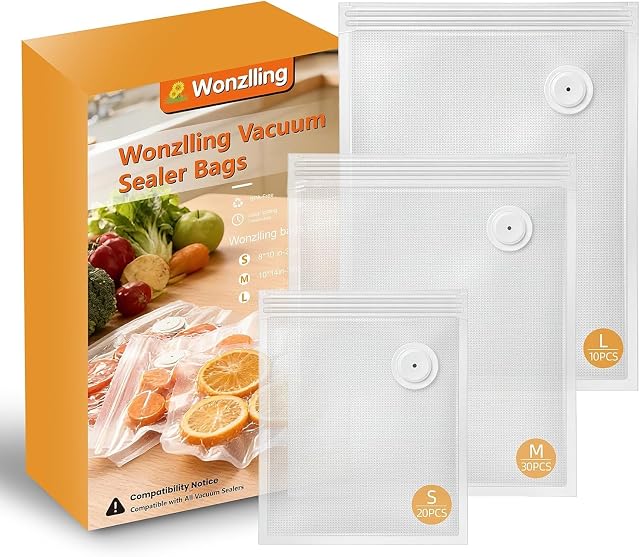
Sixty reusable zipper bags with an air valve in three sizes, for a vacuum pump rather than a heat sealer.
Best for: Meal prep with a handheld pump, where reopening a bag matters more than a permanent seal
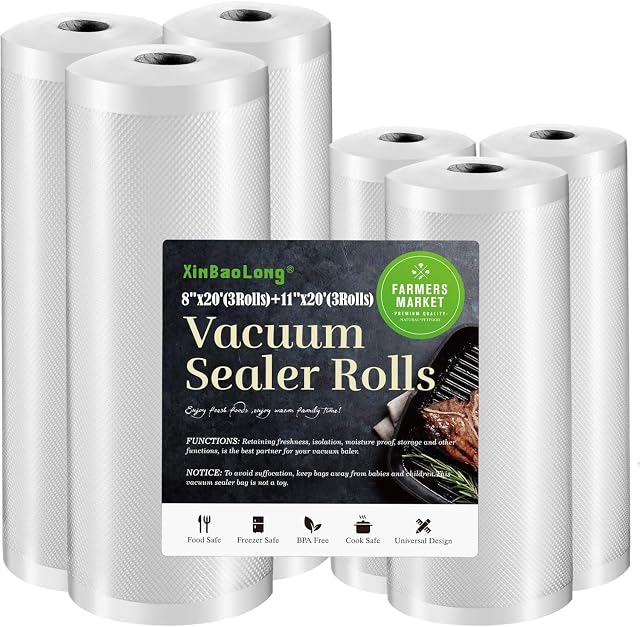
Six heat-seal rolls — three 8 inch and three 11 inch, each 20 feet — cut to length, BPA free, boil and microwave safe.
Best for: Bulk sealing at the lowest cost per bag, on any suction machine
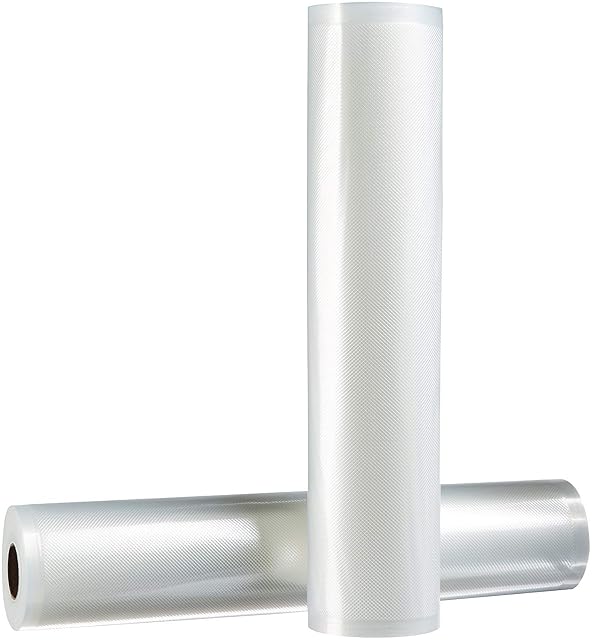
Two rolls of vacuum film, each 11.8 inches wide and 19.7 feet long (30 × 600 cm) — about 39 feet in all. Amazon states BPA-free, tear-resistant material suitable for sous-vide, microwave-safe and boilable, for handheld and common bar sealers. On Amazon.com the reference opens the German listing, currently unavailable.
Best for: A first roll, and anyone who seals odd-shaped things.
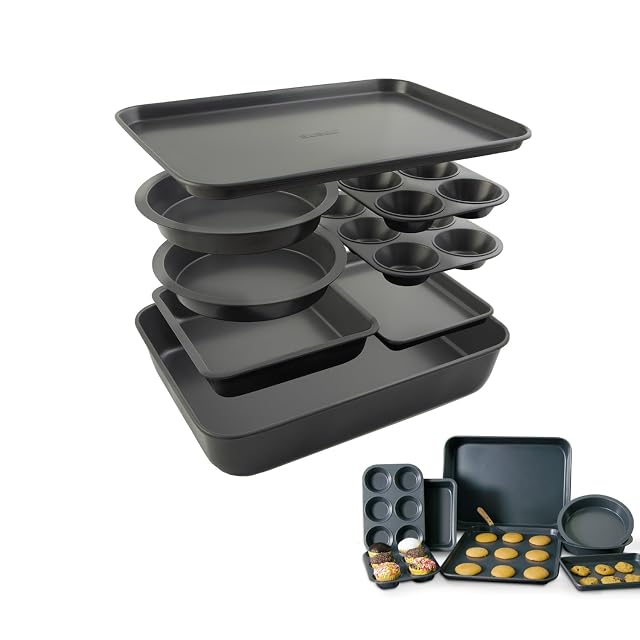
Eight nesting nonstick pans — a roaster, two oven trays, two 8-inch rounds, a square pan and muffin cups — stacking to 17.63 × 13.11 × 3.58 inches.
Best for: A small kitchen that needs eight pans and has one shelf for them
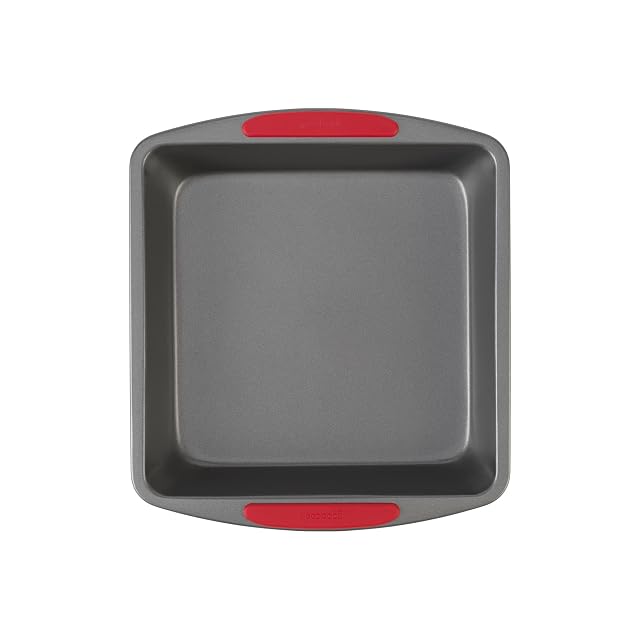
An 8 × 8 inch heavy-gauge steel square pan with ergonomic silicone grips on both handles, a scratch-resistant non-stick coating and a dishwasher-safe finish.
Best for: Brownies and half-batch cakes, lifted out of a hot oven without fumbling
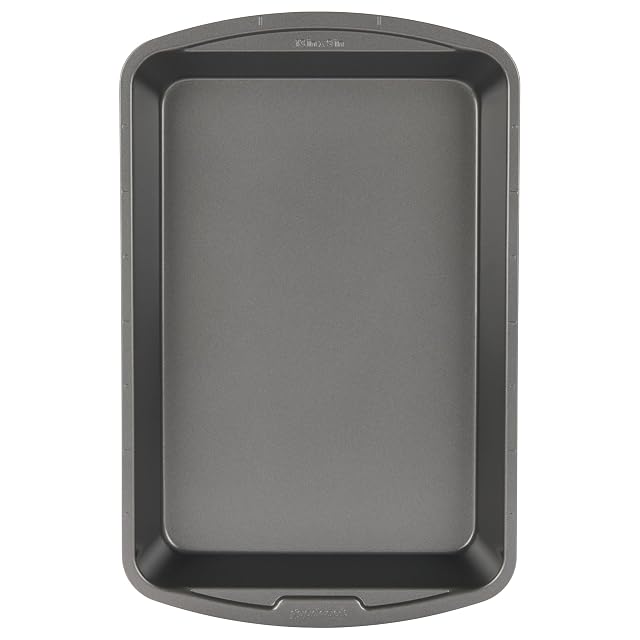
A 13 × 9 × 2 inch heavy-gauge steel bake and roast pan with a scratch-resistant metal-utensil safe non-stick coating and wide rims.
Best for: A box cake, a lasagne or a roast chicken, in one 13 × 9 pan