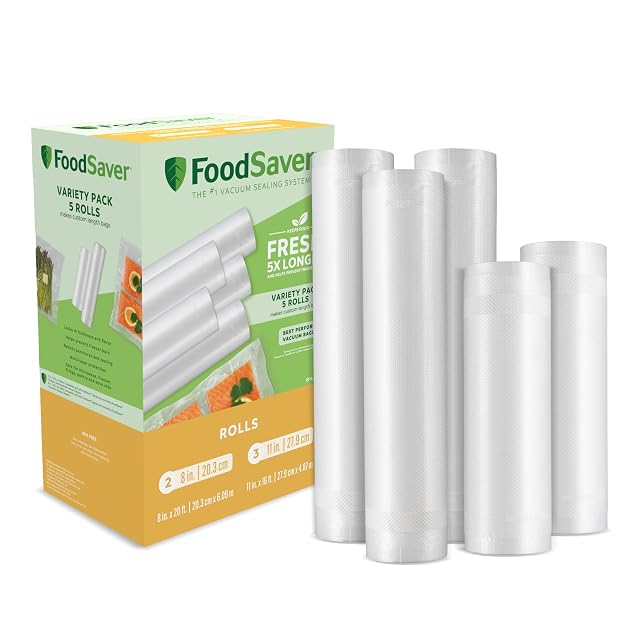
Best for: A FoodSaver machine, where certainty and a heavier film are worth the premium
≈ $30
Check price on Amazon Made in the USA, and 2.8 times the cheapest film per square inch
Five heat-seal rolls, two 8 inch and three 11 inch, made in the USA for FoodSaver systems, cut to length.
Best for: A FoodSaver machine, where certainty and a heavier film are worth the premium
“Includes two 8 X 20 inches heat seal rolls and three 11 X 16 inches heat seal rolls.”
A roll is measured width × length, and 8 × 20 inches is a sheet — enough for one steak, not a roll.
The catalog weight settles it. 3.1 lb (1,400 g) for five rolls.
Read as feet: 2 × 20 + 3 × 16 = 88 feet → about 0.56 oz (15.9 g) a foot. Read as inches: 88 inches is 7.3 feet → 6.8 ounces (192 g) a foot, which would be a film heavier than sheet metal.
For scale: the xinbaolong at $14.52 is 2.9 lb (1.3 kg) for 120 feet — 0.39 oz/ft. The Wevac at $20.99 is 2 lb (907 g) for 100 feet — 0.32 oz/ft.
So the bullet means feet, and this is the heaviest film on the shelf at about 0.56 oz/ft — which is consistent with the description’s “multi-layer design” and with the dishwasher claim below.
The two listings that get the unit right are worth noting. The xinbaolong writes “8”x20’”, with the prime mark for feet. The Wevac spells it out: “11 inch by 50 feet.”
The title here gives only the widths — “8 (2 Pack) and 11 (3 Pack)” — and leaves the lengths to the bullet that has them wrong.
2 × (8” × 20 ft) + 3 × (11” × 16 ft) = 3,840 + 6,336 = 10,176 square inches for $29.99.
0.295 cents a square inch. The shelf:
xinbaolong, $14.52 — 0.106¢/in², 120 feet in two widths Syntus, $22.99 — 0.139¢, 150 pre-cut bags in three sizes Wevac, $20.99 — 0.159¢, 100 feet in one width, plus a bone guard this — 0.295¢, 88 feet in two widths Wonzlling, $27.99 — 0.380¢, 60 reusable zipper bags, so its cost per use falls
So it is the most expensive film here and supplies the least total area of the three roll packs.
What the premium buys, by its own page:
Made in the USA — unique on this shelf. Only the Wevac states a country at all, and states China, plainly. A multi-layer film, “durable but also pliable”, which the 0.56 oz/ft weight supports. Dishwasher safety, which nothing else here claims. And certainty: “Specifically built for FoodSaver vacuum sealing systems to ensure a secure and airtight seal.”
That last one is the real argument, and it is worth taking seriously. A sealer has a maximum film thickness it can melt through and a channel geometry its pump expects. Matched film removes the one failure that costs food rather than money: a seal that looks right and lets go three weeks into the freezer.
If you own something else, the Wevac names six compatible brands — Food Saver among them — for 46 per cent less per square inch.
8 inch and 11 inch, and the split matters: eight suits a steak, a fillet or a portion of vegetables; eleven suits a chicken, a rack of ribs or a loaf.
Only this and the xinbaolong give both. The Wevac is 11 inch only, which wastes film on small items; the Syntus gives three fixed pre-cut sizes.
“Cut the roll to your desired length for a bespoke storage solution”, and in the description, “Customize the length to fit any food you need to store, allowing for zero waste scenarios.”
The roll’s real advantage is that there is no maximum length. A side of salmon, a long rack, a baguette, a bundle of asparagus — all go in a sleeve cut to measure, where nothing pre-cut on this shelf exceeds 16 inches.
What it costs is a seal and twenty seconds. A roll needs two seals per bag: one to close the end you cut, one to close it after filling. A pre-cut bag needs one, which is the Syntus argument — “no cutting or pre-sealing required”.
The mix here is three 11-inch rolls to two 8-inch, weighted toward the wider size, which suits whole birds and joints more than portions.
“safe for freezer, refrigerator, microwave, and dishwasher.”
Four conditions, and the fourth is unique on this shelf.
It is also the odd one, because heat-seal film is single use: you cut the bag open to get the food out, so there is nothing to wash. Which suggests the claim is really about the film tolerating a dishwasher’s heat and detergent if you choose to rinse and reuse a cut bag for dry goods — a common enough habit, and one no other listing here sanctions.
The paradox worth naming: the only product on this shelf designed to be reused — the Wonzlling at $27.99, with its zipper and valve — publishes no dishwasher claim at all. The single-use film does.
The other three conditions are the shelf standard. The xinbaolong claims “freezers, refrigerators, microwaves, and boiling”; the Syntus “microwave oven, cabinet, fridge, or freezer storage, in addition to boiling, sous vide”.
And boiling is the gap here. Neither bullet five nor the description mentions boiling or sous vide, and the sous-vide shelf on this site carries fourteen immersion circulators — from the Anova Nano 2.0 to the Breville Joule Turbo — all of which need a bag that holds at 130 to 185 °F (55 to 85 °C) for hours. A multi-layer film at 0.56 oz/ft is almost certainly fine for it; the page does not say so, where three rivals do.
“Thwarts freezer burn and spoilage up to 5x longer than other storage methods”, and in the description, “proven to keep your meal fresh for weeks, not just days” and “5 times greater compared to non-vacuum storage methods.”
The shelf’s claims, for comparison: the xinbaolong and the Wevac both say “3-6 times”, independently of each other. So three listings converge on the same order of magnitude.
What none of them states is the condition, and the condition decides everything.
In a freezer, vacuum sealing prevents freezer burn — the dehydration that happens when ice sublimes off an exposed surface — and there the multiple is real and large, because the mechanism is simply the absence of air. This is the claim all three are really making, and this page comes closest to admitting it by naming freezer burn first.
In a fridge, it slows oxidation and aerobic growth but does nothing to anaerobic organisms. So the fridge multiple is far smaller, and vacuum packing is not a substitute for refrigeration.
“Weeks, not days” should be read as a freezer statement. “Proven” is the word with nothing behind it: no test, no standard, no condition.
No embossing, and on a FoodSaver-specific roll that is the specification you would most expect. A suction sealer cannot evacuate a smooth bag — the walls collapse at the mouth and seal off the air behind. FoodSaver machines are suction sealers, so this film is embossed by necessity. The Wevac makes it a selling point — “embossed channels to increase suction”, “embossed micro-channel design for airtight and watertight seals” — and the Syntus publishes a “single-side textured dot pattern”. What this page gives instead is the material — “BPA free multi-layer design… durable but also pliable” — which is a statement about the layers rather than the surface. Both matter: the layers hold the barrier, the embossing lets the air out.
No thickness. Only the Syntus publishes one, at 4 mil. The 0.56 oz/ft weight is the only quantitative clue here, and it is the heaviest on the shelf.
No other machines named. “Ideal for use with FoodSaver vacuum sealing systems” is the whole of it, where the Wevac names “Food Saver, Seal a meal, Nesco, Weston, Cabela’s, Ziploc”. These rolls will work on other suction sealers; the page simply does not say so.
No puncture answer. “Prevents Food Damage” is the claim, and puncture is the real failure mode — a rib bone, a fish fin or a frozen edge goes through at the moment you vacuum, because the film is being pulled tight onto the food. The Wevac ships a bone guard; the Syntus names “bone punctures” and publishes 4 mil. The free habit with any film: fold kitchen paper over the bone before sealing.
No boiling or sous vide, as above.
No guarantee, where the Wevac offers a “no questions return policy”.
Read on the day this page was built: $29.99 at the American Amazon shop.
Read from Keepa on the day this page was last revised; stock and price both move without notice.
Prices quoted in this text were read on 2026-10-17. The live price is at the top of the page.
Feet, and the catalog weight settles it. Bullet seven reads: "Includes two 8 X 20 inches heat seal rolls and three 11 X 16 inches heat seal rolls." But a roll is measured width × length, and 8 × 20 inches is a sheet rather than a roll — you could seal one steak in it. Weigh it. The catalog records 3.1 lb (1.4 kg) for the five rolls. Read as feet: 2 × 20 + 3 × 16 = 88 feet, which gives about 0.56 oz (15.9 g) a foot. Read as inches: 88 inches is 7.3 feet, which would give 6.8 ounces (192 g) a foot — a film heavier than sheet metal. For comparison, the xinbaolong at $14.52 is 2.9 lb (1.3 kg) for 120 feet, or 0.39 oz/ft, and the Wevac at $20.99 is 2 lb (907 g) for 100 feet, or 0.32 oz/ft. So the bullet means feet, and this is the heaviest film on the shelf at 0.56 oz/ft — which is consistent with the "multi-layer design" in the description and with the dishwasher claim. The two listings that get the unit right are worth noting: the xinbaolong writes "8"x20'" with the prime mark for feet, and the Wevac spells it out — "11 inch by 50 feet". The title here gives only the widths, "8 (2 Pack) and 11 (3 Pack)", and leaves the lengths to the bullet that has them wrong.
Only if you own a FoodSaver, and then arguably yes. 2 × (8" × 20 ft) + 3 × (11" × 16 ft) = 3,840 + 6,336 = 10,176 square inches for $29.99 — 0.295 cents a square inch, against xinbaolong 0.106¢, Syntus 0.139¢ and Wevac 0.159¢. So it is the most expensive film here and supplies the least total area of the three roll packs. What the premium buys, by its own page: "Made in USA: Proudly manufactured in the United States" — unique on this shelf, where only the Wevac states a country at all and states China; a "multi-layer design" that is "durable but also pliable", which the 0.56 oz/ft weight supports; dishwasher safety, which nothing else here claims; and "Specifically built for FoodSaver vacuum sealing systems to ensure a secure and airtight seal." That last line is the real argument. A FoodSaver machine has a published bag thickness it can melt through and a channel geometry its pump expects, and matching film removes the one failure that wastes food rather than money: a seal that looks right and lets go in the freezer. If you own something else, the Wevac names six compatible brands — including Food Saver — for 46 per cent less per square inch.
It does not, and on a FoodSaver-specific roll it is the one specification you would expect. A suction sealer cannot evacuate a smooth bag. It pulls air out through the open mouth, and with smooth film the two walls collapse against each other at the mouth within a second and seal off the air behind them — the pump runs on and nothing more comes out. Embossing — raised channels or dots on one face — holds the walls apart so air keeps flowing from the far end. FoodSaver machines are suction sealers, so this film is embossed by necessity. Two listings on this shelf make it a selling point: the Wevac at $20.99 has "embossed channels to increase suction" and an "embossed micro-channel design for airtight and watertight seals", and the Syntus at $22.99 a "single-side textured dot pattern... enhance suction". The xinbaolong is silent too. What this page offers instead is the description of the film itself — "BPA free multi-layer design... durable but also pliable, forming an airtight barrier around foods" — which is a statement about the material rather than the surface. Both matter: the layers hold the barrier, the embossing lets the air out. Only one of the two is published here.
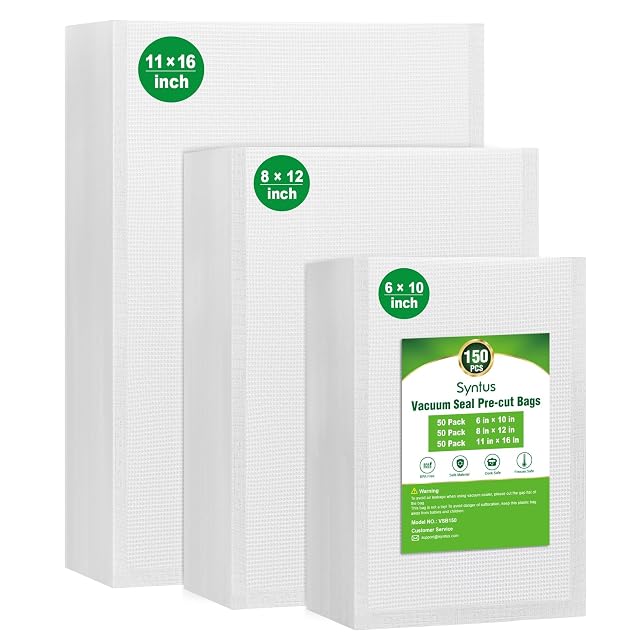
A hundred and fifty 4-mil pre-cut bags in gallon, quart and pint sizes, textured for suction, with no air valve.
Best for: Portioning in quantity on a desktop sealer, where speed beats a custom fit
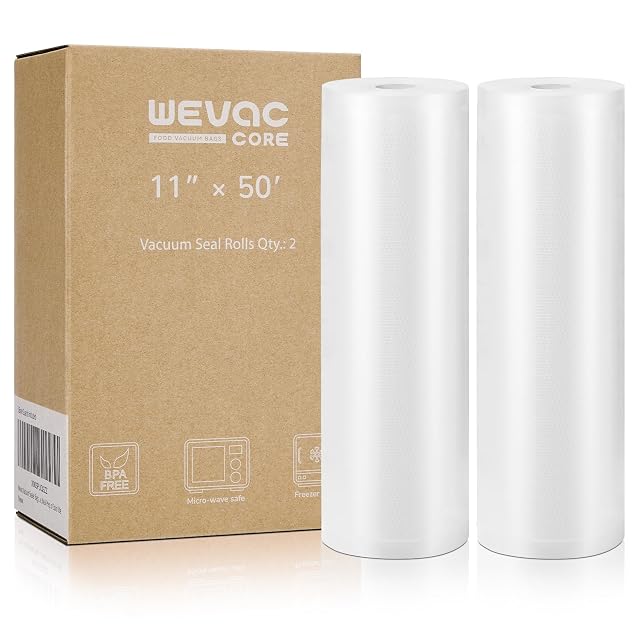
Two 11-inch by 50-foot embossed rolls with a bone guard, named compatible with six machine brands.
Best for: Large or awkward items on any suction machine, where a bone guard earns its place
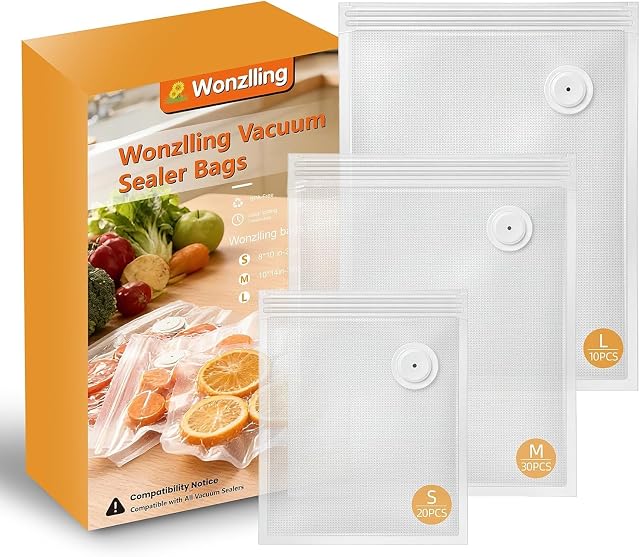
Sixty reusable zipper bags with an air valve in three sizes, for a vacuum pump rather than a heat sealer.
Best for: Meal prep with a handheld pump, where reopening a bag matters more than a permanent seal
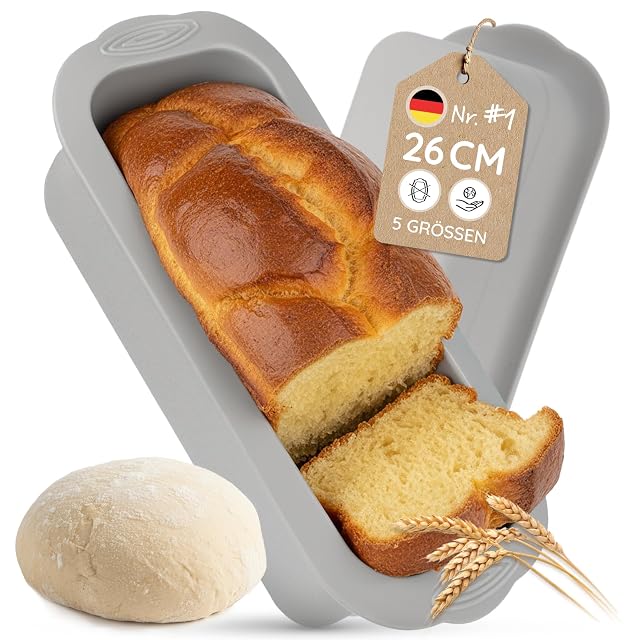
A silicone loaf pan 10.2 inches (26 cm) long holding 2.2 quarts (2.1 L), in platinum silicone certified to LFGB, the German food-contact standard, and stated PFAS- and BPA-free. Backefix publishes reinforced outer walls and grip area against bulging, and a lotus-effect interior that releases without greasing. It is not sold on Amazon.com.
Best for: Anyone who has fought a loaf out of a pan, or who avoids PFAS.
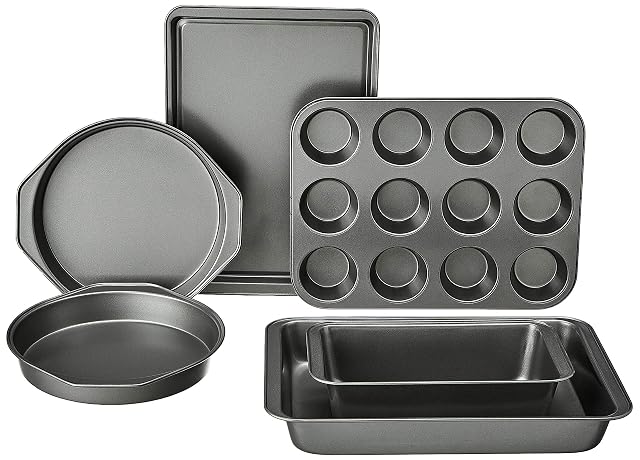
Six nonstick carbon steel pans — a 9 × 5 loaf, two 9-inch rounds, a 12-cup muffin, a 13 × 9 roast pan and a 13 × 9 sheet — oven safe to 428 °F.
Best for: Furnishing a kitchen from nothing, at the lowest price per pan here
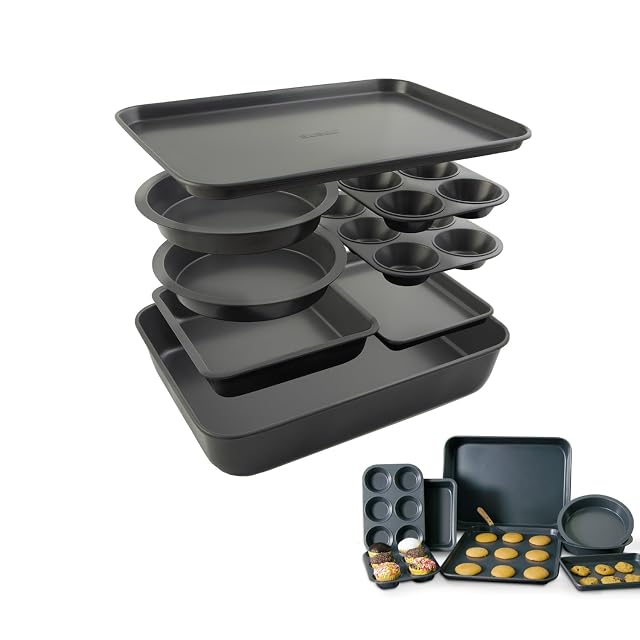
Eight nesting nonstick pans — a roaster, two oven trays, two 8-inch rounds, a square pan and muffin cups — stacking to 17.63 × 13.11 × 3.58 inches.
Best for: A small kitchen that needs eight pans and has one shelf for them