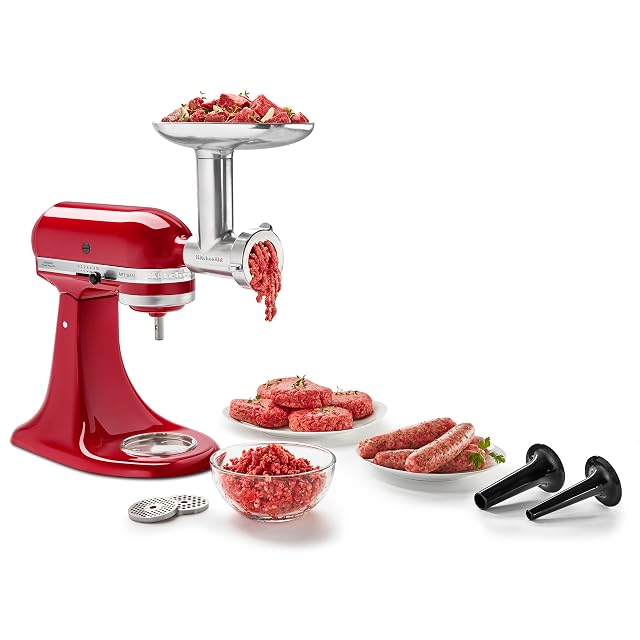
Best for: Mincing your own meat for burgers and sausage, on a mixer you already own
≈ $80
Check price on Amazon Pre-chill it — the only technique published on this shelf
A metal food grinder for any KitchenAid mixer hub, with fine, medium and coarse plates and two sausage stuffer tubes.
Best for: Mincing your own meat for burgers and sausage, on a mixer you already own
“Pre-chill the grinder in the refrigerator or freezer to maintain a cold grinding temperature for a neat and clean grind every time.”
Meat is muscle and fat, and the two behave completely differently under a blade.
Cold fat is firm and cuts. Warm fat is soft and smears — it spreads over the plate, blocks the holes, and emulsifies into the lean instead of staying in discrete pieces.
The result is paste rather than mince, and it is self-reinforcing: once the holes start blocking, the screw works harder, the friction warms everything further, and the next handful is worse.
What it looks like on a plate. A burger made from properly cut mince has visible fat and an open, loose texture that holds juice. One made from smeared mince is dense and rubbery, and renders its fat out in the pan rather than through the meat.
The bullet gives one third of the technique. The full version:
Chill the grinder — body, screw, blade and plate — in the freezer for half an hour. Chill the meat until it is firm at the edges, not frozen through. Work in small batches, so nothing sits warming on the tray while you grind.
That is the whole difference between home mince and good home mince, and it is the reason the word metal in the title matters: a metal body holds the cold through a batch in a way a plastic one cannot.
“the included fine, medium and coarse grinding plates and two sausage stuffer tubes.”
The plate is a disc of holes, and the hole size sets the texture.
Coarse keeps the meat in distinct pieces — the right choice for a burger, where an open structure holds juice, and for a rustic sausage. Medium is the general-purpose mince: bolognese, meatballs, a pie filling. Fine is for pâté, a smooth sausage, or a second pass over something already ground.
Grinding twice is a real technique and the page does not mention it. Coarse first, then fine, gives a far better fine mince than going straight to the fine plate — because one pass through a small hole does most of its work by crushing rather than cutting, which is the smearing problem again in another form.
The two tubes are two sausage calibres: a thin breakfast link and a thicker one. They are a large part of why this costs eighty dollars rather than forty, and they turn the attachment from a mincer into a sausage machine.
What the page does not publish is the hole sizes. Not one figure in millimeters — where the KSMVSA slicer at $69.95 on this same shelf publishes all three of its cuts: 3 mm, 4 mm and 6 mm. On a grinder those numbers matter just as much, because the difference between a 4.5 mm and a 10 mm plate is the difference between a sausage and a burger.
And two of the named uses are not meat at all: “grind hard cheeses or even fresh bread crumbs”. Both work well — a grinder is better than a processor on stale bread, because it cuts rather than pulverizes — and neither needs chilling.
“Connect to any household KitchenAid Stand Mixer power hub.”
The power hub is the socket on the front of the mixer head, behind a hinged cover: a standardized drive output KitchenAid has kept unchanged across the range for decades. Anything that bolts to it fits everything.
The two other hub attachments here say the same:
KSMVSA slicer, $69.95 — “Compatible with any KitchenAid Stand Mixer” KSMPRA pasta roller, $204.90 — “Fits all Household KitchenAid Stand Mixers”
And the item that does not use the hub is the one with exclusions. The KSMICM ice cream maker at $96.56 replaces the bowl, and bowls are not standardized: seven excluded models by name — Artisan Mini KSM3316 and KSM3317, bowl-lift K5SS, KSM50, KSM500, KSM450, Professional KSM90 and KG25H — with “verify your model number compatibility before ordering” said twice.
Likewise the two three-piece bowl-tool sets on this shelf, OMOVAN at $19.99 and MEET JUICE at $21.99, are tilt-head only; and the New Metro pouring chute at $24.94 hooks over the rim, so it excludes glass bowls, flared and fluted edges, and two specific KitchenAid bowls.
Hub attachments fit everything. Anything that touches the bowl does not.
One qualification worth reading: “household”. KitchenAid also makes commercial mixers, and the word excludes them — the only limit on the page.
“The larger food tray allows you to process more ingredients in one batch, cutting down on food prep time. Compared to model FGA.”
A comparative claim with its benchmark named — which on this shelf is rare, and the only other instance is the New Metro chute naming an alternative product’s ASIN.
The FGA was KitchenAid’s earlier grinder attachment, and naming it tells you two useful things: that this is a redesign rather than a new product line, and that the improvement is in batch size rather than in grinding.
Why the tray matters more than it sounds, and this connects to the first section. A bigger tray means fewer interruptions, and every interruption is time the meat spends warming at room temperature. So a larger tray is not just convenience — it supports the cold-grinding technique the page recommends four bullets later.
Its 1134 grams is the mid-point of this shelf: New Metro 7.5 oz · KSMVSA 1.3 lb · this 2.5 lb · KSMICM 6 lb · KSMPRA 7.5 lb. For a metal grinder that weight is reassuring — a screw and a body heavy enough to resist the force of a stiff grind, and heavy enough to hold a chill.
And a storage case, as on the KSMVSA: three plates, two tubes, a screw, a blade and a ring is eight loose pieces, and loose grinder plates in a drawer are a lost set within a year.
No hole sizes, as above — the central omission, and conspicuous beside the slicer’s three millimeter figures on the same shelf.
No dishwasher statement, and on a part that handles raw meat that is the omission with hygiene attached. This shelf gives four different answers to the same question, none of them predictable by product type:
KSMVSA slicer, $69.95 — “All blades are dishwasher safe on the top rack” New Metro chute, $24.94 — “dishwasher safe” KSMICM ice cream maker, $96.56 — “Once the bowl has reached room temperature, simply clean with warm, soapy water” KSMPRA pasta roller, $204.90 — “Hand Wipe only - cleaning tool included” this — nothing at all
The safe assumption on a metal grinder is hand-washing and immediate drying, because the screw and the plate are the parts a dishwasher cannot reach into and standing water in a grinder body is how it corrodes. Which is also the practical counterweight to the pre-chill advice: a grinder that has been in the freezer will sweat when it comes out, so dry it before storing.
No speed guidance, on an attachment driven by a variable-speed motor. A grinder wants a steady moderate speed; too fast and the screw outruns the plate, which is another route to smearing.
No capacity or throughput, so “larger tray” has no figure behind it.
No further plates, so the three you get are the three you have — where a standalone grinder usually has a range of plates available.
No country of manufacture and no warranty, neither of which anything on this shelf publishes. “Genuine KitchenAid” appears on the slicer and the pasta roller and not here, though the part number and the FGA comparison carry the same weight.
And the mixer is sold separately, stated in bullet one. The eighty dollars buys a grinding head and borrows a motor already on the counter.
Read on the day this page was built: $80 at the American Amazon shop.
Read from Keepa on the day this page was last revised; stock and price both move without notice.
Prices quoted in this text were read on 2026-10-17. The live price is at the top of the page.
Because warm fat smears instead of cutting, and this is the only technique published anywhere on this shelf. Bullet four: "Pre-chill the grinder in the refrigerator or freezer to maintain a cold grinding temperature for a neat and clean grind every time." Here is the mechanism. Meat is muscle and fat, and the two behave completely differently under a blade. Cold fat is firm and cuts; warm fat is soft and smears — it spreads over the plate, blocks the holes, and emulsifies into the lean instead of staying in discrete pieces. The result is paste rather than mince, and once it starts it gets worse as the friction of grinding warms everything further. What that looks like on a plate. A burger made from properly cut mince has visible fat and holds a loose, open texture; one made from smeared mince is dense and rubbery and renders its fat out in the pan. So the full technique, of which the bullet gives one third: chill the grinder — body, screw, blade and plate — in the freezer for half an hour; chill the meat until it is firm at the edges; and work in batches small enough that nothing sits warming on the tray. That is the whole difference between home mince and good home mince, and it is why a metal body matters: metal holds the cold a plastic one cannot.
Three textures and two sausage calibres, and the plates are the part that changes the food. Bullet two: "the included fine, medium and coarse grinding plates and two sausage stuffer tubes." The plate is a disc of holes, and the hole size sets the texture. Coarse keeps the meat in distinct pieces — the right choice for a burger, where you want an open structure that holds juice, and for a rustic sausage. Medium is the general-purpose mince: bolognese, meatballs, a pie filling. Fine is for pâté, a smooth sausage, or a second pass over something already ground once. Grinding twice is a real technique and the page does not mention it: coarse first, then fine, gives a far better fine mince than going straight to the fine plate, because one pass through a small hole does most of its work by crushing. The two tubes are for two sausage diameters — a thin breakfast link and a thicker one — and they are the reason this costs eighty dollars rather than forty. What the page does not publish is the hole sizes in millimeters, which is a real gap: the KSMVSA slicer at $69.95 on this shelf publishes all three of its cuts — 3 mm (0.12 in), 4 mm (0.16 in) and 6 mm (0.24 in) — and on a grinder the figures matter just as much. And bullet two names a use that is not meat at all: "grind hard cheeses or even fresh bread crumbs", which the description repeats. Both work, and neither needs chilling.
Yes, if it is a household KitchenAid — with no exclusions at all, and the reason is where it attaches. Bullet one: "Connect to any household KitchenAid Stand Mixer power hub and use the power of the motor to run the metal food grinder attachment." The power hub is the socket on the front of the mixer head, behind a hinged cover: a standardized drive output KitchenAid has kept unchanged across the range for decades. Anything that bolts to it fits everything. The other two hub attachments on this shelf say the same — the KSMVSA slicer at $69.95, "Compatible with any KitchenAid Stand Mixer", and the KSMPRA pasta roller at $204.90, "Fits all Household KitchenAid Stand Mixers". The item here that does not use the hub is the one with exclusions. The KSMICM ice cream maker at $96.56 replaces the bowl, and bowls are not standardized: it names seven excluded models — Artisan Mini KSM3316 and KSM3317, bowl-lift K5SS, KSM50, KSM500, KSM450, Professional KSM90 and KG25H — and tells you twice to verify your model first. Likewise the two three-piece bowl-tool sets here are tilt-head only, and the New Metro pouring chute at $24.94 excludes glass bowls and flared rims. Hub attachments fit everything; anything touching the bowl does not.
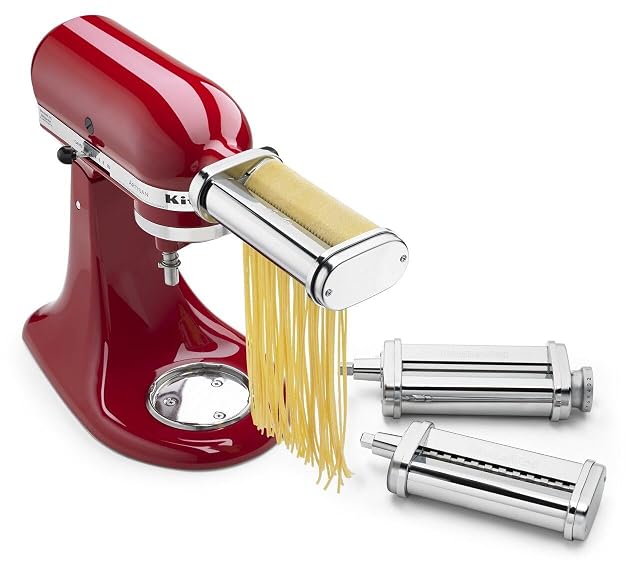
A stainless pasta roller with eight thickness settings plus spaghetti and fettuccine cutters, for any KitchenAid mixer.
Best for: Fresh pasta in quantity, where eight thicknesses and clean stainless cutting earn the price
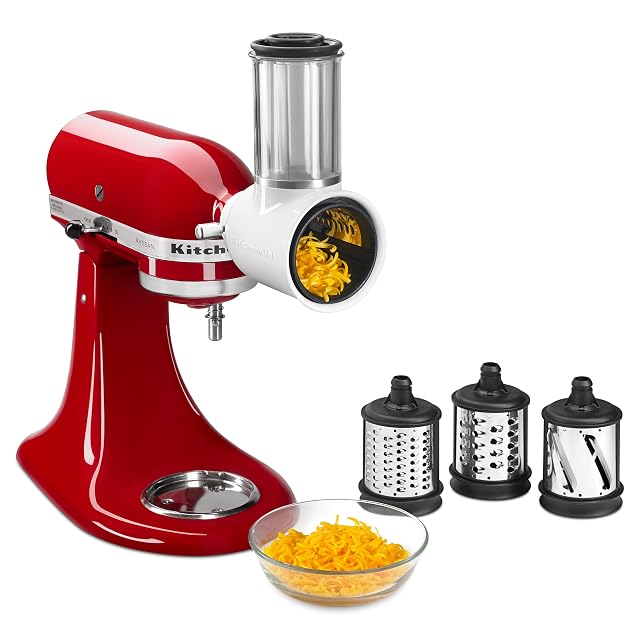
A genuine KitchenAid hub attachment with a 3 mm (0.12 in) slicing blade, 4 mm (0.16 in) and 6 mm (0.24 in) shredding blades, a food pusher and a case.
Best for: Slicing and shredding straight into the bowl, on a mixer you already own
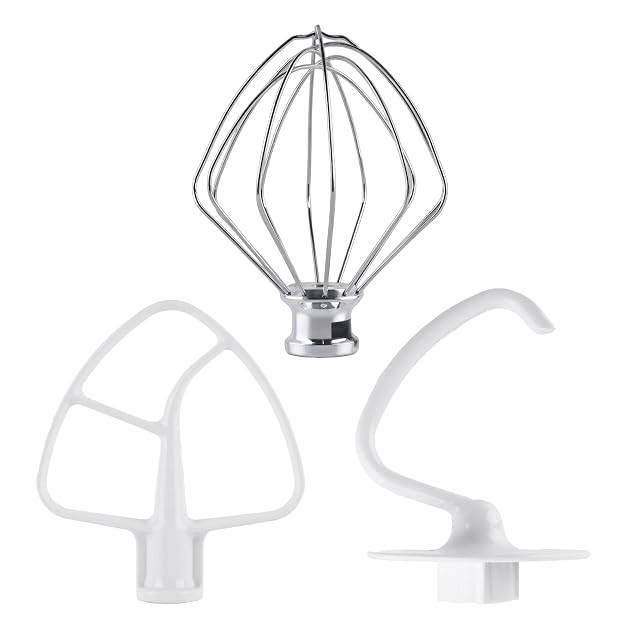
A K45WW wire whip, K45DH dough hook and K45B flat beater with a scraper edge, in stainless, aluminum and nylon.
Best for: A tilt-head KitchenAid where the bowl wall needs wiping as the beater turns
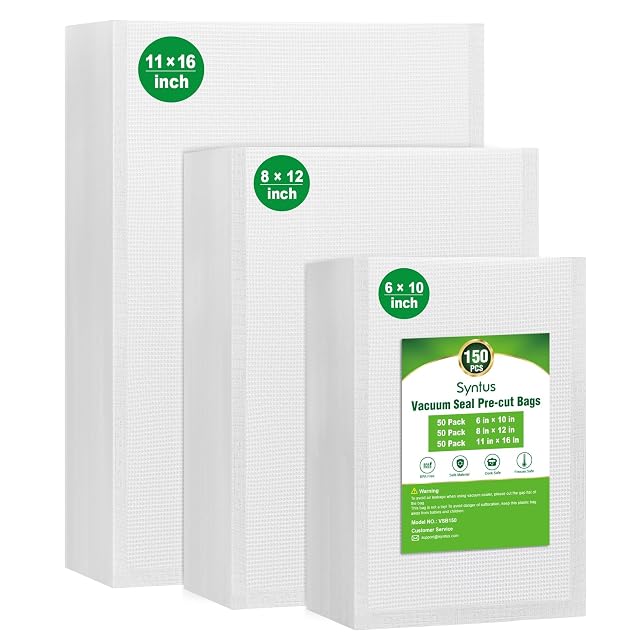
A hundred and fifty 4-mil pre-cut bags in gallon, quart and pint sizes, textured for suction, with no air valve.
Best for: Portioning in quantity on a desktop sealer, where speed beats a custom fit
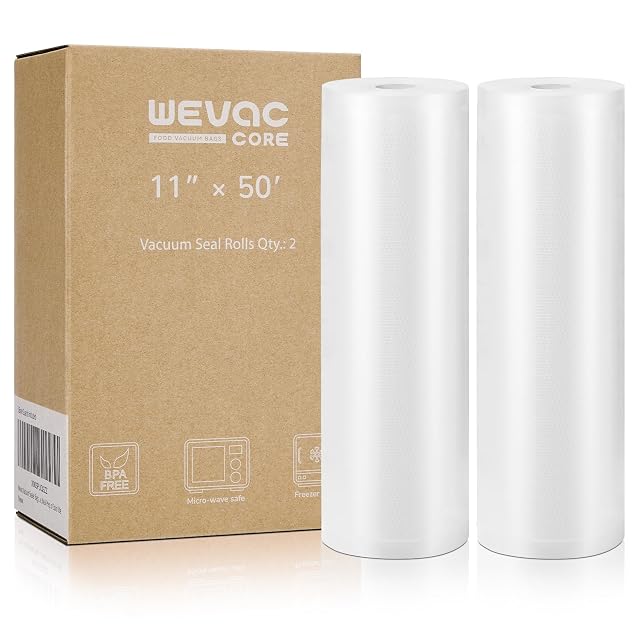
Two 11-inch by 50-foot embossed rolls with a bone guard, named compatible with six machine brands.
Best for: Large or awkward items on any suction machine, where a bone guard earns its place

Sixty reusable zipper bags with an air valve in three sizes, for a vacuum pump rather than a heat sealer.
Best for: Meal prep with a handheld pump, where reopening a bag matters more than a permanent seal