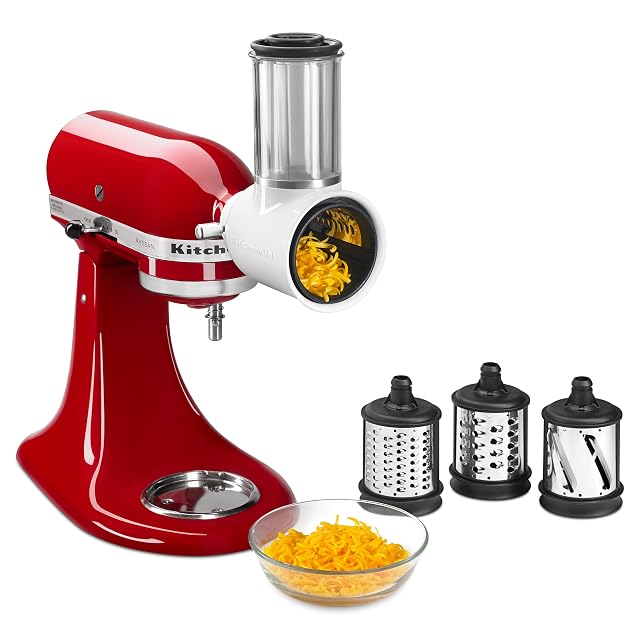
Best for: Slicing and shredding straight into the bowl, on a mixer you already own
≈ $70
Check price on Amazon Three blades with millimeters, and it fits any KitchenAid mixer
A genuine KitchenAid hub attachment with a 3 mm (0.12 in) slicing blade, 4 mm (0.16 in) and 6 mm (0.24 in) shredding blades, a food pusher and a case.
Best for: Slicing and shredding straight into the bowl, on a mixer you already own
“3mm Slicing Blade… 4mm Medium Shredding Blade… 6mm Coarse Shredding Blade.”
The only millimeter specifications anywhere on this shelf, and each comes with the job it is for.
Slicing against shredding is the distinction that matters. A slicing blade cuts across the food and gives you discs — 3 mm is the thickness of a cucumber slice for a salad or a potato for a gratin. A shredding blade cuts strips, and the millimeter figure is the width of the strip.
So 4 mm (0.16 in) is the fine shred for cheese on a pizza or carrot in a slaw, and 6 mm (0.24 in) is the coarse one for cabbage, rösti potato or anything that should keep some bite after cooking.
One millimeter is not a small difference at this scale. Four to six is a 50 per cent increase in strip width, which changes how fast something cooks and how much water a slaw gives up.
The named uses are well chosen too: cucumber, carrot, celery, courgette for the slicer; cheese and firm vegetables for the medium; cabbage and potato for the coarse. Those are the cuts a domestic kitchen actually repeats.
And three is a deliberate minimum rather than a shortfall — a 3 mm slice, a fine shred and a coarse shred cover most of it. What the page does not do is name any further blade available separately, so the three you get are the three you have.
“Compatible with any KitchenAid Stand Mixer.” And the description says how: “attach the… Attachment to the power hub of your KitchenAid Stand Mixer.”
The power hub is the socket on the front of the mixer head, behind a hinged cover — a standardized drive output KitchenAid has kept the same across the range for decades. Anything that bolts to it fits everything.
The two other hub attachments here say the same thing:
KSMMGA grinder, $79.88 — “any household KitchenAid Stand Mixer power hub” KSMPRA pasta roller, $204.90 — “Fits all Household KitchenAid Stand Mixers”
And the item that does not use the hub is the one with exclusions. The KSMICM ice cream maker at $96.56 replaces the bowl, and bowls are not standardized — hence seven named exclusions: Artisan Mini KSM3316 and KSM3317; bowl-lift K5SS, KSM50, KSM500, KSM450; Professional KSM90 and KG25H. Its page says “verify your model number compatibility before ordering” twice.
The same logic covers the rest of the shelf. The two three-piece bowl-tool sets — OMOVAN at $19.99 and MEET JUICE at $21.99 — are tilt-head only, because the shaft and bowl differ from a bowl-lift. And the New Metro pouring chute at $24.94 hooks over the rim, so it excludes glass bowls, flared and fluted edges, and two specific KitchenAid bowls.
Hub attachments fit everything. Anything that touches the bowl does not. That one sentence is the buying rule for this shelf.
“Slice or shred into any size bowl for just the amount you need.”
That is the one thing this does that a food processor does not, and it is worth being precise about.
A food processor cuts into its own bowl. To grate an ounce of parmesan you assemble a bowl, a lid, a disc and a pusher, grate for four seconds, then wash four parts.
This discharges into the open. Grate straight over a plate, a pan or a mixing bowl, stop when you have enough.
And it uses the appliance already on the counter — which for anyone who bakes is the one that never gets put away. “Transform your stand mixer into a versatile kitchen appliance” is the pitch, and the honest version of it is that the motor and the footprint are already paid for.
Where the food processor wins is throughput. It has a motor sized for cutting rather than for mixing, a wider feed tube on most models, and no mixer head in the way. The cookverdict food-processor shelf carries nine of them, from a 3-cup Cuisinart to a 12-cup Hamilton Beach.
So the test is quantity. Small amounts, often, with nothing to assemble: this earns its seventy dollars. Prep in volume: the processor wins.
Against the rest of this shelf it is also the least necessary of the three hub attachments, and the cheapest, by about ten dollars, for that reason. The KSMMGA grinder minces meat, which no food processor does properly — a processor bruises and smears where a grinder cuts. The KSMPRA pasta roller rolls sheets to eight stated thicknesses, which nothing else in a kitchen does. This one duplicates a machine many kitchens already have.
“2-in-1 Food Pusher for both large and small diameter fruits and vegetables - from cucumbers to celery.”
Two bores in one part, and it matters more than it reads.
A pusher is a safety device before it is a convenience. The whole point is that your fingers never approach a blade turning at mixer speed. And a pusher sized for a cucumber is useless on a stick of celery, because the celery wanders in the tube and comes out in wedges rather than slices.
So “2-in-1” means the tube has a large opening with a small insert — wide for a potato, narrow for celery, a carrot or a spring onion. Which is the same arrangement a good food processor uses, and the reason the cut quality holds on thin produce.
The storage case is the other small inclusion that matters. “The attachment and included accessories pack organize inside a convenient storage case.”
Three blades and a two-part pusher is five loose pieces, and loose blades in a drawer are both dangerous and lost. Two items on this shelf ship a case: this and the KSMMGA grinder, which is “packed and organized inside its own storage case”. The KSMPRA pasta roller ships a cleaning brush instead, for a reason explained below.
“All blades are dishwasher safe on the top rack for easy clean up.”
“On the top rack” is the qualification that matters, and it is not boilerplate. The bottom rack of a dishwasher sits closest to the heating element, and sustained heat is what distorts thin steel and softens plastic carriers.
And this shelf gives four different answers to the same question, which is worth laying out because none of them is predictable from the product type:
this — all blades, top rack New Metro pouring chute, $24.94 — “dishwasher safe”, unqualified KSMICM ice cream maker, $96.56 — “Once the bowl has reached room temperature, simply clean with warm, soapy water”. The freezer bowl must warm up first KSMPRA pasta roller, $204.90 — “Hand Wipe only - cleaning tool included”. The most expensive item on the shelf must never be washed: water in the rollers rusts them, and wet dough is far worse than dry KSMMGA grinder, $79.88 — nothing on washing, but “Pre-chill the grinder in the refrigerator or freezer” OMOVAN and MEET JUICE — “easy to clean”, no detail
So read the cleaning line before buying any of them. On a slicer, dishwasher-safe blades are most of the reason to use it at all — the alternative is washing a sharp disc by hand.
No speed guidance. This runs off a variable-speed motor, and nothing on the page says which speed to use. On a slicer that is a real omission: too fast and soft produce tears rather than cutting; too slow and hard produce jams. The KSMMGA grinder at least publishes a technique — “pre-chill the grinder” — and the KSMPRA publishes eight thickness settings.
No further blades. Three are included and none is named as available separately, so there is no finer slice, no julienne and no crinkle cut. A food processor’s disc range is open-ended.
No capacity or throughput, which is the figure that would settle the food-processor comparison.
No feed tube dimensions, where the “2-in-1” pusher implies two and gives neither.
No country of manufacture, which nothing on this shelf publishes.
No warranty, which nothing on this shelf publishes either — and “Genuine KitchenAid… designed and engineered by the manufacturers” is a provenance claim rather than a term.
And the mixer is sold separately, stated twice. Worth remembering that the seventy dollars buys a cutting head and borrows a motor you have already paid for.
Read on the day this page was built: $69.95 at the American Amazon shop.
Read from Keepa on the day this page was last revised; stock and price both move without notice.
Prices quoted in this text were read on 2026-10-17. The live price is at the top of the page.
Because of where each one attaches, and the difference explains the whole shelf. This one says "Compatible with any KitchenAid Stand Mixer", and the description says how: "Simply attach the... Attachment to the power hub of your KitchenAid Stand Mixer." The power hub is the socket on the front of the mixer head, behind a hinged cover — a standardized drive output that KitchenAid has kept the same across the range for decades. So anything that bolts to it fits everything. The two other hub attachments here say the same: the KSMMGA grinder at $79.88, "any household KitchenAid Stand Mixer power hub", and the KSMPRA pasta roller at $204.90, "Fits all Household KitchenAid Stand Mixers". The KSMICM ice cream maker at $96.56 does not use the hub — it replaces the bowl, and bowls are not standardized. Hence its seven named exclusions: Artisan Mini KSM3316 and KSM3317; bowl-lift K5SS, KSM50, KSM500, KSM450; Professional KSM90 and KG25H — and "verify your model number compatibility before ordering", said twice. The same logic covers the rest of the shelf. The two three-piece bowl-tool sets are tilt-head only, because the shaft and bowl differ from a bowl-lift. And the New Metro pouring chute at $24.94 hooks over the rim, so it excludes glass bowls, flared edges and two specific KitchenAid bowls. Hub attachments fit everything; anything touching the bowl does not.
Three distinct cuts, and this is the only listing on the shelf to publish any dimension in millimeters at all. Bullet three names each with its job: "3mm (0.12 in) Slicing Blade great for cucumbers, carrots, celery and zucchini; 4mm (0.16 in) Medium Shredding Blade great for cheeses and firm vegetables, such as carrots, to a finer consistency; 6mm (0.24 in) Coarse Shredding Blade great for shredding cabbages, potatoes and more." The distinction that matters is slicing against shredding. A slicing blade cuts across the food and gives you discs — 3 mm (0.12 in) is the thickness of a cucumber slice for a salad or a potato for a gratin. A shredding blade cuts strips, and the millimeter figure is the width of the strip. So 4 mm (0.16 in) is the fine shred you want for cheese on a pizza or carrot in a slaw, and 6 mm (0.24 in) is the coarse one for cabbage, rösti potato or anything that should keep some bite after cooking. One millimeter is not a small difference at this scale. Four to six is a 50 per cent increase in strip width, which changes how fast something cooks and how much water a slaw gives up. And three blades is a deliberate minimum rather than a limitation: a 3 mm (0.12 in) slice, a fine shred and a coarse shred cover most of what a domestic kitchen cuts. What the page does not name is any further blade available separately, so the three you get are the three you have.
Probably not, and the honest answer depends on whether your processor is out on the counter. What a food processor does better: it has a motor sized for the job, a wider feed tube on most models, and a bowl that catches what it cuts. What this does better, and the page names both. "Slice or shred into any size bowl for just the amount you need" — it discharges into the open, so you can grate an ounce of parmesan straight over a plate without assembling and then washing a processor bowl and lid. And it uses the mixer already on the counter, which for anyone who bakes is the appliance that never gets put away. Against the rest of this shelf, the comparison is clearer. The KSMMGA grinder at $79.88 and the KSMPRA pasta roller at $204.90 do things a food processor cannot do at all — mince meat properly, and roll pasta to eight stated thicknesses. This one duplicates a machine many kitchens already have, which is why it is the cheapest of the three hub attachments here, by about ten dollars. The practical test: if you grate cheese and slice cucumber in small quantities and resent washing a processor for it, this earns its seventy dollars. If you prep in volume, the processor wins on throughput — and the cookverdict food-processor shelf has nine of them.
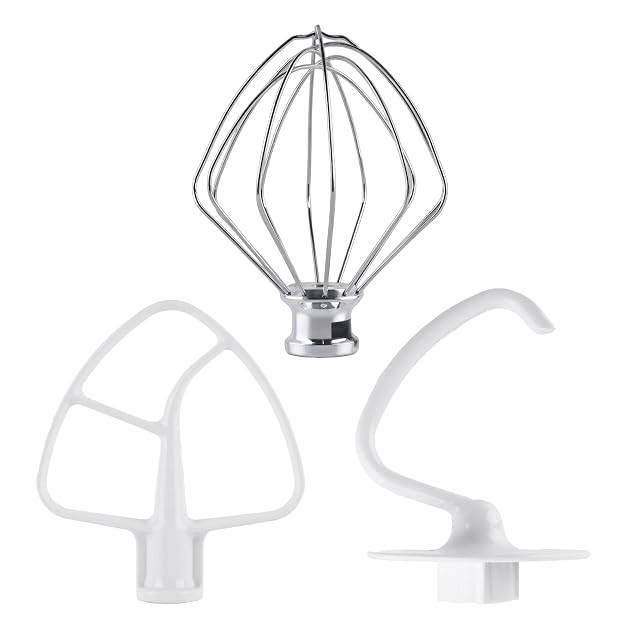
A K45WW wire whip, K45DH dough hook and K45B flat beater with a scraper edge, in stainless, aluminum and nylon.
Best for: A tilt-head KitchenAid where the bowl wall needs wiping as the beater turns
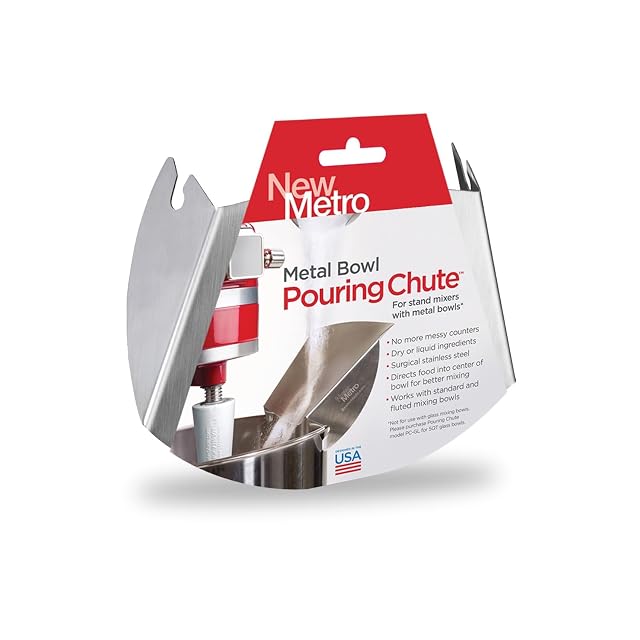
A polished steel pouring chute for metal stand mixer bowls, fitting KitchenAid, Cuisinart, Kenwood and SMEG.
Best for: Loading flour and sugar into a metal bowl without half of it reaching the counter
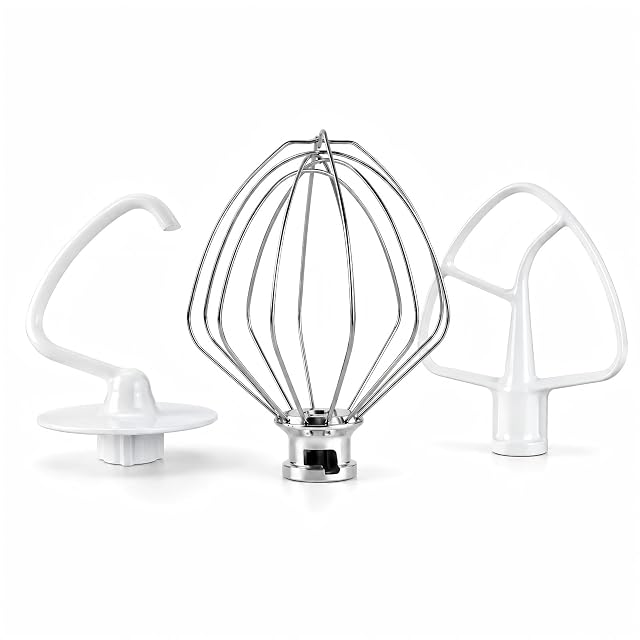
A K45WW wire whip, K45DH dough hook and K45B coated flat beater for KitchenAid tilt-head mixers of 4.5 to 5 quarts.
Best for: A tilt-head KitchenAid of 4.5 or 5 quarts whose original tools have worn or gone missing

Sixty reusable zipper bags with an air valve in three sizes, for a vacuum pump rather than a heat sealer.
Best for: Meal prep with a handheld pump, where reopening a bag matters more than a permanent seal
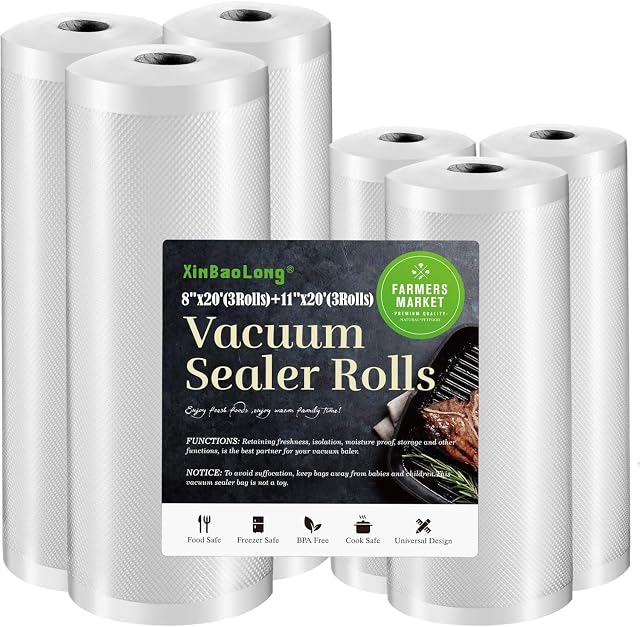
Six heat-seal rolls — three 8 inch and three 11 inch, each 20 feet — cut to length, BPA free, boil and microwave safe.
Best for: Bulk sealing at the lowest cost per bag, on any suction machine
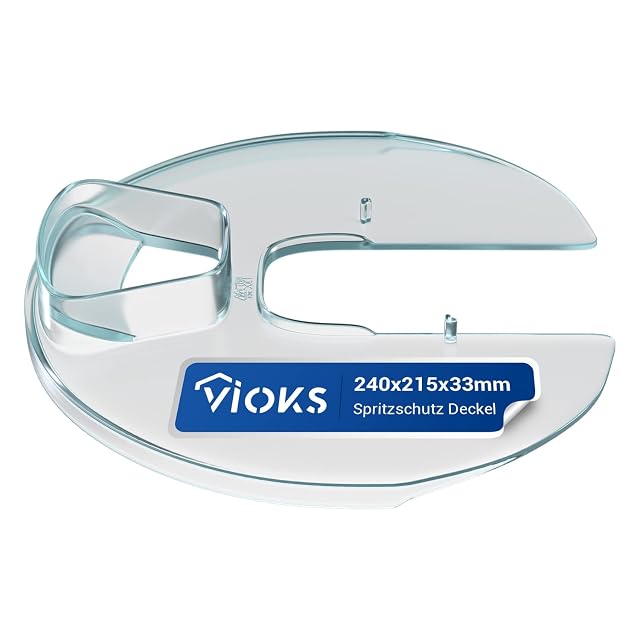
A replacement splash guard equivalent to Bosch/Siemens part 00482103, for the MUM4 range and the Profimixx 44, 46 and 47. VIOKS publishes the dimensions — 9.4 by 8.5 by 1.3 inches — and eleven model numbers. Sold on the European Amazon stores, not on Amazon.com.
Best for: An owner of a Bosch MUM4 or Profimixx whose mixer works fine and whose splash guard vanished.