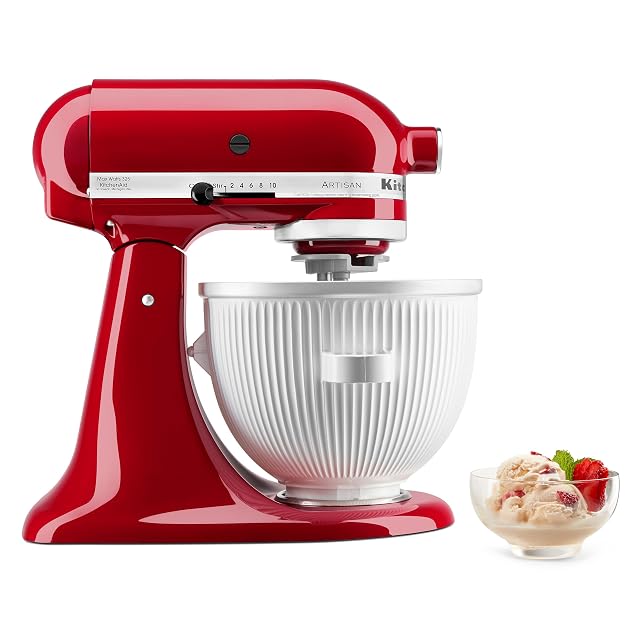
Best for: A compatible KitchenAid and a freezer with room for the bowl to live in
≈ $97
Check price on Amazon Seven mixers excluded by name, because it replaces the bowl
A two-quart freezer bowl, dasher and hub assembly that churns ice cream, gelato or sorbet in under thirty minutes.
Best for: A compatible KitchenAid and a freezer with room for the bowl to live in
“in less than 30 minutes* *Excluding prep time.”
The prep time is freezing the bowl, and the page never gives a figure for it.
A freezer-bowl ice cream maker works by stored cold. The bowl has a sealed coolant in its double wall, and it has to be brought right down to freezer temperature before anything goes in. There is no compressor and no refrigeration: the thirty minutes of churning is spent spending the cold the bowl already has.
Which has three consequences the page leaves out.
The bowl lives in the freezer. A bowl that has been in for two hours produces soup. Chilled right through takes many hours, which is why these bowls are stored frozen rather than in a cupboard.
And at 6 pounds it is a real amount of freezer space, committed permanently to an attachment you may use monthly. That is the second heaviest item on this shelf — New Metro 7.5 oz · KSMVSA 1.3 lb · KSMMGA 2.5 lb · this 6 lb · KSMPRA 7.5 lb — and almost all of the weight is coolant.
You cannot do two batches back to back. The bowl comes out of a churn warm, and it has to be refrozen from scratch. So two quarts in one go is the real capacity, not a rate.
The honest reading of the claim: thirty minutes of churning, on a bowl you froze yesterday.
Which is not a criticism of the attachment so much as of the asterisk. Thirty minutes of churning is fast, and the alternative — a standalone compressor machine — costs several times this and takes up counter space permanently.
Tilt-head: fits most, except Artisan Mini KSM3316 and KSM3317. Bowl-lift: fits most, except K5SS, KSM50, KSM500 and KSM450 at 5, 5.5 and 6 quarts. Professional line: not compatible with KSM90 and KG25H.
Seven models, three families — and the page says “Please verify your model number compatibility before ordering” twice, in bullets two and three.
The reason is where it attaches. The description: “attach the bowl to the base of your household KitchenAid Stand Mixer.”
This is the only attachment on this shelf that replaces the bowl. Bowl diameter, bowl height and base geometry all vary across the range, so a bowl-shaped accessory cannot fit everything.
Compare the three hub attachments here, which fit everything:
KSMVSA slicer, $69.95 — “Compatible with any KitchenAid Stand Mixer” KSMMGA grinder, $79.88 — “any household KitchenAid Stand Mixer power hub” KSMPRA pasta roller, $204.90 — “Fits all Household KitchenAid Stand Mixers”
The power hub is a standardized drive socket on the front of the mixer head, unchanged across the range for decades. Anything that bolts to it fits anything.
And the same division explains the rest of the shelf. The two three-piece bowl-tool sets — OMOVAN at $19.99, MEET JUICE at $21.99 — are tilt-head only, because the shaft and bowl differ. The New Metro pouring chute at $24.94 hooks over the rim, so it excludes glass bowls, flared and fluted edges and two specific KitchenAid bowls.
Hub attachments fit everything. Anything that touches the bowl does not. That is the buying rule for this shelf, and this listing is the clearest illustration of it — to its credit, since it names every exception rather than saying “most” and leaving you to find out.
“Redesigned dasher for thorough ingredient incorporation rotates inside the bowl to spread, scrape and mix for even freezing.”
All the cold in this machine is in the bowl wall, so that is where the mixture freezes first — in a thin layer against the metal. If nothing removes it, that layer insulates the rest, and you get a frozen shell around liquid custard.
The dasher shaves it off continuously and folds it back into the middle, so the whole volume comes down together. That is the “spread, scrape and mix” of the bullet, and the three verbs are doing real work.
And there is a second effect that matters more for texture than for temperature. Agitation keeps ice crystals small.
Ice cream is a foam of fat, water, sugar and air, and what makes it smooth rather than gritty is that no crystal grows large enough to feel on the tongue. Constant scraping and folding prevents growth. Which is why the same mixture frozen still in a tub comes out hard and coarse, and why churning is not simply freezing with extra steps.
It also explains the three named products. “Ice creams, gelatos or sorbets” are three different ratios of fat, sugar and water, and all three depend on the same mechanism: gelato has less air and more density, sorbet has no fat at all and relies almost entirely on crystal size for its texture. A dasher that scrapes well is what makes a sorbet smooth.
The hub assembly and the handles are the other half of the redesign: “Redesigned assembly and new handles easily connect to your KitchenAid Stand Mixer to quickly start churning.” Which matters on a part you are fitting to a mixer while holding a frozen bowl — a job done quickly or not at all, because every second the bowl is out of the freezer is cold spent.
“Once the bowl has reached room temperature, simply clean with warm, soapy water.”
That instruction is about the bowl rather than about hygiene, and it is worth taking seriously. A sealed double-walled vessel at freezer temperature, filled with warm water, is a thermal shock across a joint that has to stay sealed for the life of the product. If the coolant chamber fails the bowl is finished — there is no serviceable part.
So: let it warm, then wash. Not the other way round.
And this shelf gives four different answers to the same question, none of them predictable from the product type:
KSMVSA slicer, $69.95 — “All blades are dishwasher safe on the top rack” New Metro chute, $24.94 — “dishwasher safe” this — warm soapy water, after it reaches room temperature KSMPRA pasta roller, $204.90 — “Hand Wipe only - cleaning tool included” KSMMGA grinder, $79.88 — nothing on washing at all OMOVAN and MEET JUICE — “easy to clean”, no detail
Read the cleaning line before buying any of them.
One practical consequence the page does not draw: warming up, washing and drying a bowl takes an hour or two, and refreezing takes many more. So the real cycle time for a second batch is most of a day — which is the figure that would have been more useful than “under 30 minutes”.
No freezing time, as above — the central omission, and the one the asterisk points at without filling in.
No freezer temperature required, which follows from it. A domestic freezer runs anywhere from about 5 °F down to −13 °F (−15 to −25 °C), and a bowl in a warm freezer will not churn.
No second bowl offered. On an attachment whose cycle time is governed entirely by refreezing, a spare bowl is the obvious accessory and the page does not mention one. Compare the KSMVSA and the KSMMGA, which both ship storage cases for their loose parts, and the New Metro chute, which names an alternative product with its ASIN.
No speed guidance, on an attachment driven by a variable-speed motor. A dasher turning too slowly leaves the frozen layer on the wall; one turning too fast warms the mixture by friction. It is the one setting a reader would want, inside a thirty-minute window.
No yield in volume after churning. Two quarts is the bowl; ice cream gains volume as air is folded in, so the usable fill is less than the bowl’s capacity, and the page does not say how much less.
No recipe or ratio guidance, where the result depends on the mixture at least as much as on the machine.
No “Genuine KitchenAid” claim, which the KSMVSA and the KSMPRA both carry — though the KSMICM part number and the model-by-model exclusion list carry the same weight.
No country of manufacture, which nothing on this shelf publishes. The warranty is not in the bullets either — it appears only in the product details, as one year.
And the mixer is sold separately, stated three times across bullets two, three and five.
Read on the day this page was built: $96.56 at the American Amazon shop.
Read from Keepa on the day this page was last revised; stock and price both move without notice.
Prices quoted in this text were read on 2026-10-17. The live price is at the top of the page.
The part that takes the longest. Bullet four: "Our 2 quart bowl lets you make your favorite ice creams, gelatos or sorbets in less than 30 minutes* *Excluding prep time." The prep time is freezing the bowl, and it is the one figure the page never gives. A freezer-bowl ice cream maker works by stored cold: the bowl has a sealed coolant in its double wall, and it has to be brought down to freezer temperature before anything goes in it. There is no compressor and no refrigeration — the thirty minutes of churning is spent spending the cold the bowl already has. What that means in practice. A bowl at freezer temperature right through takes many hours, which is why these bowls live in the freezer rather than in the cupboard, and why a bowl that has been in for two hours produces soup. The page says nothing about how long, nor at what temperature, nor whether the bowl may be refrozen immediately for a second batch — and the answer to the last one is no, which is why two quarts in one go is the real capacity rather than a rate. The honest reading of the claim: thirty minutes of churning, on a bowl you froze yesterday. And one consequence for storage, which the page also omits: the bowl is 6 pounds (2.72 kg) and it has to live in the freezer. That is a real amount of freezer space committed permanently to an attachment you may use monthly.
Because it is the only attachment on this shelf that replaces the bowl, and bowls are not standardized. The three KitchenAid hub attachments here fit everything: the KSMVSA slicer at $69.95 says "any KitchenAid Stand Mixer", the KSMMGA grinder at $79.88 "any household... power hub", the KSMPRA pasta roller at $204.90 "Fits all Household KitchenAid Stand Mixers". The power hub is a standardized drive socket on the front of the mixer head, unchanged across the range for decades — so anything bolting to it fits anything. This one does not use it. The description: "attach the bowl to the base of your household KitchenAid Stand Mixer." It is a bowl plus a hub assembly, and bowl diameter, bowl height and base geometry all vary across the range. Hence the list: tilt-head except Artisan Mini KSM3316 and KSM3317; bowl-lift except K5SS, KSM50, KSM500 and KSM450 at 5, 5.5 and 6 quarts; and not compatible with Professional KSM90 and KG25H. Seven models, three families — and the page says "Please verify your model number compatibility before ordering" twice, in bullets two and three. The same logic covers the rest of the shelf: the two three-piece bowl-tool sets are tilt-head only, and the New Metro pouring chute at $24.94 excludes glass bowls and flared rims. Hub attachments fit everything; anything touching the bowl does not.
It scrapes the frozen layer off the wall, and that is the whole mechanism of churning. Bullet six: "Redesigned dasher for thorough ingredient incorporation rotates inside the bowl to spread, scrape and mix for even freezing." Here is why scraping is the point. All the cold in this machine is in the bowl wall, so that is where the mixture freezes first — in a thin layer against the metal. If nothing removes it, that layer insulates the rest, and you get a frozen shell around liquid custard. The dasher’s job is to shave that layer off continuously and fold it back into the middle, so the whole volume comes down together. And there is a second effect that matters more for texture than for temperature. Agitation keeps ice crystals small. Ice cream is a foam of fat, water, sugar and air, and what makes it smooth rather than gritty is that no crystal grows large enough to feel. Constant scraping and folding prevents that — which is why churning is not simply freezing with extra steps, and why the same mixture frozen still in a tub comes out hard and coarse. What the page does not say is which speed to use. This is driven by a variable-speed motor, and a dasher turning too slowly leaves the layer on the wall while one turning too fast warms the mixture by friction — the one setting a reader would want, on an attachment with a thirty-minute window.
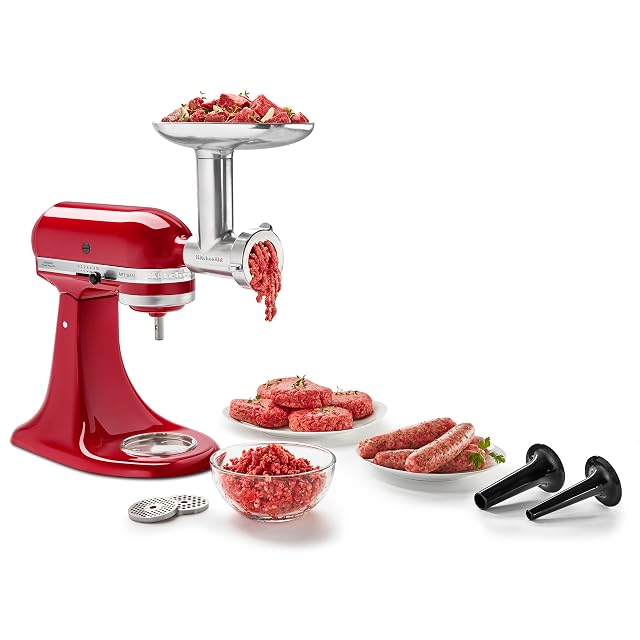
A metal food grinder for any KitchenAid mixer hub, with fine, medium and coarse plates and two sausage stuffer tubes.
Best for: Mincing your own meat for burgers and sausage, on a mixer you already own
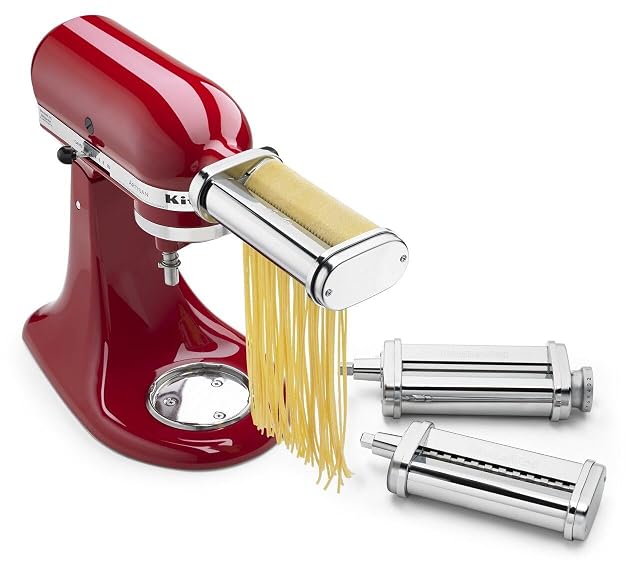
A stainless pasta roller with eight thickness settings plus spaghetti and fettuccine cutters, for any KitchenAid mixer.
Best for: Fresh pasta in quantity, where eight thicknesses and clean stainless cutting earn the price
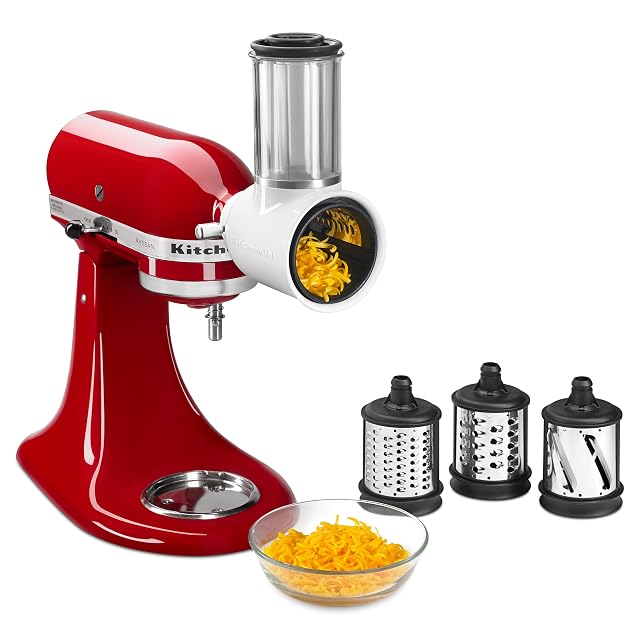
A genuine KitchenAid hub attachment with a 3 mm (0.12 in) slicing blade, 4 mm (0.16 in) and 6 mm (0.24 in) shredding blades, a food pusher and a case.
Best for: Slicing and shredding straight into the bowl, on a mixer you already own
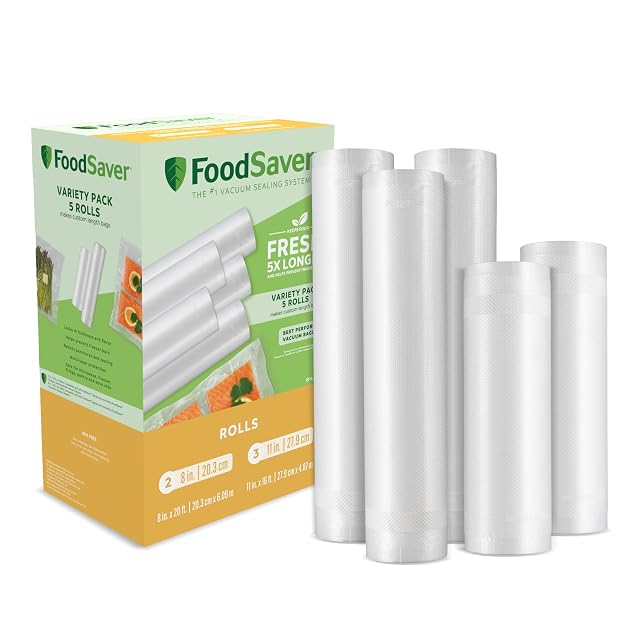
Five heat-seal rolls, two 8 inch and three 11 inch, made in the USA for FoodSaver systems, cut to length.
Best for: A FoodSaver machine, where certainty and a heavier film are worth the premium
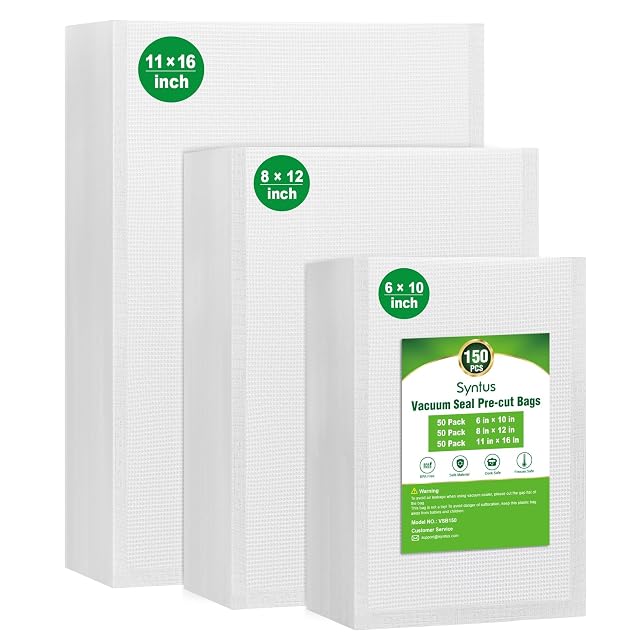
A hundred and fifty 4-mil pre-cut bags in gallon, quart and pint sizes, textured for suction, with no air valve.
Best for: Portioning in quantity on a desktop sealer, where speed beats a custom fit
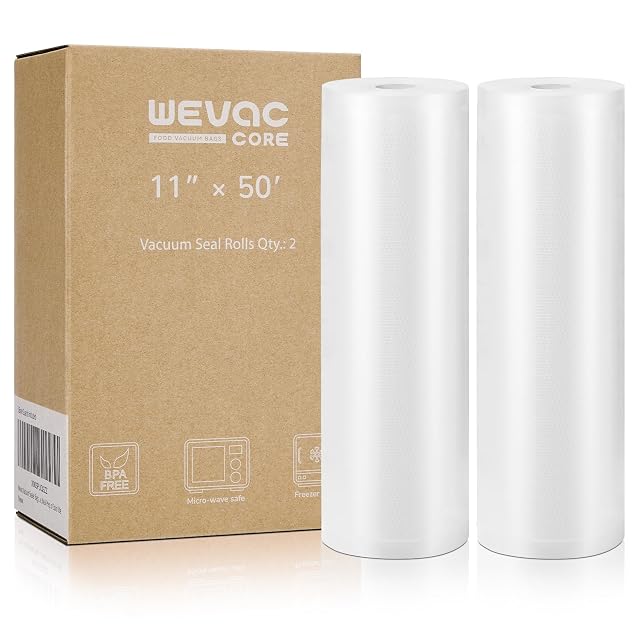
Two 11-inch by 50-foot embossed rolls with a bone guard, named compatible with six machine brands.
Best for: Large or awkward items on any suction machine, where a bone guard earns its place