Bowl liters tell you how much air a bowl holds. Dough weight tells you what a mixer will turn without stalling, and it is published by one maker on this entire site.
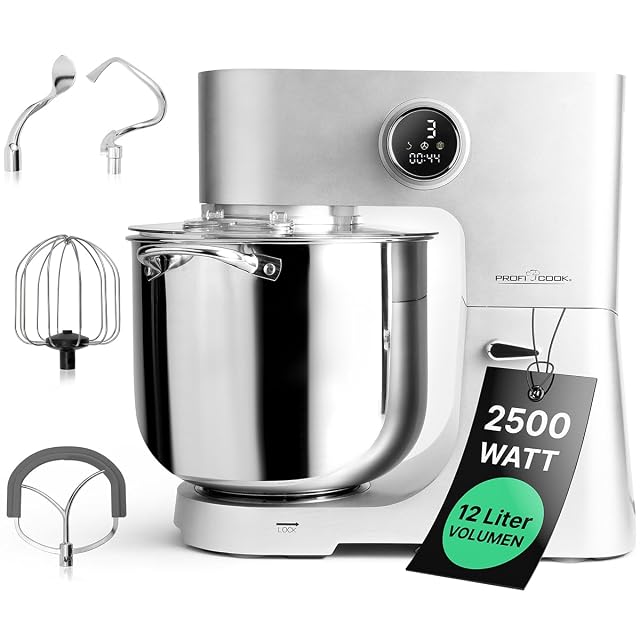
The ProfiCook PC-KM 1254 publishes 8.5 kg (18.7 lb) of dough in a 12-liter
bowl, a 2,500 W motor, and — the specification nobody else gives — a metal
gearbox in a die-cast aluminum housing.
Its own listing cannot agree on whether it has twelve or thirteen speeds. Both
figures are on our review page with their sources.
Named for the job
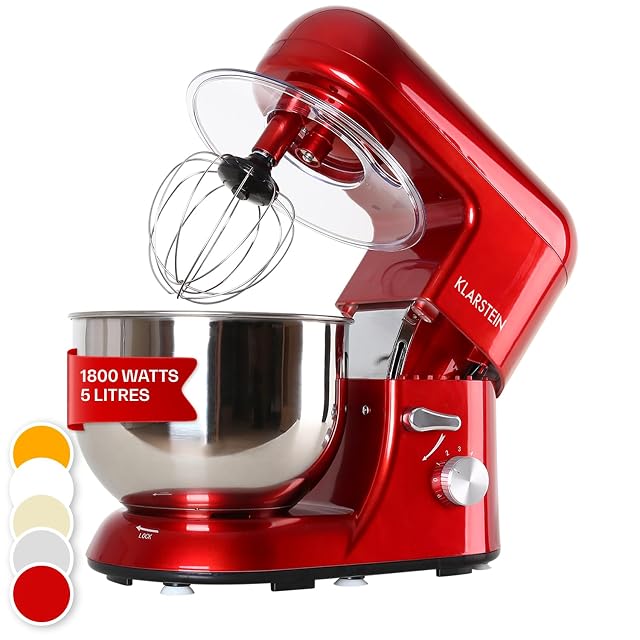
The Klarstein Knetmaschine explicitly states heavy doughs — yeast and bread
— which two of its rivals do not. Planetary action, six speeds, a 5-liter bowl.
Its power appears twice in its own listing and differently: 2,000 W in the
title, 1,800 W in the text. Either figure clears the Kenwood.
When the hub matters more than the motor
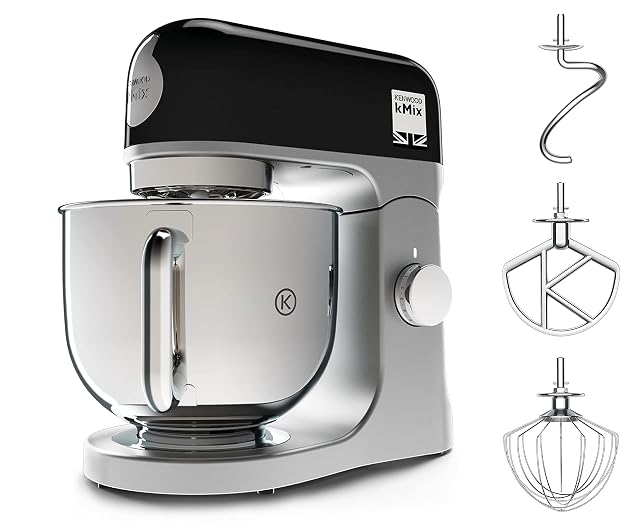
The Kenwood kMix publishes the lowest power here at 1,000 W and the widest
future: over twenty attachments, all stated dishwasher-safe, on a metal
body. It is also the only stand mixer here with stepless speed and a pulse.
Buy this one if the mixer has to keep acquiring jobs for a decade.
What we would not do
Compare these four on wattage. Between 1,000 W with a metal body and 2,000 W
with unstated gearing, the second is the riskier purchase.
Which appliance earns its place?
You make bread every week
This is the machine built for it, and the criterion is sustained torque, not peak wattage.
You make firm, low-hydration dough
Weight and a planetary action matter: a light machine walks across the countertop.
You bake occasionally
A hand mixer with hooks costs far less and stores in a drawer.
You want one machine for everything
Check which attachments exist and what they cost: that is where the format's value really sits.
Picking by what you make
Bread dough
The demanding use, and the one that separates machines. Long kneading under load is what a stand mixer is for.
Cakes and creaming
Effortless and hands-free, and the use that gets the machine out between bakes.
Whisking
Well done by the balloon whisk, though a hand mixer does it just as well for less.
Attachments
Mincers, pasta rollers and slicers turn the motor into a kitchen base. Whether that matters depends entirely on what you will actually use.
The handful of figures that count
Weight and stability
Firm dough pushes back. A machine that walks across the countertop is one that is too light for what you are asking of it.
Sustained torque rather than peak power
Kneading is a long, constant load. Quoted wattage says what the motor draws, not what it can hold for ten minutes.
Bowl capacity against your usual batch
A bowl too large kneads a small dough badly, because the hook never engages it. Both directions are a problem.
Bowl-lift or tilt-head
Lift models are generally steadier under heavy dough; tilt-head models are easier to load and to scrape. It is a genuine trade-off.
Gearing and the sound under load
Metal gearing survives repeated dough sessions better than plastic. The change in sound under load is what tells you the machine is working, not straining.
Which figure for which kitchen
What you knead
What matters
The warning sign
Firm bread dough
Weight and torque
The machine walks
Enriched dough
Bowl shape
Dough climbing the hook
Small batches
A bowl not too large
The hook spins free
Long sessions
Gearing and cooling
A hot motor housing
The common slips
Buying on wattage
A high figure says the motor can draw a lot, not that it can hold a load. For dough, sustained torque and gearing decide the outcome.
Kneading too small a batch in a large bowl
The hook turns above the dough and nothing happens. Bowl size has to match the batches you actually make.
Running at high speed for dough
Kneading happens at low speed. High speed strains the gearing and throws dough up the hook without developing it.
Ignoring the machine walking
A mixer creeping across the countertop under load is telling you the dough is at or beyond its limit. Leaving it unattended there is how it reaches the floor.
By the household you cook for
The weekly baker
A heavy machine with metal gearing and a bowl matched to your loaf. The format at its most justified.
The cake baker
Almost any stand mixer will do, and the choice comes down to bowl and attachments.
The occasional baker
A hand mixer with hooks: it costs far less, stores away, and the difference only shows on firm dough.
Cleaning, parts and working life
A stand mixer is a long-lived machine whose weak points are the gearing and the hub seal. Flour dust works into the attachment hub, and dough dries in the hook and bowl if they are left; neither is dramatic, and both shorten the machine's life.
Wash the hook and bowl straight away: dried dough is far harder to remove.
Keep the attachment hub clean and free of flour.
Wipe under the head where dough climbs, not just the bowl.
Do not run beyond the maker's stated kneading time in one go.
Safety
A powerful motor with an open bowl and a heavy head.
Never put a hand or a spatula into a turning bowl.
Lower a tilt-head with control: it is heavy and springs down.
Stop the machine before changing attachments, not just slow it.
Keep the appliance away from the countertop edge when kneading firm dough.
The only stand mixer here that publishes what it will actually turn: up to 8.5 kg (18.7 lb) of dough in a 12-liter bowl, behind a 2,500 W motor, a die-cast aluminum housing and a metal gearbox. An LED display shows speed and time. Its speed count is published twice and differently — thirteen in the title, twelve in the text.
Best for: Bread in real quantities, from someone who wants the dough figure before buying.
A 5-liter planetary mixer that Klarstein states moves the tool in eight directions, with six speeds and a dough hook and whisk supplied. Its power is published twice and differently: the listing title says 2,000 W, the specification text says an 1,800 W motor. We report both.
Best for: Bread and yeast doughs, from a maker that at least names what it is for.
The kMix: a 1,000 W motor in a metal housing, with stepless speed control and a pulse function rather than fixed steps. Kenwood states the range extends with over twenty dishwasher-safe attachments, and supplies a three-piece baking set — K-beater, whisk and dough hook — plus a splash guard.
Best for: A mixer bought once, for the attachment range it opens rather than for its motor.
That is the wrong question, and it is the one the category invites. ProfiCook publishes 8.5 kg (18.7 lb) of dough in a 12-liter bowl; every other mixer here publishes liters and says nothing about flour. Ask for the dough figure.
Why does the gearbox matter?
Because stiff dough is a torque problem, and molded plastic gears are where inexpensive mixers fail. ProfiCook states metal gearing in a die-cast aluminum housing; the others publish nothing about what is inside.
What size bowl for bread?
One matched to the batch you usually make: too large and the hook never engages a small dough, too small and it climbs out. The batch decides, not the ambition.
Bowl-lift or tilt-head?
Lift is generally steadier under heavy dough; tilt-head is easier to load and scrape. Both work; the choice follows how firm your dough usually is.
Why does my machine move on the countertop?
The dough is at or beyond what the machine can hold. Reducing the batch, raising hydration or accepting a heavier machine are the three real answers.
How long should I knead?
Follow the maker's stated maximum for one session; these motors have duty limits. Rest periods are better than pushing through.
Metal or plastic gears?
Metal gearing survives repeated dough sessions better. Some designs deliberately use a sacrificial plastic part to protect the motor, which is a different choice, not a defect.
Is a stand mixer worth it for cakes alone?
It is convenient rather than necessary: a hand mixer does cakes just as well. The case for a stand mixer is bread and long, hands-free work.
Each appliance, and the kitchen it earns its space in
What marks the bands apart: Bowl — Entry level 4 · Mid range 5 · Upper range 5
What goes with one of these
Baskets, liners and spares from the same aisle, at the price we recorded. Check they fit the appliance you pick before ordering: it depends on the capacity and the part number, which the product page states.
The appliances here are from the catalog of this site. Specifications are what the maker publishes and what the Amazon listing shows; prices are the Keepa figure on the date below, and both change. Ranking uses declared specifications, the balance of stated strengths and stated limits, and price. Nothing on this site has been cooked with, and no page here says otherwise.
Last checked on
Prices quoted in these summaries are dated readings. The live price is shown next to each product.
The tool we use ourselves
Chosen your tool? Now buy it at the right price.
Stand mixers and air fryers swing by fifty dollars or more across the year, and
the biggest "discounts" often land at prices the same model sold for six weeks earlier.
UniverTrack tracks the real price history across retailers, spots fake
reductions, and alerts you when it is genuinely the moment to buy.
Real price historyBuy-now alertsAI buying assistant