What the maker puts in writing
- “Built to take it all on with the durable and built-to-last metal construction, and 59 touchpoints around the mixer bowl for great mixing results.”
- “4.5 Quart Stainless Steel Bowl to mix up to 8 dozen cookies in a single batch. Dishwasher safe. Using the flat beater; 28g (1 oz) dough each”
- “Easily add ingredients with the tilt-head design, because you’ll have better access to the bowl - lock the head in place while mixing”
- “10 speeds for nearly any task or recipe, from mixing ingredients together on the stir speed, to whipping cream at speed 8, you’ll get thorough ingredient incorporation every time”
- “10 plus attachments to make more with your mixer to make everything from fresh pasta to burgers, veggie noodles, ice cream and more, sold separately”
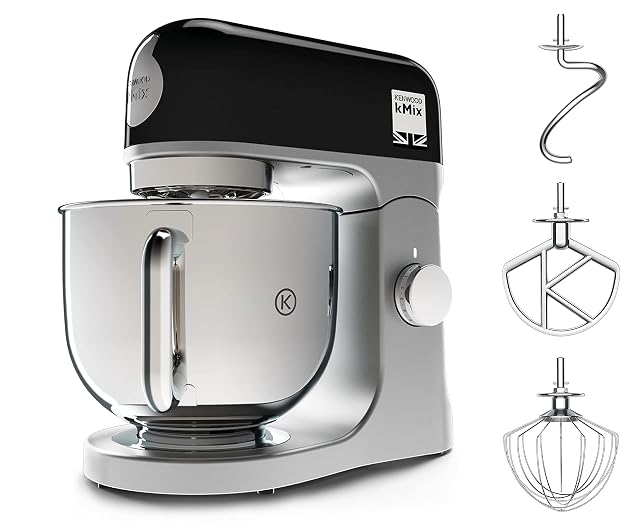
- “Model K455 includes (1) 4.5 Quart Stainless Steel Bowl, (1) Coated Flat Beater, (1) Coated Dough Hook, (1) 6-Wire Whip”
- From the name: “Classic Series”, “K45SS”, “Onyx Black”
- Reference K45SSOBO · Catalog: 22 lb, 14.1 × 8.7 × 13.9 in (358 × 221 × 353 mm)
The attachment hub, which is the only real moat on this shelf
“10 plus attachments to make more with your mixer to make everything from fresh pasta to burgers, veggie noodles, ice cream and more, sold separately”
Two items on this shelf publish a hub, and both are KitchenAid.
this at $322.99 — “10 plus attachments”
The bowl-lift — “Over 10 stand mixer attachments available*, to make everything from fresh pasta to burgers, veggie noodles, ice cream and more, sold separately”
And here is the oddity: not one of the five KSM150PS Artisan listings at $399.96 to $499.95 mentions the hub at all.
So the two cheaper KitchenAids sell the ecosystem and the most expensive one does not mention it.
Why the hub is the strongest argument on this shelf. A power take-off on the front of the head turns a mixer into a different machine. A meat grinder. A pasta roller and cutter. A spiralizer. An ice cream churn. A food processor attachment. A juicer.
None of the other five items here — the two Hamilton Beach machines, the Martha Stewart, the VIVOHOME, the OLIXIS — has one. They mix, and that is the whole of what they do.
Which is also the lock-in, and it works in your favor over time. An attachment bought for this machine fits the next KitchenAid you buy, and the hub has been physically unchanged across the line for a very long time — which is why a grinder bought today fits a mixer bought in twenty years.
The “sold separately” is doing real work in the sentence. The attachments are not cheap, and a grinder or a pasta set can cost a meaningful fraction of this machine.
So the honest way to weigh it: if you will buy one attachment, the hub pays for itself against a $149.99 mixer. If you will never buy one, you are paying $150 more for metal and a badge.
And the companion argument is the one this page states as a material rather than a feature.
Twenty-two pounds of metal, which is the stability feature nobody calls one
“the durable and built-to-last metal construction”
The shelf, by catalog weight:
24.3 lb — the KitchenAid Artisan in Almond Cream at $499.00
22.8 lb — Black Matte and Blue Velvet, the same model
22 lb — Contour Silver and Pistachio, the same model
22 lb — this
11 lb — the VIVOHOME at $149.99
10.2 lb — the Hamilton Beach 63390 at $126.95
9 lb — the Martha Stewart at $149.99
7.1 lb — the OLIXIS (currently unavailable)
Not published — the KitchenAid bowl-lift, the Hamilton Beach Classic at $62.95
The heaviest machine here is 3.4 times the lightest, and the five KitchenAids that publish a weight are the five heaviest.
What mass actually does. A dough hook in a stiff dough does not spin freely; it meets resistance, and the reaction pushes the machine — slowly, across the countertop, towards the edge.
A 22-pound cast base absorbs it. A 9-pound one does not.
Which is why the light machines on this shelf publish a feature for it and the heavy ones publish a material.
VIVOHOME, 11 lb — “Strong suction cups help keep the dough mixer stable during mixing”
Martha Stewart, 9 lb — a “HEAVY-DUTY BASE: Sturdy construction enhances stability and minimizes movement for smoother, more controlled operation”
this, 22 lb — “durable and built-to-last metal construction”
So this page’s claim is the same claim, stated as what the machine is made of rather than as what has been added to it. Which is the more durable version: a casting does not come unstuck.
And the other half of what metal buys is the thing no page on this shelf discusses: the gearbox. A mixer’s drive is a worm gear and a set of spur gears, and in a metal-bodied machine they run in grease inside a casting rather than in a plastic housing.
No item here publishes a gear material, which is the actual durability question — because the gear that fails on a mixer is usually a sacrificial one, designed to break before the motor does.
“Lock the head in place while mixing” is the small structural detail in bullet three and it matters more on a tilt-head than it sounds. An unlocked head rides up under load in a stiff dough, and the beater rises away from the bowl floor.
Which is the structural argument for the one bowl-lift on this shelf. The KSM55SXXX publishes “a 3-point locking bowl for stability” and a head that does not move at all — plus “2x the power in the bowl than Tilt-head stand mixer*”, footnoted “*Compared to KSM150 when measuring peak HP in the bowl; above speed 2.”
Four and a half quarts, with the method declared
“4.5 Quart Stainless Steel Bowl to mix up to 8 dozen cookies in a single batch. Dishwasher safe. Using the flat beater; 28g dough each”
8 × 12 × 28 g is 5.9 lb of dough.
Which makes the claim checkable rather than impressive, and that is the point of publishing the method.
The shelf, by bowl size and claim:
6.3 qt — the OLIXIS (currently unavailable), no claim at all on the largest bowl here
6 qt — the VIVOHOME at $149.99 — “3 bread loaves or 2.2 lbs flour”, the only claim here stated in flour
5.5 qt — the KitchenAid bowl-lift — “11 dozen cookies per batch*, knead over 7 lbs of bread, or mash 6 lbs of potatoes”
5.3 qt — the Martha Stewart at $149.99 — “up to 9 dozen cookies”, with no method stated
5 qt — the five Artisans at $399.96 to $499.95 — “9 dozen cookies*”
4.5 qt — this, 8 dozen
4 qt — both Hamilton Beach machines, no figure
So Martha Stewart claims the same 9 dozen as the 5-quart Artisan on a 5.3-quart bowl — consistent with KitchenAid’s basis, and undeclared. And the largest bowl on this shelf publishes nothing at all.
The caution that matters more than the count: a bowl is not a capacity.
A stand mixer’s real limit is the motor and the gearing, not the volume — and this page publishes no wattage, so there is no way to tell whether 5.9 lb of stiff dough is within the machine or merely within the bowl.
Which is why the bowl-lift’s claim is the most informative on the shelf: it pairs 5.5 quarts with “2x the power in the bowl” and with weights — 7 lbs of bread, 6 lbs of potatoes — rather than counts.
The honest reading of 4.5 quarts: a single standard batch of anything, and no double batches.
And the thing in its favor that nobody on this shelf states: a bowl too large for the job leaves the beater turning above the mixture. Half a cup of cream in a 6-quart bowl will not whip, because the whisk never reaches it — which makes the smaller bowls here better at small jobs.
The bowl has no handle on this page. The five Artisans at $399.96 to $499.95 publish “a comfortable handle” and the Martha Stewart at $149.99 publishes an “ergonomically designed bowl handle” — which on a 4.5-quart bowl full of dough is a real convenience and part of what the extra $77 or more buys.
Ten speeds, and a stir speed at the bottom
“10 speeds for nearly any task or recipe, from mixing ingredients together on the stir speed, to whipping cream at speed 8”
The shelf, by count:
12 — the Martha Stewart at $149.99
11 distinct, plus a 1/2 speed — the KitchenAid bowl-lift
10 — this, the five Artisans at $399.96 to $499.95, the OLIXIS (currently unavailable)
10 plus pulse — the VIVOHOME at $149.99
7 — the Hamilton Beach 63390 at $126.95
6 plus QuickBurst — the Hamilton Beach Classic at $62.95
Why the count tells you less than the ends of the range.
A mixer whose speed 1 is too fast throws flour out of the bowl, and there is no setting below it.
This phrasing is the more useful kind. A “stir speed” below the mixing range, and whipping cream at speed 8 — two steps below maximum — which tells you the top of the dial is headroom rather than the working range.
Three pages on this shelf address the slow end. This formula, which appears on six of KitchenAid’s seven pages here. The Martha Stewart at $149.99 — “Precision control lets you gently fold”. And the bowl-lift, which is the only machine here with a step below one and the only one that says what it is for: “Designed for folding, 1/2 speed gently adds delicate ingredients, like blueberries and egg whites, into recipes without overbeating.”
What this page does not have at the other end is a burst. Two machines here do: the VIVOHOME’s pulse at $149.99 and the Hamilton Beach Classic’s QuickBurst at $62.95, “an extra burst of power at any speed” — which is what a stalled dough wants.
And nothing on this page says what happens to the speed under load. The Hamilton Beach 63390 at $126.95 is the only item on this shelf to claim it: “No matter how thick or heavy your ingredients are, the powerful 300 watt motor… maintains constant speed.”
A motor without speed regulation slows when it meets resistance — set speed 2 in a batter and it holds, put a bread dough in and it drops. KitchenAid’s slide control is widely understood to be regulated; this page does not say so.
What is not published
No wattage. All seven KitchenAid machines on this shelf publish none. Five items do: 660 W on the VIVOHOME at $149.99, 300 W on the Hamilton Beach 63390 at $126.95 and the OLIXIS, 290 W peak on the Hamilton Beach Classic at $62.95.
And KitchenAid’s own alternative grandeur is the better one, published once on this shelf and only comparatively. “Peak HP in the bowl” is torque at the beater, which is what a mixer does — where watts at the wall is what the motor draws, and between the two sits a reduction gear that trades speed for torque. A 300 W motor through a deep reduction can beat a 660 W one through a shallow one. No absolute figure for either is published anywhere here.
No load behavior, as above.
No flex-edge beater. The box contains a “Coated Flat Beater”, and the coating is never named on any of the seven KitchenAid pages here. Two items on this shelf scrape as they mix, and both cost $149.99: the VIVOHOME’s “Flex edge beater scrapes sides and bottom as it mixes; No more stopping to scrape” and the Martha Stewart’s “flat beater with silicone edge”. KitchenAid sells a flex edge beater separately — which, to be fair, is exactly what the hub bullet is about.
No pouring shield. The contents list is explicit and does not include one. Four items on this shelf publish a shield: the Martha Stewart at $149.99 with “an accessible pour chute”, the VIVOHOME at $149.99 which lets you “pour while running”, the Hamilton Beach 63390 at $126.95 with a removable splatter shield and no chute, and one of the five Artisan listings, the Blue Velvet at $399.96, whose contents include a Pouring Shield. Which is itself an oddity: the same Artisan either includes one or does not, depending on which color’s listing you read.
No color range statement. Three of the five Artisan listings at $399.96 to $499.95 publish “over 20 colors available”; this page is Onyx Black and says nothing about alternatives.
No noise figure. One page on this shelf mentions noise at all: the VIVOHOME at $149.99 — “Low-noise operation” — with no number.
No cord length. One item on this shelf publishes one: the KitchenAid Artisan in Contour Silver at $499.00, whose single bullet reads “10-speed slide control ranges from a very fast whip to a very slow stir. Cord length : 36 Inches”. Eleven publish nothing.
No gear material, as above, which no item on this shelf publishes.
No tilt-back height, which nothing here publishes — the figure that decides whether the head will open under a wall cupboard, on a machine whose whole access design is a tilting head. The one bowl-lift on this shelf is the only item for which the question does not arise.
No warranty. Not at least one of the sixteen items on this shelf publishes a term — and “built-to-last” in bullet one is the phrase that would most want one behind it.
Availability
Read on the day this page was built: $322.99 at the American Amazon shop.
Read from Keepa on the day this page was last revised; stock and price both move without notice.
Prices quoted in this text were read on 2026-10-17. The live price is at the top of the page.