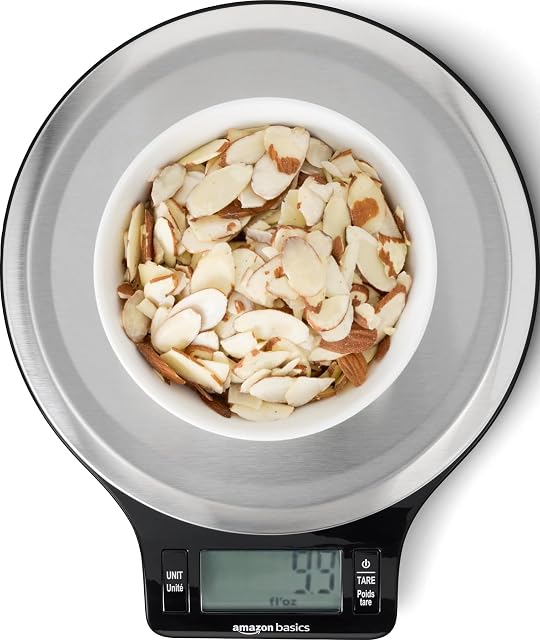
Best for: Everyday weighing on a wide platform, with the threshold stated
≈ $11
Check price on Amazon A published 2-gram minimum, for eleven dollars
An 11-pound kitchen scale with a stainless platform, a wide LCD, five units, tare, a published 2-gram minimum and two AAA batteries included.
Best for: Everyday weighing on a wide platform, with the threshold stated
That is rarer on this shelf than it should be. No mission statement, no gift suggestion, no “we cherish every customer” — a capacity, a floor, a unit list, a material, a battery, a tare and a dimension.
And one of those figures is the most useful on the page.
“2 grams minimum, up to about 5000 grams”
Five of the thirteen scales sold on Amazon.com publish a minimum weighable load:
2 g — this, and the Etekcity USB at $29.99 (“as light as 2 g”) 3 g — the GGQ at $17.98 (“from 0.1oz/3g”), the Etekcity nutritional at $39.99 (“between 3 g - 5000 g”) 0.01 g — the Letron at $34.99, on its mini platform
The other eight say nothing.
Why the minimum is not the same as the resolution. Resolution is the step — how finely the display changes. The minimum is the point below which the scale does not respond at all.
A 1-gram scale with a 2-gram floor shows 0 for 1.5 g and jumps to 2 g at the threshold. So a teaspoon of yeast, a pinch of salt, a gram of saffron are simply not there.
That is not imprecision. It is a refusal to weigh.
And it is why the resolution figure alone misleads. At least twelve of the fifteen scales on this shelf read in 1-gram steps. The only one that reads finer is the Letron at $34.99, whose mini platform does 0.01 g up to 500 g while its large platform does 1 g up to 33 lb.
One gram is the resolution of flour, not of salt. A 7 g sachet of yeast at ±1 g is ±14 percent; 3 g of salt is ±33 percent. 500 g of flour at ±1 g is ±0.2 percent, which is finer than any recipe needs.
The only page on this shelf to state a limit in its own words is the Greater Goods at $24.99: “Not for laboratory or microgram measurements.”
The workaround nobody here suggests: weigh small ingredients by multiplying. Ten grams of yeast weighed once and divided by eye beats one gram weighed ten times on a scale with a two-gram floor.
Bullet six publishes it and the catalog agrees: 210 × 178 × 32 mm.
Only four scales on this shelf publish any dimension:
this — 8.3 × 7 × 1.3 in, overall Escali, $25 — 8.5 × 6 × 1.5 in, overall Greater Goods, $24.99 — 7.6 × 5.6 × 1.3 in, overall GGQ, $17.98 — the only one to publish the platform rather than the body: “7.5” x 5.5” in stainless steel panel provide more stability and space for larger containers”
Why width matters in use. A mixing bowl is wider than it is deep, and a bowl that overhangs the platform is a bowl you can knock off center.
Worse: an overhanging bowl that touches the countertop takes part of the load off the scale, and the reading drops with no warning at all. That is the quietest error a kitchen scale produces.
Seven inches of width takes a standard 8-inch mixing bowl with its rim clear of the countertop.
The trade is storage and the shadow. A wider body is a wider slab to find a drawer for — and the display sits under the bowl, which is the one genuine design problem of a kitchen scale and which this page does not address at all.
Two scales on this shelf do:
Both OXO models, $37.95 and $64.95 — “Display pulls away from base to avoid shadowing from plates or bowls” Greater Goods, $24.99 — “the bright Hi-Def LCD display extends beyond the weighing platform for better visibility under large mixing bowls”
And a “wide LCD screen” is this page’s answer, which is a legibility claim rather than a geometry one. Four scales here publish a backlight — the SOYOK at $6.98 (a “night vision mode”), the Ultrean at $6.98 (a “negative white digital display”), the Etekcity at $13.99 (“Backlit LCD with large fonts”) and the OXO 5 lb at $37.95 (“optional backlight”) — and this one does not.
No display size or digit height is published by any scale on this shelf.
“food-safe, BPA-free plastic components” and “Stainless steel platform”
It is the commonest construction in this class and most pages leave it vague.
The shelf, by material:
304 stainless, grade named — the Ultrean at $6.98, the Etekcity at $13.99 (“304 food-grade”), the Etekcity nutritional at $39.99 Stainless, grade unstated — the SOYOK at $6.98, the GGQ at $17.98, the Greater Goods at $24.99, the OXO at $64.95 (“Stainless Steel is smudge and fingerprint-resistant”) Glass — the KitchenAid at $23.99 Stainless and glass — the Letron at $34.99 “Chrome”, with no material named — the Escali at $25 Steel platform on BPA-free plastic — this
What follows. The platform is what meets food, and stainless is the right answer there: lemon juice, vinegar, brine and raw meat mark lesser surfaces.
The body holds the load cell, and plastic is lighter and quieter than steel and does nothing worse to the measurement.
At 381 grams this sits mid-shelf: Etekcity 200 g · SOYOK 222 g · GGQ 250 g · Greater Goods 367 g · this 381 g · Escali 431 g · KitchenAid 535 g · Letron 544 g · Etekcity nutritional 544 g · OXO 5 lb 581 g · Etekcity USB 700 g · OXO 11 lb 816 g.
A heavier scale slides less when you stir a bowl standing on it — which, on a 7-inch-wide platform designed for exactly that, is worth something.
“BPA-free” is worth one qualification. BPA is a bisphenol used in some polycarbonates, and its relevance to a scale is slight: the plastic here is the housing, not a food-contact surface. The platform is steel.
And the care instruction this page does not give, which the KitchenAid at $23.99 does: “Hand wash only; do not immerse in water or put in dishwasher; for best results, wipe with a damp cloth and dry thoroughly.”
A steel top is not a sealed body. Only one scale on this shelf publishes a water rating — the Etekcity USB at $29.99, IPX6 — and both OXO scales solve it mechanically: “Platform removes for hand washing.”
“displays results in pounds, ounces, grams, fluid ounces, and ml”
Five is the middle of this shelf. Six on the SOYOK at $6.98 and the Ultrean at $6.98 (which add kg and milk ml) · five here, on the GGQ at $17.98, the Etekcity at $13.99 and the Etekcity USB at $29.99 · four on the Letron at $34.99 (g, oz, lb, kg) · three on the Escali at $25 (oz, lb:oz, g) — the fewest, on the scale with the only lifetime warranty here.
What a scale is doing when it shows you milliliters. It cannot measure volume. It measures mass and divides by an assumed density — and the assumption is water, at 1.00 gram per milliliter.
Which is why five scales on this shelf offer a second volume mode for milk. Milk is about 1.03 g per milliliter, so “milk ml” applies the other divisor — and the entire content of that feature is a three percent difference. The SOYOK, the Ultrean, the Etekcity USB (“milliliters (milk and water)”) and the Etekcity nutritional (“ml (water & milk)”) all publish it; this one does not, and offers plain ml and fl oz.
Which is the more honest arrangement, because a milliliter reading on any of these scales is a water reading — and anything denser than water will read low on it.
The better habit, which no page on this shelf suggests: weigh liquids in grams. A mass in grams can be checked against the packet; a converted volume cannot.
And one caution on unit switching: the unit does not necessarily reset on power-up. Check the display before you trust the number, particularly if somebody else used the scale last.
No resolution, stated directly. The 2-gram minimum and the 5000-gram maximum imply 1-gram steps, which is what every other 11-pound scale on this shelf publishes — but the figure itself is absent.
No auto shutoff duration. The durations on this shelf vary by a factor of two and a half: 2 minutes — the SOYOK at $6.98, the GGQ at $17.98, the Greater Goods at $24.99 · 3 minutes — the KitchenAid at $23.99 · 4 minutes — the Escali at $25 · 5 minutes — the Letron at $34.99. Six scales, including this, publish none.
Why it matters: a multi-ingredient recipe is weighed cumulatively, and a scale that switches off between two additions loses the tare. The Greater Goods answers it with the only timed HOLD here — “keep readings on screen for up to 5 minutes”.
No backlight, as above.
No HOLD function, where three scales here have one.
No overload or low-battery warning, where two scales publish both: the SOYOK at $6.98 and the GGQ at $17.98. An overload warning protects the load cell — pushing a strain gauge past its capacity bends it permanently, after which the scale reads consistently wrong rather than failing outright.
No anti-slip feet, where the SOYOK publishes four and the GGQ “4 no-slip rubbers”. A strain-gauge scale measures a beam’s deflection, and a scale not resting evenly on all four feet reads wrong.
No care instruction, as above.
No warranty. Three items on this shelf publish something: the Escali at $25 — a lifetime warranty, the only one here · the Greater Goods at $24.99 — 5 years limited plus “lifetime support from our St. Louis team” · the GGQ at $17.98 — “12 Months Support”. Ten publish nothing, including the $64.95 OXO.
No country of manufacture, which no item on this shelf publishes.
Read on the day this page was last revised: $11 at the American Amazon shop.
Read from Keepa on the day this page was last revised; stock and price both move without notice.
Prices quoted in this text were read on 2026-10-17. The live price is at the top of the page.
That anything lighter reads zero, and it is the most useful number on this page because only four other scales on this shelf publish it. Bullet three: "Weighs up to 11 pounds (2 grams minimum, up to about 5000 grams)". The five that publish a threshold: 2 g (0.1 oz) — this, and the Etekcity USB at $29.99 ("as light as 2 g (0.1 oz)") · 3 g (0.1 oz) — the GGQ at $17.98 ("from 0.1oz/3g") and the Etekcity nutritional at $39.99 ("between 3 g (0.1 oz) - 5000 g (176.4 oz)") · 0.01 g — the Letron at $34.99, on its mini platform. The other eight say nothing. Why it is not the same as resolution. Resolution is the step size — how finely the display changes. The minimum is the point below which the scale does not respond at all. A 1-gram scale with a 2-gram floor will show 0 for 1.5 g (0.1 oz) and jump to 2 g (0.1 oz) at the threshold — so a teaspoon of yeast, a pinch of salt, a gram of saffron simply are not there. That is not imprecision, it is a refusal to weigh. And it is why the resolution figure on its own misleads. At least twelve of the fifteen scales here read in 1-gram steps; the only one that reads finer is the Letron at $34.99, whose mini platform does 0.01 g up to 500 g (17.6 oz). So on this shelf the practical rule is: 2 to 3 grams is the floor, 1 gram is the step, and small ingredients are out of reach. The way to work round it, which no page here suggests: weigh the small ingredients by multiplying. Ten grams of yeast weighed once and divided by eye is more accurate than 1 g (0.04 oz) weighed ten times on a scale with a 2 g (0.1 oz) floor.
The page publishes the whole unit at 8.3 by 7 by 1.3 inches, which is the widest footprint on this shelf under thirty dollars. Bullet six: "Product Dimensions: 8.3 x 7 x 1.3 inches (LxWxH)." The catalog agrees: 210 × 178 × 32 mm (8.27 × 7.01 × 1.26 in). Only four scales here publish any dimension. this — 8.3 × 7 × 1.3 in overall · the Escali at $25 — 8.5 × 6 × 1.5 in overall · the Greater Goods at $24.99 — 7.6 × 5.6 × 1.3 in overall · and the GGQ at $17.98, which is the only one to publish the platform rather than the body: "7.5" x 5.5" in stainless steel panel provide more stability and space for larger containers." Why width matters in use. A mixing bowl is wider than it is deep, and a bowl that overhangs the platform is a bowl you can knock off center. Worse, an overhanging bowl that touches the countertop takes part of the load off the scale — and the reading drops without warning. Seven inches of width takes a standard 8-inch mixing bowl with its rim clear. The trade is storage and the shadow. A wider body is a wider slab to find a drawer for, and the display sits under the bowl — which is the one real design problem of a kitchen scale, and this page does not address it. Two scales on this shelf do. Both OXO models — $37.95 and $64.95 — "Display pulls away from base to avoid shadowing from plates or bowls". The Greater Goods at $24.99 — "the bright Hi-Def LCD display extends beyond the weighing platform for better visibility under large mixing bowls".
Less than the platform being steel, and this page is unusually plain about the construction. Bullet one: "Digital kitchen scale with food-safe, BPA-free plastic components." Bullet two: "Stainless steel platform with wide LCD screen." So: a steel top on a plastic body, which is the commonest construction in this class and one most pages leave vague. The shelf, by material: 304 stainless named — the Ultrean at $6.98, the Etekcity at $13.99, the Etekcity nutritional at $39.99 · stainless, grade unstated — the SOYOK at $6.98, the GGQ at $17.98, the Greater Goods at $24.99, the OXO at $64.95 ("Stainless Steel is smudge and fingerprint-resistant") · glass — the KitchenAid at $23.99 · stainless and glass — the Letron at $34.99 · "Chrome", no material named — the Escali at $25 · steel platform on BPA-free plastic — this. What follows in practice. The platform is what meets food, and stainless is the right answer there: lemon juice, vinegar, brine and raw meat all mark lesser surfaces. The body is what holds the load cell, and plastic is lighter and quieter than steel and does nothing worse to the measurement. At 381 grams this sits in the middle of the shelf — against 200 g (7.1 oz) for the Etekcity at $13.99 and 816 g (28.8 oz) for the OXO at $64.95 — and a heavier scale slides less when you stir a bowl standing on it. The one caution the page does not give, and the KitchenAid at $23.99 does: "do not immerse in water or put in dishwasher". A steel top is not a sealed body. Wipe it; keep water out of the seams and the battery hatch.
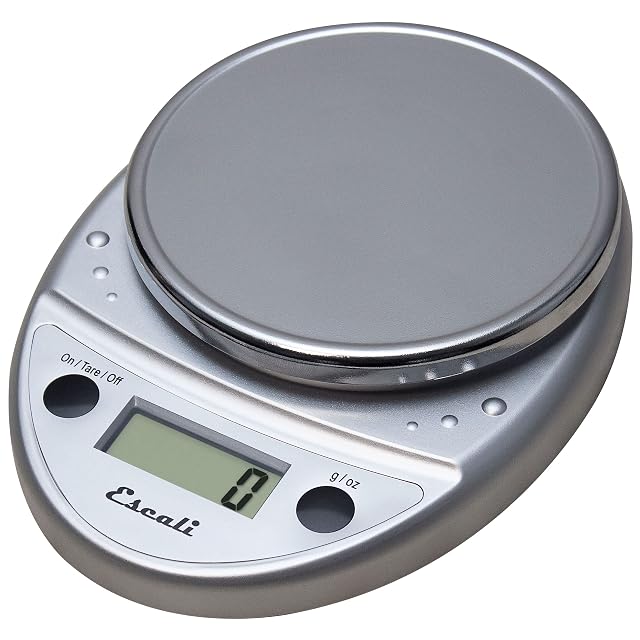
An 11-pound food scale with two-button operation, a sealed control panel, three units, 1-gram increments, a four-minute shutoff and a lifetime warranty.
Best for: A scale you expect to keep, where the warranty is the point
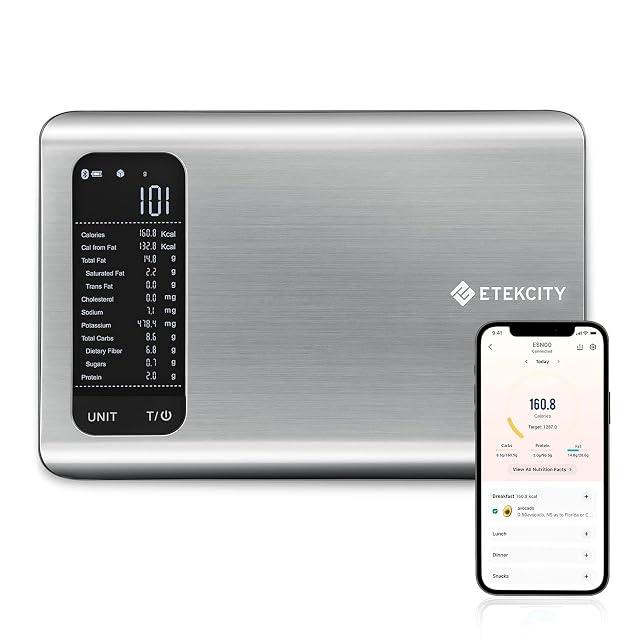
An 11-pound scale with four sensors, a 3-gram floor and 1-gram steps, tracking up to 19 nutrients through the Vesync app with Apple Health and Fitbit links.
Best for: Tracking intake, where the database matters more than the last gram
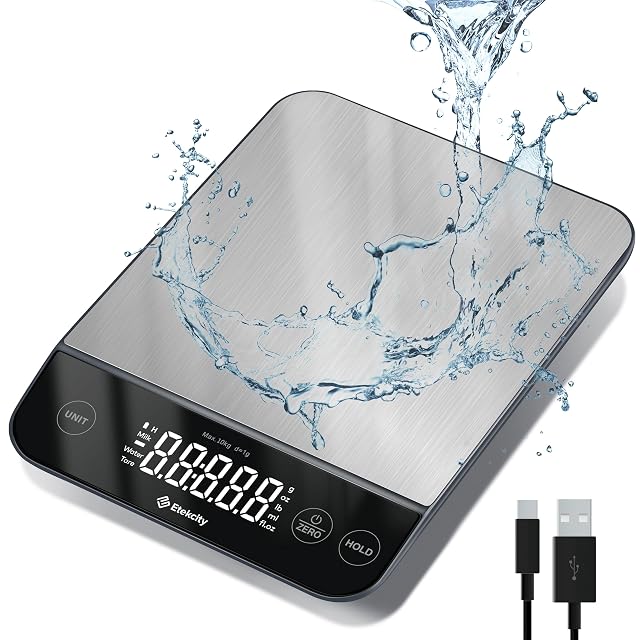
A 22-pound kitchen scale rated IPX6 waterproof with a USB-C rechargeable battery, a published 2-gram minimum, five units, tare and a hold function.
Best for: A wet kitchen, where the scale meets liquids and gets rinsed
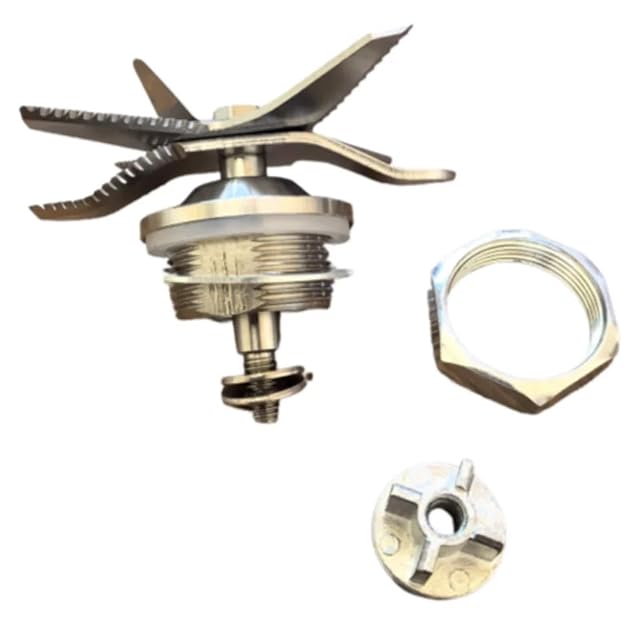
Stainless steel replacement blades, stated compatible with Instant container replacement blades. The listing describes household-scale grinding across ingredients of different hardness and mentions dumpling and meatball fillings; it publishes no dimensions, no blade count and no machine reference.
Best for: Nobody we can identify from what the listing publishes.
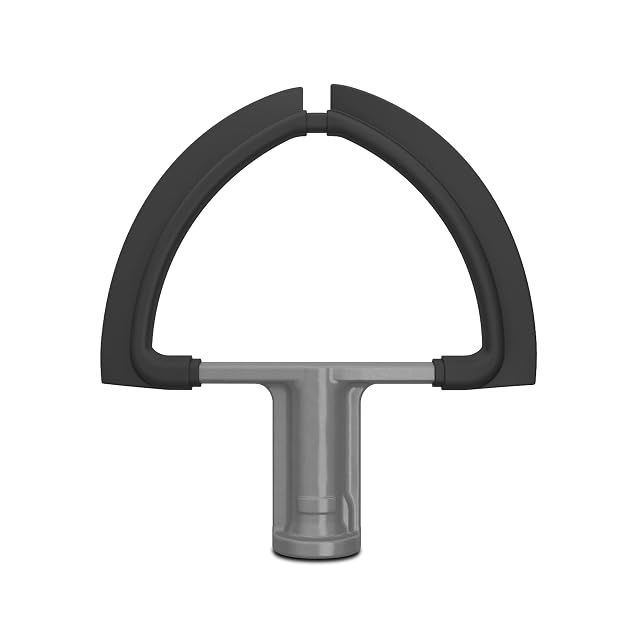
A double flex edge beater for KitchenAid bowl-lift mixers with stainless bowls in the KSM75, KSM55, KSM60 and KSM70 families, scraping twice as often, top-rack dishwasher safe.
Best for: A KSM75, KSM55, KSM60 or KSM70 bowl-lift with a stainless bowl
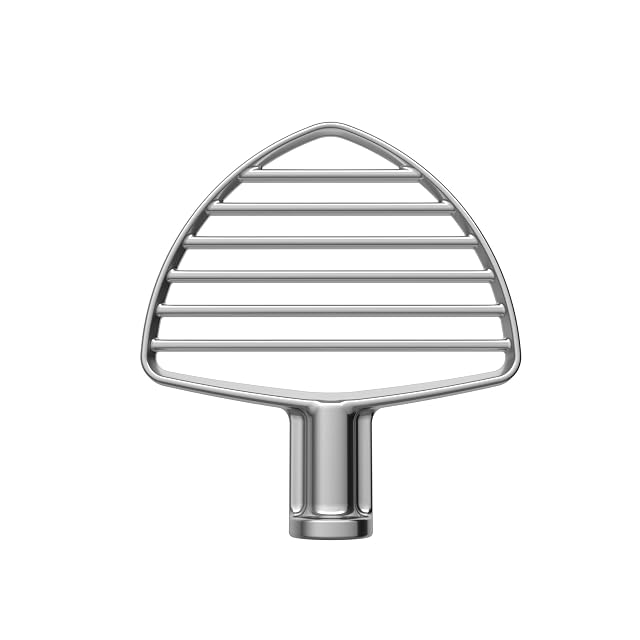
A pastry beater for eighteen named bowl-lift KitchenAid mixers with stainless bowls, cutting cold butter into flour, supplied with a scraper and dishwasher safe.
Best for: Pastry in a bowl-lift KitchenAid, if the weight is the thing you want