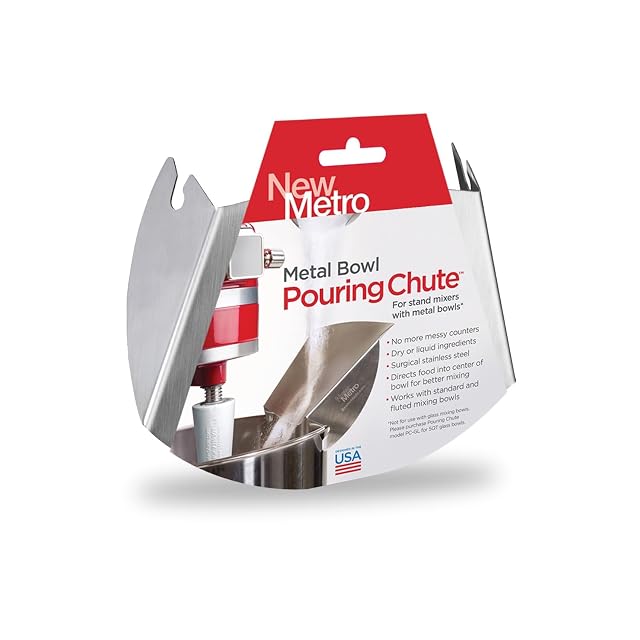
Best for: Loading flour and sugar into a metal bowl without half of it reaching the counter
≈ $25
Check price on Amazon Four brands, four exclusions, and a named alternative for glass bowls
A polished steel pouring chute for metal stand mixer bowls, fitting KitchenAid, Cuisinart, Kenwood and SMEG.
Best for: Loading flour and sugar into a metal bowl without half of it reaching the counter
“compatible with most KitchenAid, Cuisinart, Kenwood & SMEG stand mixers with metal mixing bowls.”
Every other item on this shelf is KitchenAid only. The three KitchenAid hub attachments, the ice cream maker, and both three-piece bowl-tool sets — all of them.
And the reason this one can be cross-brand is that it takes no drive. A chute does not connect to the motor and does not go on the shaft. It hooks over the bowl rim, so what it has to match is a rim rather than a machine.
Which is also why the exclusions are about bowls and not about mixers:
“It DOES NOT work with KitchenAid NSF Certified 5 Qt, GLASS STAND MIXER BOWLS or KitchenAid 6000 Series/bowls with FLUTED or FLARED EDGE.”
A flared or fluted edge gives the hook nothing square to sit on. A glass bowl has a thicker, differently profiled rim. The NSF Certified 5 quart is a commercial-specification bowl with its own rim.
Four exclusions, named in capitals — and then the page does something no other listing here does.
“Have a stand mixer with a glass mixer bowl? Look for the Glass Bowl Pouring Chute (B09HRCM3ST), it fits the KitchenAid Tilt-Head 3.5 or 5 Qt glass bowl.”
An ASIN for a different item, published on this page.
That is the opposite of what most compatibility statements do. The usual pattern on this shelf is to name what fits and stop: the KSMVSA slicer at $69.95 says “any KitchenAid Stand Mixer”, the KSMMGA grinder at $79.88 “any household… power hub”, the KSMPRA pasta roller at $204.90 “Fits all Household KitchenAid Stand Mixers”.
The one that comes closest to this page’s care is the KSMICM ice cream maker at $96.56, which names seven excluded models and says “verify your model number compatibility before ordering” twice — but it does not tell you what to buy if yours is one of them.
And the shelf’s two bowl-tool sets split on exactly this. The OMOVAN at $19.99 says “Not compatible with bowl-lift models”; the MEET JUICE at $21.99, selling the same three parts, says nothing of the kind and sends you to an image for its full list.
What is still missing here is a rim diameter, which would settle it for any bowl in any kitchen. The exclusion list is the whole test, so read it against your own bowl before ordering — and look at the rim, not the badge.
Bullet three: “Made from polished high grade surgical steel.” The description: “made from high grade stainless steel, it will not bend.”
They are the same family of metal, and the page gives two names for it three lines apart — which is worth noticing on a page otherwise this careful about detail.
“Surgical steel” is a marketing term rather than a specification. It usually denotes one of the austenitic stainless grades used for instruments, 304 or 316, and it has no single legal definition in cookware.
“Stainless steel” is the honest description, and the description’s sentence is the more useful of the two because it adds the property that matters: “it will not bend during the most rigorous use.”
Which is the real argument against the alternative, and the page makes it directly:
“unlike plastic versions, ingredients won’t stick to the pouring chute, but slide easily into the stand mixer bowl.”
Two separate advantages, and both are true.
Flour and icing sugar cling to plastic, by static and by surface roughness — and a chute that holds the flour has not done its job. Polished metal sheds it.
And a plastic chute flexes when you tip two pounds of flour into it, which unseats it from the rim at exactly the wrong moment. 7.5 ounces of steel does not — and that is the lightest item on this shelf, so the weight is in the right place rather than being a burden.
Dishwasher safe, which puts it among the easy half of this shelf: the KSMVSA publishes “All blades are dishwasher safe on the top rack”, while the KSMPRA pasta roller — the most expensive item here — is “Hand Wipe only” and the KSMICM must reach “room temperature” first.
“Pouring Shield patented design directs ingredients into the center of your stand mixer, for more efficient and thorough mixing.”
Two words there are doing real work, and they are easy to read past.
“Shield” as well as “chute.” The same part does two jobs: it guides what you are adding in, and it stops what is already in the bowl coming out. Flour at the start of a mix and sugar at the end both leave a bowl as dust, and a stand mixer at speed throws liquid.
“Into the center.” This is the non-obvious bit. A stand mixer is a planetary machine: the beater spins on its own axis while orbiting the bowl. Ingredients dropped at the wall get dragged round the outside and sit there; ingredients dropped at the center are taken up by the beater immediately. So a chute aimed at the middle is not a convenience — it changes how fast a dry addition disappears.
And it is the complement of the other bowl problem, which the description raises on its own initiative: the film of unmixed butter or flour that a rigid flat beater leaves against the wall. “for the ultimate stand mixer success, find the Original BeaterBlade… eliminates hand-scraping the mixing bowl and cuts mixing time by as much as 50%.”
That 50 per cent is the only quantified claim anywhere on this shelf, and it is made about a product not sold on this page. Treat it as the maker’s claim about a different item — but the mechanism is real, and one set here has exactly that feature: the MEET JUICE at $21.99, whose “K45B Coated Flat Blade Paddle with Scraper” is the only scraping beater on the shelf, against the OMOVAN at $19.99 with the same three tools and a plain paddle.
So the two bowl problems divide cleanly. This chute solves getting ingredients in. A scraper beater solves getting them off the wall. Neither does the other’s job, and together they cost under $50.
The ladder on this shelf spans ten times:
OMOVAN — $19.99, three bowl tools MEET JUICE — $21.99, the same three with a scraper this — $24.94, 7.5 oz KitchenAid KSMVSA — $69.95, 1.3 lb, slicer and shredder KitchenAid KSMMGA — $79.88, 2.5 lb, food grinder KitchenAid KSMICM — $96.56, 6 lb, ice cream maker KitchenAid KSMPRA — $204.90, 7.5 lb, pasta roller and cutters
And this is the only item on the shelf that does not take power, which is the division worth holding onto. The three KitchenAid hub attachments turn the mixer into another machine — a slicer, a grinder, a pasta mill. The two bowl-tool sets replace what came with it. This and the ice cream bowl are neither: they are things that go on the bowl or in place of it.
Which makes the comparison not with the dearer items but with a spatula and some care. Twenty-five dollars buys you the end of flour on the counter and the end of batter on the splashback — on every bake, for as long as the mixer lasts.
No rim diameter, as above — the figure that would replace the exclusion list with a measurement.
No bowl capacity range. It fits “the KA-MINI” and excludes the “NSF Certified 5 Qt” and the 6000 Series, so the covered range has to be inferred from the exceptions. The glass alternative names “3.5 or 5 Qt”.
One material, not two, as above.
No hook detail, which is the part that does the work: how it seats, whether it clips, whether it can be left in place while the head tilts.
No statement about tilting the head. On a tilt-head mixer the head hinges back over the bowl rim, and anything hooked on that rim is in the way. The page does not say whether the chute must come off first — and it is the obvious question for a part that sits exactly there.
No weight limit or capacity, on a part you tip a bag of flour through.
No country of manufacture, which nothing on this shelf publishes.
And no mention of the other half of its own range beyond a name. The “Original BeaterBlade” is recommended twice over and never given an ASIN, where the glass chute is. For a page that volunteers a competitor’s product code, that is an odd place to stop.
Read on the day this page was built: $24.94 at the American Amazon shop.
Read from Keepa on the day this page was last revised; stock and price both move without notice.
Prices quoted in this text were read on 2026-10-17. The live price is at the top of the page.
It depends on the bowl rather than the mixer, and this is the most carefully bounded compatibility statement on the shelf. It fits: "most KitchenAid, Cuisinart, Kenwood & SMEG stand mixers with metal mixing bowls", including "the KA-MINI". Four brands, which nothing else here manages — every other item on this shelf is KitchenAid-only. It does not fit: "KitchenAid NSF Certified 5 Qt, GLASS STAND MIXER BOWLS or KitchenAid 6000 Series/bowls with FLUTED or FLARED EDGE." Four exclusions, named. The reason is that a chute hooks over the rim, so what matters is the rim: its diameter, its thickness, and whether it is straight. A flared or fluted edge gives the hook nothing square to sit on. A glass bowl has a thicker, differently profiled rim. And the NSF Certified 5 quart is a commercial-specification bowl with its own rim. And then the page does something no other listing here does: it names the product you want instead. "Have a stand mixer with a glass mixer bowl? Look for the Glass Bowl Pouring Chute (B09HRCM3ST), it fits the KitchenAid Tilt-Head 3.5 or 5 Qt glass bowl." An ASIN for a different item, published on this page. What is still missing is a rim diameter, which would settle it for any bowl — so the exclusion list is the whole test.
They are the same family of metal, and the page gives two names for it three lines apart, which is worth noticing on a page otherwise this careful. Bullet three: "Made from polished high grade surgical steel." The description: "The Pouring Chute is made from high grade stainless steel, it will not bend during the most rigorous use." "Surgical steel" is a marketing term rather than a specification. It usually denotes one of the austenitic stainless grades used for instruments — 304 or 316 — and it has no single legal definition in cookware. "Stainless steel" is the honest description, and the description is the more informative of the two sentences because it adds the property that matters: it will not bend. Which is the real argument against the alternative, and the page makes it directly: "unlike plastic versions, ingredients won’t stick to the pouring chute, but slide easily into the stand mixer bowl". Two separate advantages there. Flour and icing sugar cling to plastic by static and by surface roughness, and a chute that holds the flour has not done its job. And a plastic chute flexes when you tip a bag of flour into it, so it unseats from the rim. Both are fixed by a polished metal one — and by 7.5 ounces, which is the lightest item on this shelf and still heavy enough to stay put.
Because the thing it advertises is the other half of the same problem, and the page is unusually open about it. The description ends: "for the ultimate stand mixer success, find the Original BeaterBlade that works for your stand mixer, which makes baking fun, fast, eliminates hand-scraping the mixing bowl and cuts mixing time by as much as 50%." That 50 per cent is the only quantified claim anywhere on this shelf, and it is made about a product not sold on this page. Treat it as the maker’s claim about a different item — but the mechanism is real and it is worth understanding, because it bears directly on what else to buy here. A rigid flat beater leaves a film of unmixed butter or flour against the bowl wall, because it runs a fixed distance from the wall and that distance is not zero. So you stop, scrape with a spatula, and start again — two or three times in a creaming step. A scraper edge on the beater wipes the wall as it orbits. And one set on this shelf has exactly that: the MEET JUICE at $21.99, whose "K45B Coated Flat Blade Paddle with Scraper" is the only scraping beater here, against the OMOVAN at $19.99 with the same three tools and a plain paddle. So the two bowl problems divide cleanly: this chute solves getting ingredients in; a scraper beater solves getting them off the wall.
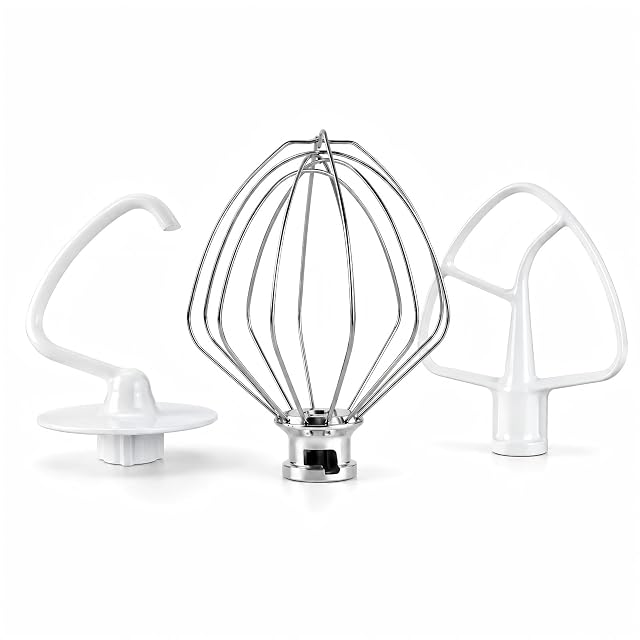
A K45WW wire whip, K45DH dough hook and K45B coated flat beater for KitchenAid tilt-head mixers of 4.5 to 5 quarts.
Best for: A tilt-head KitchenAid of 4.5 or 5 quarts whose original tools have worn or gone missing
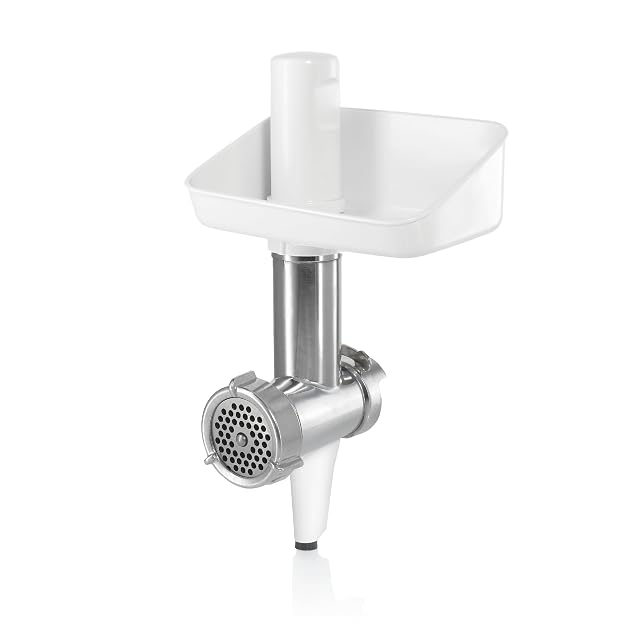
Bosch’s own meat grinder attachment for the Serie 4 hub, stated at about 2.2 lb (1 kg) of meat per minute, with a 4.5 mm (0.18 in) stainless perforated plate, a blade, a filling tray and a pusher in the box. It fits Bosch Serie 4 mixers only, and it is not sold on Amazon.com.
Best for: A Bosch Serie 4 owner who minces more than twice a year.
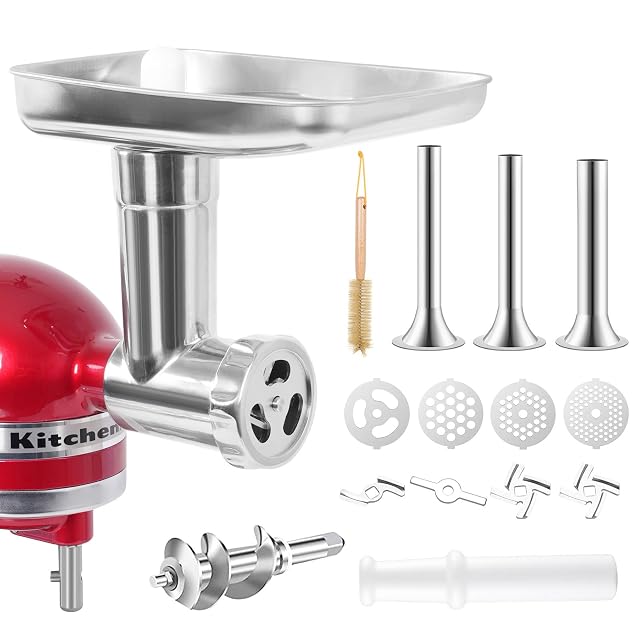
A third-party meat grinder attachment in stainless steel, stated to fit all KitchenAid stand mixers and the Cuisinart SM-50 series. Gdrtwwh lists four grinding plates, two blades and three sausage tubes, dishwasher-safe parts, and uses covering mince, sausages and breadcrumbs.
Best for: A KitchenAid owner who wants a metal grinder and a sausage kit in one box.
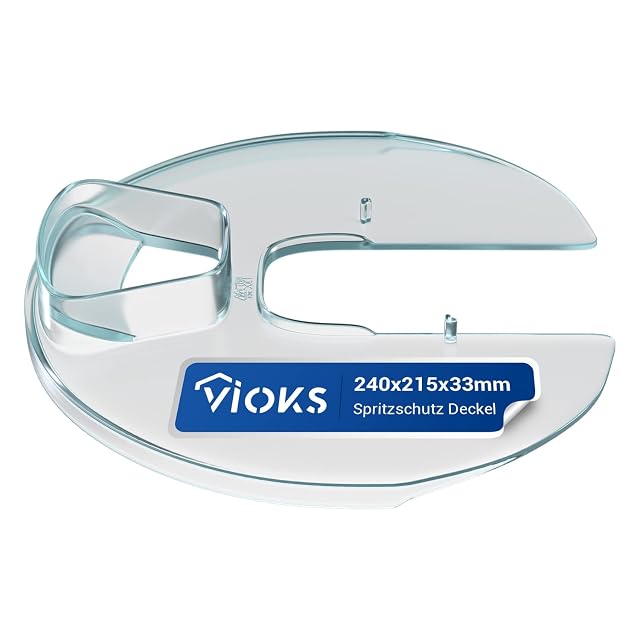
A replacement splash guard equivalent to Bosch/Siemens part 00482103, for the MUM4 range and the Profimixx 44, 46 and 47. VIOKS publishes the dimensions — 9.4 by 8.5 by 1.3 inches — and eleven model numbers. Sold on the European Amazon stores, not on Amazon.com.
Best for: An owner of a Bosch MUM4 or Profimixx whose mixer works fine and whose splash guard vanished.
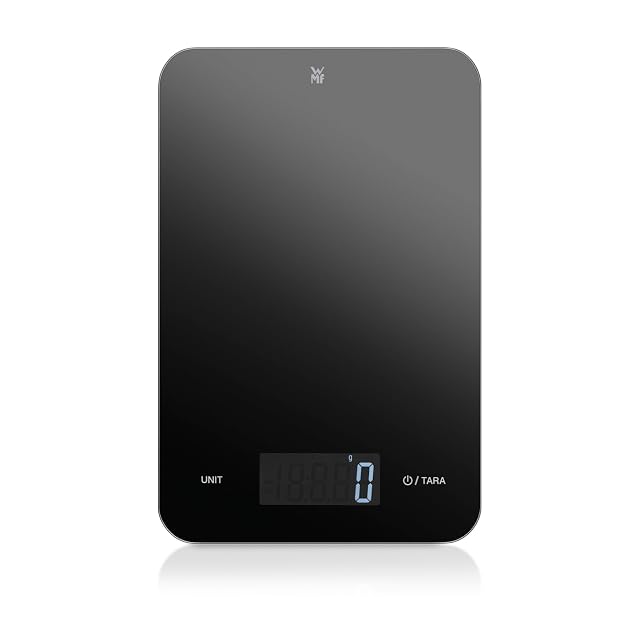
Eleven pounds in one-gram steps on a 9.1 by 5.9 inch safety-glass surface, with four units — milliliters, grams, fluid ounces and pounds-ounces — so liquids are weighed by volume. Tare, battery indicator, automatic shut-off, and a CR2032 cell in the box.
Best for: Baking where liquids are measured by volume and the scale lives on the countertop.
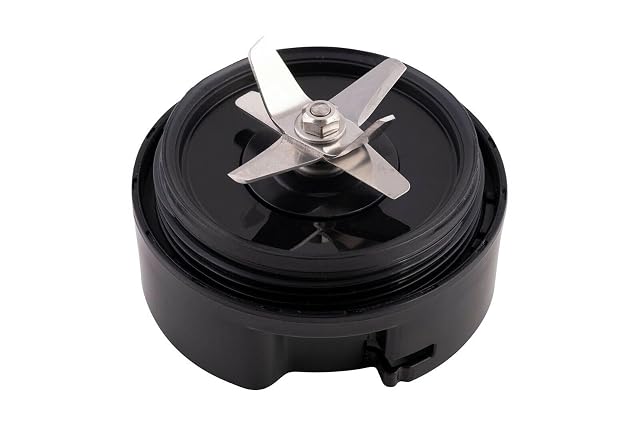
WMF's own replacement blade unit for the Kult X and Kult Pro countertop blenders. The listing publishes the two compatible machine references — 3200000395 and 3200000396 — and almost nothing else. Sold on the European Amazon stores, not on Amazon.com.
Best for: A Kult X or Kult Pro owner whose blender has stopped crushing ice.