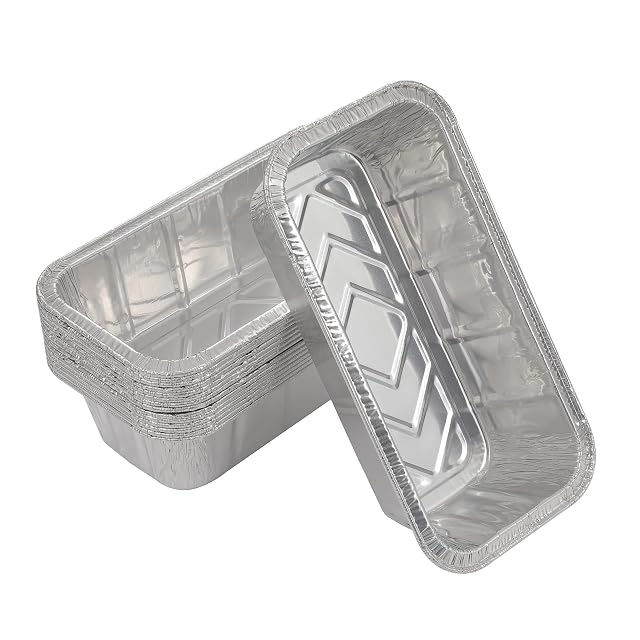
Forty cents a pan, and the only dough-weight capacity on the shelf
Waytiffer 25-Pack 8.5 × 4.5 in Foil Loaf Pans
Twenty-five heavy-duty aluminum foil loaf pans of 8.5 × 4.5 × 2.5 inches, rated 2 lb, recyclable and oven safe.
Specifications
- Price per pan
- 40 cents — 25 pans for $9.99
- Capacity
- 2 lb — the only dough-weight capacity on this shelf
- Size
- 8.5 × 4.5 × 2.5 inches, all three published
- Catalog confirms it
- 216 × 114 × 64 mm = 8.5 × 4.5 × 2.5 inches exactly
- Weight per pan
- 12.0 g (0.4 oz) — catalog 299 g (10.5 oz) for twenty-five
- Material
- Aluminum foil, stated high thermal conductivity
- Airflow claim
- Stated to optimize airflow for heat distribution
- Recyclable
- Yes, stated fully recyclable
- Return
- A no-questions-asked return is stated
- Oven limit
- Not published — "extremely high temperatures" with no figure
- Foil thickness
- Not published, behind a heavy-duty claim
- Smaller than the steel
- 8.5 × 4.5 against the 9 × 5 standard
- Lid
- None mentioned
- Reference
- Not stated by the maker
- Amazon reference
- B09BJGLM9Y
- EAN
- 8368456418612
The plus side, and the minus
Strengths
- Forty cents a pan, against $5.99 for the cheapest steel loaf pan here
- The only dough-weight capacity on the shelf — 2 lb — and all three dimensions published
- The catalog figure matches the published size exactly, which almost nothing here does
Compromises
- 8.5 × 4.5 is smaller than the 9 × 5 standard the rest of the shelf uses
- "Extremely high temperatures" with no number, on the one page that raises the subject
- No foil thickness, and 12 grams of foil needs a tray under it when full
What the maker puts in writing
- “STANDARD SIZE--- Pans Dimensions: 8.5”L x 4.5” W x 2.5”H, Great for holding bread, cookie and cake batters, fruit and veggie salads, quiches, and beyond.”
- “ECO-FRIENDLY SUPER VALUE PACK --- …Fully recyclable… They also optimize airflow during cooking, promoting proper heat distribution for tasty results. This pack includes 25 Aluminum Foil.”
- “QUALITY HEAT CONDUCTION COOKWARE --- The aluminum trays have a high thermal conductivity which allows them to handle extremely high temperatures for oven use.”
- “SINCE SLICED BREAD---Our versatile loaf pans help you effortlessly prepare, transfer, and serve breads, cakes, casseroles, and other foods”
- “VALUE FOR YOUR MONEY --- If you are not satisfied for any reason, simply return the item, no questions asked”
- From the name: “2Lb Heavy Duty Disposable Aluminum Foil Premium Bread Tins Standard Size”
- Catalog: 299 g (10.5 oz), 216 × 114 × 64 mm (8.50 × 4.49 × 2.52 in)
The only dough-weight capacity on this shelf, and it checks out
“2Lb” is a dough weight, not a dimension.
A loaf tin is traditionally designated by the weight of dough it takes — 1 lb and 2 lb are the two standard sizes — and 2 lb is the common large loaf.
Check it against the volume. 8.5 × 4.5 × 2.5 inches is 95.6 cubic inches, about 1.57 liters. A 2 lb bread dough is around 900 grams, which fills that to roughly two thirds before rising and reaches the rim on oven spring. The figure is consistent with the dimensions.
Which is more than the same maker manages on its other listing. The Waytiffer mini pie tins at $9.99 are called “4 inch” in the name and measured at “4.5 inch diameter on top and 2.5 inch diameter on bottom” in the bullet — three figures, and the name is none of them.
And no other American loaf pan on this shelf publishes a capacity at all — only the two European tins, the Kaiser and the Backefix, give a volume, 2.1 L each. The three steel 9 × 5 pans — GoodCook $5.99, Sur La Table $11.70, KitchenAid $14.99 — publish a plan size, no depth, and no volume. A loaf pan is a volume, and that is the figure a recipe is written against.
One size warning. 8.5 × 4.5 is smaller than the 9 × 5 standard the steel on this shelf uses — about 15 percent less base area. A recipe sized for a 9 × 5 will rise higher in this than intended, which for bread means a mushroom top and for a batter means spillage.
The catalog confirms the published size exactly, which is rare here
Bullet one publishes 8.5 × 4.5 × 2.5 inches. The catalog reads 216 × 114 × 64 mm. That is 8.50 × 4.49 × 2.52 inches.
Almost nothing else on this shelf lines up like that.
The two GoodCook flat pans do: the 13 × 9 bake & roast at $9.99 catalogs at 330 × 229 × 51 mm = 13.0 × 9.0 × 2.0 inches, exactly its bullet; the MegaGrip 8 × 8 at $10.09 at 203 × 203 mm = 8.0 × 8.0, exactly.
The steel loaf pans do not. The GoodCook 9 × 5 and the KitchenAid 9 × 5 both catalog at 279 × 152 mm — 11.0 × 6.0 inches, two inches over in each direction, because a loaf pan is measured at the base and the rim flares.
This foil pan is measured the same way as the steel ones and still matches, which says its walls are steeper and its rim narrower — consistent with pans that have to nest twenty-five deep.
The two sets both match as well: Elbee publishes a 17.63 × 13.11 × 3.58 inch stack and catalogs at 448 × 333 × 91 mm; Amazon Basics publishes 16.25 × 11.75 × 6.25 and catalogs at 413 × 298 × 159 mm. Both exact.
Twelve grams, and what that changes about the bake
299 grams for 25 pans is 12.0 grams each.
Against the shelf: the maker’s own pie tin is 2.2 g; the GoodCook 9 × 5 steel pan is 268 g, twenty-two times this; the Amazon Basics pieces average 302 g; the Elbee pieces 454 g.
Aluminum conducts heat about three times better than steel, and this pan is thin. So it reaches oven temperature almost immediately and holds almost no heat of its own.
Three consequences the page does not draw.
The base browns fast, because nothing stands between the oven’s radiant heat and the dough. That is why bakeries use foil, and it is a genuine advantage for bread.
It stops cooking the moment it leaves the oven. A 268 gram steel pan keeps browning the crust for several minutes after it comes out; this does not. So turn the loaf out at once — resting bread in a foil pan steams the base in its own moisture.
And it will flex under a point load. A steel pan can be lifted by one end when full; twelve grams of foil cannot. Bread solves this itself, because dough sets and becomes self-supporting in the first ten minutes. A quiche never does — and bullet one lists quiches. Slide a baking sheet underneath, which also lets you move four at a time.
Bullet two adds a claim worth noting: “they also optimize airflow during cooking, promoting proper heat distribution”. Thin separate pans with air all round them do bake more evenly than a single heavy tray of batter, and that part is sound.
Extremely high temperatures, with no number
“high thermal conductivity which allows them to handle extremely high temperatures for oven use.”
The material claim is true and the safety claim is not a figure.
Aluminum melts at about 660 °C, far above any domestic oven, so the foil is in no danger — but that is not what a buyer is asking.
Two items on this shelf publish an actual limit, and both are sets:
Amazon Basics, $31.99 — “Oven-safe to 428 degrees F”, which is exactly 220 °C: a figure specified in metric and converted Elbee, $59.99 — “oven safe in a conventional one up to 420 degrees Fahrenheit”, plus “Safe to use in a convection oven”
Many bread recipes call for 450 °F, above both of those.
This is the item on the shelf most likely to clear 450 °F, and it declines to say so.
The one real caution with foil is the grill, not the oven: radiant heat from an element a few inches away is intense and local, and thin foil will discolour and can scorch what is under it. Nothing on this page distinguishes baking from grilling.
Recyclable, with a condition the bullet omits
“Fully recyclable, our small disposable food containers help reduce your carbon footprint” · “Bake the world a better place!”
Aluminum is one of the few single-use materials where the claim holds up. It recycles indefinitely without degrading, and reprocessing takes a small fraction of the energy of smelting it from ore — which is why scrap aluminum has a real resale value and scrap plastic largely does not.
The condition the bullet omits is that it must be clean. Foil with baked-on dough and fat is contaminated, and many kerbside schemes reject it on that basis. Scrape and rinse, or it goes in the bin.
And bullet five is the shelf’s only commercial promise of any kind: “If you are not satisfied for any reason, simply return the item, no questions asked.”
No item on this shelf publishes a warranty — not the $59.99 Elbee set, not the $31.99 Amazon Basics, not either KitchenAid. A return offer on a disposable is the nearest thing to one here, which is an odd place for it to land.
What is not published
No foil gauge or thickness, behind “Heavy Duty” in the name and “QUALITY HEAT CONDUCTION” in a bullet. Foil is specified in mils or microns, and no item on this shelf publishes a thickness of anything.
No oven temperature, as above.
No lid. Foil loaf pans are commonly sold with board or foil lids, which is what makes them useful for giving food away — and bullet four is all about transport: “prepare, transfer, and serve”. Nothing says whether a lid is included, and nothing in the name or the bullets mentions one.
No reuse statement. Sold as disposable; foil will take a second bake; the page does not say.
No stacking or storage claim, where the maker’s pie tins sell “Easily Stack & Store” in the name. Twenty-five loaf pans at 299 grams nest into very little, and this listing never mentions it.
No warranty and no country of manufacture, which no item on this shelf publishes.
Availability
Read on the day this page was built: $10 at the American Amazon shop.
Read from Keepa on the day this page was last revised; stock and price both move without notice.
Prices quoted in this text were read on 2026-10-17. The live price is at the top of the page.
What readers want to know
What does "2Lb" mean on a loaf pan?
It is a dough weight, and it is the only dough-weight capacity published on this shelf. The name says "2Lb... Premium Bread Tins Standard Size - 8.5" X 4.5" X 2.5"". A loaf tin is traditionally designated by the weight of dough it takes, not by its dimensions — a 1 lb tin and a 2 lb tin are the two standard sizes, and 2 lb is the common large loaf. Check it against the volume. 8.5 × 4.5 × 2.5 inches is 95.6 cubic inches, about 1.57 liters. A 2 lb bread dough is around 900 grams and roughly fills that to the rim before rising, which is the right relationship: dough goes in to about two thirds and the oven spring takes it to the top. So the figure is consistent with the dimensions, which is more than can be said for the maker’s pie tin, where the name says 4 inch and the bullet says 4.5 and 2.5. Why it matters that nothing else here publishes one. The three steel 9 × 5 pans on this shelf — GoodCook $5.99, Sur La Table $11.70, KitchenAid $14.99 — publish a plan size and no depth and no volume. A loaf pan is a volume, and a recipe written for a 2 lb tin will overflow a smaller one. This foil pan is slightly smaller than the 9 × 5 standard: 8.5 × 4.5 against 9 × 5, which at the base is about 15 percent less area. A recipe sized for a 9 × 5 will rise higher in this than the recipe intends.
Is twelve grams of foil enough on its own?
For bread, yes; for a wet batter carried across a kitchen, put a tray under it. The catalog weight is 299 grams for 25 pans — 12.0 grams each, which is five and a half times the maker’s own pie tin (2.2 g) and one twenty-second of the GoodCook 9 × 5 steel pan (268 g (9.5 oz)). What foil cannot do is hold its shape under a point load. A steel pan can be picked up by one end when full; a foil pan at twelve grams will flex, and a flexing wall lets the loaf sag away from it. The structural answer the bullets do not give is the bake itself. Bread dough sets as it bakes — it becomes self-supporting within the first ten minutes — so by the time you take it out, the loaf is holding the pan up rather than the reverse. A quiche or a batter never does that, and bullet one lists "quiches" and "fruit and veggie salads" among the uses. For those, slide a baking sheet under the pans. It also solves the other problem, which is getting 25 pans in and out: a tray carries four at a time and gives you something rigid to grip. And the foil’s real advantage appears on the way out. At 12 grams the pan holds almost no heat, so a loaf stops baking the moment it leaves the oven — where a 268 gram steel pan keeps cooking the crust for several minutes. Which means no resting in the pan: turn the loaf out immediately, or the base steams in its own moisture.
Why does the page claim "high thermal conductivity" and then not give a temperature?
Because it is making a true material point and a vague safety one in the same sentence. Bullet three: "The aluminum trays have a high thermal conductivity which allows them to handle extremely high temperatures for oven use." The first half is correct and useful. Aluminum conducts heat about three times better than steel, and this pan is thin, so it reaches oven temperature almost at once and holds very little heat of its own. The filling drives the bake. The base browns quickly because nothing stands between the oven’s radiant heat and the dough, which is exactly why commercial bakeries use foil. The second half is not a figure. "Extremely high temperatures" could mean anything. For reference, aluminum melts at about 660 °C (1220 °F), far above any domestic oven, so the foil itself is in no danger — but that is not what a buyer is asking, and the honest answer would be a number. Two items on this shelf do publish one: the Amazon Basics six-piece set at $31.99 says "Oven-safe to 428 degrees F", which is exactly 220 °C (428 °F); the Elbee eight-piece at $59.99 says "oven safe... up to 420 degrees Fahrenheit" and adds convection. Many bread recipes call for 450 °F, above both of those — and this foil pan is the one item on the shelf that almost certainly clears it and declines to say so. The one real caution with foil: under a grill element, where the heat is radiant and very local, thin foil will discolour and can scorch what is under it.
More pans & molds
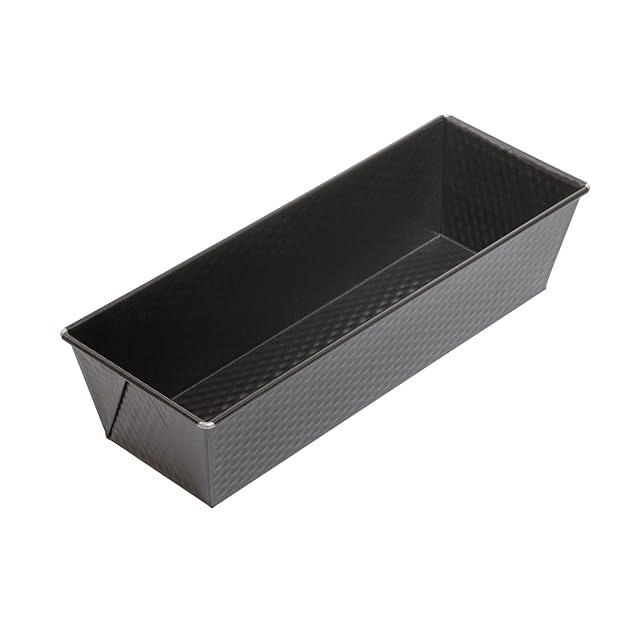
Kaiser Classic 11.8 in Steel Loaf Pan
A classic coated steel loaf pan, published at 11.8 by 4.3 by 3.1 inches (30 × 11 × 8 cm) and 2.2 quarts (2.1 L). Kaiser states a single-layer PES coating with a small PTFE content, sourdough resistance, good heat conduction for even baking, and its own manufacture in Germany.
- Size
- 11.8 × 4.3 × 3.1 in (30 × 11 × 8 cm)
- Capacity
- 2.2 qt (2.1 L)
- Material
- Steel, single-layer PES coating with a small PTFE content
- Stated
- Sourdough-resistant, oven-safe, made in Germany
- On Amazon.com
- Listed under the same reference
- Amazon reference
- B00008WX4E (identical on 6 markets)
- EAN
- 4006932621210
- Publishes dimensions AND volume — 11.8 × 4.3 × 3.1 in and 2.2 qt (2.1 L)
- Steel conducts heat better than silicone: an even bake and a browned crust
- A coated pan: the coating is the wear part
Best for: Bread and cakes where a browned, even crust matters, in a full-size oven.
≈ $29Check price on Amazon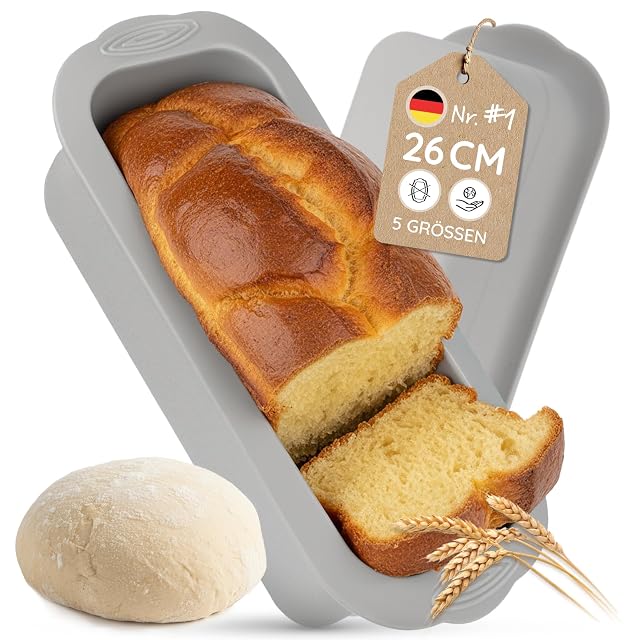
Backefix 26 cm Silicone Loaf Pan
A silicone loaf pan 10.2 inches (26 cm) long holding 2.2 quarts (2.1 L), in platinum silicone certified to LFGB, the German food-contact standard, and stated PFAS- and BPA-free. Backefix publishes reinforced outer walls and grip area against bulging, and a lotus-effect interior that releases without greasing. It is not sold on Amazon.com.
- Length
- 10.2 in (26 cm)
- Capacity
- 2.2 qt (2.1 L) — the same as the steel Kaiser on this site
- Material
- Platinum silicone, LFGB-certified
- Stated free of
- PFAS and BPA
- Construction
- Reinforced outer walls and grip area, against bulging
- Release
- Lotus-effect surface, stated to need no greasing
- Part number
- Not published
- On Amazon.com
- Not listed
- Amazon reference
- B0FG1XB8R6 (identical on 5 markets)
- EAN
- 4262365940063
- Stated PFAS- and BPA-free, in LFGB-certified platinum silicone
- Releases without greasing, per Backefix’s lotus-effect surface
- Silicone browns a crust less than steel does
Best for: Anyone who has fought a loaf out of a pan, or who avoids PFAS.
Search Amazon for this model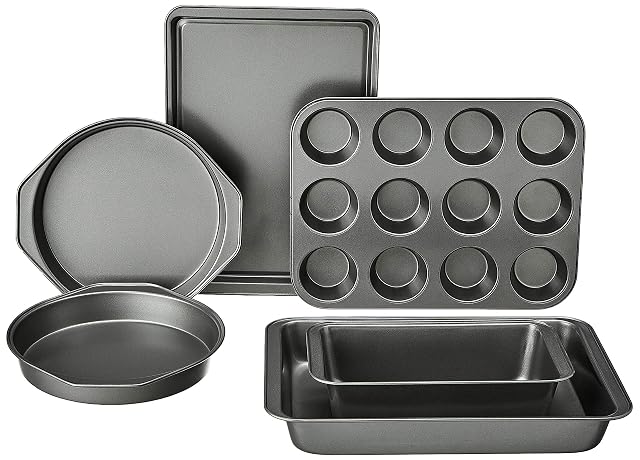
Amazon Basics 6-Piece Nonstick Bakeware Set
Six nonstick carbon steel pans — a 9 × 5 loaf, two 9-inch rounds, a 12-cup muffin, a 13 × 9 roast pan and a 13 × 9 sheet — oven safe to 428 °F.
- Price per pan
- $5.33 — the cheapest steel per pan on this shelf
- Contents
- 9 × 5 loaf, 2 × 9-inch round, 12-cup muffin, 13 × 9 roast, 13 × 9 sheet
- Oven limit
- 428 °F, which is exactly 220 °C
- Material
- Heavy-weight nonstick carbon steel
- Washing
- Hand wash for best results — no dishwasher claim
- Weight
- 1814 g (64 oz) for six — 302 g (10.7 oz) a piece
- Stack
- 16.25 × 11.75 × 6.25 inches, confirmed by the catalog
- Storage per piece
- About 199 cubic inches
- Covers a box mix
- Both ways — a 13 × 9 and two 9-inch rounds
- Reference
- 99225
- Metal utensils
- Not claimed
- Cup size on the muffin pan
- Not published
- Individual pan depths
- None published
- Description
- Four lines, all of them headings
- Amazon reference
- B0764M2JXY
- EAN
- 0806574992259
- Five dollars thirty-three a pan, cheaper per pan than any single pan on this shelf
- An oven limit in writing — 428 °F — which only one other item here publishes
- Hand wash for best results, and no dishwasher claim at all on a six-piece set
Best for: Furnishing a kitchen from nothing, at the lowest price per pan here
≈ $32Check price on Amazon
Elsewhere in the kitchen drawer
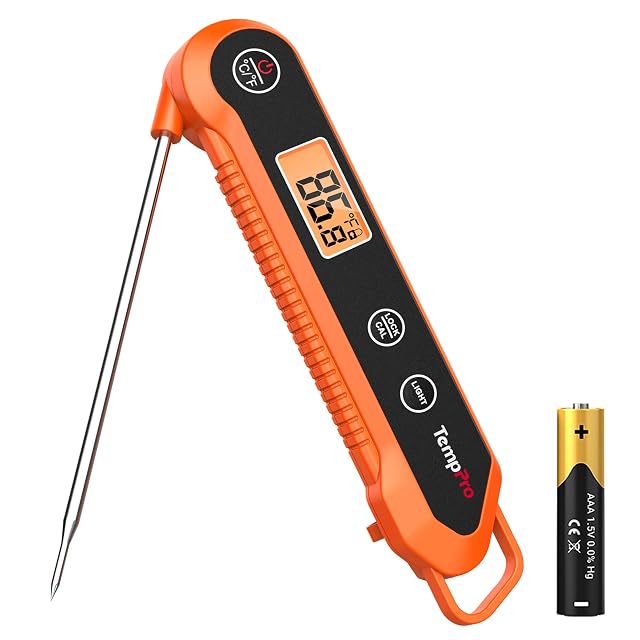
TempPro TempSwift TP03H Meat Thermometer
A one-second folding-probe thermometer rated IPX6 waterproof, with a calibration function, a bright backlit display, a magnetic back and a hook.
- Waterproof
- IPX6 — high-pressure jets; dust is not rated
- Calibration
- Published — one of only five sold on Amazon.com
- Speed
- 1 second, from the product name
- Probe
- Folding, for drawer storage
- Storage
- A magnetic back and a hook
- Display
- Large numbers, bright backlight
- Weight
- 51 g (1.8 oz), folded to 157 × 26 × 40 mm (6.18 × 1.02 × 1.57 in)
- Reference
- TP03H
- Bullets published
- Four — the fewest on this shelf
- Accuracy
- Not published, where both stablemates give ±0.9 °F
- Temperature range
- Not published, where both stablemates give −58 to 572 °F
- Battery
- Not published, where the TP03A names a AAA
- Auto shutoff
- Not published
- Probe length
- Not published
- Amazon reference
- B07Y51PCW7
- EAN
- 4897099880530
- IPX6 and a calibration function, which its two stablemates both lack
- Folds flat with both a magnet and a hook, at 51 grams
- No accuracy figure at all, where both stablemates publish ±0.9 °F
Best for: A folding thermometer that gets rinsed and can be checked against ice water
≈ $10Check price on Amazon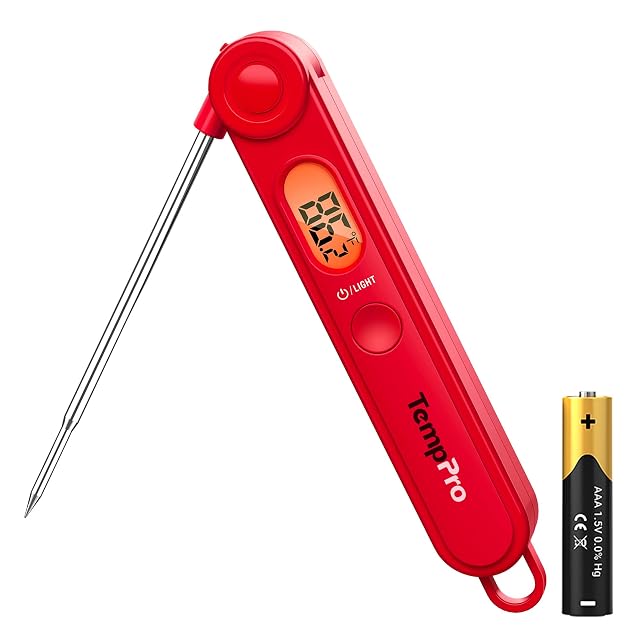
TempPro TempSwift TP03A Folding Meat Thermometer
A one-second folding-probe thermometer accurate to ±0.9 °F, with a backlit display, a magnet, a hook and a single AAA battery instead of a button cell.
- Battery
- 1 AAA, not a button cell — unique on this shelf
- Accuracy
- ±0.9 °F
- Speed
- 1 second
- Probe
- Folding, released at the push of a button
- Range
- −58 to 572 °F
- Display
- Large numbers, bright backlight
- Storage
- A built-in magnet and a hook
- Controls
- Two buttons — probe release, and backlight with power
- Named uses
- Meat, water, milk, candy, fried foods
- Weight
- 48 g (1.7 oz), folded to 155 × 33 × 41 mm (6.10 × 1.30 × 1.61 in)
- Reference
- FBA_TP03A
- Waterproof rating
- None published — the TP03H at $9.98 publishes IPX6
- Calibration
- None — the TP03H at $9.98 has it
- Probe length
- Not published
- Amazon reference
- B01IHHLB3W
- EAN
- 6927082801711
- A AAA battery rather than a button cell, which no other item here publishes
- ±0.9 °F in one second, matched only by its own sibling and beaten only by a $19.99 thermocouple
- No waterproof rating at all, where the same maker's TP03H, a cent cheaper, has IPX6
Best for: Everyday grilling and roasting, from a magnet on the hood, without hunting for button cells
≈ $10Check price on Amazon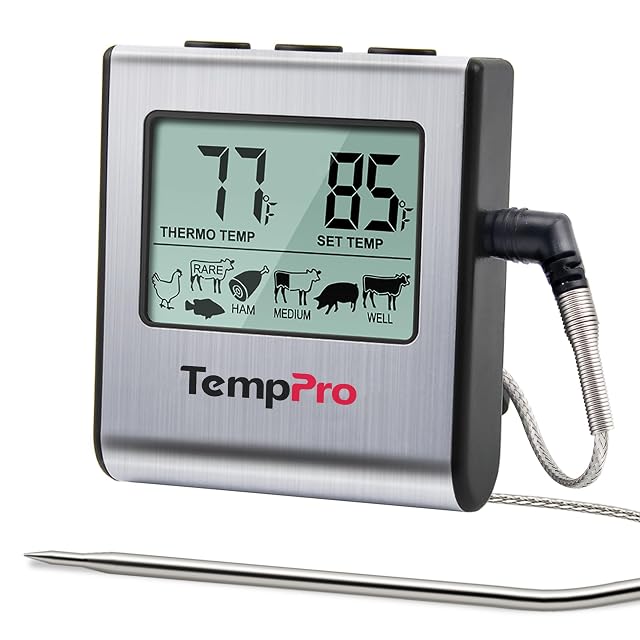
TempPro TempTrack TP-16 Leave-In Meat Thermometer
A leave-in probe thermometer with USDA preset alarms, a 99-hour timer, a 6.5 inch stepdown probe and a 40 inch mesh cable rated to 716 °F.
- Probe and wire rating
- 716 °F — the only heat rating on this shelf
- USDA presets
- Preset target temperatures per food, all resettable
- Timer
- Up to 99 hours 59 minutes, with an alarm
- Probe length
- 6.5 inches, with a stepdown tip — the longest here
- Cable
- 40 inches of stainless steel mesh
- Cooking range
- 32 to 572 °F (0 to 300 °C)
- Accuracy
- ±1.8 °F / 1 °C, at 1 degree resolution
- Storage
- A magnet, a hanging hole and a tabletop stand — three modes
- Alarm
- Beeps on target temperature or on time
- Display
- Large LCD
- Weight
- 96 g (3.4 oz) for the base — 57 × 15 × 39 mm (2.24 × 0.59 × 1.54 in)
- Reference
- TP-16
- Waterproof rating
- None published — and the base must not be washed
- Calibration
- Not published
- Amazon reference
- B017613C3C
- EAN
- 0747090310434
- The only probe on this shelf rated for oven heat — 716 °F for probe and wire
- USDA preset targets with an alarm, and every preset overwritable
- ±1.8 °F, the loosest published accuracy on this shelf
Best for: Long cooks — a smoker, a brisket, a roast — where the door stays shut
≈ $20Check price on Amazon