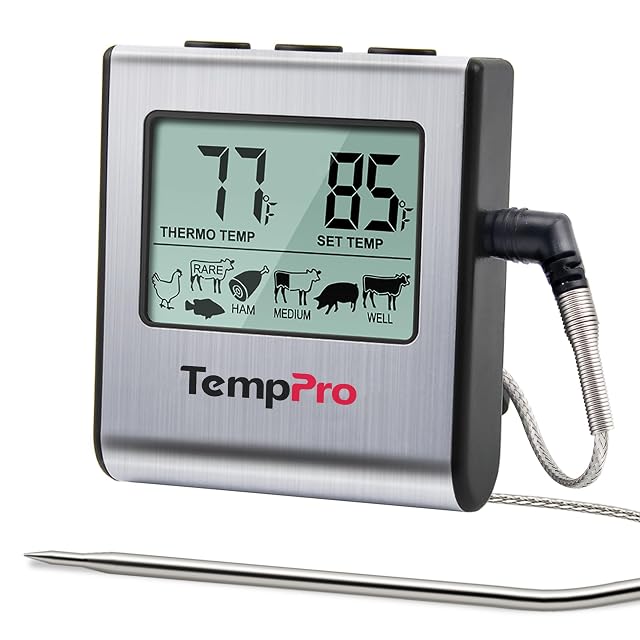
Best for: Long cooks — a smoker, a brisket, a roast — where the door stays shut
≈ $20
Check price on Amazon Probe and wire rated to 716 °F, and USDA presets
A leave-in probe thermometer with USDA preset alarms, a 99-hour timer, a 6.5 inch stepdown probe and a 40 inch mesh cable rated to 716 °F.
Best for: Long cooks — a smoker, a brisket, a roast — where the door stays shut
The KitchenAid at $11.99 publishes the warning no other page on this shelf does: “Digital thermometers are not meant to be left in food during cooking. The plastic and electronic components could be damaged with excessive heat.”
That applies to all eleven instant-reads sold on Amazon.com, from $9.97 to $18.99, and to the two European ones.
This unit is built the other way round. The probe goes in the meat, a 40 inch stainless steel mesh cable runs out of the oven, and the display and electronics sit outside — on a magnet, a hook, or a stand.
And it is the only item on this shelf that rates the part that stays in: “Meat probe and wire can withstand up to 716 degrees Fahrenheit.”
What that buys is continuous watching, which an instant-read cannot give. A brisket is a twelve-hour cook finishing at 195 to 205 °F, with hours stalled around 160. With an instant-read the only way to know is to open the lid, which costs heat every time. With this you set the target and it beeps.
Two items on this shelf work this way. The comparison matters:
this, $19.99 — a 40 inch mesh cable · a 99 hour 59 minute timer · USDA presets, resettable · a 6.5 inch stepdown probe · 32 to 572 °F · ±1.8 °F at 1 degree resolution · probe and wire rated 716 °F · three storage modes · no warranty Taylor, $24.24 — a 4-foot silicone cord · a 24 hour timer · a programmable target · no probe length · 32 to 392 °F, the narrowest range on this shelf · no accuracy figure · no heat rating · a magnet and a stand · one year limited warranty
So the cheaper of the two publishes nearly everything and buys no warranty; the dearer publishes almost nothing and buys a year.
“Meat probe and wire can withstand up to 716 degrees Fahrenheit” is a survival figure, not a measuring range — and the distinction is the whole point of a leave-in thermometer.
The measuring range is separate: 32 to 572 °F (0 to 300 °C).
Nothing else on this shelf publishes a survival figure at all. Two pages gesture at one: the KitchenAid says electronics “could be damaged with excessive heat” without a number, and the Waytiffer-style phrasing appears on the Taylor, which offers nothing.
Why 716 °F is the right order of magnitude. An oven runs 300 to 500 °F. A barbecue under a closed lid goes well past 500. A smoker holds 225 to 250 °F for hours. 716 °F (380 °C) clears all of them with margin — which is what a part sitting in that air for twelve hours needs.
And it explains the materials. The cable is stainless steel mesh, not plastic sheath. A plastic-jacketed lead would soften in a door gap and melt on a grill lid; mesh-sheathed stainless is the only sensible answer, and it is also why the cable survives being compressed by a door.
The Taylor at $24.24 publishes a “4-foot silicone cord” and no rating. Food-grade silicone is generally serviceable to around 220 °C — about 430 °F — which is lower than this and may be perfectly adequate, and the page does not say.
The measuring range has one visible consequence: 32 °F at the bottom, so this cannot be used as a fridge or freezer thermometer, where six items on this shelf reach −58 °F. Which is correct for the format — a leave-in with a cable is not the tool you put in a freezer.
“Programmable alert with preset temperatures for specific foods recommended by USDA; All of the preset temps can be reset to your desired tastes”
It is the only item on this shelf with presets at all. The nearest equivalent is printed rather than programmed: the Alpha Grillers at $14.97 ships “instructions, meat temperature chart” in its box.
Why presets are worth having. A thermometer only answers the question you ask, and the question is a number — and most people do not know the numbers.
The USDA figures are safety minima:
Poultry — 165 °F Ground meat — 160 °F Whole cuts of beef, pork, lamb and veal — 145 °F with a three-minute rest
Those are the floor, not the target — which is exactly why the second half of the bullet matters.
What the presets do if followed blindly. Chicken breast at 165 °F is safe and dry; many cooks pull it lower and rest it, because carryover continues the cook. Pork at 145 °F is faintly pink and correct, far below where most people take it. And beef is the clearest case: the USDA minimum of 145 °F is medium, so a rare steak at 125 °F or a medium rare at 135 °F will not trigger the alarm until it is overcooked unless you reset it.
And the long cooks sit far above any safety figure. Brisket and pulled pork finish at 195 to 205 °F, not because of safety but because that is where collagen turns to gelatine.
So: use the presets as a floor and overwrite them for taste, which is precisely what the page tells you to do — and that is a more honest instruction than most of this shelf manages.
“timer and alarm functions, up to 99 hours 59 minutes… will beep to notify you once the food ever reaches preset temperature or time limits”
Two alarms, on two different quantities, which is the complete arrangement: one on temperature, one on the clock.
The Taylor at $24.24 publishes a timer “up to 24 hours”.
Does 99 hours matter? For meat, no — the longest domestic cook is a 16- to 20-hour brisket or shoulder. For the two uses the storage bullet names, possibly yes: “cheese making” involves holds of many hours, and a sourdough bulk fermentation and cold proof together can run two or three days.
What matters more than the ceiling is that the timer and the temperature alarm are independent. A long cook has two failure modes — the meat finishing early while you are out of the room, and a stall that goes on longer than the cook should — and this unit will tell you about both.
The accuracy figure is the page’s weakest number and it is honestly stated: “1 degree resolution, 1.8 degrees Fahrenheit / 1 degrees Celsius.”
±1.8 °F is the loosest published tolerance on this shelf:
±0.5 °F — the ThermoMonster at $16.99, a thermocouple, with NIST cited ±0.9 °F — the TempPro TP-02S at $9.99 and TP03A at $9.99 ±1 °F — the ANDAXIN at $9.99, both ONFIKY units at $9.97 and $9.98, the LONICERA at $12.99 ±1.8 °F — this
And for the job it does, it is enough. A brisket at 203 °F and a brisket at 205 °F are the same brisket. The one degree resolution is more relevant than the tolerance on a cook where you are watching a trend over hours rather than catching a moment — and the instant-reads are the tools for the moment.
Seven of the fourteen items sold on Amazon.com publish no accuracy figure at all, including both Taylor units.
The four published probe lengths on this shelf:
6.5 inches — this, with a stepdown tip 5.3 inches — the TempPro TP-02S at $9.99, rigid 5 inches — the LONICERA at $12.99 4 inches — the ThermoMonster at $16.99
Ten items publish nothing, including both Taylor units and the KitchenAid.
Why length matters more on a leave-in than anywhere else. The probe has to reach the center of the joint and then stay there for hours while the meat shrinks around it. A short probe works loose and ends up reading the oven, which is the classic leave-in failure: a reading that climbs suddenly to 300 °F because the tip has backed out into the air.
Six and a half inches lets you insert along the length of a joint rather than into its side, which is both more secure and reads the true center.
The stepdown tip is the detail nobody else on this shelf publishes. A shaft that narrows at the end does two things: the thin section comes to temperature faster, because there is less metal to heat, and it leaves a smaller hole, so less juice escapes over a long cook. It also means the thick part of the shaft carries the structural load while only the tip is doing the measuring.
And the cable has to get out of the oven, which the page does not explain. A domestic oven door closes on a flexible gasket, and a thin cable passes under it without breaking the seal. Forty inches is about a meter, and the geometry is tighter than it sounds: the probe is in the middle of a joint on the middle shelf, perhaps fifteen inches from the door, leaving about two feet to reach a magnet or a countertop. Enough for an oven. Tight for a barbecue, where the base must not sit on a hot lid.
Two habits neither leave-in page gives. Route the cable out of the side of the door rather than the bottom, where hinge pressure is lowest. And never close the door on the plug — the junction between probe and cable is the part that fails.
“a magnetic back… a hanging hole… and a tabletop stand for any layout”
It is the only item on this shelf with all three.
The shelf, on storage: a magnet on eight of the fourteen items sold on Amazon.com · a hang hole on three — this, the TempPro TP-02S at $9.99 and the ANDAXIN at $9.99 · a folding probe on the TempPro TP03A and TP03H · a probe cover that becomes a handle on the Taylor Compact at $18.99, the only storage feature here that improves the grip · a tabletop stand on this and the Taylor at $24.24, whose display “can stand up to be seen easily” and whose “magnetized back can be used to attach to oven door”.
On a leave-in, the stand is not a nicety. The base has to sit somewhere for twelve hours within reach of a forty-inch cable — and the three options correspond to three real kitchens: an oven door or a hood for the magnet, a rail for the hook, a countertop for the stand.
And the magnet has a specific use here the page does not spell out. The base on the oven door is the shortest cable run there is, which is what makes forty inches workable at all.
The base is small and light: 96 grams, 57 × 15 × 39 mm — about 2.2 × 0.6 × 1.5 inches — which is the size of a matchbox and does not include the probe or the cable. For comparison on the shelf, the handhelds run from 23 g to 113 g.
Four uses are named in the same bullet and two are unusual. “baking, smoking, candy making, and cheese making.” Cheese making appears on no other page here, and it is a genuinely apt use: curd setting, scalding and stretching all happen in narrow temperature bands over long holds, which is a timer-and-alarm job rather than a spot-check job.
No waterproof rating, and on this unit that matters in a specific way. The base has a socket for the probe plug, and a socket cannot be sealed the way a sealed handheld can — so the base must not be rinsed at all, whatever the probe can take. Four items on this shelf publish IP67 or IPX6, one IP65, and the two leave-in units publish nothing, which is probably the honest position for the format. Wash the probe, wipe the base.
No calibration function, where five items on this shelf have one. The free check still works — crushed ice topped with water, stirred, holds 32 °F / 0 °C; boiling water is 212 °F at sea level, falling about 1 °F per 500 feet — and at ±1.8 °F you would want to know.
No reading speed. Ten items on this shelf publish one, from 0.5 s to under 6 s. On a leave-in it hardly matters, since the probe is already at temperature — which is a fair reason to omit it.
No sensor type. Only two pages on this shelf name theirs — the KitchenAid’s thermistor at under six seconds and the ThermoMonster’s thermocouple at half a second — and one word explains a twelvefold difference.
No battery type or battery life. On a unit that must run unattended for 99 hours, this is the sharpest omission on the page. Only the TempPro TP03A at $9.99 makes the cell an argument — “1 AAA battery instead of a button cell… lasts twice as long” — and both ONFIKY units publish “4000+ Hour Battery Life”. A twelve-hour brisket wants a cell you can be sure of.
No alarm volume, on a unit whose entire value is that it beeps while you are elsewhere.
No second probe or channel, so one food at a time.
No warranty, where the Taylor at $24.24 — the other leave-in here — publishes one year limited, and the LONICERA at $12.99 publishes 18 months plus a 60-day money-back guarantee, the longest term on this shelf.
No country of manufacture, which no item on this shelf publishes.
Read on the day this page was built: $20 at the American Amazon shop.
Read from Keepa on the day this page was last revised; stock and price both move without notice.
Prices quoted in this text were read on 2026-10-17. The live price is at the top of the page.
It stays in the food with the oven shut, which no instant-read can do — and one page here says so explicitly. The KitchenAid at $11.99 publishes the warning nobody else does: "Digital thermometers are not meant to be left in food during cooking. The plastic and electronic components could be damaged with excessive heat." That applies to all eleven instant-reads sold on Amazon.com, from $9.97 to $18.99, and to the two European ones. This unit is built the other way round. The probe goes in the meat, a 40 inch stainless steel mesh cable runs out of the oven, and the display and electronics sit outside on a magnet, a hook or a stand. And it is the only item here that publishes a heat rating for the part that stays in: "Meat probe and wire can withstand up to 716 degrees Fahrenheit." What that buys you is the thing an instant-read cannot give: continuous watching. A brisket is a twelve-hour cook that finishes at 195 to 205 °F and spends hours stalled around 160 — and the only way to know where it is with an instant-read is to open the lid, which costs heat every time. With this you set the target and it beeps. The two units on this shelf that work this way are this and the Taylor at $24.24. The comparison is worth making: this has a 40 inch mesh cable, a 99 hour 59 minute timer, USDA presets, a 6.5 inch stepdown probe, a 32 to 572 °F range and the 716 °F rating. The Taylor has a 4-foot silicone cord, a 24 hour timer, a programmable target, no probe length, a 32 to 392 °F range, no heat rating — and a one-year warranty, which this does not have.
Target temperatures for each kind of meat, built in, and the page is unusually sensible about them. Bullet one: "Programmable alert with preset temperatures for specific foods recommended by USDA; All of the preset temps can be reset to your desired tastes." It is the only item on this shelf with presets at all. The nearest equivalent is printed rather than programmed: the Alpha Grillers at $14.97 ships "instructions, meat temperature chart" in the box. Why the presets are worth having. A thermometer only answers the question you ask it, and the question is a number — and most people do not know the numbers. The USDA figures are safety minima: poultry 165 °F, ground meat 160 °F, whole cuts of beef, pork, lamb and veal 145 °F with a three-minute rest. Those are the floor, not the target, which is exactly why the second half of the bullet matters. What the presets will do if you follow them blindly. Chicken breast at 165 °F is safe and dry — many cooks pull it at 155 and rest it, because carryover continues the cook. Pork at 145 °F is pink and correct, and well below what most people cook it to. And beef is the clearest case: the USDA minimum of 145 °F is medium, so a rare steak at 125 °F or a medium rare at 135 °F will trigger the alarm late or not at all unless you reset it. Brisket and pulled pork go to 195 to 205 °F, far above any safety figure, because that is where collagen breaks down. So use the presets as a floor and overwrite them for taste, which is precisely what the page tells you to do.
Through the door seal, and the page never mentions it — which is the one practical thing a buyer needs to know. The bullet says what the cable is for: "40 inches stainless steel mesh cable connects thermometer to base, outside of oven." The arrangement in practice. A domestic oven door closes on a flexible gasket, and a thin cable passes under it at the top or the side without breaking the seal in any meaningful way. The door shuts on the cable, not on the probe plug. Which is why the cable is mesh-sheathed stainless rather than plastic — it is being compressed by a door and heated by the gap, and this is the only item on the shelf that rates the wire: 716 °F for probe and wire. Forty inches is about a meter, and the geometry is tighter than it sounds: the probe is in the middle of a joint on the middle shelf, which is perhaps fifteen inches from the door, so the cable has about two feet left to reach a magnet or a countertop. That is enough for an oven door and tight for a barbecue, where the base must not sit on the lid. The Taylor at $24.24 publishes a 4-foot silicone cord — eight inches longer, and silicone rather than mesh, with no heat rating at all, which on a cord that lives in a door gap is the figure to want. Two habits neither page gives. Route the cable out of the side of the door rather than the bottom, where the hinge pressure is lowest. And never close the door on the plug — the junction between probe and cable is the part that fails.
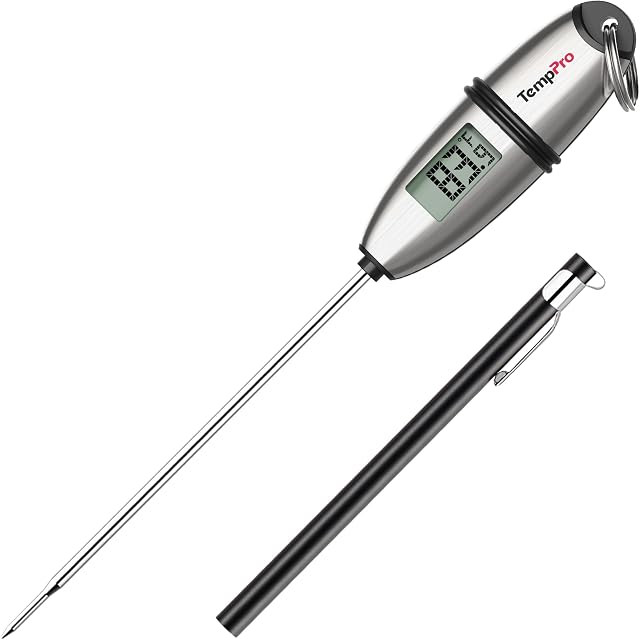
A one-second instant-read thermometer accurate to ±0.9 °F, with a rigid 5.3 inch stainless probe, −58 to 572 °F and a ten-minute auto shutoff.
Best for: Bread, deep pots and liquids, where probe reach matters more than a magnet
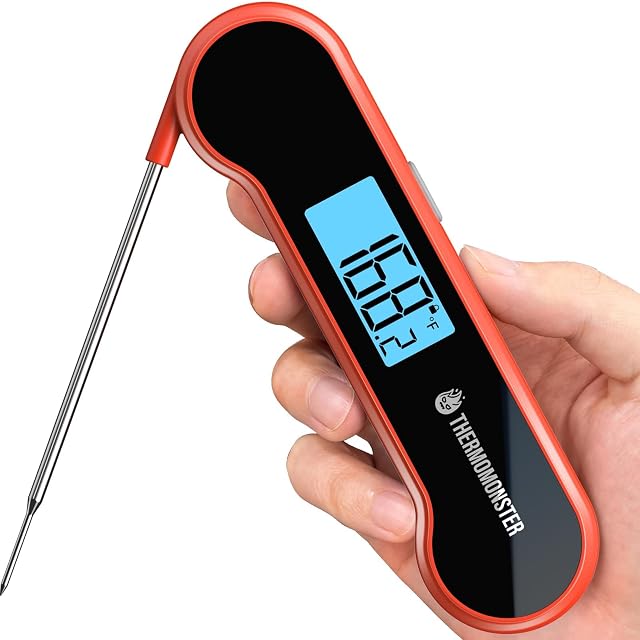
A thermocouple thermometer with NIST-certified ±0.5 °F accuracy in half a second, a 4-inch probe, a temperature lock, an auto-flip display and motion wake.
Best for: Thin cuts, fast reads and anyone who holds a thermometer in the left hand
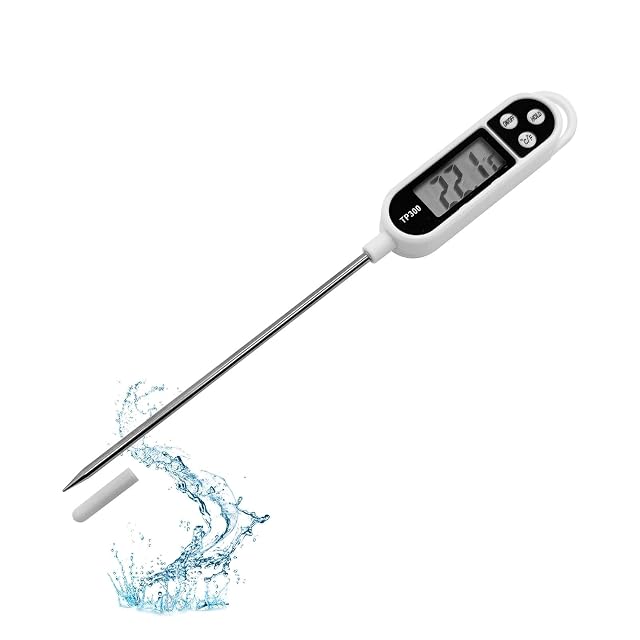
A digital instant-read thermometer stated to read in 2 to 3 seconds, to ±1 °C, from −58 to 572 °F, on a food-grade stainless probe, with a hold button, a probe cover and hanging holes. Sold on the European Amazon stores, not on Amazon.com.
Best for: A reader in Europe; in the United States, one of the thermometers sold on Amazon.com in this hub.
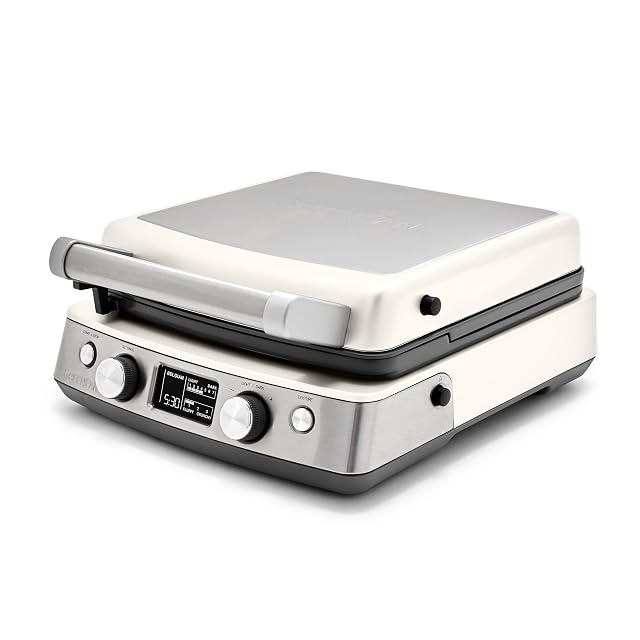
A four-square waffle maker with diamond-infused ceramic cast plates free of PFAS and PFOA, two plate sets stored inside, an XL LCD, shade control and an extra-large moat.
Best for: A household that wants Belgian and classic waffles without a fluoropolymer
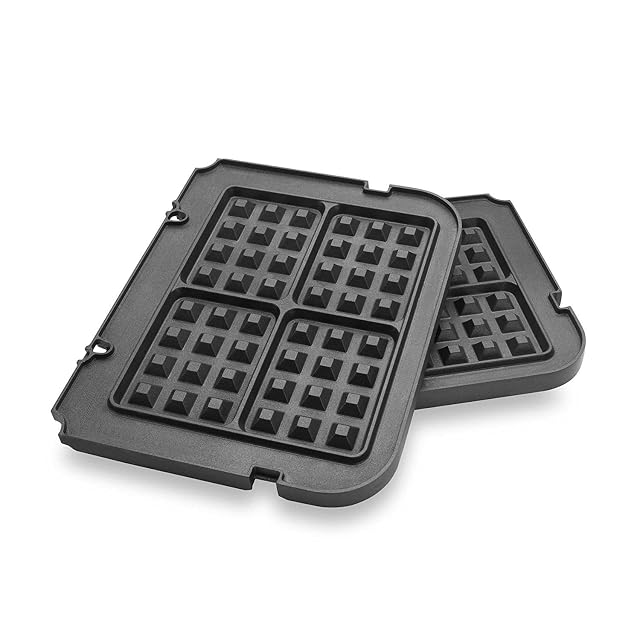
A two-plate waffle set in food-grade aluminum with double-layer non-stick for the Cuisinart Griddler GR-4N, GR-5B, GR-6 and GRID-8N, baking four ¾-inch Belgian waffles.
Best for: A Cuisinart Griddler GR-6 or GRID-8N, which nothing else here fits
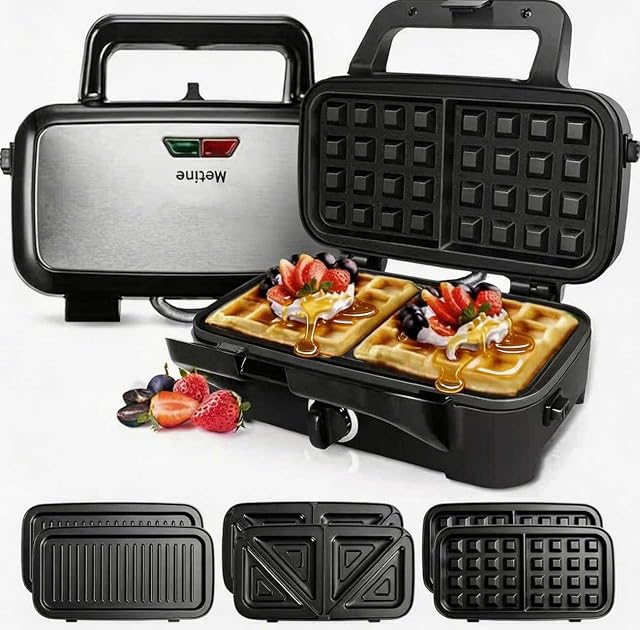
A 1,200-watt three-in-one with waffle, sandwich and grill plates each 10.8 × 5.5 inches, five browning levels, a ready light and published cooking times.
Best for: A household that wants control and repeatability from a three-in-one press