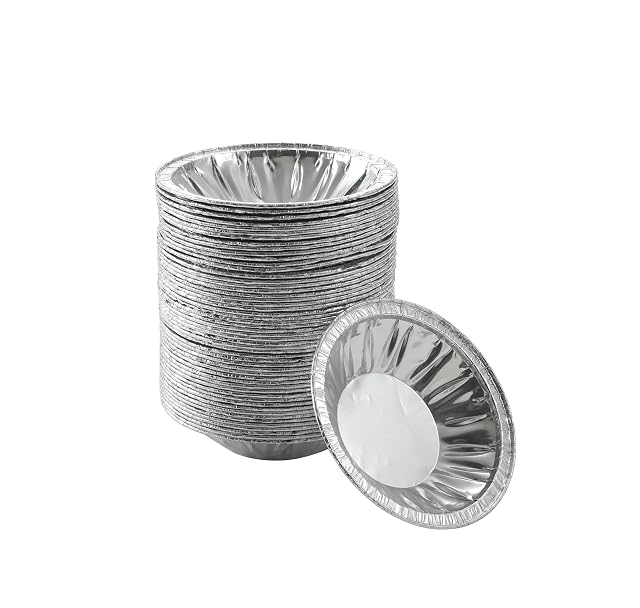
Twenty cents a tin, and 2.2 grams each
Waytiffer 50-Pack 4.5 in Foil Mini Pie Tins
Fifty heavy-duty aluminum foil mini pie and tart tins, 4.5 inches across the top and 2.5 across the base, stackable and recyclable.
Specifications
- Price per tin
- 20 cents — 50 tins for $9.99
- Weight per tin
- 2.2 g (0.1 oz) — catalog 109 g (3.8 oz) for the pack of fifty
- Top diameter
- 4.5 inches
- Base diameter
- 2.5 inches — under a third of the top area
- Depth
- Not published; the catalog figure is 50 mm (1.97 in), about 2 inches
- Material
- 100 percent aluminum foil
- Recyclable
- Yes, stated
- Freeze and reheat
- Both, stated in the product name
- Rigidity claim
- Stated not to bend or fold in during baking
- Packaging
- A thick box rather than plastic
- Three diameters given
- The name says 4 inch; the bullet says 4.5 and 2.5
- Oven limit
- Not published
- Foil thickness
- Not published, behind a heavy-duty claim
- Reference
- The catalog field reads Waytiffer
- Amazon reference
- B0BPM2RZHK
- EAN
- 8909956385068
The plus side, and the minus
Strengths
- Twenty cents a tin, against $5.99 for the cheapest steel pan here
- Nothing to wash, and foil goes from freezer to oven to table
- Fifty of them weigh 109 grams in total, so storage is nothing
Compromises
- Three different diameters for one pan, across the name and the bullets
- The 2.5 inch base is under a third of the top area, so the pie is mostly wall
- No foil thickness and no oven limit, behind a heavy-duty claim
What the maker puts in writing
- “HEAVY-DUTY & DURABLE ALUMINUM TIN FOIL --- With these 100% aluminum foil mini pie tins, we provide top quality and durability. The small pie pans won’t bend or fold in during baking”
- “MINI SIZE --- These disposable tart pans measure 4.5 inch diameter on top and 2.5 inch diameter on bottom, The small round baking dishes are a wonderful choice for the making of pies, tarts, cobblers, personal-sized cakes”
- “DISPOSABLE FOR QUICK & EASY, MESS-FREE CLEAN-UP --- …also great for picnics, BBQ’s, camping trips and travel – simply dispose of them after eating!”
- “VALUE THICK BOX PACK OF 50 CAKE PANS FOR THE PANTRY --- …bulk pack of 50 pieces, Stronger than ordinary plastic packaging”
- “RECYCLABLE ENVIRONMENTAL PROTECTION MATERIALS --- Use aluminum foil material which can be recycled”
- From the name: “Pie Pans 4 inch”, “Easily Stack & Store, Freeze & Reheat”
- Reference Waytiffer · Catalog: 109 g (3.8 oz), 114 × 114 × 50 mm (4.49 × 4.49 × 1.97 in)
Three diameters for one pan, and the name is the wrong one
The name says 4 inch. The bullet says 4.5 on top and 2.5 on the bottom. The catalog says 114 × 114 mm, which is 4.49 inches — the top figure, to within a hundredth.
So nothing on this page is actually 4 inches, and the only figure the catalog corroborates is the one in the bullet.
The taper is steep, and that is the real specification.
A 2.5 inch base has an area of about 4.9 square inches. A 4.5 inch top has about 15.9. The base is 31 percent of the top.
Against: the flat part — the bit that holds filling without it sliding down a slope — is small. A “personal-sized” pie in this tin is mostly wall.
In favor: a steep cone is precisely why fifty of them nest into one box, which the bullets sell twice: “Easily Stack & Store” in the name, “bulk pack of 50 pieces” in bullet four. A near-vertical tin does not stack.
The depth is not published. The catalog says 50 mm, about 2 inches, and that is the only number for it.
The same maker does better on its other listing. The Waytiffer foil loaf pan at $9.99 publishes all three dimensions in the bullet — “8.5”L x 4.5” W x 2.5”H” — and the catalog confirms them exactly at 216 × 114 × 64 mm. Two listings, one maker, two standards of disclosure.
Two point two grams of foil, and no gauge behind the heavy-duty claim
“we provide top quality and durability. The small pie pans won’t bend or fold in during baking.”
The catalog weight is 109 grams for fifty tins — 2.18 grams each.
For scale on this shelf:
this — 2.2 g a tin Waytiffer foil loaf pan, $9.99 — 12.0 g a pan (299 g for 25), five and a half times as much foil for roughly four times the plan area GoodCook 9 × 5 steel, $5.99 — 268 g, which is 123 times this tin Amazon Basics six-piece, $31.99 — 302 g a piece (1814 g for six) Elbee eight-piece, $59.99 — 454 g a piece (the only item here to publish its own weight: “8 pounds”)
What is missing is the thickness. Foil is specified in mils or microns, and “heavy-duty” has no threshold behind it. Nothing on this shelf publishes a thickness of anything, foil or steel.
And what makes a shallow foil tin rigid is mostly its shape. The rolled rim and the fluted wall are what stop it folding — both are present on this tin, and neither is mentioned anywhere on the page.
The practical test: carry one filled, by the rim, with one hand. A tin that survives that will not buckle in an oven, where nothing is lifting it.
Twenty cents against six dollars, and they are not substitutes
$9.99 for 50 is 20 cents a tin.
The cheapest steel pan on this shelf is $5.99. The cheapest steel per piece is the Amazon Basics set at $5.33. So one steel pan costs what 30 of these cost.
If you bake once, for an event, there is no argument — and the saving is not really the money. It is bullet three: “simply dispose of them after eating”. Fifty individual tarts and nothing comes home to be washed.
If you bake every week, the arithmetic inverts inside a year.
But nothing else on this shelf makes an individual tart. The steel here is 9 × 5 loaf (three times), 8 × 4 loaf, 13 × 9 roast, 8 × 8 square, 12-cup muffin, 9 inch round cake — and the nearest equivalent, the KitchenAid 12-cup muffin pan at $21.99, has cups far smaller than 4.5 inches.
And the third use is one no steel pan can do: “Freeze & Reheat”, in the product name, and “picnics, BBQ’s, camping trips and travel” in bullet three. A tin you can give away with the food still in it.
Aluminum bakes differently from steel, and nobody here says so
“100% aluminum foil” is a material claim with a baking consequence.
Aluminum conducts heat about three times better than steel and this tin is two grams thin, so it reaches oven temperature almost immediately and holds almost no heat of its own. The filling drives the bake, not the pan.
Two practical effects. The base browns fast, because there is nothing between the oven floor’s radiant heat and the pastry — which is good for a tart shell and the reason commercial bakeries use foil. And it cools as fast as it heats, so a tart taken out of the oven in one of these stops cooking at once, where a 268 gram steel pan keeps going for several minutes.
The reverse is the limit: no thermal mass means no buffering. On a hot oven floor or under a grill element, a 2.2 gram tin gives the pastry no protection at all.
Neither Waytiffer listing mentions any of this, and the only thermal claim on either is on the loaf pan: “The aluminum trays have a high thermal conductivity which allows them to handle extremely high temperatures for oven use”, plus “they also optimize airflow during cooking”. Which is the right idea on the wrong listing — and even there, no temperature is given.
Recyclable, and that claim is actually sound
“Use aluminum foil material which can be recycled to solve… pollution problems such as the difficult melted disposable plastic”
Aluminum is one of the few single-use materials where this holds up. It is recycled indefinitely without losing properties, and reprocessing it takes a small fraction of the energy of making it from ore — which is why scrap aluminum has a real resale value and scrap plastic largely does not.
The condition the bullet omits is that it has to be clean. Foil with baked-on pastry and fat is contaminated, and many kerbside schemes reject it on that basis. Scrape and rinse it, or it goes in the bin like anything else.
The packaging claim is the smaller one and it is fair: “Stronger than ordinary plastic packaging”, a thick box rather than a bag. Fifty tins weighing 109 grams in total need a box or they arrive as one crushed stack.
What is not published
No foil gauge or thickness, as above, behind a heavy-duty claim.
No depth. The bullet gives two diameters and no height; the catalog says 50 mm.
No oven temperature limit. Only two items on this shelf publish one — the Amazon Basics set at 428 °F and the Elbee set at 420 °F — and neither Waytiffer listing does, although the loaf pan goes as far as “extremely high temperatures” without a figure.
No capacity, where the sister listing publishes “2Lb” for its loaf pan. A 4.5 inch tapered tin holds a specific volume and it is not given.
No statement on whether they can be reused. They are sold as disposable and foil will take a second bake, and the page does not say.
No warranty and no country of manufacture, which no item on this shelf publishes.
Availability
Read on the day this page was built: $9 at the American Amazon shop.
Read from Keepa on the day this page was last revised; stock and price both move without notice.
Prices quoted in this text were read on 2026-10-17. The live price is at the top of the page.
What readers want to know
How big is it really — 4 inches, 4.5 or 2.5?
Four and a half across the top, and the name is wrong. The product name says "Pie Pans 4 inch, Mini Pie Tins". Bullet two says something different: "These disposable tart pans measure 4.5 inch diameter on top and 2.5 inch diameter on bottom." And the catalog settles it: 114 × 114 × 50 mm, which is 4.49 × 4.49 × 1.97 inches — matching the top figure to within a hundredth of an inch. So the name understates the top by half an inch and nothing on the page is 4 inches. The taper is the part worth understanding. A base of 2.5 inches has an area of about 4.9 square inches; a top of 4.5 inches has about 15.9. The base is 31 percent of the top. That is a steep cone for a pie tin, and it has two consequences. Against: the flat part — the bit that holds filling without it running down a slope — is small, so a "personal-sized" pie is mostly wall. In favor: steep walls are exactly why fifty of these nest into one box, and the bullet sells that: "Easily Stack & Store". A near-vertical tin would not stack. The depth is not published anywhere, and the catalog figure of 50 mm (1.97 in) — about 2 inches — is the only number for it. For comparison on this shelf: the Waytiffer foil loaf pan at $9.99 publishes all three of its dimensions in the bullet (8.5 × 4.5 × 2.5 inches) and the catalog confirms them exactly. The same maker, two listings, two standards of disclosure.
Is 2.2 grams of foil enough not to buckle?
The page asserts it and publishes nothing to support it. The claim is bullet one: "With these 100% aluminum foil mini pie tins, we provide top quality and durability. The small pie pans won’t bend or fold in during baking." The catalog gives the weight of the pack: 109 grams for fifty tins — 2.18 grams each. For scale on this shelf: the GoodCook 9 × 5 steel pan at $5.99 weighs 268 grams, which is 123 times as much. The Waytiffer foil loaf pan at $9.99 weighs 299 grams for 25, or 12.0 grams each — five and a half times this tin, for a pan roughly four times the plan area. So per square inch the loaf pan is the heavier foil. What is missing is the gauge. Foil is specified in mils or microns, and "heavy-duty" is a marketing word with no threshold behind it. Nothing on this shelf publishes a thickness — not this, not the loaf pans, not any of the steel. What actually makes a shallow foil tin rigid is its shape, not only its thickness: the rolled rim and the fluted wall are what stop it folding, and both are visible on this tin and neither is mentioned. The practical test: carry one filled, by the rim, with one hand. A tin that passes that will not buckle in an oven, where nothing is lifting it.
Foil tins or a steel pan — which is actually cheaper?
It depends entirely on how many times you bake, and the crossover is early. Twenty cents a tin, fifty of them, nothing to wash. The cheapest steel pan on this shelf is $5.99 — the GoodCook 9 × 5 — and the cheapest per piece is the Amazon Basics six-piece set at $31.99, which is $5.33 a piece. So one steel pan costs what 30 of these cost. If you bake once, for an event, fifty individual tarts for $9.99 is unarguable, and the real saving is not the money: it is that nothing comes home to be washed, and bullet three says exactly that — "simply dispose of them after eating". If you bake every week, the arithmetic inverts within a year. But the two are not substitutes, and that is the honest answer. These are 4.5 inch individual tins; nothing else on this shelf makes an individual tart at all. The steel on this shelf is 9 × 5 loaf, 13 × 9 roast, 8 × 8 square, 8 × 4 loaf, 12-cup muffin and 9 inch round cake. The nearest equivalent is a muffin pan — the KitchenAid 12-cup at $21.99 — and its cups are far smaller than 4.5 inches. And the third use is the one the bullets name and the steel cannot do: "Freeze & Reheat", picnics, camping, travel. A tin you can give away with the food in it.
More pans & molds
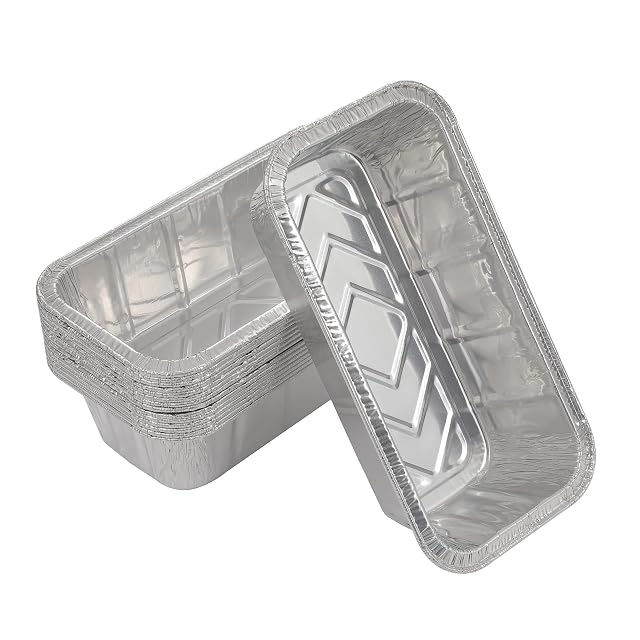
Waytiffer 25-Pack 8.5 × 4.5 in Foil Loaf Pans
Twenty-five heavy-duty aluminum foil loaf pans of 8.5 × 4.5 × 2.5 inches, rated 2 lb, recyclable and oven safe.
- Price per pan
- 40 cents — 25 pans for $9.99
- Capacity
- 2 lb — the only dough-weight capacity on this shelf
- Size
- 8.5 × 4.5 × 2.5 inches, all three published
- Catalog confirms it
- 216 × 114 × 64 mm = 8.5 × 4.5 × 2.5 inches exactly
- Weight per pan
- 12.0 g (0.4 oz) — catalog 299 g (10.5 oz) for twenty-five
- Material
- Aluminum foil, stated high thermal conductivity
- Airflow claim
- Stated to optimize airflow for heat distribution
- Recyclable
- Yes, stated fully recyclable
- Return
- A no-questions-asked return is stated
- Oven limit
- Not published — "extremely high temperatures" with no figure
- Foil thickness
- Not published, behind a heavy-duty claim
- Smaller than the steel
- 8.5 × 4.5 against the 9 × 5 standard
- Lid
- None mentioned
- Reference
- Not stated by the maker
- Amazon reference
- B09BJGLM9Y
- EAN
- 8368456418612
- Forty cents a pan, against $5.99 for the cheapest steel loaf pan here
- The only dough-weight capacity on the shelf — 2 lb — and all three dimensions published
- 8.5 × 4.5 is smaller than the 9 × 5 standard the rest of the shelf uses
Best for: Baking bread or meatloaf to give away, twenty-five times over
≈ $10Check price on Amazon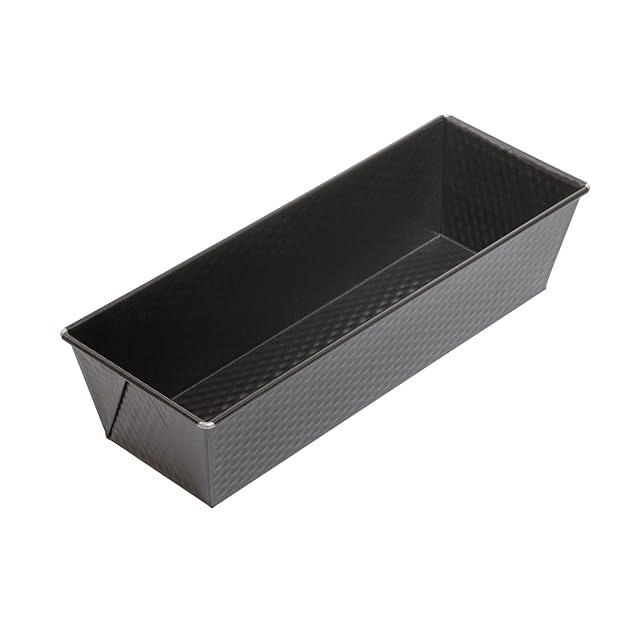
Kaiser Classic 11.8 in Steel Loaf Pan
A classic coated steel loaf pan, published at 11.8 by 4.3 by 3.1 inches (30 × 11 × 8 cm) and 2.2 quarts (2.1 L). Kaiser states a single-layer PES coating with a small PTFE content, sourdough resistance, good heat conduction for even baking, and its own manufacture in Germany.
- Size
- 11.8 × 4.3 × 3.1 in (30 × 11 × 8 cm)
- Capacity
- 2.2 qt (2.1 L)
- Material
- Steel, single-layer PES coating with a small PTFE content
- Stated
- Sourdough-resistant, oven-safe, made in Germany
- On Amazon.com
- Listed under the same reference
- Amazon reference
- B00008WX4E (identical on 6 markets)
- EAN
- 4006932621210
- Publishes dimensions AND volume — 11.8 × 4.3 × 3.1 in and 2.2 qt (2.1 L)
- Steel conducts heat better than silicone: an even bake and a browned crust
- A coated pan: the coating is the wear part
Best for: Bread and cakes where a browned, even crust matters, in a full-size oven.
≈ $29Check price on Amazon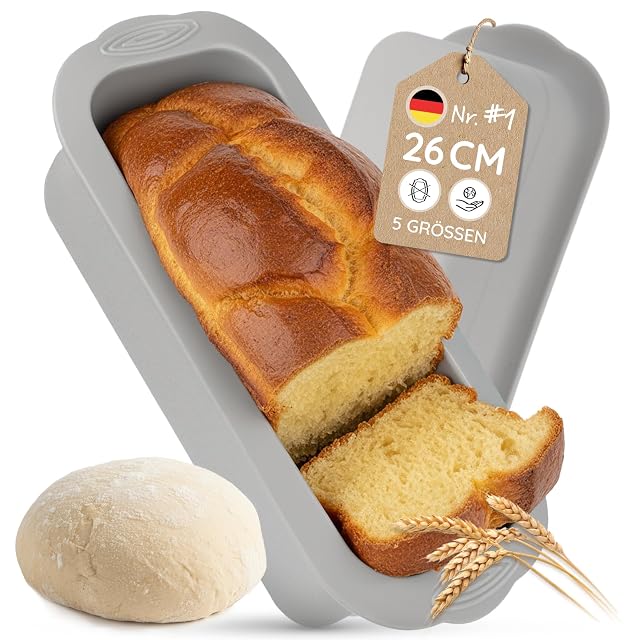
Backefix 26 cm Silicone Loaf Pan
A silicone loaf pan 10.2 inches (26 cm) long holding 2.2 quarts (2.1 L), in platinum silicone certified to LFGB, the German food-contact standard, and stated PFAS- and BPA-free. Backefix publishes reinforced outer walls and grip area against bulging, and a lotus-effect interior that releases without greasing. It is not sold on Amazon.com.
- Length
- 10.2 in (26 cm)
- Capacity
- 2.2 qt (2.1 L) — the same as the steel Kaiser on this site
- Material
- Platinum silicone, LFGB-certified
- Stated free of
- PFAS and BPA
- Construction
- Reinforced outer walls and grip area, against bulging
- Release
- Lotus-effect surface, stated to need no greasing
- Part number
- Not published
- On Amazon.com
- Not listed
- Amazon reference
- B0FG1XB8R6 (identical on 5 markets)
- EAN
- 4262365940063
- Stated PFAS- and BPA-free, in LFGB-certified platinum silicone
- Releases without greasing, per Backefix’s lotus-effect surface
- Silicone browns a crust less than steel does
Best for: Anyone who has fought a loaf out of a pan, or who avoids PFAS.
Search Amazon for this model
Elsewhere in the kitchen drawer
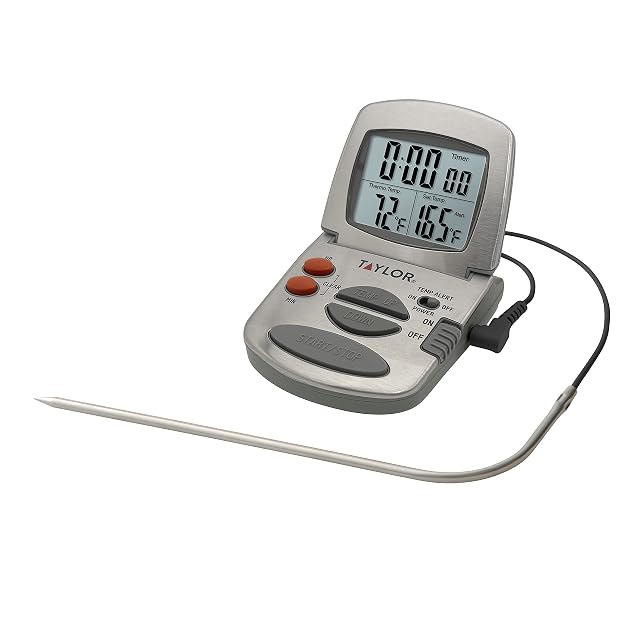
Taylor 147821 Programmable Wired Probe Thermometer
A leave-in probe thermometer with a 4-foot silicone cord, a programmable temperature alarm, a 24-hour timer, a magnetized back and a one-year warranty.
- Cord
- 4 feet of silicone — the longest on this shelf
- Programmable alarm
- Set a target, watch the actual temperature
- Timer
- Up to 24 hours
- Warranty
- One year limited
- Range
- 32 to 392 °F — the narrowest on this shelf
- Probe
- Durable stainless steel; length not published
- Storage
- A stand-up display and a magnetized back for the oven door
- Monitors through the door
- Stated — the display stays outside
- Catalog size
- 127 × 32 × 225 mm (5 × 1.26 × 8.86 in)
- Reference
- 147821
- Accuracy
- Not published — "Highly accurate"
- Cord heat rating
- Not published, where the rival rates probe and wire to 716 °F
- Presets
- None — the rival carries USDA presets
- Weight
- Not published
- Amazon reference
- B001GD1WHU
- EAN
- 0077784147825
- Four feet of cord, eight inches more than the other leave-in here
- A programmable target alarm and a 24-hour timer, with the display outside the oven
- 32 to 392 °F, the narrowest range on the shelf, on the most expensive item sold on Amazon.com
Best for: Oven roasting where the door stays shut and the display sits on it
≈ $24Check price on Amazon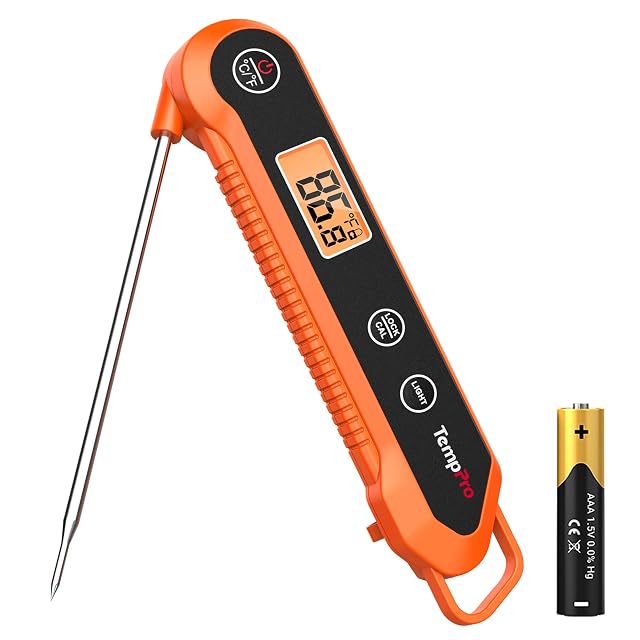
TempPro TempSwift TP03H Meat Thermometer
A one-second folding-probe thermometer rated IPX6 waterproof, with a calibration function, a bright backlit display, a magnetic back and a hook.
- Waterproof
- IPX6 — high-pressure jets; dust is not rated
- Calibration
- Published — one of only five sold on Amazon.com
- Speed
- 1 second, from the product name
- Probe
- Folding, for drawer storage
- Storage
- A magnetic back and a hook
- Display
- Large numbers, bright backlight
- Weight
- 51 g (1.8 oz), folded to 157 × 26 × 40 mm (6.18 × 1.02 × 1.57 in)
- Reference
- TP03H
- Bullets published
- Four — the fewest on this shelf
- Accuracy
- Not published, where both stablemates give ±0.9 °F
- Temperature range
- Not published, where both stablemates give −58 to 572 °F
- Battery
- Not published, where the TP03A names a AAA
- Auto shutoff
- Not published
- Probe length
- Not published
- Amazon reference
- B07Y51PCW7
- EAN
- 4897099880530
- IPX6 and a calibration function, which its two stablemates both lack
- Folds flat with both a magnet and a hook, at 51 grams
- No accuracy figure at all, where both stablemates publish ±0.9 °F
Best for: A folding thermometer that gets rinsed and can be checked against ice water
≈ $10Check price on Amazon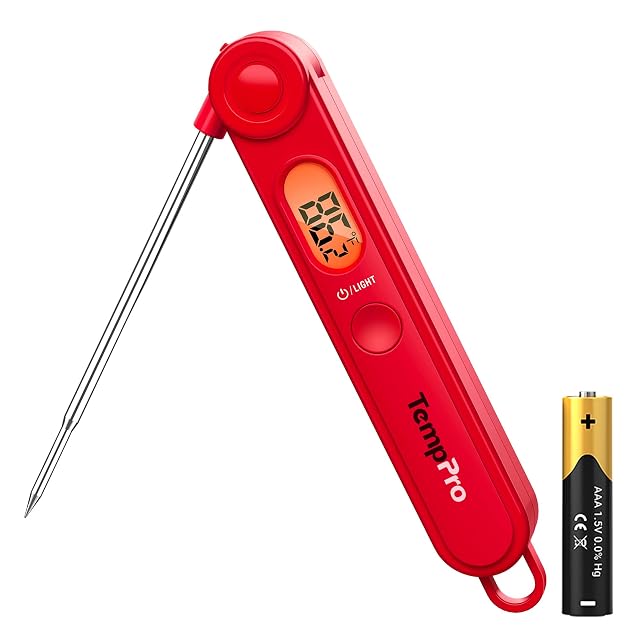
TempPro TempSwift TP03A Folding Meat Thermometer
A one-second folding-probe thermometer accurate to ±0.9 °F, with a backlit display, a magnet, a hook and a single AAA battery instead of a button cell.
- Battery
- 1 AAA, not a button cell — unique on this shelf
- Accuracy
- ±0.9 °F
- Speed
- 1 second
- Probe
- Folding, released at the push of a button
- Range
- −58 to 572 °F
- Display
- Large numbers, bright backlight
- Storage
- A built-in magnet and a hook
- Controls
- Two buttons — probe release, and backlight with power
- Named uses
- Meat, water, milk, candy, fried foods
- Weight
- 48 g (1.7 oz), folded to 155 × 33 × 41 mm (6.10 × 1.30 × 1.61 in)
- Reference
- FBA_TP03A
- Waterproof rating
- None published — the TP03H at $9.98 publishes IPX6
- Calibration
- None — the TP03H at $9.98 has it
- Probe length
- Not published
- Amazon reference
- B01IHHLB3W
- EAN
- 6927082801711
- A AAA battery rather than a button cell, which no other item here publishes
- ±0.9 °F in one second, matched only by its own sibling and beaten only by a $19.99 thermocouple
- No waterproof rating at all, where the same maker's TP03H, a cent cheaper, has IPX6
Best for: Everyday grilling and roasting, from a magnet on the hood, without hunting for button cells
≈ $10Check price on Amazon