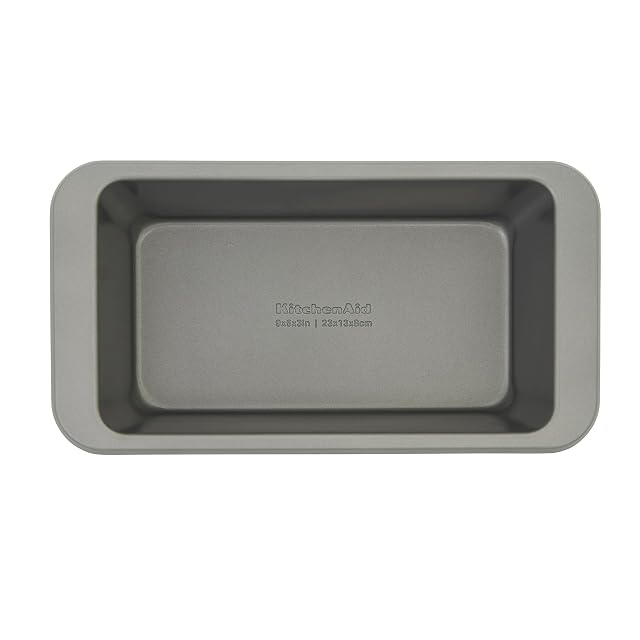
Aluminized steel and extended handles
KitchenAid 9 × 5 in Nonstick Loaf Pan
A 9 × 5 inch aluminized steel loaf pan with a Swiss-engineered non-stick coating, extended handles and a rim designed against warping.
Specifications
- Material
- Aluminized steel — carbon steel coated in aluminum alloy
- Size
- 9 × 5 inches
- Occupies
- 11 × 6 inches of shelf — catalog 279 × 152 mm (11 × 5.98 in)
- Depth
- Catalog 77 mm (3.03 in), about 3.0 inches — not published on the page
- Extended handles
- Stated grippable in pot holders
- Anti-warp rim
- A uniquely designed rim is stated to prevent warping
- Coating
- Swiss-engineered heavy-duty; composition not published
- Dishwasher
- Safe, with no caveat
- Color
- Contour Silver
- Reference
- KQ957OSNSA
- Bullets
- The same five as the maker’s 12-cup muffin pan, verbatim
- Metal utensils
- Not claimed
- Weight
- Not published
- Oven limit
- Not published — "stands up to high heat" with no figure
- Amazon reference
- B0CJP39XBY
- EAN
- 0015388080476
The plus side, and the minus
Strengths
- Aluminized steel, which conducts better than plain carbon and does not rust where intact
- Extended handles, stated to be grippable in pot holders
- Deeper than the cheap rival — 3.0 inches against 2.6 by the catalog figures
Compromises
- Five bullets identical to the maker’s muffin pan, promising jelly rolls and sheet cakes
- Two and a half times the price of the cheapest 9 × 5, with no metal-utensil claim
- No weight, no gauge, no oven limit behind "stands up to high heat"
What the maker puts in writing
- “NONSTICK: Swiss-engineered heavy-duty coating allows for nonstick release when baking”
- “VERSATILE: Great for everyday baking, from whipping up cookies, bars, jelly rolls, and sheet cakes, to making easy one-pan weeknight meals”
- “EXTENDED HANDLES: provide a secure grip for easy transport, making transferring pan in and out of the oven safer and simpler, even when wearing pot holders”
- “EVEN BAKING: Aluminized steel construction promotes consistent heat distribution across the pan”
- “DISHWASHER SAFE: for easy cleanup”
- Description: “perfect for making bread, cakes, meatloaf, and casseroles” · “stands up to high heat” · “features a uniquely designed rim to prevent warping”
- Reference KQ957OSNSA · Catalog: 279 × 152 × 77 mm (11 × 5.98 × 3.03 in)
Aluminized steel, which is the one real material difference among the steel pans here
“Aluminized steel construction promotes consistent heat distribution across the pan”
It is carbon steel hot-dipped in an aluminum-silicon alloy, bonded metallurgically rather than painted on.
That buys two things.
Conduction. Aluminum conducts heat about three times better than steel, so the surface layer spreads a hot spot sideways before the batter sees it. “Even heat distribution” is asserted on at least nine of the thirteen items on this shelf and this is one of only two with a material reason behind the claim.
Corrosion resistance. The aluminum layer does not rust — and plain carbon steel rusts wherever its non-stick film is broken, which on bakeware happens at the rim first, from stacking and from knives.
The shelf, by material:
Aluminized steel — this and the 12-cup muffin pan at $21.99, the only two Plain carbon steel — the four GoodCook pans and the Sur La Table at $11.70 Unstated — Amazon Basics (“heavy-weight steel”) and Elbee (“rust resistant”, with no material named at all) 100 percent aluminum foil — the two Waytiffer packs; coated steel — the European Kaiser loaf tin; platinum silicone — the Backefix
Is it worth $14.99 against the $5.99 GoodCook 9 × 5? What it buys is the rim and the reflectivity. It will outlast a plain carbon pan at the edges, and being Contour Silver and reflective it browns more gently than the gray GoodCook — a real baking difference, since a dark surface absorbs radiant heat and a light one reflects it.
What it does not buy is a metal-utensil claim. The $5.99 pan has one and this does not.
Five bullets shared with a muffin pan, and one of them is false
All five bullets on this page appear word for word on the KitchenAid 12-cup muffin pan at $21.99.
Including bullet two: “Great for everyday baking, from whipping up cookies, bars, jelly rolls, and sheet cakes, to making easy one-pan weeknight meals.”
That cannot be true of either pan.
A jelly roll is a thin sheet of sponge baked flat and rolled, which needs a shallow rimmed sheet. This is a three-inch-deep loaf pan. A sheet cake needs the same shallow sheet. Cookies cannot be baked in a loaf pan in any useful sense, and twelve muffin cups cannot bake any of the four.
The description, which is written per product, is accurate: “perfect for making bread, cakes, meatloaf, and casseroles”. The muffin pan’s description is equally accurate about muffins.
So the page contradicts itself — three correct uses in the description, four wrong ones in bullet two.
Compare the maker that writes per pan. The GoodCook 13 × 9 at $9.99 publishes “ideal size for a full box of cake, brownie, or other dessert mixes” — specific, checkable, and true of that pan and no other here.
Read bullet two as collection boilerplate and the description as the specification. This pan does bread, cake, meatloaf and casseroles.
Eleven by six inches, and three inches deep
The catalog reads 279 × 152 × 77 mm — 11.0 × 6.0 × 3.0 inches, for a pan labeled 9 × 5.
The GoodCook 9 × 5 at $5.99 catalogs at exactly the same plan figure: 279 × 152 mm. Two makers, two pans, one number.
A loaf pan is a tapered box. The quoted size is the base; the walls slope outwards so the loaf releases; the rim is wider. Add this pan’s extended handles and you get two inches more in each direction.
The flat pans on this shelf prove the rule by not following it. The GoodCook 13 × 9 catalogs at 330 × 229 × 51 mm = 13.0 × 9.0 × 2.0 inches, exactly its label; the MegaGrip 8 × 8 at 203 × 203 mm = 8.0 × 8.0, exactly.
The depth is where this pan separates from the cheap one, and neither page publishes it.
this — 77 mm, about 3.0 inches GoodCook 9 × 5, $5.99 — 65 mm, about 2.6 inches Sur La Table 9 × 5, $11.70 — no third dimension at all
Nearly half an inch between two pans of the same nominal size. On a loaf pan depth decides whether a risen dough crowns above the rim or goes over it — a recipe written for a three-inch pan will overflow a two-and-a-half-inch one, and no page on this shelf publishes a depth.
If you are buying for bread rather than for cake, this is the deeper of the two, and that is the practical argument for it.
Extended handles: reach, not grip
“EXTENDED HANDLES: provide a secure grip for easy transport… safer and simpler, even when wearing pot holders”
Three items on this shelf address getting the pan out of the oven, three different ways:
Extended handles — this pan and the 12-cup muffin pan: tabs projecting beyond the body, so hands sit further from the hot walls and outside the pan’s footprint Silicone grips — the GoodCook MegaGrip 8 × 8 at $10.09, the only silicone grips on this shelf: real grip, on a pan with no long side to hold Wide rims — the GoodCook 13 × 9 at $9.99: a continuous lip, grippable in mitts
The other eight items say nothing at all about it.
Why reach matters on a loaf pan. A 9 × 5 is narrow and deep, so there is nowhere for your fingers except the two short ends — and the short ends are where the oven walls are closest when the pan sits across a shelf. A tab that projects an inch is an inch your knuckles are not touching the oven.
The cost is footprint, and this pan shows it: 11.0 × 6.0 inches for a 9 × 5, part rim flare and part handles. No handle projection is published, here or anywhere on this shelf, which on a 22-inch oven shelf is the difference between two pans across and one.
A rim designed against warping, and no thickness behind it
“features a uniquely designed rim to prevent warping”
This is the only anti-warp mechanism described on the shelf, rather than simply asserted. Everyone else credits the steel: “heavy-duty gauge steel resists warping” (GoodCook, three pans), “heavy-weight steel construction” (Amazon Basics), “rust resistant” (Elbee).
And a rim is genuinely where the mechanism lives. Warping is a thin sheet taking a permanent set when the hot part expands against the cool part past the yield point. A rolled or beaded rim stiffens the whole panel in bending — the same reason a sheet of paper holds its shape once you fold an edge on it. The rim is the structural member of a shallow steel pan.
But no thickness is published. Gauge is a number and no item on this shelf gives one — “heavy-duty aluminized steel” is the whole of it here, and the shelf’s other four phrases for the same thing are equally numberless.
Nor is a weight. This is one of four items on the shelf with no catalog weight, so there is not even a proxy. For reference the maker’s own 12-cup muffin pan is 794 g, the GoodCook 9 × 5 is 268 g, and the MegaGrip 8 × 8 is 310 g.
And the one cause of warping that is in your hands is thermal shock: let the pan cool before it meets water. Nothing on this shelf says so.
Dishwasher safe, with no caveat — and that is the outlier
“DISHWASHER SAFE: for easy cleanup”
Four words, on both KitchenAid pans, with nothing qualified.
The shelf, on washing:
KitchenAid, both pans — “DISHWASHER SAFE”, no caveat GoodCook, three pans — “dishwasher safe… hand washing is recommended for longer-lasting use”, and the 8 × 4 set sharpens it to “but hand-washing is recommended” Amazon Basics, $31.99 — “Hand wash for best results”, no dishwasher claim at all Elbee, $59.99 — “Dishwasher safe and rust resistant”, the shelf’s only mention of rust GoodCook 13 × 9 and Sur La Table — nothing either way
Aluminized steel is the material with the best case for the unqualified claim, because the thing a dishwasher does to plain carbon steel is rust it at every break in the coating, and the aluminum layer does not rust.
What a dishwasher still does to any of them is attack the non-stick film — hot, alkaline, abrasive, repeatedly. The honest reading of the whole shelf is GoodCook’s: the machine is safe for the pan and hand washing lasts longer.
One habit for this pan in particular: dry it immediately rather than letting it drain. The aluminized layer protects the steel where it is intact; a cut edge or a deep scratch is still bare steel underneath.
What is not published
No oven temperature limit, behind “stands up to high heat” in the description. Only the Amazon Basics set (428 °F, exactly 220 °C) and the Elbee set (420 °F, plus convection) publish a figure, and many bread recipes call for 450 °F, above both.
No gauge or thickness, as above.
No weight, one of four items here without one.
No depth on the page. The catalog says 77 mm.
No handle projection, on the pan that sells its handles.
No metal-utensil claim, where the $5.99 GoodCook has one. A 9 × 5 loaf that catches at a corner gets a knife run round it, and this page does not say whether that is allowed.
No coating composition. “Swiss-engineered heavy-duty” names an origin and a property, not a material. Only the Sur La Table at $11.70 states what its coating is free of — “PFOA, PFAS, PTFE Free” — and only by negation.
No capacity. The only dough-weight capacity on this shelf is on a disposable: the Waytiffer foil loaf pan at $9.99 publishes “2Lb”.
No warranty and no country of manufacture, which no item on this shelf publishes.
Availability
Read on the day this page was built: $13 at the American Amazon shop.
Read from Keepa on the day this page was last revised; stock and price both move without notice.
Prices quoted in this text were read on 2026-10-17. The live price is at the top of the page.
What readers want to know
What is aluminized steel, and is it worth the money?
Carbon steel hot-dipped in an aluminum-silicon alloy, and it is the one genuine material difference among the steel pans on this shelf. Two bullets name it: "Aluminized steel construction promotes consistent heat distribution across the pan", and the description adds "heavy-duty aluminized steel pan stands up to high heat". What the process does. The steel sheet is passed through molten aluminum alloy, which bonds to it metallurgically rather than sitting on top as paint would. You get two things. Conduction: aluminum conducts heat roughly three times better than steel, so the surface layer spreads a hot spot sideways before the batter sees it. And corrosion resistance: the aluminum layer does not rust, which matters because plain carbon steel rusts wherever its non-stick film is broken — and on bakeware the film breaks at the rim first, from stacking and from knives. The shelf, by material: aluminized steel — this and the 12-cup muffin pan at $21.99, the only two. Plain carbon steel — the four GoodCook pans and the Sur La Table at $11.70. Unstated — the Amazon Basics six-piece ("heavy-weight steel") and the Elbee eight-piece ("rust resistant", with no material named at all). 100 percent aluminum foil — the two Waytiffer packs; coated steel — the European Kaiser loaf tin; platinum silicone — the Backefix. Is it worth $14.99 against $5.99? The honest answer is that it buys the rim and the reflectivity. It will outlast a plain carbon pan at the edges, and being Contour Silver and reflective it browns more gently than the gray GoodCook. What it does not buy is a metal-utensil claim, which the $5.99 pan has and this does not.
Why are the bullets the same as the muffin pan’s?
Because they are a collection boilerplate rather than a specification, and on both pans one of the five is false. All five bullets on this page appear word for word on the KitchenAid 12-cup muffin pan at $21.99: "NONSTICK: Swiss-engineered heavy-duty coating", "VERSATILE: Great for everyday baking, from whipping up cookies, bars, jelly rolls, and sheet cakes, to making easy one-pan weeknight meals", "EXTENDED HANDLES", "EVEN BAKING: Aluminized steel construction", "DISHWASHER SAFE". The versatility bullet cannot be true of either pan. A jelly roll is a thin sheet of sponge baked flat and rolled — it needs a shallow rimmed sheet, and this is a three-inch-deep loaf pan. A sheet cake needs the same thing. Neither a 9 × 5 loaf pan nor a tray of twelve muffin cups can bake either, and cookies cannot be baked in a loaf pan in any useful sense. The description, which is written per product, is accurate: "perfect for making bread, cakes, meatloaf, and casseroles" here, and "perfect for making 12 evenly sized and shaped muffins, cupcakes, and egg bites" there. So the page contradicts itself: three correct uses in the description, four wrong ones in bullet two. Compare the maker that writes per pan. The GoodCook 13 × 9 at $9.99 publishes "ideal size for a full box of cake, brownie, or other dessert mixes" — a claim that is specific, checkable and true of that pan and no other on the shelf. Read bullet two as collection copy and the description as the specification, and this pan does bread, cake, meatloaf and casseroles.
What do extended handles give you that a rim does not?
Reach, which is a different thing from grip — and on a loaf pan it is the more useful of the two. The bullet: "EXTENDED HANDLES: provide a secure grip for easy transport, making transferring pan in and out of the oven safer and simpler, even when wearing pot holders." Three items on this shelf address getting the pan out of the oven, and each does it differently. Extended handles — this pan and the 12-cup muffin pan at $21.99: tabs that project beyond the body, so your hands are further from the hot walls and outside the pan’s footprint. Silicone grips — the GoodCook MegaGrip 8 × 8 at $10.09, the only silicone grips on the shelf: real grip, on a pan that has no long side to hold. Wide rims — the GoodCook 13 × 9 at $9.99: a continuous lip, "easy to take in and out of the oven, even while wearing oven mitts". The other eight items say nothing at all. Why reach matters on a loaf pan specifically. A 9 × 5 is narrow and deep, so there is nowhere to put your fingers except the two short ends — and the short ends are exactly where the oven walls are closest when the pan sits across a shelf. A tab that projects an inch is an inch your knuckles are not touching the oven. The cost is footprint, and this pan shows it: the catalog plan is 279 × 152 mm (11 × 5.98 in), 11.0 × 6.0 inches, for a pan labeled 9 × 5 — two inches over each way, partly rim flare and partly those handles. No handle projection is published, here or anywhere on the shelf.
More pans & molds
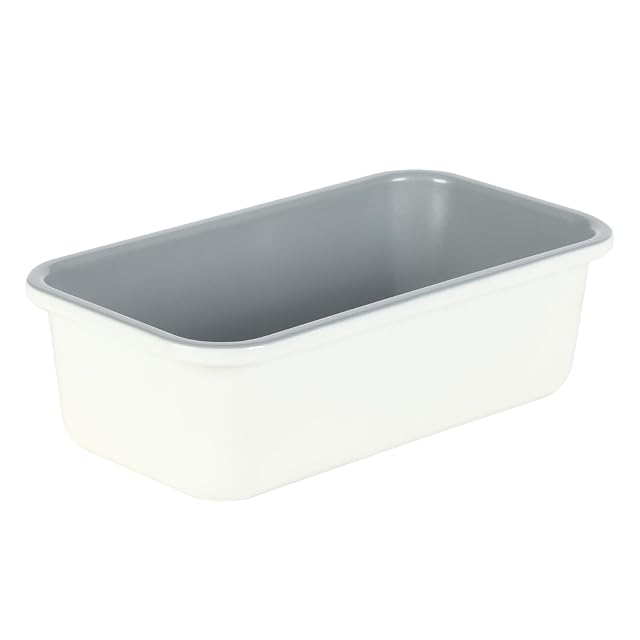
Sur La Table Bake Sale 9 × 5 in Loaf Pan
A 9 × 5 inch carbon steel loaf pan with a PFOA, PFAS and PTFE free non-stick interior and a linen white exterior.
- Coating
- PFOA, PFAS and PTFE free — the only PFAS-free statement for a non-stick coating on this shelf
- Size
- 9 × 5 inches
- Material
- Carbon steel, with no gauge or adjective
- Color
- Linen White — the lightest pan on the shelf
- In the box
- One pan, stated
- Catalog plan
- 127 × 229 mm = 5.0 × 9.0 inches
- Reference
- 141170.01
- Depth
- Not published, and the catalog has no third dimension at all
- Metal utensils
- Not claimed — consistent with a non-fluoropolymer coating
- Dishwasher
- No statement either way
- Weight
- Not published
- Oven limit
- Not published
- Thickness or gauge
- Not published
- Warranty
- Not published
- Amazon reference
- B0DBB9PYBM
- EAN
- 0085081622723
- The only coating on this shelf that declares what it is free of
- Carbon steel with a light exterior, which browns more gently than a dark pan
- No depth, and the catalog carries only two dimensions
Best for: A buyer who wants a 9 × 5 loaf pan with no fluoropolymer in it
≈ $12Check price on Amazon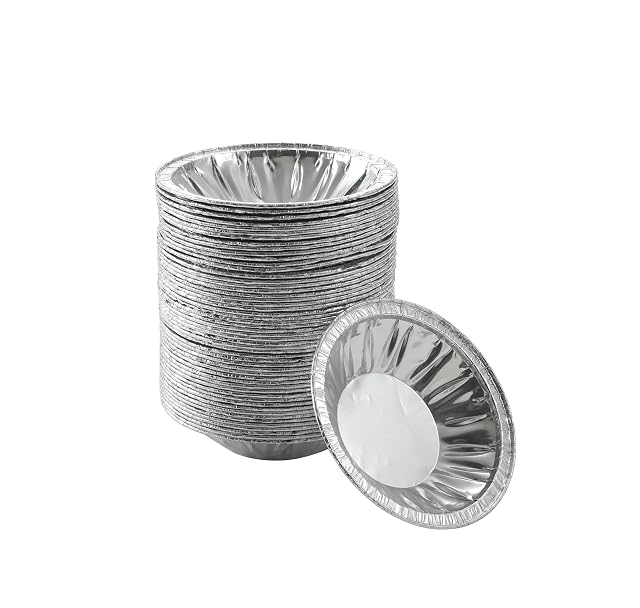
Waytiffer 50-Pack 4.5 in Foil Mini Pie Tins
Fifty heavy-duty aluminum foil mini pie and tart tins, 4.5 inches across the top and 2.5 across the base, stackable and recyclable.
- Price per tin
- 20 cents — 50 tins for $9.99
- Weight per tin
- 2.2 g (0.1 oz) — catalog 109 g (3.8 oz) for the pack of fifty
- Top diameter
- 4.5 inches
- Base diameter
- 2.5 inches — under a third of the top area
- Depth
- Not published; the catalog figure is 50 mm (1.97 in), about 2 inches
- Material
- 100 percent aluminum foil
- Recyclable
- Yes, stated
- Freeze and reheat
- Both, stated in the product name
- Rigidity claim
- Stated not to bend or fold in during baking
- Packaging
- A thick box rather than plastic
- Three diameters given
- The name says 4 inch; the bullet says 4.5 and 2.5
- Oven limit
- Not published
- Foil thickness
- Not published, behind a heavy-duty claim
- Reference
- The catalog field reads Waytiffer
- Amazon reference
- B0BPM2RZHK
- EAN
- 8909956385068
- Twenty cents a tin, against $5.99 for the cheapest steel pan here
- Nothing to wash, and foil goes from freezer to oven to table
- Three different diameters for one pan, across the name and the bullets
Best for: Fifty individual tarts for an event, with no washing up
≈ $10Check price on Amazon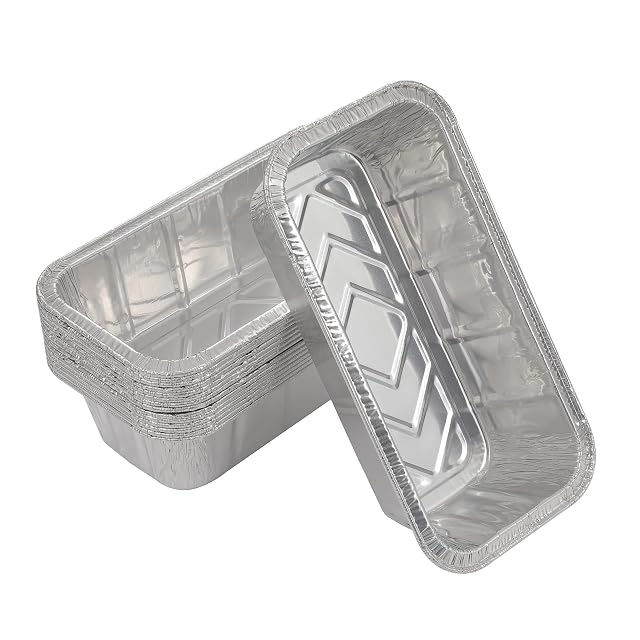
Waytiffer 25-Pack 8.5 × 4.5 in Foil Loaf Pans
Twenty-five heavy-duty aluminum foil loaf pans of 8.5 × 4.5 × 2.5 inches, rated 2 lb, recyclable and oven safe.
- Price per pan
- 40 cents — 25 pans for $9.99
- Capacity
- 2 lb — the only dough-weight capacity on this shelf
- Size
- 8.5 × 4.5 × 2.5 inches, all three published
- Catalog confirms it
- 216 × 114 × 64 mm = 8.5 × 4.5 × 2.5 inches exactly
- Weight per pan
- 12.0 g (0.4 oz) — catalog 299 g (10.5 oz) for twenty-five
- Material
- Aluminum foil, stated high thermal conductivity
- Airflow claim
- Stated to optimize airflow for heat distribution
- Recyclable
- Yes, stated fully recyclable
- Return
- A no-questions-asked return is stated
- Oven limit
- Not published — "extremely high temperatures" with no figure
- Foil thickness
- Not published, behind a heavy-duty claim
- Smaller than the steel
- 8.5 × 4.5 against the 9 × 5 standard
- Lid
- None mentioned
- Reference
- Not stated by the maker
- Amazon reference
- B09BJGLM9Y
- EAN
- 8368456418612
- Forty cents a pan, against $5.99 for the cheapest steel loaf pan here
- The only dough-weight capacity on the shelf — 2 lb — and all three dimensions published
- 8.5 × 4.5 is smaller than the 9 × 5 standard the rest of the shelf uses
Best for: Baking bread or meatloaf to give away, twenty-five times over
≈ $10Check price on Amazon
Elsewhere in the kitchen drawer
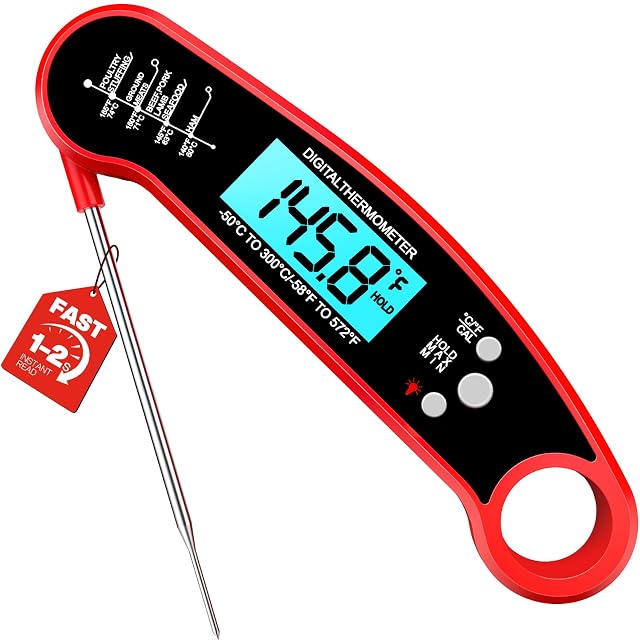
ONFIKY FM152 Instant Read Meat Thermometer
A one-to-two second instant-read thermometer accurate to ±1 °F, fully sealed to IP67, with calibration, a backlit LCD, a magnet and 4,000+ hours of battery.
- Waterproof
- IP67 — dust-tight and 30 minutes under a meter of water
- Speed
- 1 to 2 seconds
- Accuracy
- ±1 °F
- Battery life
- Over 4,000 hours, with auto-sleep and motion wake
- Calibration
- Published — one of only five sold on Amazon.com
- Range
- −58 to 572 °F (−50 to 300 °C)
- Display
- Large bright LCD with backlight
- Units
- A simple °C / °F switch
- Magnet
- Built in, for a fridge, stove or grill
- Body
- Durable ABS, stated to withstand drops
- Named uses
- Grilling, barbecue, smoking, air frying, baking, candy, liquids
- Reference
- FM152
- Probe length
- Not published
- Warranty
- Not published
- Amazon reference
- B0GVM8N2CK
- EAN
- 0799473213108
- IP67, so it survives immersion — the cheapest such item on this shelf
- Calibration and over four thousand hours of battery, with motion wake
- No probe length published, on a thermometer sold for deep liquids
Best for: A grill and kitchen thermometer that lives on the hood and gets rinsed
≈ $10Check price on Amazon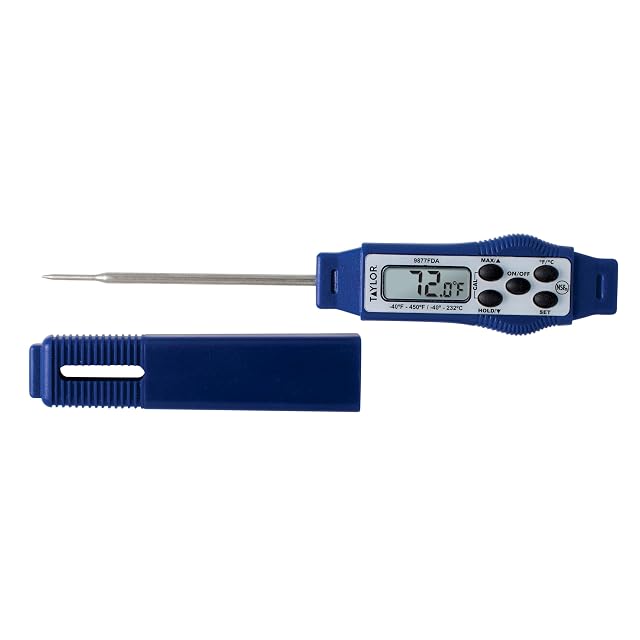
Taylor Compact 9877FDA Pen-Style Thermometer
A waterproof pen-style thermometer reading −40 to 450 °F, with a large LCD, a HOLD function, a ten-minute auto shutoff and a probe cover that becomes a handle.
- Probe cover
- Snaps onto the back to form a handle — unique on this shelf
- HOLD
- Locks the reading for viewing away from the heat
- Auto shutoff
- Ten minutes
- Range
- −40 to 450 °F
- Probe
- Responsive stainless steel; length not published
- Waterproof
- Claimed — splashes and quick rinses, with no IP code
- Display
- Large clear LCD
- Format
- Slim pen style, for a drawer or an apron pocket
- Weight
- 31 g (1.1 oz) — 210 × 27 × 18 mm (8.27 × 1.06 × 0.71 in)
- Color
- Grey
- Reference
- 9877FDA
- Accuracy
- Not published
- Speed
- Not published — "fast, reliable results"
- Backlight
- Not published, where nine items on this shelf have one
- Amazon reference
- B00E99L3G8
- EAN
- 0077784987704
- The probe cover doubles as a handle, which nothing else here does
- A HOLD function and a ten-minute shutoff, both genuinely useful
- No accuracy figure and no reading speed at nineteen dollars
Best for: An apron pocket, where the cover-handle and the hold button do the work
≈ $19Check price on Amazon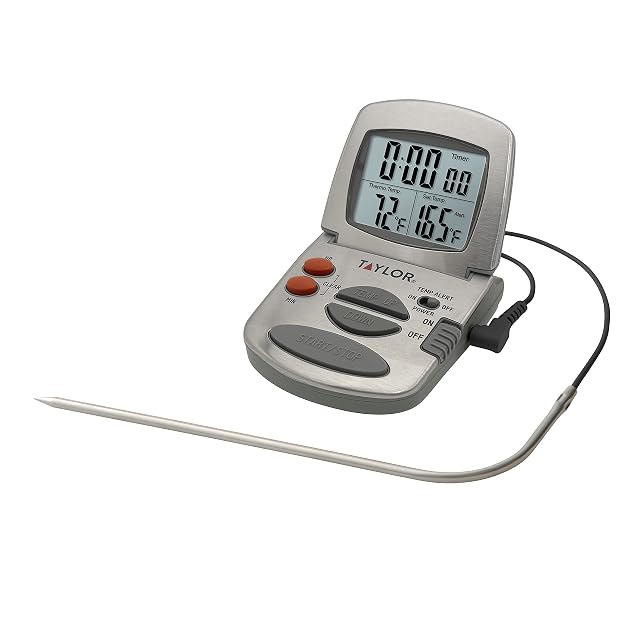
Taylor 147821 Programmable Wired Probe Thermometer
A leave-in probe thermometer with a 4-foot silicone cord, a programmable temperature alarm, a 24-hour timer, a magnetized back and a one-year warranty.
- Cord
- 4 feet of silicone — the longest on this shelf
- Programmable alarm
- Set a target, watch the actual temperature
- Timer
- Up to 24 hours
- Warranty
- One year limited
- Range
- 32 to 392 °F — the narrowest on this shelf
- Probe
- Durable stainless steel; length not published
- Storage
- A stand-up display and a magnetized back for the oven door
- Monitors through the door
- Stated — the display stays outside
- Catalog size
- 127 × 32 × 225 mm (5 × 1.26 × 8.86 in)
- Reference
- 147821
- Accuracy
- Not published — "Highly accurate"
- Cord heat rating
- Not published, where the rival rates probe and wire to 716 °F
- Presets
- None — the rival carries USDA presets
- Weight
- Not published
- Amazon reference
- B001GD1WHU
- EAN
- 0077784147825
- Four feet of cord, eight inches more than the other leave-in here
- A programmable target alarm and a 24-hour timer, with the display outside the oven
- 32 to 392 °F, the narrowest range on the shelf, on the most expensive item sold on Amazon.com
Best for: Oven roasting where the door stays shut and the display sits on it
≈ $24Check price on Amazon