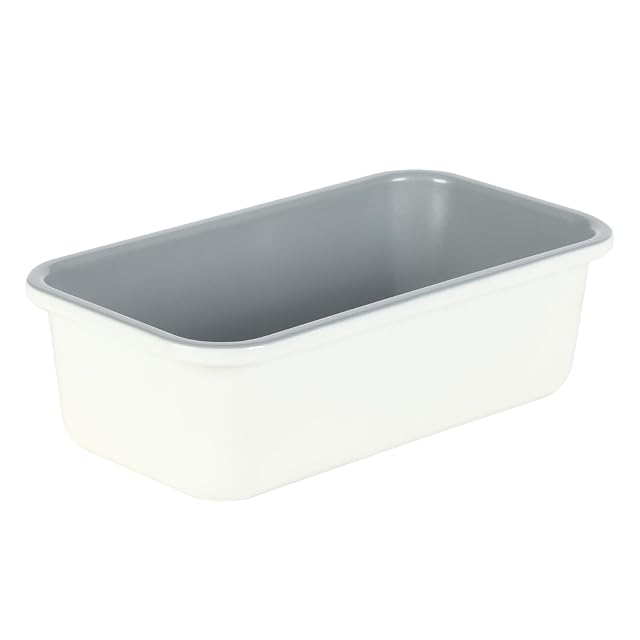
Best for: A buyer who wants a 9 × 5 loaf pan with no fluoropolymer in it
≈ $12
Check price on Amazon The only coating here that declares what it leaves out
A 9 × 5 inch carbon steel loaf pan with a PFOA, PFAS and PTFE free non-stick interior and a linen white exterior.
Best for: A buyer who wants a 9 × 5 loaf pan with no fluoropolymer in it
“PFOA, PFAS, PTFE Free” is in the product name, and nowhere else on this shelf is coating chemistry mentioned at all.
The three initialisms are nested rather than parallel. PFAS is the whole family of per- and polyfluoroalkyl substances. PTFE is one member — the polymer sold as Teflon, and the standard non-stick film on bakeware. PFOA is another, historically used as a processing aid in making PTFE and phased out of that use years ago.
So “PTFE free” is the claim that carries the weight. Without PTFE this is a ceramic or sol-gel type coating: a silica-based film, which is a materially different thing rather than a reformulation.
And the shelf’s own data is consistent with it.
This page makes no metal-utensil claim. GoodCook claims it on three of four pans — the 9 × 5 at $5.99 (“metal spatula safe”), the 13 × 9 at $9.99 (in the product name) and the 8 × 4 set at $11.99. Ceramic-type coatings are hard but brittle, and the usual guidance for them is no metal utensils and no high dry heat. The silence fits the chemistry.
Nobody else on this shelf says anything about what their coating is. KitchenAid calls it “Swiss-engineered heavy-duty” on both pans — a property, not a material. Amazon Basics, Elbee and the GoodCook pans say “nonstick” and stop.
What follows in practice: this is the pan to choose if fluoropolymers are the reason you are shopping, and the pan to line with parchment if you intend to cut in it.
The catalog reads 127 × 229 mm — 5.0 × 9.0 inches. That is the published size and nothing more. No depth.
Every other single steel pan on this shelf has three figures:
GoodCook 9 × 5, $5.99 — 279 × 152 × 65 mm KitchenAid 9 × 5, $14.99 — 279 × 152 × 77 mm GoodCook 13 × 9, $9.99 — 330 × 229 × 51 mm MegaGrip 8 × 8, $10.09 — 203 × 203 × 49 mm Waytiffer foil loaf, $9.99 — 216 × 114 × 64 mm
And depth is the figure a loaf pan is judged on. The two rival 9 × 5 pans differ by nearly half an inch — 65 mm against 77 mm, 2.6 inches against 3.0 — and neither publishes it either.
On a loaf pan depth decides whether a risen dough crowns above the rim or goes over it. A recipe written for a three-inch pan will overflow a two-and-a-half-inch one, and the whole shelf leaves you to guess.
There is a second oddity. The two rival 9 × 5 pans both catalog at 11.0 × 6.0 inches — two inches over in each direction — because a loaf pan is measured at the base and the rim flares. This one catalogs at exactly 9 × 5.
So its figure is either the base, like theirs, or simply the label repeated. The page gives no way to tell. Budget 11 × 6 inches of oven shelf for it, as for the others, and treat the depth as unknown.
“CARBON STEEL BAKEWARE: ideal for uniform heat conduction and distribution to bake and brown evenly” · “one 9-inch carbon steel loaf pan”
It names its material plainly, without an adjective in front of it.
The shelf’s vocabulary for the same thing: “heavy-duty gauge steel” (GoodCook, three pans) · “heavy-gauge steel” (MegaGrip) · “heavy-weight steel construction” (Amazon Basics) · “heavy-duty aluminized steel” (KitchenAid, two pans) · “rust resistant”, with no material at all (Elbee) · “100% aluminum foil” (the two Waytiffer packs).
“Carbon steel” is the honest plain description — and the one real material distinction on this shelf is the KitchenAid pans’ aluminized steel, which is carbon steel hot-dipped in an aluminum-silicon alloy. That matters twice over: aluminum conducts heat about three times better than steel, and the coating does not rust where it is intact.
Plain carbon steel rusts wherever its non-stick film is broken. Only the Elbee set at $59.99 mentions rust at all — “Dishwasher safe and rust resistant” — and this page does not.
No gauge, no thickness and no weight are published, which leaves “uniform heat conduction” unsupported by any number. This is also one of several items on the shelf with no catalog weight, so there is not even a proxy: for comparison the GoodCook 9 × 5 is 268 g and the KitchenAid 12-cup muffin pan is 794 g.
This is the lightest steel pan on the shelf.
Color on bakeware is not cosmetic. A dark surface absorbs radiant heat; a light or shiny one reflects it. At the same oven setting a dark pan runs hotter at the wall, browns the crust faster and finishes sooner; a pale pan gives a paler, softer bottom crust and a slower bake.
The shelf, lightest to darkest:
bare aluminum foil — the two Waytiffer packs, the most reflective here Linen White — this pan Contour Silver — the KitchenAid 9 × 5, aluminized and reflective Gray — all four GoodCook pans, the darkest Evergreen — the KitchenAid 12-cup muffin pan
What that makes this pan good and bad at. Good for a delicate cake or a sweet enriched dough that would over-brown. Less good for a crusty loaf, where you want the wall hot.
If a recipe was developed in a dark pan, expect a few more minutes in this one — or a slightly higher setting, with the caveat that no oven limit is published here, as for at least nine of the thirteen items on this shelf.
And the irony is that this is the one page selling color as a feature: “VIBRANT EXTERIOR: colorful pieces inspire creativity in any kitchen” — a bullet about a variable that genuinely affects baking, which says nothing about baking.
Bullet two is the brand’s mission statement, and it contains a typo in the published text: “making and sharing good good at home together”, then “roll up your sleeves, mix up a happy kitchen, and set the table for free-flowing conversations”.
Bullet five is “VIBRANT EXTERIOR: colorful pieces inspire creativity in any kitchen.”
That leaves three bullets of product information: what is in the box, that the interior is non-stick, and that the body is carbon steel.
For comparison at a lower price, the GoodCook 9 × 5 at $5.99 publishes five bullets and all five are about the pan — size and uses, heat distribution, scratch and warp resistance, the coating, and the dishwasher — plus metal spatula safety in the description.
And what this page does not publish anywhere:
No dishwasher statement. “Easy cleanup” is as far as it goes. The three GoodCook pans publish “dishwasher safe… hand washing is recommended for longer-lasting use”; both KitchenAid pans publish “DISHWASHER SAFE” flatly; Amazon Basics publishes “Hand wash for best results”; Elbee publishes “Dishwasher safe and rust resistant”. Four of thirteen items here say nothing, and this is one.
No metal-utensil claim, as above — which on a coating sold as PTFE-free is probably the right silence.
No warping claim, which is the shelf’s most repeated promise: GoodCook makes it three times, KitchenAid twice via a “uniquely designed rim”. This page makes it nought times, on a pan with no published gauge.
The useful line in bullet three is the one about serving: “exceptional food release when cutting and sharing slices of cakes or pies down to the last crumb”. It describes cutting in the pan, on the one pan here that never says you may use metal to do it.
No depth, and no third catalog dimension, unlike every other single steel pan here.
No weight, one of several items here without one.
No gauge or thickness, like every item on this shelf.
No oven temperature limit. Only the Amazon Basics six-piece at $31.99 (428 °F, exactly 220 °C) and the Elbee eight-piece at $59.99 (420 °F, plus convection) publish one. A ceramic-type coating is the kind most sensitive to high dry heat, which makes the omission more pointed here than on a PTFE pan.
No dishwasher statement, as above.
No metal-utensil claim, as above.
No coating composition, only what it excludes. “PFOA, PFAS, PTFE Free” tells you what is not in it and not what is.
No capacity. The only dough-weight capacity on this shelf is on a disposable: the Waytiffer foil loaf pan at $9.99 publishes “2Lb”.
No warranty and no country of manufacture, which no item on this shelf publishes.
Read on the day this page was built: $12 at the American Amazon shop.
Read from Keepa on the day this page was last revised; stock and price both move without notice.
Prices quoted in this text were read on 2026-10-17. The live price is at the top of the page.
That the coating is not a fluoropolymer, and this is the only page on the shelf to say what a coating leaves out — the only other word on coating chemistry here is the Kaiser's, which declares a small PTFE content. The three initialisms are nested, not parallel. PFAS is the whole family of per- and polyfluoroalkyl substances. PTFE is one member of it — the polymer sold as Teflon, and the standard non-stick film on bakeware. PFOA is a different member, historically used as a processing aid in making PTFE and phased out of that use. So "PTFE free" is the load-bearing claim: without PTFE, this is a ceramic or sol-gel type coating — a silica-based film, which is a genuinely different material. And the shelf’s own data is consistent with that. This page makes no metal-utensil claim, where GoodCook claims it on three of its four pans — the 9 × 5 at $5.99, the 13 × 9 at $9.99 and the 8 × 4 set at $11.99. Ceramic-type coatings are hard but brittle, and the usual guidance for them is no metal and no high dry heat, so the silence fits. Nobody else on this shelf says anything. KitchenAid calls its coating "Swiss-engineered heavy-duty" on both pans, which names a property and not a material. Amazon Basics, Elbee and the three GoodCook pans say "nonstick" and stop. The practical consequence: this pan is the one to choose if fluoropolymers are the reason you are shopping, and the one to line with parchment if you intend to cut in it.
Because the third was never entered, and this is the only single steel pan on the shelf missing one. The catalog reads 127 × 229 mm — 5.0 × 9.0 inches — which is the published size and nothing else. Every other single steel pan here has three figures. The GoodCook 9 × 5 at $5.99 reads 279 × 152 × 65 mm (11 × 5.98 × 2.56 in); the KitchenAid 9 × 5 at $14.99 reads 279 × 152 × 77 mm (11 × 5.98 × 3.03 in); the GoodCook 13 × 9 reads 330 × 229 × 51; the MegaGrip 8 × 8 reads 203 × 203 × 49. And the depth is the figure a loaf pan is judged on. The two rival 9 × 5 pans differ by nearly half an inch — 65 mm (2.56 in) against 77 mm (3.03 in), about 2.6 inches against 3.0 — and neither publishes it either. On a loaf pan, depth decides whether a risen dough crowns above the rim or spills over it, and a recipe written for a three-inch pan will overflow a two-and-a-half-inch one. There is a second oddity worth stating. The two rival 9 × 5 pans both catalog at 11.0 × 6.0 inches, two inches over in each direction, because a loaf pan is measured at the base and the rim flares outwards. This one catalogs at exactly 9 × 5. So its figure is either the base, like theirs, or it is simply the label repeated — and there is no way to tell from the page which. Budget 11 × 6 inches of oven shelf for it, as for the others, and treat the depth as unknown.
Yes, and this is the lightest pan on the shelf facing the darkest. Color on bakeware is not decoration. A dark surface absorbs radiant heat; a light or shiny one reflects it. So at the same oven setting a dark pan runs hotter at the wall, browns the crust faster and bakes a loaf in slightly less time; a pale pan gives a paler, softer bottom crust and a slower bake. The shelf, by color: Linen White, this one, the lightest · Contour Silver, the KitchenAid 9 × 5 at $14.99, aluminized and reflective · Gray, all four GoodCook pans, the darkest here · Evergreen, the KitchenAid 12-cup muffin pan at $21.99 · bare aluminum foil, the two Waytiffer packs, the most reflective of all. What it means for this pan. A white 9 × 5 is the gentle end: good for a delicate cake or a sweet enriched dough that would over-brown, and less good for a crusty loaf, where you want the wall hot. If a recipe was developed in a dark pan, expect to add a few minutes in this one — or raise the setting slightly, with the caveat that no oven limit is published for this pan, as for at least nine of the thirteen items here. And the one page on this shelf that sells color as a feature is this one — "VIBRANT EXTERIOR: colorful pieces inspire creativity in any kitchen" — which says nothing about any of the above.
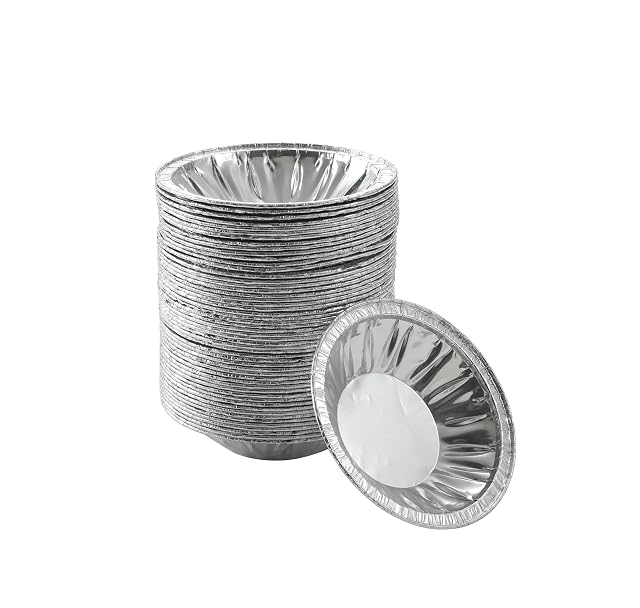
Fifty heavy-duty aluminum foil mini pie and tart tins, 4.5 inches across the top and 2.5 across the base, stackable and recyclable.
Best for: Fifty individual tarts for an event, with no washing up
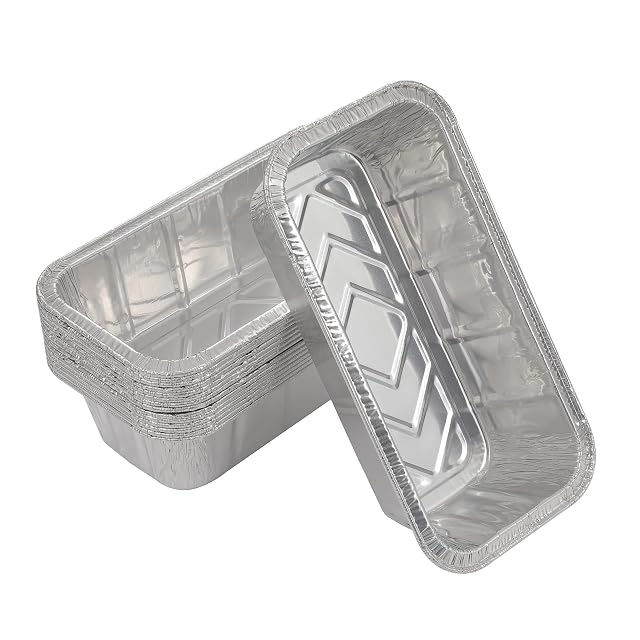
Twenty-five heavy-duty aluminum foil loaf pans of 8.5 × 4.5 × 2.5 inches, rated 2 lb, recyclable and oven safe.
Best for: Baking bread or meatloaf to give away, twenty-five times over
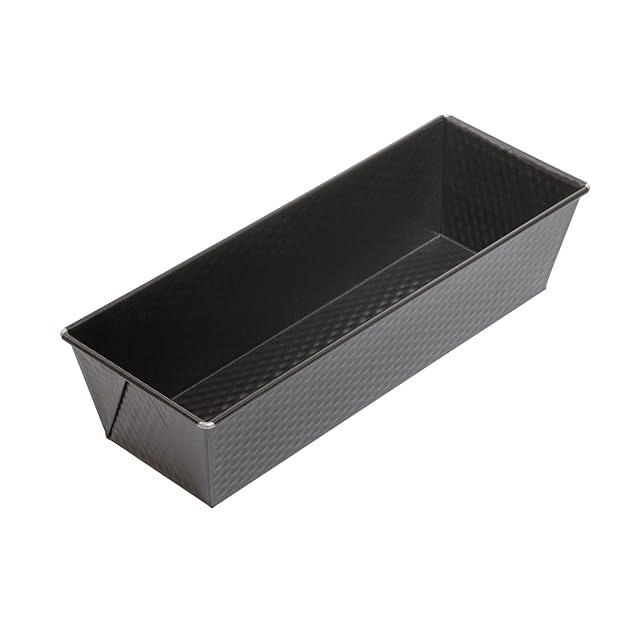
A classic coated steel loaf pan, published at 11.8 by 4.3 by 3.1 inches (30 × 11 × 8 cm) and 2.2 quarts (2.1 L). Kaiser states a single-layer PES coating with a small PTFE content, sourdough resistance, good heat conduction for even baking, and its own manufacture in Germany.
Best for: Bread and cakes where a browned, even crust matters, in a full-size oven.
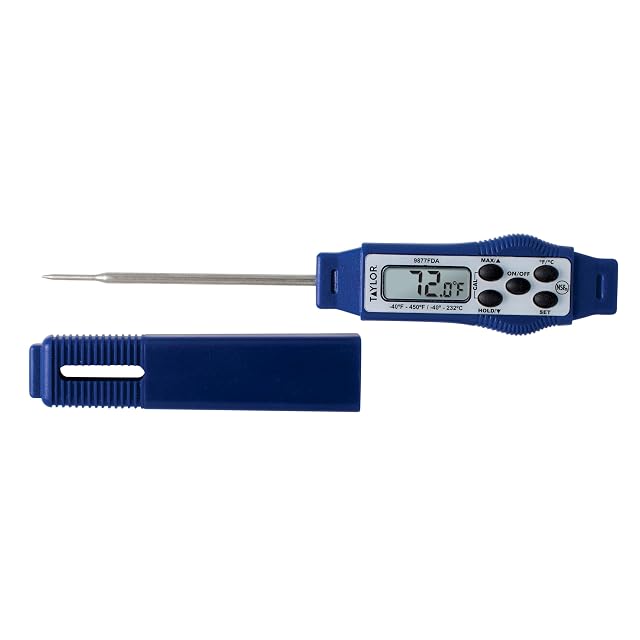
A waterproof pen-style thermometer reading −40 to 450 °F, with a large LCD, a HOLD function, a ten-minute auto shutoff and a probe cover that becomes a handle.
Best for: An apron pocket, where the cover-handle and the hold button do the work
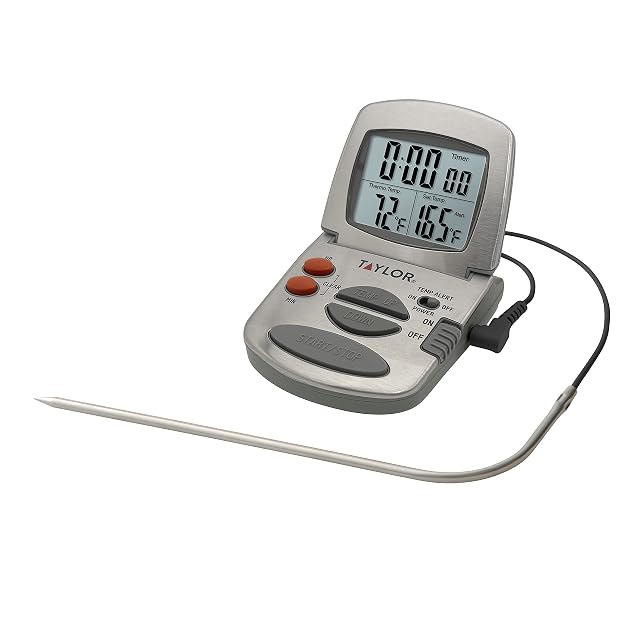
A leave-in probe thermometer with a 4-foot silicone cord, a programmable temperature alarm, a 24-hour timer, a magnetized back and a one-year warranty.
Best for: Oven roasting where the door stays shut and the display sits on it
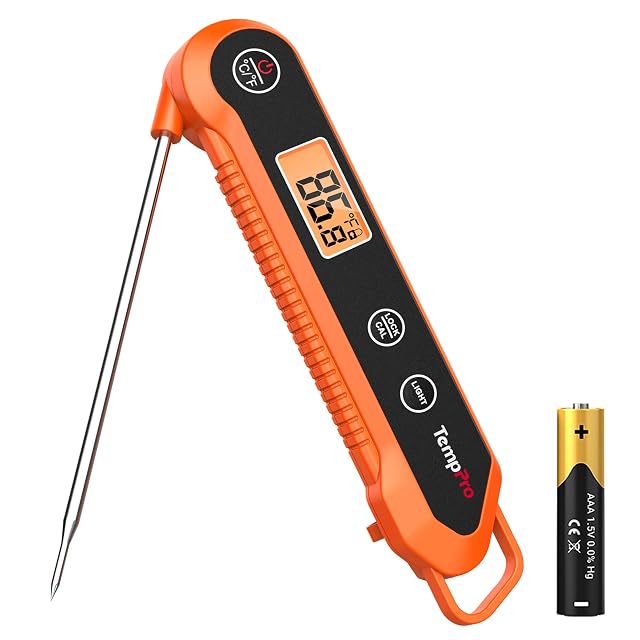
A one-second folding-probe thermometer rated IPX6 waterproof, with a calibration function, a bright backlit display, a magnetic back and a hook.
Best for: A folding thermometer that gets rinsed and can be checked against ice water