What the maker puts in writing
- “5-IN-1 DAILY PREP: Built for parents, family cooks, and small kitchens. Make shakes, sauces, salsa, minced meat, ground coffee, spices, and simple daily meals.”
- “4-CUP SETUP: Includes BPA-free 47oz pitcher, 2.5-cup chopper bowl, 18oz cup, and 11oz cup”
- “3 BLADE OPTIONS: Cross blade blends liquid recipes. Flat blade grinds coffee and dry spices. S-blade chops meat, vegetables, herbs, nuts, and sauces.”
- “2 SPEEDS + PULSE: …Pulse supports quick bursts, instant start, self-cleaning with water, and smoother blending when adding liquid for frozen fruit or thick shakes.”
- “EASY TO CLEAN: Removable cups, bowl, pitcher, lids, and blades are simple to rinse and dishwasher safe except the motor base. Handle blades with care.”
- “SAFETY BACKED: ETL certified with lock design, suction feet, and overheating protection. Limit each run to 60 seconds. Includes 2-year warranty and 24-hour response.”
- Reference SBL359ABCE · Catalog: 2495 g (88 oz), 119 × 119 × 361 mm (4.69 × 4.69 × 14.2 in)
Sixty seconds, which is the only duty cycle on this shelf
“Limit each run to 60 seconds.”
Every machine on this shelf has that constraint. This is the only one that publishes it.
The limit is about heat. A blender or chopper motor is small and air-cooled by its own fan, and under load it heats faster than it sheds. Run it for three minutes on something stiff and the windings reach the point where a thermal cutout trips — or, on a machine without one, where the motor’s life shortens quietly.
The Ganiza at $55.99 admits the same thing without a number: “equipped with an overheating protection system. If the machine stops working, please wait a few minutes for the machine to cool down before starting it.”
At least seven of the thirteen machines here publish nothing at all.
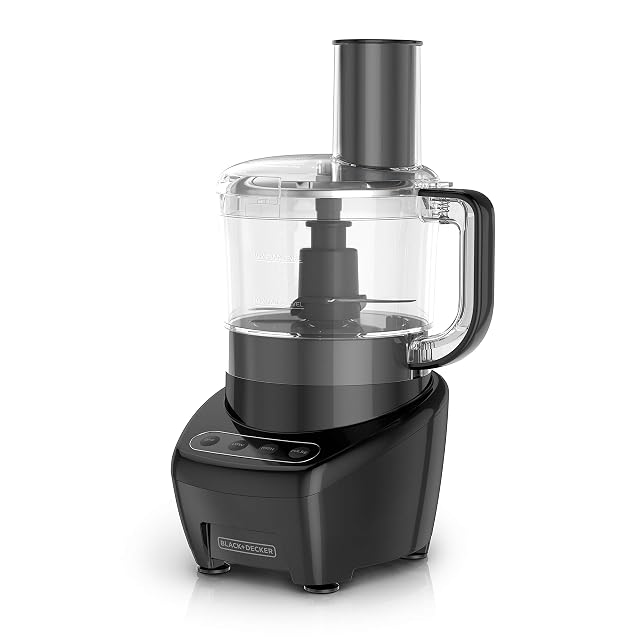
Which matters most on the longest jobs. Nut butter takes minutes of continuous running while the mass heats and stiffens, and the BLACK+DECKER FP4200BC at $37.49 names it as a use with no duty cycle given.
So borrow this figure for the whole shelf. A minute on, a minute off, is the safe rhythm on any of them.
And pulse rather than hold, which this page also recommends — “Pulse supports quick bursts, instant start”. Pulsing is better technique as well as kinder to the motor: food falls back into the blade’s path between bursts, which is how you get even chopping instead of purée underneath and whole pieces on top.
The limit is not a weakness of this machine. It is the one page honest about a constraint they all share.
Two years and an ETL mark, both unique here
“ETL certified with lock design, suction feet, and overheating protection… Includes 2-year warranty and 24-hour response.”
Two years is the longest warranty on this shelf, and the only other one published anywhere here is the Cuisinart’s 18 months. Seven of nine machines publish none.
And ETL is the only certification on the shelf. It is a third-party electrical safety mark — tested rather than asserted — which on a mains appliance with a blade and a bowl of liquid is the right thing to carry.
The four safeguards named are each worth a line:
A lock design, so the motor will not run unless the vessel is seated. Every machine here has an interlock of some kind; the Ninja at $109.99 describes it as a feature — “operates only when properly assembled” — and the BLACK+DECKER FP4200BC and Hamilton Beach 70725 both lead on making it less annoying, with a lid-as-lock and “Stack & Snap” respectively.
Suction feet, shared with the Hamilton Beach 70725 — “the suction cup feet prevent sliding for greater stability”. On a blender, a machine that walks across a counter under load is a real problem.
Overheating protection, shared with the Ganiza.
And the sixty seconds above.
“Handle blades with care” in bullet five is the other candid line. Three loose blades in a drawer is the hazard of a multi-vessel machine, and this is the only page on the shelf that says so.
Four vessels, three blades, and what each is for
“BPA-free 47oz pitcher, 2.5-cup chopper bowl, 18oz cup, and 11oz cup.”
“Cross blade blends liquid recipes. Flat blade grinds coffee and dry spices. S-blade chops meat, vegetables, herbs, nuts, and sauces.”
This is a blender with a chopper bowl attached, and the vessels say so. 47 ounces is about 1.4 liters, and a pitcher with a cross blade is a blender. The 18 oz and 11 oz cups are single-serve smoothie cups — a blender format, not a processor one.
And the three blades are three genuinely different geometries:
A cross blade has four arms at different angles, creating the vertical circulation a blender needs: liquid must be pulled down and thrown up or the top never reaches the blade.
An S-blade is two flat wings cutting in a narrow band at the bottom of a bowl — right for solids.
A flat blade is for dry grinding: no lift, no circulation, just a horizontal plane striking particles until they are small.
The flat blade is the one worth having, with one honest limit. For spices it works properly: cumin, pepper, coriander, fennel come out usably even, and you are not extracting them with water under pressure so the spread of particle sizes does not matter.
For coffee it does. A blade grinder cuts whatever it strikes, so you get dust and boulders in one batch — and because extraction depends on particle size, dust over-extracts and turns bitter while boulders under-extract and turn sour.
The Cuisinart at $39.95 reaches the same conclusion and contradicts itself doing it: its bullet says “not recommended to grind beans as it chops”, and its description names “coffee beans” as a use for the blunt edge of its reversible blade.
So this is a spice grinder that will also abuse coffee — and it is the only machine on this shelf with a dedicated dry-grinding blade at all.
Two and a half cups, which is the processor half
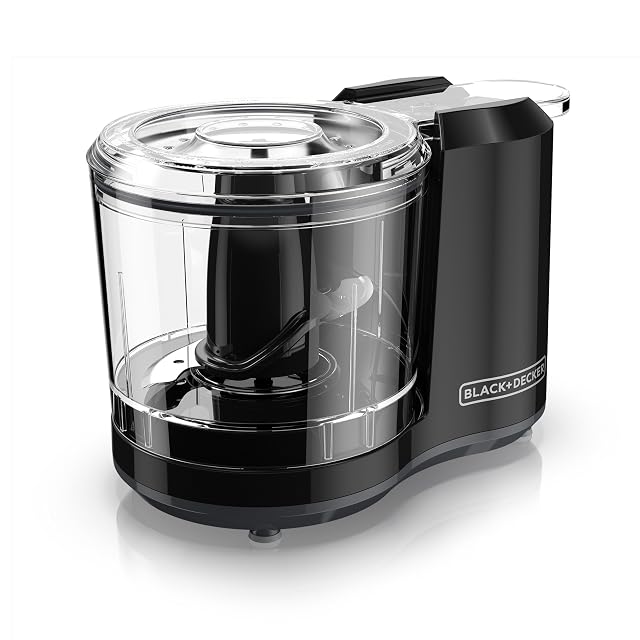
The chopper bowl is 2.5 cups — second smallest on this shelf, after the BLACK+DECKER HC150B at 1.5, and below the Cuisinart at 3 and the KitchenAid at 3.5.
The full ladder: 1.5 · 2.5 · 3 · 3.5 · 8 (B+D FP4200BC) · 8 × 2 (Ganiza) · 9 (Ninja) · 10 and 12 (Hamilton Beach).
And there is no feed chute and no slicing disc, so it cannot slice or shred anything.
At least five of the thirteen machines on this shelf are in the same position — this, the HC150B, the Cuisinart, the KitchenAid and the Ganiza — while the words “food processor” appear in eight of the nine titles.
The four that genuinely slice are the BLACK+DECKER FP4200BC at $37.49, the Ninja at $109.99, and both Hamilton Beach machines at $52.95 and $69.99.
So read “5-in-1” as five vessel-and-blade combinations rather than five functions. What you are buying is a blender that also chops small quantities and grinds spices — a sensible combination for a small kitchen, and a different machine from everything else here.
Which is also the fair way to read the price. At $49.99 this is not competing with the 10-cup Hamilton Beach at $52.95; it is competing with a blender plus a spice grinder plus a small chopper, bought separately.
Two speeds plus pulse matches the shelf standard — the KitchenAid, Ganiza and both Hamilton Beach machines have the same, the BLACK+DECKER FP4200BC low, high and pulse, the HC150B pulse alone, and the Ninja four Auto-iQ presets.
And “self-cleaning with water” is a real blender technique rather than a claim: water and a drop of detergent, pulsed for a few seconds, cleans a pitcher far better than a brush can reach — and it keeps your hand away from a cross blade.
No wattage, which is the gap
Nothing on this page states a motor power, and only one other machine on this shelf does the same: the KitchenAid at $54.99.
The rest: 450 W continuous on four machines — the BLACK+DECKER FP4200BC, both Hamilton Beach models and the Ganiza. 250 W on the Cuisinart. 150 W on the HC150B.
And the Ninja publishes 1000 “peak” watts, which is a different unit: the momentary draw at startup or stall rather than sustained power. It is the only machine here using that convention — “1000PW” in the title, “1000-peak-watt” in bullet one — and it cannot be set against a continuous 450.
What makes the omission less serious here is that the page publishes the thing wattage is usually a proxy for: how long you may run it. A duty cycle tells you more about a small motor than its nameplate does.
And the weight gives a clue. 2495 grams puts it mid-shelf — above the Ganiza’s 2268 g, below the Hamilton Beach 70730’s 2812 g — which for a machine carrying a 1.4-liter pitcher and a motor base is a reasonable amount of material. The ladder: HC150B 544 g · Cuisinart 998 g · KitchenAid 1225 g · Ganiza 2268 g · this 2495 g · 70730 2812 g · 70725 2980 g · Ninja 3470 g.
What is not published
No wattage, as above.
No disc and no chute, as above.
No pitcher material. BPA-free is stated, and whether the 47 oz pitcher is glass or plastic is not — which matters for a blender, because glass resists scratching from ice and plastic survives being dropped. The Ganiza is the only machine on this shelf to name its bowl materials: an 8-cup glass bowl and an 8-cup stainless steel one.
No crush-ice claim, on a machine whose bullet four names “frozen fruit”. Ice is the hardest thing a blender does and the fastest way to blunt a blade.
No oil hole or drizzle feature, which the three small choppers here all have: the HC150B’s “oil holes”, the Cuisinart’s two “pinholes” for “a perfect emulsion”, the KitchenAid’s “drizzle basin”. On a 2.5-cup bowl, that is the feature its size would most reward.
No bowl scraper, which only the Hamilton Beach 70730 at $52.95 has.
No storage solution, on a machine with four vessels, three blades and four lids — eleven parts, and the page says nothing about where they go. Two machines on this site’s stand-mixer-attachment shelf ship storage cases for exactly this reason.
No country of manufacture, which nothing on this shelf publishes.
Availability
Read on the day this page was built: $50 at the American Amazon shop.
Read from Keepa on the day this page was last revised; stock and price both move without notice.
Prices quoted in this text were read on 2026-10-05. The live price is at the top of the page.