What the maker puts in writing
- “1.5-CUP CAPACITY - 1.5 Cup chopper is perfect for small jobs; enjoy fresh chopped herbs, bread crumbs, fruits and veggies, chocolate and more”
- “DISHWASHER SAFE - Dishwasher-Safe Removable Parts”
- “STAY SHARP STAINLESS STEEL BLADES - Bi-level stainless steel blades stay sharp, providing long-lasting performance”
- “EASILY ADD OIL WHILE MIXING - The chopper is equipped with oil holes, allowing you to easily add oil to hummus and vinaigrette as you mix without making a mess.”
- “150W MOTOR FOR POWERFUL CHOPPING - 150W Power for chopping and mincing; equipped with a base, bowl, and lid; improved chopping assembly & one-touch pulse control”
- Reference HC150B · Catalog: 544 g (19.2 oz), 165 × 102 × 127 mm (6.50 × 4.02 × 5 in)
A chopper, not a processor — and that is the shelf’s real division
This has no slicing disc and no feed chute. It chops; it does not slice or shred.
At least five of the thirteen machines here are in the same position: this, the Cuisinart at $39.95, the KitchenAid at $54.99, the Ganiza at $55.99 and the Sangcon at $49.99. And the words “food processor” appear in eight of the nine titles.
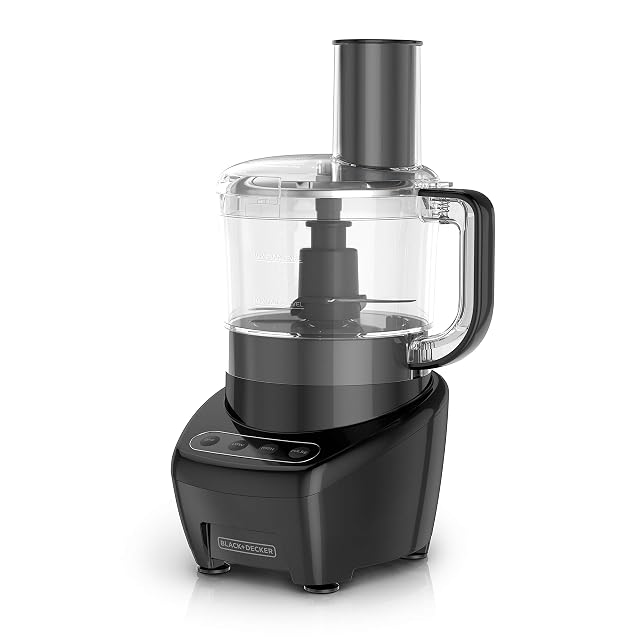
The four that genuinely slice all have both a chute and a reversible disc: the BLACK+DECKER FP4200BC at $37.49, the Ninja at $109.99, and the two Hamilton Beach machines at $52.95 and $69.99.
So the test before buying anything on this shelf is: is there a chute in the lid and a flat disc in the box? No chute means no cucumber slices, no shredded cheese, no rösti potato — however many watts the motor has.
And a small bowl is a positive feature rather than a shortfall. A chopping blade cuts in a narrow band, and food thrown to the wall stops being cut. A handful of parsley in a 12-cup bowl gives you a few shredded leaves and many untouched ones; the same handful in 1.5 cups is cut evenly.
This is the smallest bowl on the shelf, and the ladder runs: 1.5 · 2.5 (Sangcon’s chopper bowl) · 3 (Cuisinart) · 3.5 (KitchenAid) · 8 (B+D) · 8 × 2 (Ganiza) · 9 (Ninja) · 10 and 12 (Hamilton Beach).
A hundred and fifty watts, and the units on this shelf do not match
150 W — the least here. The comparison:
450 W continuous — BLACK+DECKER FP4200BC, Hamilton Beach 70730, Hamilton Beach 70725, Ganiza
250 W — Cuisinart
150 W — this
No wattage at all — KitchenAid, Sangcon
1000 “peak” watts — Ninja
The Ninja’s figure is in a different unit. A peak watt is the momentary draw at startup or stall; a continuous rating is what the motor sustains. The two are not comparable, and the Ninja is the only machine on this shelf using the peak convention — its title reads “1000PW” and bullet one “1000-peak-watt”.
What 150 W will do in this bowl: herbs, onion, garlic, cooked fruit, bread, chocolate — the list in bullet one, and it is honest.
What it will struggle with is anything hard and dry in quantity: raw carrot, parmesan, nuts, ice. A small motor does not stall gracefully — it slows and heats.
Which is where the figure almost nobody publishes matters. Only the Sangcon states a duty cycle — “limit each run to 60 seconds” — and the Ganiza admits the same limit without a number: “if the machine stops working, please wait a few minutes for the machine to cool down.” Seven of nine publish nothing. Treat a minute as the ceiling here, and pulse rather than hold.
“One-touch pulse control” is the whole interface, and on a bowl this size that is the right amount. Pulsing is also better technique than running continuously: it lets the food fall back into the blade’s path between bursts, which is how you get even chopping rather than a purée at the bottom and whole pieces on top.
The oil holes, which are the reason to own a small one
“equipped with oil holes, allowing you to easily add oil to hummus and vinaigrette as you mix without making a mess.”
An emulsion is oil suspended in water, and it only forms if the oil goes in slowly while the blade is turning. Pour it in at once and it sits on top. Drip it in and the blade breaks it into droplets small enough to stay suspended.
That is mayonnaise, aioli, a stable vinaigrette, and the final stage of hummus — and holes in the lid let you pour steadily with the lid shut and the machine running, which is otherwise a two-handed job with a jug and an open bowl.
At least three of the thirteen machines on this shelf have this feature, and they are the three smallest.
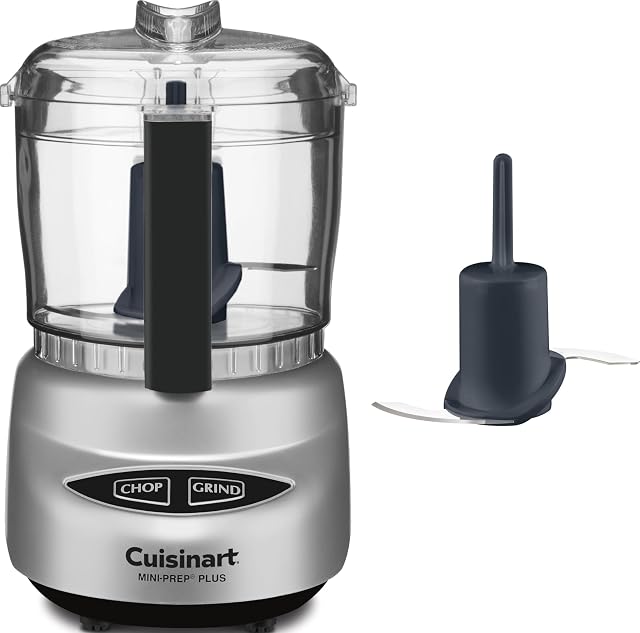
Cuisinart, $39.95 — “two receptacles in the lid have pinholes for one or two oils to stream into the bowl while the processor is blending a perfect emulsion”. The most explicit version, and the only one to mention two oils at once.
KitchenAid, $54.99 — a “drizzle basin”, and “Easily incorporate liquid ingredients for sauces and dressings while processing”.
this — oil holes.
The six larger machines have none, and that is consistent rather than an oversight: half a cup of mayonnaise in a 12-cup bowl will not reach the blade at all.
Bi-level blades are the other construction note: two cutting levels on one shaft, so the blade works through the depth of the bowl rather than only at the bottom. On a 1.5-cup bowl that is most of what stops the usual chopper fault — purée underneath, chunks on top.
Five hundred and forty-four grams, and what the price buys
$14.44 — a third of the next cheapest machine here, and the ladder runs to $109.99.
Per cup it is not cheap, which is the honest counterweight:
Ganiza — $3.50 a cup (two 8-cup bowls) · B+D FP4200BC — $4.69 · Hamilton Beach 70730 — $5.30 · Hamilton Beach 70725 — $5.83 · this — $9.63 · Ninja — $12.22 · Cuisinart — $13.32 · KitchenAid — $15.71
So the small bowls cost two to three times as much per cup as the large ones. Which only matters if capacity is what you want — and if it were, the BLACK+DECKER FP4200BC at $37.49 gives you 8 cups, 450 W and a reversible slicing disc for twenty-three dollars more.
At 544 grams this is the lightest machine on the shelf, and that is the practical argument for it. The ladder: this 544 g · Cuisinart 998 g · KitchenAid 1225 g · Ganiza 2268 g · Sangcon 2495 g · Hamilton Beach 70730 2812 g · Hamilton Beach 70725 2980 g · Ninja 3470 g.
A machine that weighs half a kilo lives in a cupboard and comes out for two minutes. A three-and-a-half-kilo one lives on the counter or does not get used — which is the real reason small choppers sell alongside large processors rather than being replaced by them.
Dishwasher-safe removable parts, as on at least eight of the thirteen machines here; the Ganiza is the only one that does not claim it, saying only “easy to clean with removable blades”.
What is not published
No warranty. Only two machines on this shelf publish one: the Cuisinart at 18 months and the Sangcon at 2 years with a 24-hour response. Seven of nine publish nothing — and the Sangcon is also the only one with a certification, ETL.
No run-time limit, as above.
No speed. One-touch pulse is the only control, where the Cuisinart has two buttons, the KitchenAid, Ganiza, Hamilton Beach pair and Sangcon have two speeds plus pulse, the BLACK+DECKER FP4200BC low, high and pulse, and the Ninja four Auto-iQ presets.
No bowl material, and no BPA statement — where the Cuisinart, Ninja, both Hamilton Beach machines, the Ganiza and the Sangcon all claim BPA-free, two of them specifying “in all food zones”.
No blade removal note, which matters on a chopper: the blade sits on a spindle in the bottom of the bowl, and tipping a bowl of chopped herbs out past a loose blade is how people cut themselves. The KitchenAid is the only machine here to address it, with a blade that “locks in place for convenient pouring”.
No cord storage, which the KitchenAid publishes as a “simple cord wrap”.
No recipe book, which the Cuisinart includes.
Availability
Read on the day this page was built: $14 at the American Amazon shop.
Read from Keepa on the day this page was last revised; stock and price both move without notice.
Prices quoted in this text were read on 2026-10-05. The live price is at the top of the page.