What the maker puts in writing
- “EASY ASSEMBLY: The smart design lets you set the work bowl onto the base, and uses the lid as the locking mechanism. No more struggling to lock the bowl into place.”
- “8-CUP WORK BOWL: The large capacity gives you plenty of room… creating salsas, nut butter, hummus, and so much more.”
- “STAINLESS STEEL S-BLADE: The stainless steel blade quickly chops and mixes for fast, consistent results.”
- “REVERSIBLE SLICE/SHRED DISC: The reversible metal disc lets you slice veggies quickly or shred cheese without tiring your forearms.”
- “EASY-CLEAN TOUCHPAD CONTROLS: …low, high, and pulse settings. The powerful 450W motor takes care of food quickly and easily.”
- Description: “Choose from two speeds and a pulse setting… all removable parts are dishwasher-safe”
- Reference FP4200BC · Catalog: 226 × 221 × 386 mm (8.90 × 8.70 × 15.2 in)
The cheapest machine here that can actually slice
This has a chute and a disc. At least five of the thirteen machines on this shelf do not.
An S-blade and a slicing disc do different things. An S-blade spins in the bottom of the bowl and cuts whatever enters its band: the result is chopped, with pieces of varying size, and it cannot make a slice of anything. A disc sits at the top of the bowl and food is pushed onto it down a chute, so every piece meets the blade at the same angle — slices or shreds of uniform thickness.
That is the difference between chopped cucumber and sliced cucumber, between crumbled cheese and grated cheese.
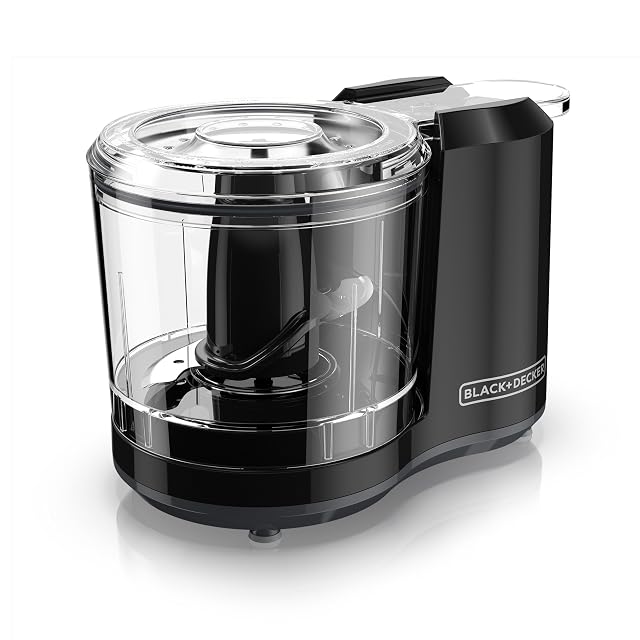
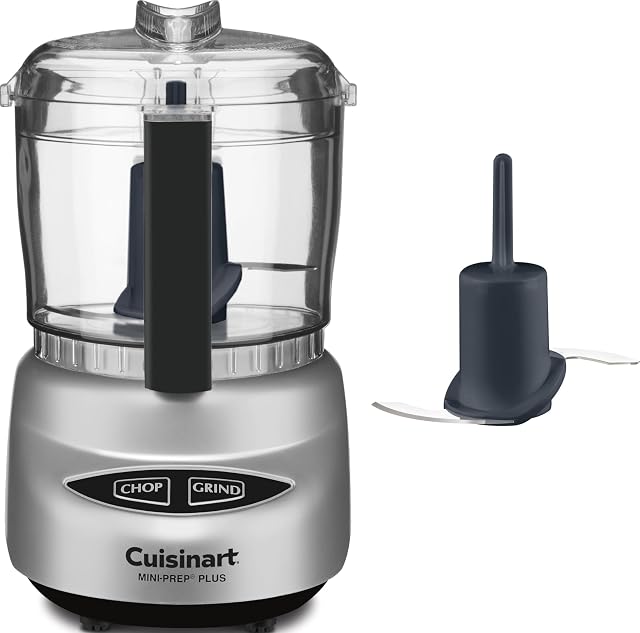
The five choppers: BLACK+DECKER HC150B at $14.44 (1.5 cups), Cuisinart at $39.95 (3), KitchenAid at $54.99 (3.5), Ganiza at $55.99 (two 8-cup bowls), Sangcon at $49.99 (a blender combo). And “food processor” appears in eight of the nine titles on this shelf.
The four that slice: this, the Ninja at $109.99, and the two Hamilton Beach machines at $52.95 and $69.99.
This is the cheapest of the four by fifteen dollars.
And “reversible” is worth reading carefully. It is one disc with two faces — slice on one side, shred on the other — so you flip it rather than storing two. Fewer parts to lose, and one thickness per function rather than a choice of them. The KitchenAid slicer attachment on this site’s stand-mixer shelf publishes three separate blades at 3 mm, 4 mm and 6 mm; nothing on this shelf publishes a cut thickness at all.
The lid is the lock, which is the complaint everybody has
“The smart design lets you set the work bowl onto the base, and uses the lid as the locking mechanism. No more struggling to lock the bowl into place.”
What normally happens: the bowl must be twisted onto the base until a tab engages a slot you cannot see, and then the lid must be twisted onto the bowl until a second tab trips the safety interlock. Two blind alignments — and a processor that will not start because one of them is a few degrees out is the commonest complaint about the whole category.
Here the bowl drops on, and tightening the lid clamps everything. One alignment instead of two.
And the Hamilton Beach 70725 at $69.99 leads on exactly the same problem, in its own first bullet: “Stack & Snap technology provides easy assembly and removes the need for difficult twist-locking.”
Two of nine machines putting assembly first is a fair indication of where the frustration lies. The Ninja at $109.99 approaches it from the other side: “Built-in safety mechanisms ensure the processor operates only when properly assembled” — which is the interlock that causes the problem, described as a feature.
Touchpad controls are the other convenience here, and the stated reason is cleaning: “Easy-Clean Touchpad Controls”. A flat panel wipes; a rocker switch collects flour in its hinge. Low, high and pulse matches the shelf standard — the KitchenAid, Ganiza, both Hamilton Beach machines and the Sangcon all have two speeds plus pulse. The Ninja substitutes four Auto-iQ presets, and the HC150B has pulse alone.
Four hundred and fifty watts, which is the shelf’s center
450 W continuous, and four machines here publish exactly that: this, both Hamilton Beach models and the Ganiza.
Below it: Cuisinart 250 W, BLACK+DECKER HC150B 150 W — both small-bowl choppers, and both matched to their bowls.
No wattage at all: the KitchenAid at $54.99 and the Sangcon at $49.99.
And the Ninja publishes 1000 “peak” watts, which is a different unit. A peak figure is the momentary draw at startup or stall; a continuous rating is what the motor sustains. The two do not compare, and the Ninja is the only machine on this shelf using that convention — “1000PW” in the title, “1000-peak-watt” in bullet one.
So on continuous power this is level with every other full-size processor here, at a third to a half of their price.
Eight cups against the alternatives: Ninja 9 · Hamilton Beach 70730 10 · Hamilton Beach 70725 12.
What capacity governs is batch size before you stop and empty — and the usable figure is lower than the printed one, because a processor must not be filled past the blade with anything liquid. A 12-cup bowl holds roughly half that in salsa before it weeps round the center spindle. The 70725 is the only machine on this shelf with a sealed bowl, for precisely that reason.
Per cup this is the best value here: $4.69, against $5.30 (70730), $5.83 (70725) and $12.22 (Ninja). The three small choppers run $9.63 to $15.71 a cup.
Salsa, nut butter and hummus — and what each asks of the machine
The three named uses are well chosen, because they are three different loads.
Salsa is the easy one: soft, wet, and done in pulses. The risk is over-processing into soup, which is what pulse exists for.
Hummus needs the opposite — sustained running to get chickpeas smooth, and oil added gradually. This has no oil hole, where the three small choppers on this shelf all do: the HC150B’s “oil holes”, the Cuisinart’s “pinholes” for “a perfect emulsion”, the KitchenAid’s “drizzle basin”. On an 8-cup bowl you lift the lid and pour, which works but is messier.
Nut butter is the hard one, and it is the real test of a 450 W motor. Nuts go from chopped to paste over several minutes of continuous running, and the motor is loaded the whole time while the mass heats and stiffens. No run-time limit is published here — and only the Sangcon publishes one anywhere on this shelf: “limit each run to 60 seconds”. The Ganiza admits the same constraint without a number: “if the machine stops working, please wait a few minutes for the machine to cool down.”
For nut butter, work in two- or three-minute stints and let the motor rest. At least seven of the thirteen machines on this shelf tell you nothing about how long they may run.
What is not published
No weight. The only machine on this shelf without one, and it matters for a reason that decides whether a processor gets used: a heavy machine lives on the counter, a light one lives in a cupboard and comes out. The ladder: HC150B 544 g · Cuisinart 998 g · KitchenAid 1225 g · Ganiza 2268 g · Sangcon 2495 g · Hamilton Beach 70730 2812 g · Hamilton Beach 70725 2980 g · Ninja 3470 g. The catalog box here is 226 × 221 × 386 mm, which is the same order as the 10-cup Hamilton Beach.
No bowl scraper. The Hamilton Beach 70730 at $52.95 is the only machine on this shelf with one, and it solves the universal processor problem: food climbs the bowl wall and stops being cut. Its scraper works “while the food processor is running or the power is off — no need to remove the lid”. Without one, you stop, unlock, scrape with a spatula, reassemble — which on this machine means undoing the one alignment its first bullet saved you.
No sealed bowl, as above.
No cut thickness for the disc, which no machine on this shelf publishes.
No dough blade, which only the Ninja has.
No BPA statement, where at least six of the thirteen machines here claim BPA-free — two of them specifying “in all food zones”.
No run-time limit and no warranty. Only the Cuisinart (18 months) and the Sangcon (2 years, plus ETL certification) publish either.
No feed chute dimensions, where the Hamilton Beach 70725 makes its “Big Mouth” chute a selling point — “Fit a whole potato or tomato right into the chute” — and the 70730 claims a “large feed chute” that reduces pre-cutting. Chute width is what decides whether you halve a potato first, and this page does not say.
Availability
Read on the day this page was built: $37 at the American Amazon shop.
Read from Keepa on the day this page was last revised; stock and price both move without notice.
Prices quoted in this text were read on 2026-10-05. The live price is at the top of the page.