What the maker puts in writing
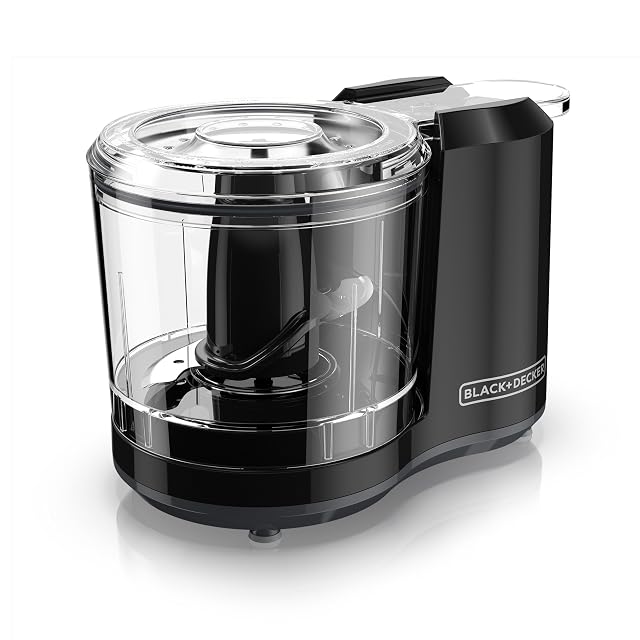
- “Convenient 3.5 cup work bowl features a locking blade, handle and pour spout for easy serving, and dishwasher-safe for quick clean up”
- “With its small, countertop friendly footprint and simple cord wrap, it’s easy to store”
- “2 speeds and pulse for coarse or fine results for anything from chunky pico de gallo and salsa, to a creamy hummus, smooth sauce or tasty dressing”
- “Easily incorporate liquid ingredients for sauces and dressings while processing with the drizzle basin”
- “Precisely chop or puree with the stainless steel multi-purpose blade that locks in place for convenient pouring”
- Description: “You can even purée cooked fruit or vegetables to make baby food, or to use as bases for soups or sauces. The drizzle basin is great for making mayonnaise, dressings, sauces and other condiments.”
- Reference KFC3516PT · Catalog: 1225 g (43.2 oz), 142 × 178 × 222 mm (5.59 × 7.01 × 8.74 in)
The locking blade, which nothing else here has
“a locking blade, handle and pour spout for easy serving” · “the stainless steel multi-purpose blade that locks in place for convenient pouring”
On every other chopper on this shelf the blade sits loose on a spindle.
Tip the bowl and the blade slides forward with the food: it blocks the spout, it drops into whatever you are pouring into, and it is sharp. The usual workarounds are to hold it down with a finger — on the hub, with the edge a centimeter away — or to lift it out first and then pour, which leaves a third of the contents clinging to it.
A blade that locks lets you pour the bowl like a jug. Which is the whole point of having a handle and a spout, and all three only work together.
Nothing else on this shelf has it. The Cuisinart at $39.95 has a “work bowl with handle” and includes a spatula instead. The Hamilton Beach 70725 at $69.99 has a “convenient pour spout” and no locking blade.
And it matters most for exactly what this page says the machine is for: “purée cooked fruit or vegetables to make baby food, or to use as bases for soups or sauces.” All wet, all poured, and all the worst case for a loose blade.
The drizzle basin, and why only the small machines have one
“Easily incorporate liquid ingredients for sauces and dressings while processing with the drizzle basin.”
An emulsion is oil suspended in water, and it only forms if the oil goes in slowly while the blade turns. Pour it in at once and it floats; drip it in and the blade shears it into droplets small enough to stay suspended.
That is mayonnaise, aioli, a stable vinaigrette, and the last stage of hummus — and the description names the right list: “great for making mayonnaise, dressings, sauces and other condiments.”
A basin is the most forgiving version of the feature: a shallow reservoir in the lid with a small hole, so you pour the whole quantity in at once and it meters itself. Hands free.
At least three of the thirteen machines here have it, and they are the three smallest:
this — a drizzle basin
Cuisinart, $39.95 — “two receptacles in the lid have pinholes for one or two oils to stream into the bowl while the processor is blending a perfect emulsion”
BLACK+DECKER HC150B, $14.44 — “oil holes… add oil to hummus and vinaigrette as you mix without making a mess”
The six larger machines have nothing of the kind, and that is consistent rather than an oversight: half a cup of mayonnaise in a 12-cup bowl never reaches the blade at all.
Which is the real argument for a small chopper. It is not a smaller processor — it is the right machine for the jobs a processor is too big for.
And the same logic covers the chopping. A blade cuts in a narrow band, so a handful of herbs in a 10-cup bowl gives you a few shredded leaves and many whole ones; the same handful in 3.5 cups is cut evenly. The ladder on this shelf: 1.5 · 2.5 · 3 · 3.5 · 8 · 8 × 2 · 9 · 10 · 12 cups.
Fifteen dollars seventy-one a cup, and the two-dollar comparison
$54.99 for 3.5 cups is $15.71 a cup — the highest on this shelf.
Ganiza $3.50 (two 8-cup bowls) · BLACK+DECKER FP4200BC $4.69 · Hamilton Beach 70730 $5.30 · Hamilton Beach 70725 $5.83 · BLACK+DECKER HC150B $9.63 · Ninja $12.22 · Cuisinart $13.32 · this $15.71
And the comparison that stings is two dollars away.
The Hamilton Beach 70730 at $52.95 gives you 10 cups, a published 450 watt motor, a reversible slicing and shredding disc, a feed chute, and a built-in bowl scraper worked with the lid shut — for $2.04 less than this.
Three times the capacity, a whole function this machine does not have, and a wattage figure this page does not publish.
Because there is no wattage here at all. Four machines on this shelf publish 450 W continuous — the FP4200BC, both Hamilton Beach models and the Ganiza. The Cuisinart publishes 250 W, the HC150B 150 W. The Ninja publishes 1000 “peak” watts, which is a different unit — the momentary draw at startup or stall rather than sustained power, and the only use of that convention here. This and the Sangcon publish nothing.
And there is no disc and no chute, so no sliced cucumber and no grated cheese. At least five of the thirteen machines here are in the same position — this, the HC150B, the Cuisinart, the Ganiza and the Sangcon — while the words “food processor” appear in eight of nine titles.
So buy it for the bowl, not for the money. The small-bowl argument above is real, and so are the four details on this page. But if capacity or slicing is what you want, two dollars buys a different class of machine.
Two speeds, and the page says what they produce
“2 speeds and pulse for coarse or fine results for anything from chunky pico de gallo and salsa, to a creamy hummus, smooth sauce or tasty dressing.”
That is the right way to describe a speed control — by the texture it gives rather than by the number.
Coarse is pico de gallo: onion, tomato and chilli still identifiable, which needs pulse rather than a speed at all.
Fine is hummus and sauces, which need sustained running.
Two speeds plus pulse matches the shelf standard — the Ganiza, both Hamilton Beach machines and the Sangcon all have the same; the FP4200BC has low, high and pulse; the Ninja substitutes four Auto-iQ presets. Below it: the Cuisinart has two buttons, chop and grind, with no pulse, and the HC150B has pulse alone.
So on control this is at the top of the small-bowl group, which is a fair part of the price difference against the Cuisinart and the HC150B.
Baby food is the use worth separating out, because it is the one job where this machine’s whole design comes together: small batches, repeated often, puréed smooth, and poured out rather than spooned. The locking blade, the spout and the handle are all for exactly that — and a 10-cup processor is the wrong tool for 150 grams of carrot.
“With its small, countertop friendly footprint and simple cord wrap, it’s easy to store, neatly tucking away when you’re finished prepping.”
This is the only machine on the shelf to publish a cord wrap, and it is a better indicator than it looks.
A loose cord is why small appliances stop being used. It will not sit flat in a cupboard, it catches on everything, and a machine that is annoying to put away ends up on the counter or at the back of a shelf.
And the weight makes the same argument. 1225 grams is third lightest here: HC150B 544 g · Cuisinart 998 g · this 1225 g · Ganiza 2268 g · Sangcon 2495 g · Hamilton Beach 70730 2812 g · Hamilton Beach 70725 2980 g · Ninja 3470 g.
A machine at 1.2 kilos comes out for two minutes and goes back. A machine at 3.5 kilos lives on the counter or does not get used — which is the real reason small choppers sell alongside large processors instead of being replaced by them.
Dishwasher-safe work bowl, as on at least eight of the thirteen machines here; only the Ganiza does not claim it.
What is not published
No wattage, as above — and only the Sangcon shares that gap, though the Sangcon compensates by publishing the thing wattage is a proxy for: a 60-second run limit.
No run-time limit. The Sangcon at $49.99 is the only machine on this shelf to publish one, and the Ganiza at $55.99 admits the constraint without a number: “if the machine stops working, please wait a few minutes for the machine to cool down.” Seven of nine say nothing — and with no wattage and no duty cycle, this page tells you nothing at all about the motor.
No warranty. Only the Cuisinart (18 months) and the Sangcon (2 years, plus ETL certification) publish either.
No disc and no chute, as above.
No BPA statement, where at least six of the thirteen machines here make one — two of them specifying “in all food zones”.
No bowl material, and the bowl is the thing being sold. The Ganiza is the only machine on this shelf to name its bowl materials: an 8-cup glass bowl and an 8-cup stainless steel one, deliberately different so that meat and vegetables are never confused.
No bowl scraper, which only the Hamilton Beach 70730 has — and which on a bowl this size is less necessary, because a small bowl keeps food near the blade anyway.
No spatula, which the Cuisinart includes.
No recipe book, which the Cuisinart also includes.
No country of manufacture, which nothing on this shelf publishes.
Availability
Read on the day this page was built: $55 at the American Amazon shop.
Read from Keepa on the day this page was last revised; stock and price both move without notice.
Prices quoted in this text were read on 2026-10-05. The live price is at the top of the page.