What the maker puts in writing
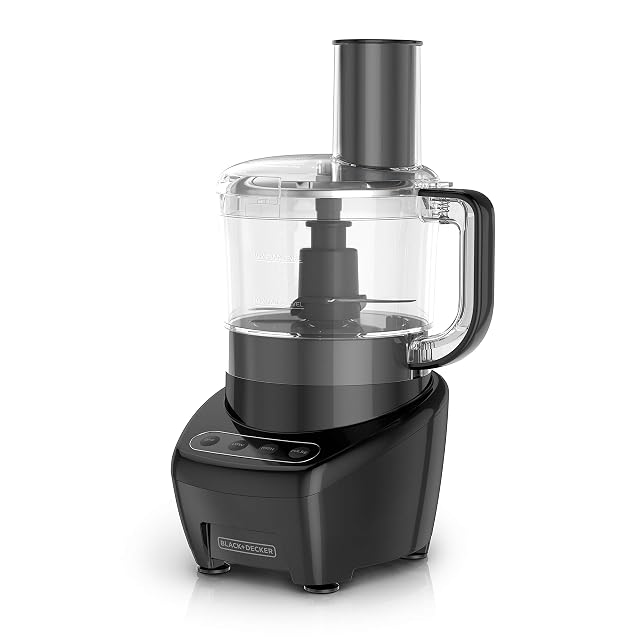
- “Built-in bowl scraper saves time. Quickly process ingredients without stopping to use a spatula. Simply move the scraper from side-to-side to scrape the bowl while the food processor is running or the power is off — no need to remove the lid.”
- “Slice, shred, chop, mix and puree with 2 versatile attachments… includes a stainless steel slicing/shredding disc and chopping/pureeing blade”
- “Powerful 450 watt motor… easily powers through the toughest ingredients”
- “Precise control with 2 speeds plus pulse… Use the high speed when you need more power and select the low speed for processing or mixing delicate foods.”
- “10 cup bowl capacity… and the large feed chute saves you time by reducing the need to pre-cut food”
- “Dishwasher safe parts. Dishwasher safe blades, bowl and lid… Parts are BPA-free in all food zones.”
- Description: “the built-in bowl scraper eliminates the need for a spatula and keeps ingredients close to the blades for more even results”
- Reference 70730 · Catalog: 2812 g (99.2 oz), 216 × 254 × 406 mm (8.50 × 10 × 16 in)
The scraper, which is the only answer here to the universal processor fault
“Simply move the scraper from side-to-side to scrape the bowl while the food processor is running or the power is off — no need to remove the lid.”
A spinning blade throws food outward, and food that reaches the bowl wall stops being cut.
So a processor works on what is in the blade’s band and leaves a ring of coarse pieces round the outside. The usual remedy is to stop, unlock the lid, scrape with a spatula, reassemble, and run again — and in that cycle the part already cut gets over-processed while you bring the rest back.
That is how a salsa becomes soup at the bottom and chunks on top.
A scraper worked from outside the lid keeps the wall clear without the stop, so everything in the bowl spends the same time against the blade. The description puts it exactly right: it “keeps ingredients close to the blades for more even results”.
Nothing else on this shelf does this. The Cuisinart at $39.95 includes a spatula in the box for the same reason — which is the honest alternative.
And the same problem recurs across this site. On the stand-mixer-attachment shelf, the MEET JUICE three-piece set at $21.99 differs from its $19.99 twin by exactly one thing: a scraper edge on its flat beater. And the New Metro Design pouring chute there names the mechanism outright, claiming a scraping blade “eliminates hand-scraping the mixing bowl and cuts mixing time by as much as 50%”.
Two shelves, one problem, and one machine here that fixes it — for two dollars more than a 3.5-cup chopper.
Ten cups, 450 watts, and a disc — for fifty-three dollars
This has a feed chute and a slicing disc. At least five of the thirteen machines on this shelf do not.
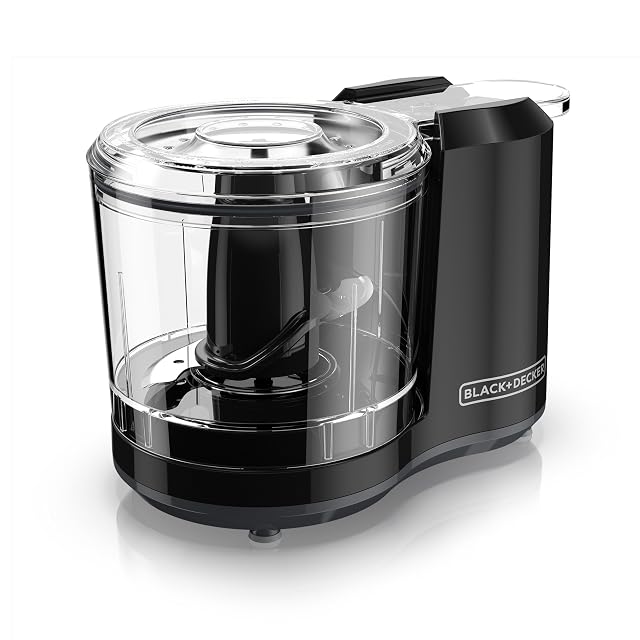
The five choppers: BLACK+DECKER HC150B at $14.44 (1.5 cups), Cuisinart at $39.95 (3), KitchenAid at $54.99 (3.5), Sangcon at $49.99 (a blender combo), Ganiza at $55.99 (two 8-cup bowls). And “food processor” appears in eight of the nine titles here.
The four that slice: the BLACK+DECKER FP4200BC at $37.49, this, the Hamilton Beach 70725 at $69.99, the Ninja at $109.99.
Which makes the sharpest comparison on this shelf a two-dollar one. The KitchenAid at $54.99 is a 3.5-cup chopper with no published wattage, no disc and no chute. This, at $52.95, is a 10-cup processor with 450 W, a reversible slicing and shredding disc, two speeds plus pulse, and the scraper above.
Per cup: BLACK+DECKER FP4200BC $4.69 · this $5.30 · Hamilton Beach 70725 $5.83 · BLACK+DECKER HC150B $9.63 · Ninja $12.22 · Cuisinart $13.32 · KitchenAid $15.71
450 W is the shelf standard, published by four machines: this, the 70725, the FP4200BC and the Ganiza. The Cuisinart publishes 250 W, the HC150B 150 W, and the KitchenAid and Sangcon nothing at all.
And the Ninja publishes 1000 “peak” watts — a different unit, being the momentary draw at startup or stall rather than sustained power, and the only use of that convention on this shelf.
“Five processing functions” from two attachments is the right way to count it: the disc slices one way and shreds the other, the S-blade chops and purées, and “mix” is the blade at low speed. Two parts, five jobs — which is also two parts to store rather than six.
Two speeds and a pulse, and the page says what each is for
“Use the high speed when you need more power and select the low speed for processing or mixing delicate foods.”
That is more guidance than most of this shelf gives, and the distinction is real.
High is for hard and dry: carrot, parmesan, nuts, potato through the disc.
Low is for anything that would turn to paste at speed — avocado, soft cheese, cooked vegetables, a cream sauce.
Pulse is the one most people under-use, and it is the technique that produces even chopping: food falls back into the blade’s path between bursts.
Which pairs with the scraper, because the two address the same failure from opposite directions: pulse brings food down into the blade, the scraper brings it in from the wall.
The large feed chute is the other stated time-saver — “reducing the need to pre-cut food before processing”. Chute width is what decides whether a potato goes in whole or halved, and no machine on this shelf publishes a dimension for it. The 70725 goes furthest with a “Big Mouth chute” that takes “a whole potato or tomato right into the chute”, plus a small chute and pusher for carrots and celery held upright.
2812 grams puts this fourth heaviest here, and the catalog box is 216 × 254 × 406 mm — a machine that lives on the counter. The ladder: HC150B 544 g · Cuisinart 998 g · KitchenAid 1225 g · Ganiza 2268 g · Sangcon 2495 g · this 2812 g · 70725 2980 g · Ninja 3470 g.
The printed capacity is the bowl volume, and with wet ingredients it is not the limit.
What limits a processor with liquid is the center spindle. The bowl sits on a shaft coming up through its base, and on an unsealed bowl that joint is the level above which liquid escapes underneath. So a 10-cup bowl holds roughly half that in salsa, soup base or batter before it weeps.
The Hamilton Beach 70725 at $69.99 is the only machine on this shelf with a sealed bowl, and it says so for precisely this reason: “12 cup sealed bowl… since it’s sealed in the center, there’s no messy leaks or spills to clean up after processing.”
For dry work the full ten cups stands, and it is a lot: a large cabbage shredded, two pounds of cheese grated, enough sliced potato for a gratin for six.
The other limit is the blade band, as above — food above the blade is not being cut, which is why over-filling gives purée at the bottom and chunks at the top regardless of capacity.
The working rule: fill to the blade for anything liquid, and to two-thirds for anything dry.
The capacity ladder on this shelf: 1.5 · 2.5 · 3 · 3.5 · 8 · 8 × 2 · 9 · 10 · 12 — and the five smallest have no disc at all.
What is not published
No sealed bowl, as above — the one thing its dearer stablemate has that this does not.
No run-time limit. Only the Sangcon at $49.99 publishes one anywhere on this shelf: “limit each run to 60 seconds”. The Ganiza at $55.99 admits the same constraint without a number — “if the machine stops working, please wait a few minutes for the machine to cool down”. Seven of nine machines say nothing, and on a 450 W motor pushed through nut butter or a long purée, a minute on and a minute off is the sensible rhythm to borrow.
No warranty. Only the Cuisinart (18 months) and the Sangcon (2 years, plus ETL certification) publish either a term or a mark.
No chute dimensions, as above.
No cut thickness for the disc — no machine on this shelf publishes one, where the KitchenAid slicer attachment on this site’s stand-mixer shelf publishes 3 mm, 4 mm and 6 mm.
No dough blade, which only the Ninja at $109.99 has — and a dough blade is the one attachment that turns a processor into a bread machine of sorts, because a plastic paddle folds dough where a steel blade cuts it.
No oil hole or drizzle basin, which the three small choppers here all have and which no large machine on this shelf does: half a cup of mayonnaise in a 10-cup bowl will not reach the blade.
No suction feet, which the 70725 and the Sangcon both publish — and a 2.8-kilo machine at 450 W does move on a counter.
No pour spout, which the 70725 and the KitchenAid both have. On a 10-cup bowl of soup base, pouring past a loose blade is the awkward moment.
No country of manufacture, which nothing on this shelf publishes.
Availability
Read on the day this page was built: $53 at the American Amazon shop.
Read from Keepa on the day this page was last revised; stock and price both move without notice.
Prices quoted in this text were read on 2026-10-05. The live price is at the top of the page.