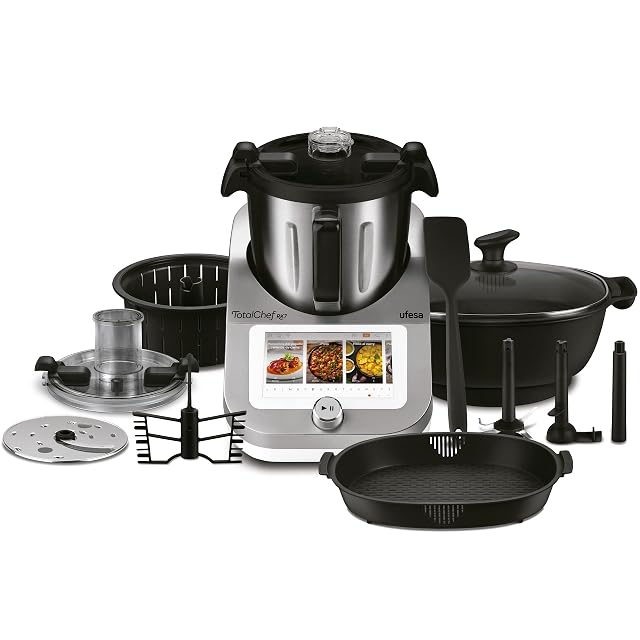
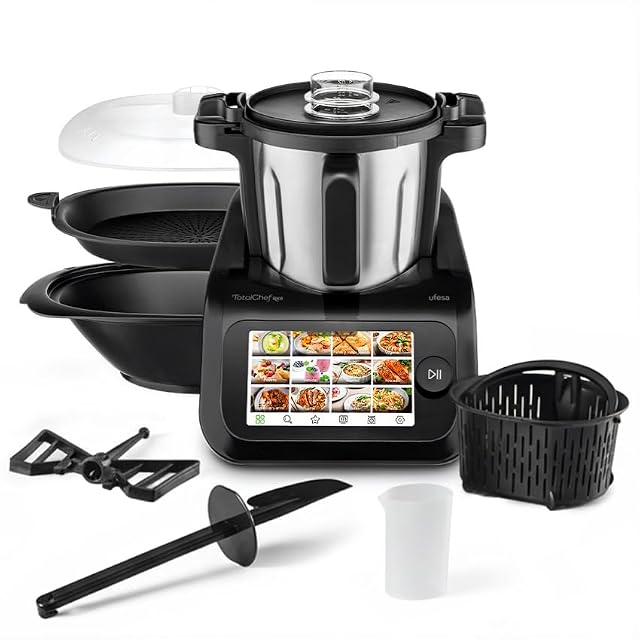
Ufesa appears in one family on this site — cooking food processors — with two
models that are genuinely different machines rather than two sizes of one.
What we found writing the reviews
RK7 against RK6. 2,000 W and 4.5 liters
(about 4.75 quarts) with eight automatic programs, against 1,200 W and
3.5 liters (about 3.7 quarts) with fifteen programs and an integrated scale.
The smaller machine is not the cheaper version of the larger; it trades power
and volume for guidance and weighing.
The best-specified pages in the family. In a category where one machine
publishes a single sentence and another publishes its color, Ufesa publishes
wattage, capacity, function count, screen size, connectivity, program names
and the accessory list individually.
A two-tier steamer. The RK7 publishes an attachment stated to cook up to
four dishes at once. A cooking robot’s real limit is that it is one jug doing
one thing, and a second tier is the only way around it.
The awkward paragraph, published. Ufesa prints its own setup sequence:
connect to Wi-Fi through the Spanish menus, update, then set the language. Almost
no manufacturer puts that in a listing. It is an evening rather than a fault,
and printing it buys a degree of trust the specification sheet alone does not.
Buying Ufesa in the United States
Both TotalChef models are European, with no Amazon.com listing and
220–240 V European plugs — neither would run on a 120 V US outlet without a
transformer. They sit at the end of their shelf for that reason. No
cooking robot on this site has a US offer. The nearest US options split the
job in two: a food processor for chopping — the
Ninja Professional Plus or the
Hamilton Beach 10-cup —
and a multi-cooker for heated cooking — see the
multi-cookers page. See also the brands page.