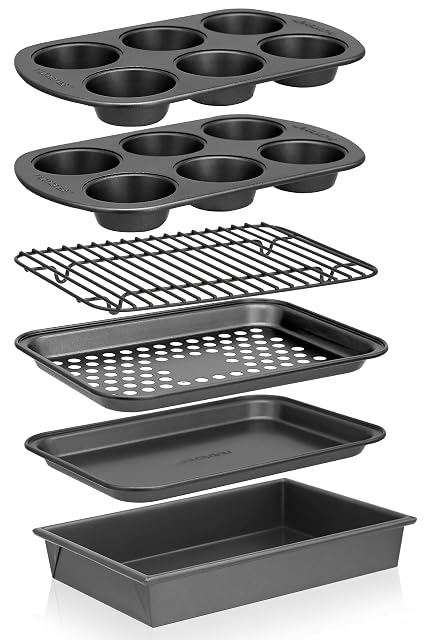
Best for: A toaster oven or a small kitchen, where the pieces have to fit a small cavity
≈ $37
Check price on Amazon Sized for a toaster oven, and four substances named
A six-piece stackable carbon steel bakeware set for toaster ovens with a roasting pan, muffin pans, a baking sheet, a rack and a perforated sheet, rated to 450 °F.
Best for: A toaster oven or a small kitchen, where the pieces have to fit a small cavity
The product name and bullet one both say it: “6-Piece Toaster Oven Bakeware Set”, “Compact… for Toaster Ovens”, and “The stackable design is perfect for maximizing space in smaller kitchens.”
Why it is the useful claim. A full-size oven shelf is about 22 inches wide and takes almost anything. A toaster oven cavity is a box with inches of margin — and a pan a quarter-inch too wide does not go in, while a pan an inch too narrow wastes the only space you have.
So a set sold for a small cavity is sized for one, and that is worth more than any feature on the page.
The catalog gives the stack: about 11.8 × 7.6 × 3 inches (300 × 193 × 75 mm), which is six pieces nested into a block the size of a shoebox lid.
One other item on this shelf is sized to a named cavity. The Breville at $19.95: “designed for use with Breville Smart Oven (BOV800XL), Smart Oven Plus (BOV810BSS), Smart Oven Pro (BOV845BSS), and Smart Oven Air (BOV900BSS)” — the only model compatibility list here — with the honest addition that it “can also be used with traditional household wall ovens”.
And the items that would not fit a toaster oven at all are worth naming.
Both GoodCook pizza pans at $18.99 and $25.19 — 15.75 inches The Unicook stone at $33.99 — 15 × 12 inches, and it requires “a minimum of 1-2 inches of clearance on ALL sides”, so 19 × 16 inches of cavity The Emile Henry stone at $109.95 — catalog about 18 × 14 inches, the largest surface on this shelf
None of those goes in a countertop oven, and this is the only set on the shelf that addresses the question.
“This 6-piece baking set includes a roasting pan, muffin pans, baking sheet, rack, and perforated baking sheet.”
Five categories, six pieces, and one plural — so the sixth is most likely a second muffin pan.
Which is the normal state of the sets on this shelf.
Moss & Stone 5-piece, $23.99 — names six things: “a baking pan (springform cake pan), round pan, rectangle loaf pan, square oven pan, 6-cup muffin pan, and red oven glove” BAKKENMASTER 18-piece, $57.99 — no list at all: “includes everything you need for versatile baking, from cakes to muffins, cookies to pizza.” Eighteen pieces and not one named.
Three sets, and not one publishes a clean itemized count.
What this set gives you, taking the list at face value.
A roasting pan — the deep piece, for a small joint or a tray of vegetables A baking sheet and a perforated baking sheet — flat and flat-with-holes, which is the right pair: the solid one for anything that runs, and the perforated one for anything you want crisp underneath A rack — the only rack on this shelf, and the piece that makes the roasting pan work properly, because meat on a rack above a pan browns all round instead of stewing in its own fat And muffin pans, plural and unmeasured
The perforated sheet is worth placing against the rest of this shelf, where six items are perforated: the Emporio Kitchen at $15.43, the BAKKENMASTER pizza pan at $15.99, both GoodCook pans, the Breville at $19.95 and this.
What the holes do. Anything that releases water — a pizza base, a chip, a tray of roasted vegetables — gives off steam that sits between the food and the metal on a solid tray. Holes let it out, so the underside browns rather than steams.
The trade is contact: metal conducts heat into food far better than air does, so a hole is a place where the base gets less heat. No hole size is published here — the Breville at $19.95 is the only page on this shelf to give one: “1/3 inch crisper holes”.
And the Bakken-Swiss at $12.59 solves the same problem a third way, with a removable basket above a tray, so air circulates all round the food and the fat drains into the tray below.
What no page here publishes is a dimension for any set piece. Not one of the three sets gives a size — which on a set whose entire selling point is fitting a small cavity is the omission that bites hardest. “Compact” is the whole of it.
“Food-safe and PFOA, PFOS, PTFE, and BPA-free”
The shelf, on chemistry:
PFOA, PFOS, PTFE and BPA free — this, the only page to add BPA PFOA, PFOS and PTFE free — the Bakken-Swiss at $12.59, the Emporio Kitchen at $15.43, the BAKKENMASTER pizza pan at $15.99 “PFOA-Free” alone, in the title — the BAKKENMASTER 18-piece set at $57.99, which says nothing about PTFE “Nonstick” with no chemistry — both GoodCook pans and the Breville at $19.95 And one that states its coating is PTFE — the Moss & Stone 5-piece set at $23.99: “Carbon Steel Non-Stick PTFE Coating” in its title
What the four are.
PTFE — sold as Teflon — is the standard non-stick film on bakeware, and the one that matters: a coating free of PTFE is a ceramic or sol-gel film instead. PFOA and PFOS are per- and polyfluoroalkyl substances. PFOA was historically a processing aid in making PTFE and was phased out of that use years ago. BPA is a bisphenol used in some polycarbonate plastics — whose relevance to a carbon steel baking tin is slight, since there is no plastic in one. The Moss & Stone set at $23.99 makes the same BPA claim about the same material.
What a ceramic coating buys and gives up. No fluoropolymer, and better scratch resistance than a sprayed non-stick. What it gives up is longevity: a ceramic film loses slipperiness with use, where PTFE stays slippery until it is physically damaged.
Which is the real trade between this set and the Moss & Stone one at $23.99, and neither page states it.
And “stain-resistant” in bullet three and the product name is the claim worth weighing against the stones. Two stones on this shelf stain permanently and say so. The Unicook at $33.99: “Frequently used pizza pans may develop discolored areas over time. This is normal and does not require cleaning.” A coated steel pan does not stain; it dulls.
“it’s built to handle temperatures up to 450°F”
The published limits on this shelf:
450 °F (230 °C) — this, the Emporio Kitchen at $15.43, the BAKKENMASTER pizza pan at $15.99, the Moss & Stone set at $23.99 Nothing — the Bakken-Swiss at $12.59, both GoodCook pans, the Breville at $19.95, the BAKKENMASTER 18-piece set at $57.99
Four items, one number — and the coating type does not change it: three of the four are ceramic or marble coatings and the Moss & Stone is PTFE.
What 450 °F covers. Almost all baking. A cake is 350 °F, biscuits and cupcakes 400 to 425, bread 425 to 450 — which matches bullet two’s list exactly: “cookies, cupcakes, bread, and more”.
What it does not cover is pizza at the temperature pizza wants. Most home pizza recipes call for 475 to 550 °F — the top of a domestic oven — and a commercial pizza oven runs 700 to 900 °F.
And the rating protects the coating rather than the steel: a non-stick film degrades above its rated range, and carbon steel does not care at these temperatures.
Which is where the three stones on this shelf live in another world.
Unicook, $33.99 — cordierite, “heat-resistant up to 1,450°F (787°C)” Ritual Life, $36.95 — cordierite, “up to 1500°F (815°C)” Emile Henry, $109.95 — “up to 900 degrees F” on gas, charcoal and wood grills, and “Can be used in all types of ovens and under the broiler”
A thousand degrees of difference, because a stone has no coating to lose.
There is one point in this set’s favor on temperature that no page states. A toaster oven’s element is much closer to the food than a wall oven’s. A pan two inches under a glowing element sees radiant heat well above the air temperature — which is the case where a 450 °F rating is most easily exceeded without the dial ever going past 425.
Keep it off the top shelf, and out from under a broil setting.
“The stackable design is perfect for maximizing space in smaller kitchens” · “the stackable design saves space in your kitchen cabinets” · “Crafted from thick carbon steel… even heat distribution”
The stacking claim is made twice, and one other set on this shelf makes it. The Moss & Stone 5-piece at $23.99: “we designed them to be stackable for easy storage, allowing you to save cabinet space.”
The BAKKENMASTER 18-piece set at $57.99 does not — on eighteen pieces, which is the set where it would matter most.
Why stacking is not trivial. A baking tin is a tapered box. Pans that nest have walls sloped enough for each to sit inside the next — and the saving is real: six pieces that nest take the depth of one plus five wall thicknesses, which the catalog gives as 75 mm for the whole stack.
The cost is wasted depth in use. A steeply tapered tin holds less than a straight-sided one of the same rim size — the trade nobody on this shelf states.
And stacking has a second cost on a coated pan. Pan rims sit on pan interiors: metal on coating, every time you put them away — which is one of the three things that actually wears a non-stick film, alongside the dishwasher and the metal utensil.
A sheet of kitchen paper between nested coated pans is the cheapest insurance there is, and no page on this shelf suggests it.
On the steel: “thick carbon steel” is a phrase and not a figure.
One item on this shelf publishes a thickness. The Emporio Kitchen at $15.43: “Built with 0.5mm thick carbon steel… resists warping over time.” For scale, heavy-gauge bakeware runs 0.03 to 0.04 inch (0.8 to 1.0 mm) — so the only published figure on this shelf is a modest one being used as a strength claim.
The shelf’s vocabulary instead: “thick” here · “high-quality” on the Bakken-Swiss at $12.59 · “premium-grade” on both GoodCook pans · “heavy-duty” on the Moss & Stone set at $23.99 · “commercial-grade” on the BAKKENMASTER 18-piece set at $57.99.
Five adjectives, one number.
At 3.4 pounds for six pieces that is about 9 ounces a piece — light, which is consistent with a compact set for a small oven and inconsistent with “thick”. For comparison, a single 13-inch pizza pan on this shelf weighs 11 ounces to 1.2 pounds.
Piece dimensions, as above — not one size for any of the six pieces, on the one set whose selling point is fitting a small cavity.
No steel thickness, as above.
No muffin-cup count or size. “Muffin pans” is plural and unmeasured — where the Moss & Stone set at $23.99 at least specifies a “6-cup muffin pan”, which is half the usual twelve. Cup size decides whether standard paper cases fit.
No hole size on the perforated sheet. The Breville at $19.95 is the only page on this shelf to publish one: “1/3 inch crisper holes”.
No rack dimensions or load, on the only rack here.
No handles. Two steel items on this shelf publish silicone handles: the Emporio Kitchen at $15.43 (“a wide, oversized handle wrapped in silicone… no mitt fumbles”) and the BAKKENMASTER 18-piece set at $57.99 (“gray silicone handles… stay cool to the touch”). Two stones have handles, and one set supplies a glove: the Moss & Stone at $23.99.
In a toaster oven that is the omission you feel most. The cavity is shallow and hot on all four sides, and you are reaching in past a glowing element.
No feet. Both GoodCook pans publish them: “feet to keep the hot pan elevated and off the countertop, preventing heat damage.” On a countertop oven the pan comes out onto a countertop already next to a hot appliance.
No metal-utensil guidance, which nothing on this shelf gives — and on a coated pan one cut in the film propagates from that point.
No warranty. Two items on this shelf publish one: the Emile Henry at $109.95 — a 10 year Guarantee whose terms are stated — and the Moss & Stone set at $23.99 (“1-year warranty”), which is the direct comparison here: a five-piece set at thirteen dollars less, with a year of cover. The Ritual Life at $36.95 offers support rather than a term. Nine publish nothing.
No country of manufacture, which no item on this shelf publishes.
Read on the day this page was built: $36.99 at the American Amazon shop.
Read from Keepa on the day this page was last revised; stock and price both move without notice.
Prices quoted in this text were read on 2026-10-17. The live price is at the top of the page.
Because it is a size statement, and it is the only one of its kind on this shelf. The product name and bullet one both say it: "6-Piece Toaster Oven Bakeware Set", "Compact Non-Stick Stackable Baking Pan Set... for Toaster Ovens", and "The stackable design is perfect for maximizing space in smaller kitchens." Why it is the useful claim. A full-size oven shelf is about 22 inches wide and takes almost anything. A toaster oven cavity is a box with inches of margin — and a pan a quarter-inch too wide does not go in, while a pan an inch too narrow wastes the only space you have. So a set sold for a small cavity is sized for one, and that is worth more than any feature on the page. The catalog gives the stack: about 11.8 × 7.6 × 3 inches (300 × 193 × 75 mm), which is six pieces nested into a block the size of a shoebox lid. One other item on this shelf is sized to a named cavity. The Breville at $19.95: "designed for use with Breville Smart Oven (BOV800XL), Smart Oven Plus (BOV810BSS), Smart Oven Pro (BOV845BSS), and Smart Oven Air (BOV900BSS)" — the only model compatibility list here — and it adds that it "can also be used with traditional household wall ovens". And the items that would not fit a toaster oven at all are worth naming. Both GoodCook pizza pans are 15.75 inches. The Unicook stone at $33.99 is 15 × 12 inches and requires "a minimum of 1-2 inches of clearance on ALL sides" — so 19 × 16 inches of cavity. The Emile Henry at $109.95 catalogs at about 18 × 14 inches. None of those goes in a countertop oven, and this is the only set on the shelf that addresses the question at all.
Probably a second muffin pan, because the bullet says "muffin pans" in the plural. Bullet one: "This 6-piece baking set includes a roasting pan, muffin pans, baking sheet, rack, and perforated baking sheet." Five categories, six pieces, and one plural. Which is the normal state of the sets on this shelf. Moss & Stone 5-piece at $23.99 — names six things: "a baking pan (springform cake pan), round pan, rectangle loaf pan, square oven pan, 6-cup muffin pan, and red oven glove". BAKKENMASTER 18-piece at $57.99 — no list at all: "includes everything you need for versatile baking, from cakes to muffins, cookies to pizza." Eighteen pieces and not one named. Three sets, and not one publishes a clean itemized count. What this set gives you, taking the list at face value. A roasting pan — the deep piece, for a small joint or vegetables. A baking sheet and a perforated baking sheet — flat and flat-with-holes, which is the right pair: the solid one for anything that runs and the perforated one for anything you want crisp underneath. A rack — the only rack on this shelf, and the piece that makes a roasting pan work properly, because meat on a rack above a pan browns all round instead of stewing in its own fat. And muffin pans, plural and unmeasured. What no page here publishes is a dimension for any set piece. Not one of the three sets gives a size — which on a set whose selling point is fitting a small cavity is the omission that bites hardest. "Compact" is the whole of it, and the catalog stack of 11.8 × 7.6 in (300 × 193 mm) is the closest thing to an answer.
It is the fullest chemistry claim on this shelf, and one item here says the opposite about its own coating. Bullet four: "Food-safe and PFOA, PFOS, PTFE, and BPA-free, it’s built to handle temperatures up to 450°F." The shelf, on chemistry: PFOA, PFOS, PTFE and BPA free — this, the only page to add BPA · PFOA, PFOS and PTFE free — the Bakken-Swiss at $12.59, the Emporio Kitchen at $15.43, the BAKKENMASTER pizza pan at $15.99 · "PFOA-Free" alone, in the title — the BAKKENMASTER 18-piece set at $57.99, which says nothing about PTFE · "nonstick" with no chemistry — both GoodCook pans and the Breville at $19.95 · and one that states its coating IS PTFE — the Moss & Stone 5-piece set at $23.99: "Carbon Steel Non-Stick PTFE Coating" in its title. What the four are. PTFE — sold as Teflon — is the standard non-stick film on bakeware, and the one that matters: a coating free of PTFE is a ceramic or sol-gel film instead. PFOA and PFOS are per- and polyfluoroalkyl substances; PFOA was historically a processing aid in making PTFE and was phased out of that use years ago. And BPA is a bisphenol used in some polycarbonate plastics — whose relevance to a carbon steel baking tin is slight, since there is no plastic in one. The Moss & Stone set at $23.99 makes the same BPA claim about the same material. What a ceramic coating buys and gives up. No fluoropolymer, and better scratch resistance than a sprayed non-stick. What it gives up is longevity: a ceramic film loses slipperiness with use, where PTFE stays slippery until it is physically damaged. Which is the real trade between this set and the Moss & Stone one — and neither page states it.
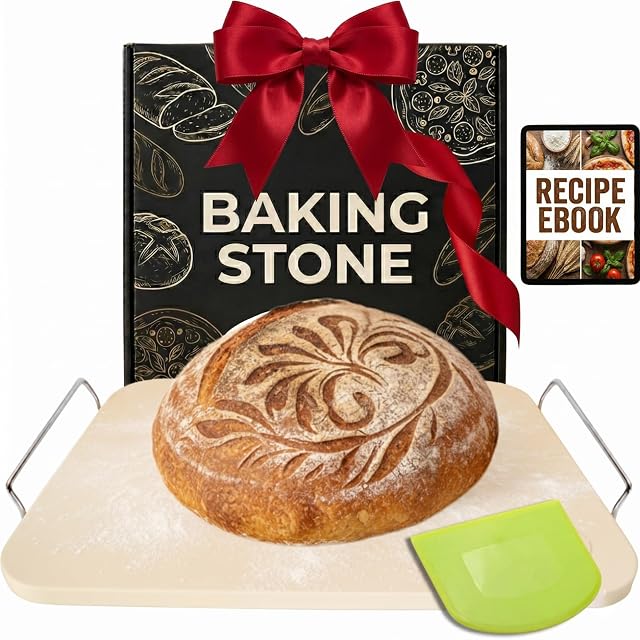
A 15-inch rectangular cordierite baking stone rated to 1500 °F with handles, a detachable carrying tray and a dough tool, hand washed without soap and never pre-seasoned.
Best for: Artisan bread in a home oven, and pizza on a grill
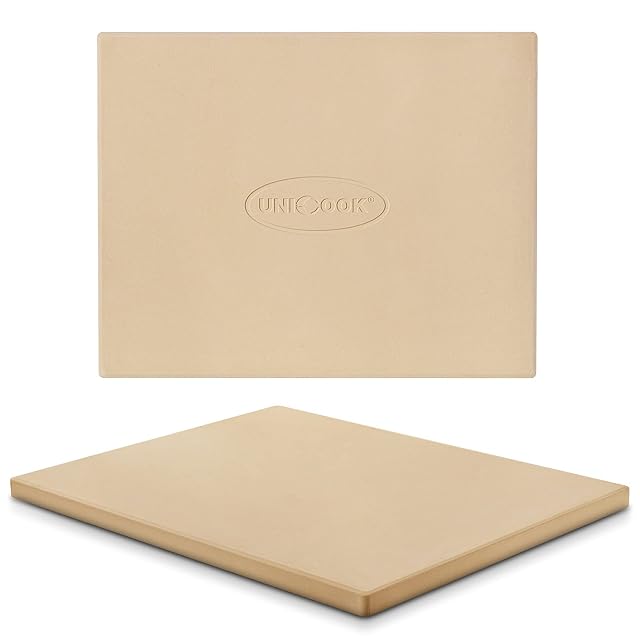
A 15 × 12 inch cordierite baking stone 0.6 inches thick and 6.8 pounds, heat-resistant to 1450 °F, reversible, with a plastic dough cutter and a no-detergent instruction.
Best for: Personal pizzas and bread in an oven with room round the stone
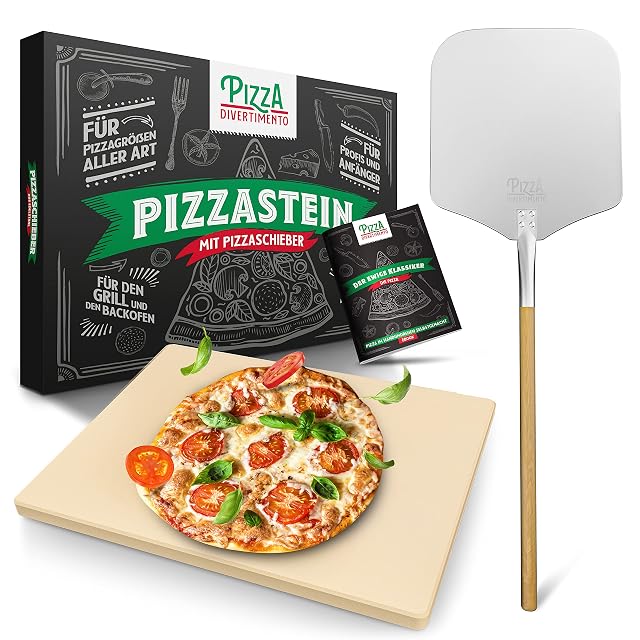
A rectangular cordierite pizza stone, 15 × 12 × 0.6 inches, sold with a 32.5-inch pizza peel whose aluminum blade is 12 × 12 inches. Stated for ovens and covered gas or charcoal grills, on indirect heat.
Best for: A first stone, bought with the peel instead of six weeks later.
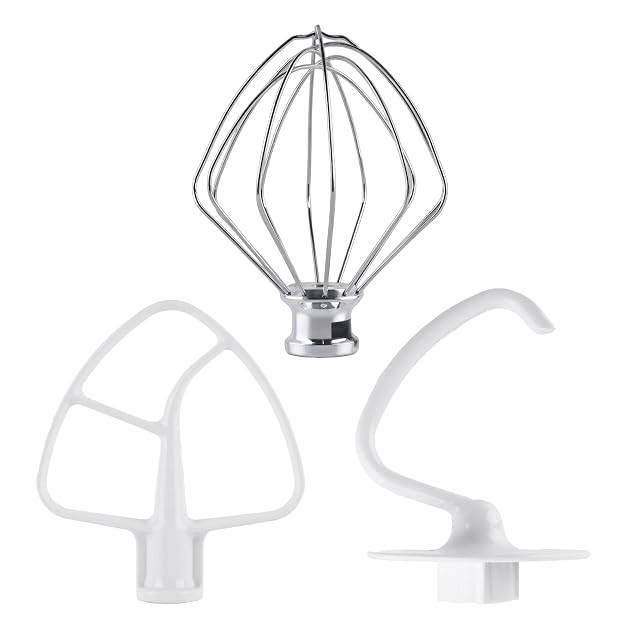
A K45WW wire whip, K45DH dough hook and K45B flat beater with a scraper edge, in stainless, aluminum and nylon.
Best for: A tilt-head KitchenAid where the bowl wall needs wiping as the beater turns
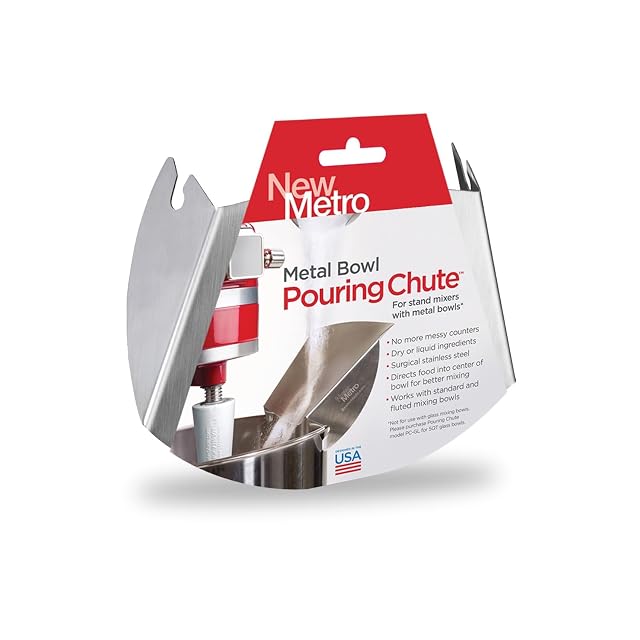
A polished steel pouring chute for metal stand mixer bowls, fitting KitchenAid, Cuisinart, Kenwood and SMEG.
Best for: Loading flour and sugar into a metal bowl without half of it reaching the counter
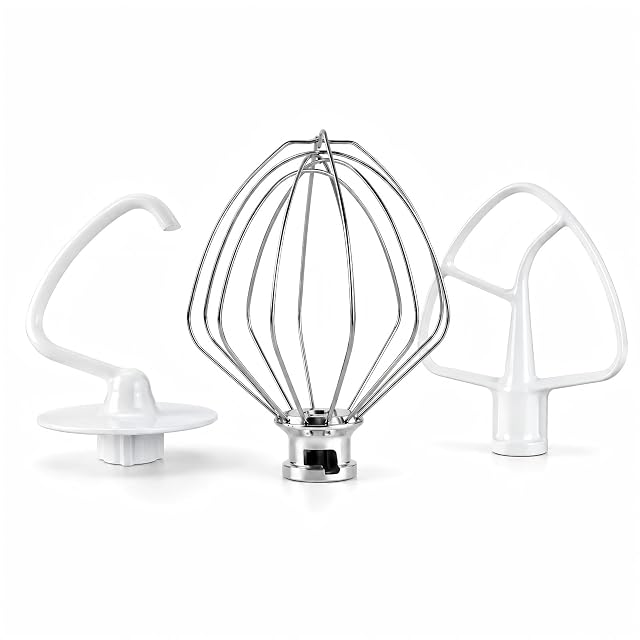
A K45WW wire whip, K45DH dough hook and K45B coated flat beater for KitchenAid tilt-head mixers of 4.5 to 5 quarts.
Best for: A tilt-head KitchenAid of 4.5 or 5 quarts whose original tools have worn or gone missing