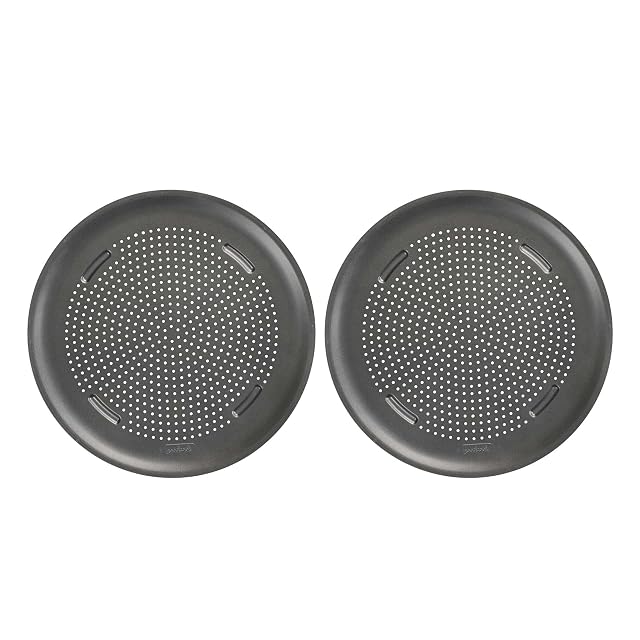
$12.60 a pan, with feet and guides
GoodCook AirPerfect 15.75-Inch Pizza Pans, Set of 2
Two 15.75-inch air-insulated perforated carbon steel pizza pans with cutting guides and molded feet, in a non-stick finish.
Specifications
- Price per pan
- $12.60 — against $18.99 for the same pan sold singly here
- Size
- 15.75 inch, published in two bullets
- Air-insulated
- Stated — the only such claim on this shelf
- Perforated
- Yes, to reduce moisture; hole size not given
- Feet
- Integrated molded feet on the bottoms
- Cutting guides
- Molded in, for uniform slices
- Material
- Non-stick carbon steel, stated to resist warping
- Weight
- 2.7 lb (1.25 kg) for the pair — 1.4 lb (624 g) each
- Catalog
- 16.5 × 16.5 × 0.59 in (419 × 419 × 15 mm), the carton for two
- Reference
- 04241
- Title
- Says 16 inch; the bullets say 15.75 twice
- Temperature limit
- Not published; four items here publish 450 °F
- Coating chemistry
- Not published
- Dishwasher
- Not published
- Amazon reference
- B0B72FK83G
- EAN
- 0076753042413
The plus side, and the minus
Strengths
- $12.60 a pan, $6.39 less than the identical single on this shelf
- Air-insulated as well as perforated, which nothing else here claims
- Feet and cutting guides, which only GoodCook publishes on this shelf
Compromises
- Sixteen inches in the title against 15.75 in two bullets
- No temperature limit, no chemistry and no dishwasher statement
- Air insulation slows the base heat, which a raw dough wants most
What the maker puts in writing
- “SET OF TWO 15.75” NONSTICK PIZZA PANS: Air-insulated and perforated to reduce moisture while baking frozen or homemade pizzas or heating up leftover slices to promote a crispier crust for a fresh taste”
- “FULL-SIZE BAKING SURFACES: Large 15.75-in. baking surface diameters accommodate pizzas of all sizes and are great for family-sized pies”
- “CONVENIENT CUTTING GUIDES: Trays feature cutting guides to help you cut and serve the perfect uniform slices every time”
- “ELEVATED BOTTOMS: Integrated molded feet on the bottoms keep the hot pans thoroughly elevated and off of countertops”
- “PREMIUM-GRADE CONSTRUCTION: Nonstick carbon steel offers an excellent mess-free release and resists warping for long-lasting durability”
- From the name: “AirPerfect Nonstick 16” Pizza Pan - Set of 2”
- Reference 04241 · Catalog: 2.7 lb (1.25 kg), 16.5 × 16.5 × 0.59 in (419 × 419 × 15 mm)
$12.60 a pan, against $18.99 for the same pan singly
This set is $25.19 for two: $12.60 a pan. The GoodCook AirPerfect single at $18.99 is $18.99 a pan — $6.39 more each.
And the two pages describe the same thing, with two differences in the wording.
this — “SET OF TWO 15.75"", “Air-insulated and perforated”, “CONVENIENT CUTTING GUIDES”, “ELEVATED BOTTOMS: Integrated molded feet”, “PREMIUM-GRADE CONSTRUCTION… resists warping” the single, $18.99 — “16” PERFORATED PIZZA PAN”, “a perforated edge and even heating technology”, “cutting guides”, “feet to keep the hot pan elevated”, “premium-grade construction that resists warping”
So the single calls it “even heating technology” and this page calls it “air-insulated” — the same thing, named properly here — and the single says 16 inches where this says 15.75 twice.
The catalog figures confirm it. 15.7 × 15.7 in (400 × 400 mm) on the single is the 15.75-inch pan. 16.5 × 16.5 × 0.6 in (419 × 419 × 15 mm) here is the carton for two stacked pans — and 0.6 inch is the pan thickness, which matters below.
Both are 15.75-inch pans. This is the honest page on the dimension and the clearer one on the mechanism.
Why buy the single at all? Only if you want one. A pizza pan is a flat object 15.75 inches across, and two take the same cupboard space as one plus 0.6 inch.
And two pans let you bake two pizzas, which on this shelf is the normal arrangement. The Bakken-Swiss at $12.59 is a 2-piece set; the Emporio Kitchen at $15.43 and the BAKKENMASTER pizza pan at $15.99 are 2 packs; three items are 5, 6 and 18-piece sets.
Among the pans, only the GoodCook single and the Breville at $19.95 are sold alone — and the Breville has a reason, being sized to four named countertop ovens.
Fifteen and three quarter inches, which is the largest pan on this shelf
The published sizes:
15.75 in — this and the GoodCook single at $18.99 13 in — the Emporio Kitchen at $15.43, the BAKKENMASTER pizza pan at $15.99, the Breville at $19.95 Rectangular stones — the Unicook at $33.99 (15 × 12 in, “ideal for baking personal pizzas up to 11 inches”), the Ritual Life at $36.95 (15 inch), the Emile Henry at $109.95 (catalog 18 × 14 in, the largest surface here)
Why the two and a half inches matter. A 15.75-inch pan has about 195 square inches of surface; a 13-inch pan has 133. Nearly half again — a large family pizza against a medium one, which is what “great for family-sized pies” in bullet two means.
And the trade is oven shelf. This pan is 15.75 inches, and a domestic oven shelf is about 22 inches wide — so one pan fits with three inches to spare and two will not go side by side.
Which is the practical limit on this set. Two pans, one oven, and they have to go on separate shelves — where a fan oven handles that and a conventional one browns the top shelf first.
At 1.4 lb (624 g) each these are the second heaviest pizza pans on this shelf, behind the 1.5 lb (680 g) single.
11 oz per pan in the BAKKENMASTER pair · 14.4 oz for the Breville · 1.2 lb per Emporio Kitchen pan · this 1.4 lb each · 1.5 lb for the GoodCook single and the Bakken-Swiss And the stones: Unicook 6.5 lb · Emile Henry 7.3 lb · Ritual Life 7.5 lb
The heaviest item on this shelf is 8.3 times the lightest, and that mass is the whole point of a stone: thermal ballast that does not drop in temperature when cold dough lands on it. A pan’s job is conduction, not storage — which is exactly what the next section is about.
Air-insulated, which is the opposite of a stone
“Air-insulated and perforated to reduce moisture while baking frozen or homemade pizzas or heating up leftover slices”
How it works. An air-insulated pan is a double sheet of steel with a sealed air gap between them.
Air conducts heat far worse than steel, so the gap slows heat into the base — which is the whole point of an insulated baking sheet: the bottom does not scorch before the top cooks.
The catalog supports it. 0.6 inch (15 mm) of thickness for a flat tray is thick for a single sheet and right for a double one.
And the GoodCook single at $18.99 calls the same thing “even heating technology” without explaining it — so this is the better-documented of the two pages.
Where it helps. Frozen pizza and reheated slices, both named in bullet one.
A frozen pizza goes into a hot oven with a frozen base and a frozen top, and the base is what burns first — so slowing the bottom heat is exactly right. Same for a leftover slice, where the base is already cooked and only needs warming.
Where it works against you. A raw dough wants hard, fast bottom heat to set the base before the top overcooks — which is why a pizzeria bakes on a stone floor at 700 to 900 °F.
An insulated pan is doing the opposite of a stone.
And the three stones on this shelf are the other extreme.
Unicook, $33.99 — 6.5 lb of cordierite, “heat-resistant up to 1,450°F (787°C)”, and “Please preheat the stone to ensure even cooking and crispy crust” Ritual Life, $36.95 — 7.5 lb, “up to 1500°F (815°C)”, “Simply preheat the stone in your oven or on the grill” Emile Henry, $109.95 — 7.3 lb, “up to 900 degrees F” on gas, charcoal and wood grills, and “under the broiler”
Mass already at temperature when the dough lands on it.
So: an insulated pan for frozen and reheated, a stone for raw dough. This page names frozen pizza first, which is the honest ordering.
And the perforation is the second half of the design, pulling the other way. A pizza base releases water as steam. On a solid tray that steam sits between the dough and the metal and the base steams rather than browns. Holes let it out.
The trade is contact — metal conducts into dough far better than air does, so a hole is a place where the base gets less heat. Which makes an insulated perforated pan a pan that deliberately gives up bottom heat twice over, in exchange for never burning a base.
No hole size is published, here or on ten other items. The Breville at $19.95 is the only page on this shelf to give one: “1/3 inch crisper holes”.
Feet and cutting guides, and the caution nobody gives
“CONVENIENT CUTTING GUIDES: Trays feature cutting guides to help you cut and serve the perfect uniform slices every time” · “ELEVATED BOTTOMS: Integrated molded feet on the bottoms keep the hot pans thoroughly elevated and off of countertops”
Only GoodCook publishes either, on this set and on the single at $18.99.
The feet. A pizza pan comes out of the oven at 400 °F or more and has to go somewhere. Set flat on a countertop it conducts straight into the surface — which marks laminate, crazes some stone and scorches wood.
And on a perforated pan the feet do a second job nobody states. They keep the holes clear of the countertop, so the steam you have just vented does not condense into a wet ring under the pan.
The cutting guides. Molded ridges that show where to cut, which solves a real thing: cutting a round pizza freehand gives you two enormous slices and four slivers. And cutting on the pan rather than on a board means the topping does not slide off in transit.
The caution. A pizza wheel on a coated pan cuts the coating, and one cut in a non-stick film propagates from that point — batter and cheese work under the edge, food sticks there permanently, and the break spreads.
The guides are raised ridges, so a wheel rides over them — but a firm pass with a sharp wheel will mark the surface between them.
Use a rocker, or lift the pizza onto a board. No page on this shelf gives any metal-utensil guidance at all, and this is the one item whose own design invites a blade.
What the rest of the shelf offers for handling instead. Two steel items publish silicone handles: the Emporio Kitchen at $15.43 (“a wide, oversized handle wrapped in silicone… no mitt fumbles”) and the BAKKENMASTER 18-piece set at $57.99 (“gray silicone handles… stay cool to the touch”). Two stones have handles: the Ritual Life at $36.95, with a detachable carrying tray, and the Emile Henry at $109.95. And one set supplies a glove: the Moss & Stone at $23.99, with a red oven glove — the only protective equipment on this shelf.
This set has feet and no handle — which on a 15.75-inch round pan with a rim all the way round means you lift it with mitts and pinch the edge, and a mitt grips by friction and pressure, which a thin rolled rim gives neither of.
What is not published
No temperature limit. Four items on this shelf publish one, and it is the same figure every time: 450 °F (230 °C) — the Emporio Kitchen at $15.43, the BAKKENMASTER pizza pan at $15.99, the Moss & Stone set at $23.99, the NutriChef set at $36.99. Five publish nothing, including both GoodCook pans.
Why it is the number to notice. A commercial pizza oven runs 700 to 900 °F. Most home pizza recipes call for 475 to 550 °F — the top of a domestic oven — because a crust needs enough bottom heat to set the base before the top overcooks. So a coated steel pan rated to 450 °F is rated below what the recipe asks for.
The rating protects the coating rather than the steel: a non-stick film degrades above its rated range and carbon steel does not care at these temperatures. Treat 450 °F as the ceiling here too — and note that on an air-insulated pan the oven can run hotter without burning the base, which is precisely the case where you would be tempted to exceed it.
No coating chemistry. Five items here publish theirs: PFOA, PFOS and PTFE free on the Bakken-Swiss at $12.59, the Emporio Kitchen at $15.43 and the BAKKENMASTER pizza pan at $15.99 · PFOA, PFOS, PTFE and BPA free on the NutriChef set at $36.99 · “PFOA-Free” alone on the BAKKENMASTER 18-piece set at $57.99.
And one states its coating is PTFE: the Moss & Stone 5-piece set at $23.99, “Carbon Steel Non-Stick PTFE Coating”.
This page says “nonstick carbon steel” and stops, as do the GoodCook single and the Breville at $19.95.
No dishwasher statement. “Mess-free release” is the whole cleaning claim, where seven items on this shelf claim dishwasher safety outright. The caveat worth importing: a dishwasher cycle is hot, alkaline and abrasive, and a coating is what it wears over hundreds of cycles. And two of the three stones sold on Amazon.com forbid soap entirely — the Unicook at $33.99 (“Do not use detergent”) and the Ritual Life at $36.95 (“no soap needed”) — because a porous stone absorbs it.
No hole size or count, as above.
No steel thickness. One item on this shelf publishes one: the Emporio Kitchen at $15.43 — “0.5mm thick carbon steel”. For scale, heavy-gauge bakeware runs 0.03 to 0.04 inch (0.8 to 1.0 mm). “Premium-grade construction” here, “high-quality” on the Bakken-Swiss and “commercial-grade” on the BAKKENMASTER 18-piece set are the shelf’s vocabulary, and none of them is a number.
No handle, as above.
No warranty. Two items on this shelf publish one: the Emile Henry at $109.95 — a 10 year Guarantee whose terms are stated, “covers any production fault or quality problem… when used in a normal domestic environment, and respecting the care and use Instructions” — and the Moss & Stone set at $23.99 (“1-year warranty”). The Ritual Life at $36.95 offers support rather than a term. Nine publish nothing.
No country of manufacture, which no item on this shelf publishes.
Availability
Read on the day this page was built: $25.19 at the American Amazon shop.
Read from Keepa on the day this page was last revised; stock and price both move without notice.
Prices quoted in this text were read on 2026-10-17. The live price is at the top of the page.
What readers want to know
Why does the single cost $6.39 more per pan?
There is no published reason, and both pans are on this shelf to compare. This set is $25.19 for two: $12.60 a pan. The GoodCook AirPerfect single at $18.99 is $18.99 a pan — $6.39 more each. And the two pages describe the same thing with two differences in the wording. This one: "SET OF TWO 15.75" NONSTICK PIZZA PANS", "Air-insulated and perforated to reduce moisture", "CONVENIENT CUTTING GUIDES", "ELEVATED BOTTOMS: Integrated molded feet", "PREMIUM-GRADE CONSTRUCTION... resists warping". The single: "16" PERFORATED PIZZA PAN", "a perforated edge and even heating technology", "cutting guides", "feet to keep the hot pan elevated", "premium-grade construction that resists warping". So the single calls it "even heating technology" and this page calls it "air-insulated" — which is the same thing named properly — and the single says 16 inches where this says 15.75 twice. The catalog figures: 15.7 × 15.7 in (400 × 400 mm) on the single, which is 15.75 inches, and 16.5 × 16.5 × 0.6 in (419 × 419 × 15 mm) here — the carton for two stacked pans. So both are 15.75-inch pans, and this page is the honest one on the dimension and the clearer one on the mechanism. Why buy the single at all? Only if you want one. A pizza pan is a flat object 15.75 inches across, and two of them take the same cupboard space as one plus 0.6 inch. And two pans let you bake two pizzas — which on this shelf is the normal arrangement: the Bakken-Swiss at $12.59 is a 2-piece set, the Emporio Kitchen at $15.43 and the BAKKENMASTER pizza pan at $15.99 are 2 packs, and three items are 5, 6 and 18-piece sets. Among the pans, only the GoodCook single and the Breville at $19.95 are sold alone — and the Breville has a reason, being sized to four named countertop ovens.
What does air-insulated mean, and is it what you want?
Two layers of steel with a gap between them — and it is a real design with a real trade. Bullet one: "Air-insulated and perforated to reduce moisture while baking frozen or homemade pizzas or heating up leftover slices to promote a crispier crust for a fresh taste." How it works. An air-insulated pan is a double sheet with a sealed air gap. Air conducts heat far worse than steel, so the gap slows heat into the base — which is the whole point of an insulated baking sheet: the bottom does not scorch before the top cooks. The catalog supports it: 0.6 inch (15 mm) of thickness for a flat tray is thick for a single sheet and right for a double one. And the single at $18.99 calls the same thing "even heating technology" without explaining it. Where it helps. Frozen pizza and reheated slices, both named in bullet one. A frozen pizza goes into a hot oven with a frozen base and a frozen top, and the base is what burns first — so slowing the bottom heat is exactly right. Same for a leftover slice, where the base is already cooked and only needs warming. Where it works against you. A raw dough wants hard, fast bottom heat to set the base before the top overcooks — which is why a pizzeria bakes on a stone floor at 700 to 900 °F. An insulated pan is doing the opposite of a stone. And the three stones on this shelf are the other extreme: the Unicook at $33.99 (6.5 lb of cordierite, "heat-resistant up to 1,450°F", "Please preheat the stone"), the Ritual Life at $36.95 (7.5 lb, 1500 °F) and the Emile Henry at $109.95 (7.3 lb, 900 °F on a grill). Mass already at temperature when the dough lands on it. So: insulated pan for frozen and reheated, stone for raw dough. This page names frozen pizza first, which is the honest ordering.
What do the feet and guides do, and what should you not do with them?
One protects the countertop, the other protects the slices — and the one caution no page gives is about the cutting wheel. Bullet three: "Trays feature cutting guides to help you cut and serve the perfect uniform slices every time." Bullet four: "ELEVATED BOTTOMS: Integrated molded feet on the bottoms keep the hot pans thoroughly elevated and off of countertops." Only GoodCook publishes either, on this set and on the single at $18.99. The feet. A pizza pan comes out of the oven at 400 °F or more and has to go somewhere — and set flat on a countertop it conducts straight into the surface, which marks laminate and scorches wood. On a perforated pan the feet do a second job nobody states: they keep the holes clear of the countertop, so the steam you have just vented does not condense into a wet ring under the pan. The cutting guides. Molded ridges that show where to cut, which solves a real thing: cutting a round pizza freehand gives you two enormous slices and four slivers. And cutting on the pan rather than on a board means the topping does not slide off in transit. The caution. A pizza wheel on a coated pan cuts the coating, and one cut in a non-stick film propagates from that point. The guides are raised ridges, so a wheel rides over them — but a firm pass with a sharp wheel will mark the surface between. Use a rocker, or lift the pizza onto a board. No page on this shelf gives any metal-utensil guidance at all, and this is the one item whose own design invites a blade. What the rest of the shelf offers for handling instead. Two steel items publish silicone handles: the Emporio Kitchen at $15.43 and the BAKKENMASTER 18-piece set at $57.99. Two stones have handles: the Ritual Life at $36.95, with a detachable carrying tray, and the Emile Henry at $109.95. And one set supplies a glove: the Moss & Stone at $23.99.
More trays & pizza stones
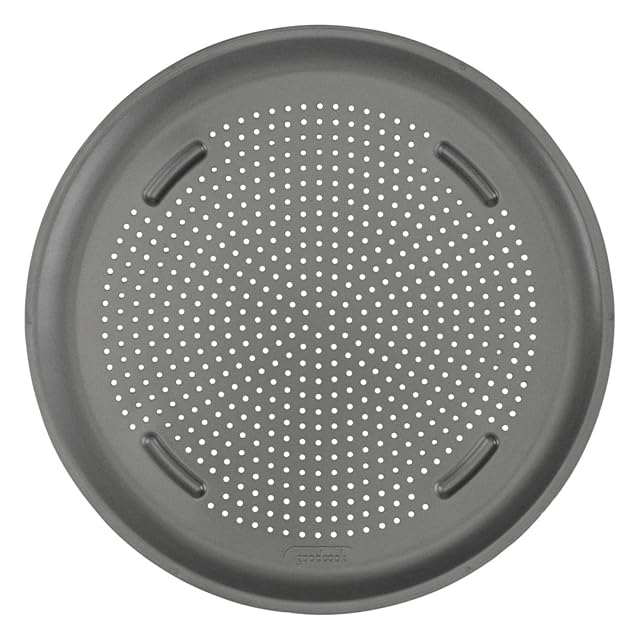
GoodCook AirPerfect 16-Inch Perforated Pizza Pan
A 16-inch perforated carbon steel pizza pan with cutting guides, molded feet to keep it off the countertop and a non-stick coating.
- Feet
- On the bottom, to keep the hot pan off the countertop — unique here
- Cutting guides
- Molded in, for even slices — unique to GoodCook on this shelf
- Size
- 16 inch in the title; the catalog reads 15.75 in (400 mm)
- Perforated
- A perforated edge, with even heating technology
- Material
- Non-stick carbon steel, stated to resist warping
- Named uses
- Homemade pizza, frozen pizza, leftover slices
- Weight
- 1.5 lb (680 g)
- Catalog
- 5.35 × 15.7 × 15.7 in (136 × 400 × 400 mm), boxed
- Reference
- 4497
- Coating chemistry
- Not published — "nonstick" with no PFAS statement
- Temperature limit
- Not published; four items here publish 450 °F
- Hole size
- Not published; only the Breville gives one
- Dishwasher
- Not stated — "quick cleanup" is the whole of it
- Price per pan
- $18.99, against $12.60 each in the maker’s own two-pack
- Amazon reference
- B097FDW796
- EAN
- 0076753044974
- Feet underneath, so a hot pan does not mark a countertop
- Cutting guides molded in, which nothing outside GoodCook here offers
- $6.39 dearer than each pan in the maker’s own two-pack
Best for: A large pizza served in even slices without scorching the countertop
≈ $19Check price on Amazon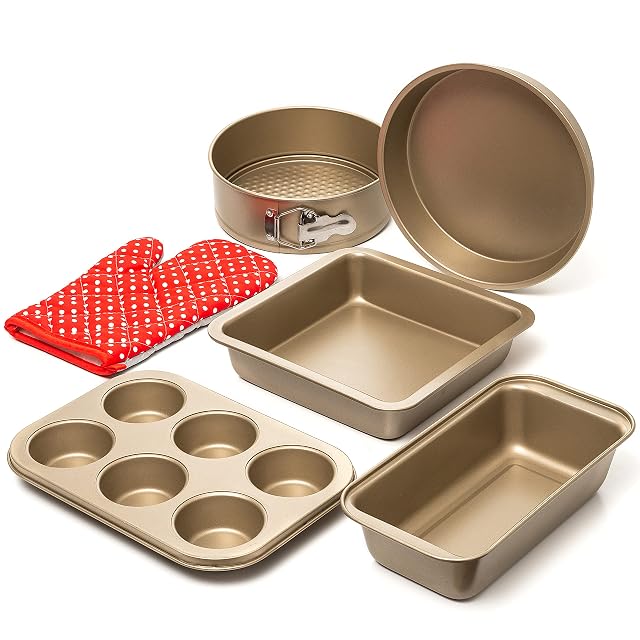
Moss & Stone 5-Piece Carbon Steel Baking Pan Set
A five-piece carbon steel baking set with a PTFE non-stick coating, stackable for storage, oven safe to 450 °F, supplied with a red oven glove and a one-year warranty.
- Coating
- PTFE, stated in the product name
- Warranty
- One year — one of two on this shelf
- Pieces named
- Six: springform, round, loaf, square, 6-cup muffin, and a glove
- Oven glove
- Included, red
- Temperature
- Up to 450 °F
- Stackable
- Stated, to save cabinet space
- Material
- Heavy-duty BPA-free carbon steel
- No fat needed
- Interlocking non-stick layers, stated to need no butter or oil
- Named bakes
- Biscuits, fudge, cheesecake, apple pie, birthday cake
- Reference
- CS-BWS-COP5
- Piece count
- The title says five and the bullet names six
- Piece dimensions
- None published
- Weight
- Not published
- Dishwasher
- Not published
- Amazon reference
- B09GYM8WT7
- EAN
- 4897038503650
- Five pans and an oven glove for $23.99
- A one-year warranty, which only one other item on this shelf matches
- The title says five pieces and the bullet names six things
Best for: A first baking set, where the piece count matters more than the figures
≈ $24Check price on Amazon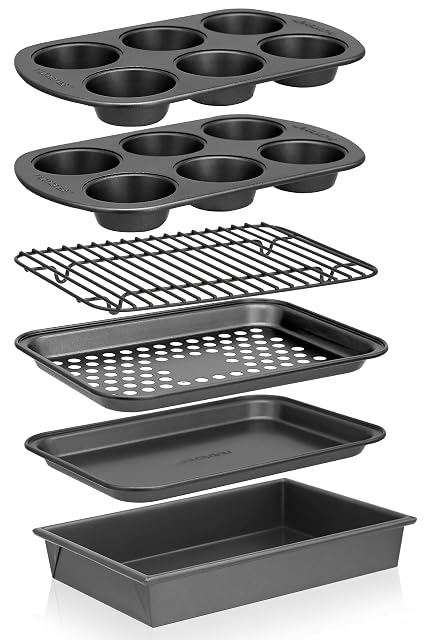
NutriChef 6-Piece Toaster Oven Bakeware Set
A six-piece stackable carbon steel bakeware set for toaster ovens with a roasting pan, muffin pans, a baking sheet, a rack and a perforated sheet, rated to 450 °F.
- Sized for
- Toaster ovens — the only such statement on this shelf
- Pieces
- Six; five named — roasting pan, muffin pans, baking sheet, rack, perforated sheet
- A rack
- Included — the only rack on this shelf
- Temperature
- Up to 450 °F
- Chemistry
- PFOA, PFOS, PTFE and BPA free — the only four-substance claim here
- Stackable
- Stated, to maximize space in smaller kitchens
- Dishwasher
- Stated safe, and stain resistant
- Material
- Thick carbon steel, no figure given
- Weight
- 3.4 lb (1.54 kg) for six pieces
- Catalog
- 11.8 × 7.6 × 2.95 in (300 × 193 × 75 mm), nested
- Reference
- NCTOBS6
- Piece dimensions
- None published
- Steel thickness
- Not published; only the Emporio Kitchen gives one
- Warranty
- Not published
- Amazon reference
- B0F34Z5ZJQ
- EAN
- 0842893176956
- The only set on this shelf that states which kind of oven it is for
- Four substances named, including BPA, which no other page here adds
- Five things named for six pieces, and no dimension for any of them
Best for: A toaster oven or a small kitchen, where the pieces have to fit a small cavity
≈ $37Check price on Amazon
Elsewhere in the kitchen drawer
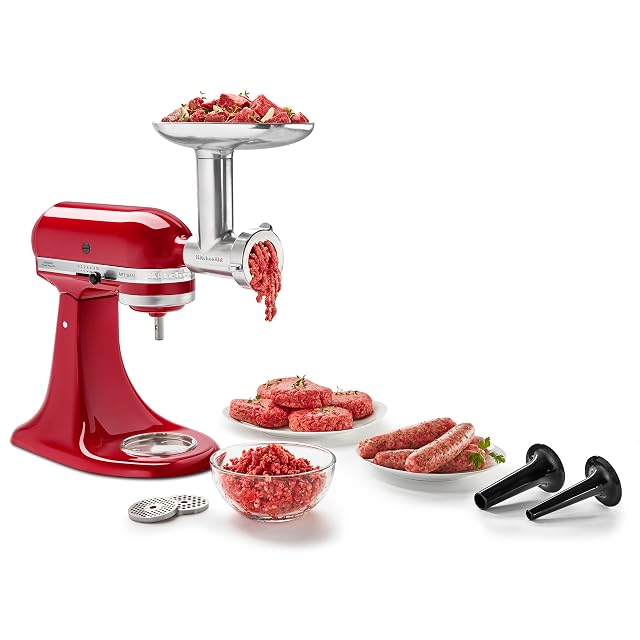
KitchenAid KSMMGA Metal Food Grinder Attachment
A metal food grinder for any KitchenAid mixer hub, with fine, medium and coarse plates and two sausage stuffer tubes.
- Technique published
- Pre-chill the grinder in the fridge or freezer — unique on this shelf
- Grinding plates
- Three — fine, medium and coarse
- Sausage tubes
- Two
- Body
- Metal
- Compatibility
- Any household KitchenAid stand mixer power hub
- Food tray
- Larger than model FGA, for bigger batches
- Named uses
- Gourmet burgers, sausage, hard cheeses, fresh breadcrumbs
- Storage
- Its own case
- Weight
- 2.5 lb
- Reference
- KSMMGA
- Dimensions
- 8.8 × 5.5 × 8.4 in (224 × 140 × 213 mm) at the catalog
- Plate hole sizes
- Not published in millimeters
- Dishwasher
- Not stated
- Mixer
- Sold separately
- Amazon reference
- B07GK7XKJK
- EAN
- 0883049478456
- Publishes the one technique that decides whether a grind works: pre-chill it
- Metal rather than plastic, three plates and two sausage tubes, in a case
- No hole sizes in millimeters, where the slicer on this shelf publishes all three
Best for: Mincing your own meat for burgers and sausage, on a mixer you already own
≈ $80Check price on Amazon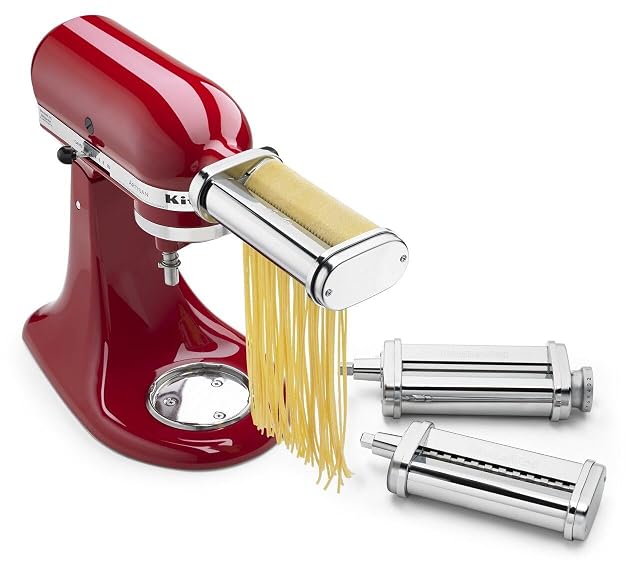
KitchenAid KSMPRA 3-Piece Pasta Roller and Cutter Set
A stainless pasta roller with eight thickness settings plus spaghetti and fettuccine cutters, for any KitchenAid mixer.
- Thickness settings
- Eight — the only numbered adjustment on this shelf
- Sheet width
- 6 inches
- Contents
- Four — pasta roller, fettuccine cutter, spaghetti cutter, cleaning brush
- Material
- Stainless steel rollers and cutters
- Cleaning
- Hand wipe only — never washed; see the FAQ
- Cleaning tool
- A brush, included for that reason
- Compatibility
- All household KitchenAid stand mixers, via the power hub
- Genuine part
- Designed and engineered by the makers of the mixer
- Weight
- 7.5 lb (3.4 kg) — the heaviest item on this shelf
- Price
- $204.90 — ten times the cheapest item here
- Reference
- KSMPRA
- Dimensions
- 9.7 × 3.8 × 2.2 in (246 × 97 × 56 mm) at the catalog
- Thickness in millimeters
- Not published — only the setting count
- Mixer
- Sold separately
- Amazon reference
- B01DBGQR1K
- EAN
- 0883049392134
- Eight numbered thickness settings and a stated six-inch sheet width
- Solid stainless rollers and cutters at seven and a half pounds, with no plastic in the path
- Must never be washed, which is counter-intuitive on a food tool at this price
Best for: Fresh pasta in quantity, where eight thicknesses and clean stainless cutting earn the price
≈ $205Check price on Amazon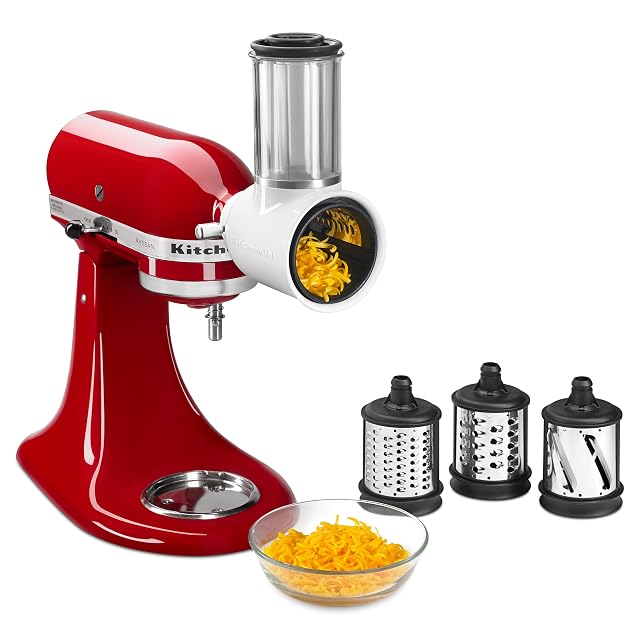
KitchenAid KSMVSA Fresh Prep Slicer and Shredder
A genuine KitchenAid hub attachment with a 3 mm (0.12 in) slicing blade, 4 mm (0.16 in) and 6 mm (0.24 in) shredding blades, a food pusher and a case.
- Blades
- Three — 3 mm (0.12 in) slicing, 4 mm (0.16 in) medium shredding, 6 mm (0.24 in) coarse shredding
- Millimeters published
- All three — the only millimeter specs on this shelf
- Compatibility
- Any KitchenAid stand mixer, via the power hub
- Genuine part
- Designed and engineered by the makers of the mixer
- Food pusher
- Two-in-one, for large and small diameter produce
- Discharges into
- Any size bowl, rather than a fixed container
- Dishwasher
- All blades, on the top rack
- Storage
- A case holds the attachment and the accessories
- Weight
- 1.3 lb (1.3 lb)
- Reference
- KSMVSA
- Dimensions
- 8 × 4 × 8.5 in (203 × 102 × 216 mm) at the catalog
- Mixer
- Sold separately
- Motor speed guidance
- Not published
- Extra blades
- None named as available separately
- Amazon reference
- B01MUTSU13
- EAN
- 0883049439570
- Three blades with their cut thicknesses published, which nothing else here does
- Fits any KitchenAid stand mixer, with no exclusions at all
- Seventy dollars for a function a food processor already performs
Best for: Slicing and shredding straight into the bowl, on a mixer you already own
≈ $70Check price on Amazon