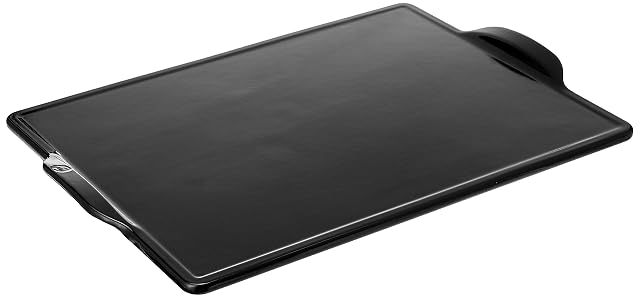
Best for: A grill or an oven, where the stone will be washed and will last
≈ $110
Check price on Amazon Ten years, and the only dishwasher-safe stone here
A rectangular BBQ ceramic grill and oven stone with handles, safe to 900 °F on gas, charcoal and wood grills, usable under a broiler, dishwasher safe and guaranteed ten years.
Best for: A grill or an oven, where the stone will be washed and will last
“10 year Guarantee. Our warranty covers any production fault or quality problem with the product when used in a normal domestic environment, and respecting the care and use Instructions.”
Two items on this shelf publish a warranty.
this — ten years, with its scope and its conditions stated Moss & Stone 5-piece set, $23.99 — “1-year warranty”, and nothing more
One other offers support rather than a term. The Ritual Life stone at $36.95: “A member of our team will respond within 24 hours to provide support.”
Nine of the twelve items sold on Amazon.com publish nothing at all.
Why the conditions are the interesting part rather than the limitation.
A ceramic object’s commonest failure is a crack, and almost every crack is caused by the owner.
Thermal shock — a cold stone into a hot oven, something frozen onto a hot stone, water on a warm one Mechanical shock — dropped, or knocked against an oven rack And stress — a stone wedged against the oven walls with no room to expand, which the Unicook at $33.99 is the only page on this shelf to warn about: “Please ensure a minimum of 1-2 inches of clearance on ALL sides inside your oven or grill for proper fit and airflow.”
So a ten-year guarantee that excludes misuse is a guarantee against a manufacturing flaw — a void, an inclusion, a firing fault — which is exactly the failure an owner cannot see and cannot cause.
And ten years is long enough to matter, because a flaw of that kind shows up after a hundred heat cycles rather than on the first.
“Respecting the care and use Instructions” is the clause that puts the responsibility back — and this page gives four of them: oven, grill, broiler, dishwasher.
What it does not give is the two instructions the cordierite stones do: preheat it, and leave clearance.
“Easy to clean. Dishwasher safe or hand wash with soap and water.”
The two cordierite stones here forbid soap.
Unicook, $33.99 — “Hand wash with warm water, using a brush if necessary. Do not use detergent.” Ritual Life, $36.95 — “Simple hand washing with warm water (no soap needed).”
Why, and why this stone is different.
Cordierite is porous, and that porosity is the property it is bought for. The Unicook page sells it directly: “The porous surface… effectively absorbs excess moisture from pizza dough, creating a crispy, golden pizza crust.”
A porous stone absorbs detergent as readily as it absorbs water, and gives it back to the next loaf.
This page describes something else. “Made of all natural materials and manufactured using Emile Henry proprietary BBQ ceramic.”
A vitrified or glazed ceramic is dense rather than porous — which is why it takes soap, a dishwasher, and a broiler.
And the trade is the moisture absorption. A dense ceramic does not draw water out of a dough the way a cordierite stone does — so the crisping mechanism here is heat and mass rather than absorption, which is exactly what bullet three describes: “The BBQ ceramic has refractory qualities which naturally offer slow, even heat diffusion.”
Three answers to one problem on this shelf.
Soak the water up — the two cordierite stones Vent it through holes — the nine steel items, of which the Breville at $19.95 is the only one to publish a hole size, “1/3 inch crisper holes” Or lift the food off the surface entirely — the Bakken-Swiss at $12.59, with a removable basket above a tray so air circulates all round it
This stone does none of the three. It relies on mass. Which works, and means a very wet dough wants a hotter stone here than it would on cordierite.
The other consequence of a dense ceramic is staining, or rather the absence of it. The Unicook at $33.99 is frank that a cordierite stone stains permanently: “Frequently used pizza pans may develop discolored areas over time. This is normal and does not require cleaning.” And the Ritual Life at $36.95 turns the same thing into a virtue: “Do not pre-season the stone, as this will cause an odor. The naturally seasoned surface improves with each use.”
A dishwasher-safe stone has neither problem and neither benefit. It stays looking like a stone, and it never develops the dry slick surface a seasoned cordierite stone acquires.
“Safe to use on gas, Charcoal and natural wood grills up to 900 degrees F. Can be used in all types of ovens and under the broiler.”
It is the most specific grill statement on this shelf.
The Unicook at $33.99 says “for oven and grill” and then tells you what not to do: “For charcoal kettle grill, please check our round stone models” — because a rectangle in a kettle blocks the airflow its own first bullet warns about. The Ritual Life at $36.95 says “your home oven or BBQ” and names no fuel. And the nine steel items are not grill tools at all.
Why a live fire is harder than an oven. An oven heats air. A grill heats by radiation from embers a few inches below.
A stone on a grate over charcoal has a hot face and a cool face at the same time — which is a temperature difference across the material, and a temperature difference is what cracks ceramic, not temperature itself.
And the three fuels behave differently. Gas is steady and controllable. Charcoal under a closed lid goes well past 700 °F. Wood spikes. Naming all three is a harder claim than naming none.
“Under the broiler” is the other unique statement on this shelf, and it is the one that catches the coated steel out.
A broiler element a few inches from the food sends radiant heat well above the air temperature — and four items on this shelf publish a 450 °F ceiling while five publish none at all.
No coated pan should go under a broiler, and only this page says anything either way.
What it is really telling you: this is a stone for finishing as well as baking. A pizza browned on top under a broiler, on a stone already at temperature, is the closest a domestic oven gets to a pizzeria.
The temperature divide across this shelf:
1500 °F (815 °C) — the Ritual Life at $36.95 1,450 °F (787 °C) — the Unicook at $33.99 900 °F, plus all ovens and under the broiler — this 450 °F (230 °C) — the Emporio Kitchen at $15.43, the BAKKENMASTER pizza pan at $15.99, the Moss & Stone set at $23.99, the NutriChef set at $36.99 Nothing published — the Bakken-Swiss at $12.59, both GoodCook pans, the Breville at $19.95, the BAKKENMASTER 18-piece set at $57.99
The two cordierite stones publish higher numbers and this one publishes the more useful claim — because 900 °F covers every real use and the broiler statement covers the one case nothing else here addresses.
The page gives no size at all. The catalog reads about 18 × 14 × 1.1 inches (457 × 356 × 28 mm).
Which makes it the largest cooking surface here.
18 × 14 in — about 252 in² — this 15.75 in round — about 195 in² — both GoodCook pans at $18.99 and $25.19 15 × 12 in — 180 in² — the Unicook at $33.99 and the Ritual Life at $36.95 13 in round — about 133 in² — the Emporio Kitchen at $15.43, the BAKKENMASTER pizza pan at $15.99, the Breville at $19.95
And the mass per unit area is the comparison that matters on a stone.
Ritual Life, $36.95 — 7.5 lb over 180 in² → about 0.0417 lb per square inch Unicook, $33.99 — 6.5 lb over 180 in² → about 0.0361 lb per square inch this — 7.3 lb over 252 in² → about 0.0290 lb per square inch
So this is the largest stone and the least dense per square inch of the three. The mass is spread over more area.
Which is a real trade and the page does not discuss it. More area takes a bigger pizza, or two small ones, or a tray of vegetables. Less mass per square inch means the surface temperature drops further when something cold lands on it — and recovery is slower per unit of area.
“Slow, even heat diffusion” in bullet three is the honest description of that. A refractory material moves heat sideways rather than quickly through, so the surface evens out rather than reaching temperature fast.
Which is also why the missing preheat instruction matters. Both cordierite stones here instruct it. The Unicook at $33.99: “Please preheat the stone to ensure even cooking and crispy crust.” The Ritual Life at $36.95: “Simply preheat the stone in your oven or on the grill.”
This page does not — and a slow-diffusing stone of 7.3 pounds needs longer, not less. A good half hour for the whole thickness to reach oven temperature, not the ten minutes an oven light takes to go out.
And the clearance instruction is the other omission. At 18 × 14 inches plus the one to two inches each side the Unicook asks for, you would need 22 × 18 inches of cavity — which is the full width of a standard domestic oven shelf. This is the item on this shelf most likely to foul an oven wall, and the one that says nothing about it.
“Handles make it easy to use and carry.”
7.3 pounds, and the second heaviest item on this shelf.
Ritual Life, $36.95 — 7.5 lb (3.4 kg), the heaviest, with handles and a detachable carrying tray this — 7.3 lb (3.31 kg), with handles Unicook, $33.99 — 6.5 lb (2.95 kg), with nothing: a stone rated to 1450 °F and no way to lift it NutriChef six-piece set, $36.99 — 3.4 lb · GoodCook pair, $25.19 — 2.7 lb · Emporio Kitchen pair, $15.43 — 2.4 lb · Bakken-Swiss, $12.59 and GoodCook single, $18.99 — 1.5 lb · BAKKENMASTER pair, $15.99 — 1.4 lb · Breville, $19.95 — 14.4 oz, the lightest here Not published — the Moss & Stone set at $23.99 and the BAKKENMASTER 18-piece set at $57.99
The heaviest item on this shelf is 8.3 times the lightest.
Why handles matter more on a grill stone than on an oven stone. An oven stone can live in the oven: in cold, out cold, never moved. A grill stone has to go out to the grill and come back — and on a grill it also has to be positioned over the heat rather than simply set down.
So the handles and the grill claim belong together, which is the one thing this page gets right about its own use case.
And the habit no page on this shelf gives, which matters most on a stone with handles. Do not move it hot.
Handles make it possible to move a hot stone, which is exactly the thing that cracks one — a hot stone set on a cold countertop is a temperature difference across the material.
Put it in before the heat and take it out after the cold. On a grill, that means leaving it on the grate until the coals are out.
What is not supplied is a tool. Two of the three stones sold on Amazon.com include one. The Unicook at $33.99: a “multi-purpose plastic scraper that functions as a dough cutter or cleaning tool for removing residue.” The Ritual Life at $36.95: a dough tool and a detachable carrying tray.
On a dishwasher-safe stone the scraper matters less — which is the one place this stone’s material works in its favor on cleaning.
No dimensions at all, as above — on the largest item on this shelf. Both other stones publish something: the Unicook its full “15” L x 12” W with 0.6” thickness”, and the Ritual Life a figure that turns out to be its box.
No preheat instruction, as above — and on a slow-diffusing refractory stone it is needed more, not less.
No clearance instruction, as above — and at 18 × 14 inches this is the item on this shelf most likely to need it.
No weight. The catalog gives 7.3 lb and the page gives nothing — where the Unicook at $33.99 publishes “about 6.8 lbs” in its first bullet.
No thickness. The Unicook is the only stone on this shelf to publish one: “0.6” thickness”. The catalog here suggests 1.1 inches (28 mm), which would be substantially thicker — and on a stone, thickness is the specification, because thermal mass is what gives a crust its bottom heat.
No pizza size. The Unicook at $33.99 is the only page on this shelf to state what fits: “ideal for baking personal pizzas up to 11 inches in diameter. For 12-inch or larger pizzas, please check our larger models.” On a stone with 252 square inches of surface, that figure would be the selling point.
No reversibility. The Unicook publishes it: “The reversible smooth surface allows use on both sides.” On a dishwasher-safe stone it matters less, since staining is not the issue it is on cordierite.
No material detail beyond “proprietary”. “Emile Henry proprietary BBQ ceramic” and “all natural materials” are the whole of it — where both rivals name cordierite, which is a specific mineral with known properties.
No bread guidance, where the Ritual Life at $36.95 is sold for it explicitly: “BAKE ARTISAN BREAD AT HOME… perfect for creating crusty, delicious bread.”
No country of manufacture, which no item on this shelf publishes — though “Emile Henry” and “proprietary” are doing some of that work implicitly, and a ten-year guarantee is the kind of commitment that requires somebody to honour it.
Read on the day this page was built: $109.95 at the American Amazon shop.
Read from Keepa on the day this page was last revised; stock and price both move without notice.
Prices quoted in this text were read on 2026-10-17. The live price is at the top of the page.
Because it is a different material, and the three pages are each consistent with their own. Bullet four: "Easy to clean. Dishwasher safe or hand wash with soap and water." The two cordierite stones here forbid soap. The Unicook at $33.99: "Hand wash with warm water, using a brush if necessary. Do not use detergent." The Ritual Life at $36.95: "Simple hand washing with warm water (no soap needed)." Why. Cordierite is porous — and that porosity is the property it is bought for, because the Unicook page sells it directly: "The porous surface... effectively absorbs excess moisture from pizza dough, creating a crispy, golden pizza crust." A porous stone absorbs detergent as readily as it absorbs water, and gives it back to the next loaf. This page describes something else: "Made of all natural materials and manufactured using Emile Henry proprietary BBQ ceramic." A vitrified or glazed ceramic is dense rather than porous — which is why it takes soap, a dishwasher, and a broiler. And the trade is the moisture absorption. A dense ceramic does not draw water out of a dough the way a cordierite stone does — so the crisping mechanism here is heat and mass rather than absorption, which is what bullet three describes: "The BBQ ceramic has refractory qualities which naturally offer slow, even heat diffusion." Three answers to one problem on this shelf. Soak the water up — the two cordierite stones. Vent it through holes — the nine steel items, of which the Breville at $19.95 is the only one to publish a hole size, "1/3 inch crisper holes". Or lift the food off the surface entirely — the Bakken-Swiss at $12.59, with a removable basket above a tray. This stone does none of the three: it relies on mass. Which works, and means a very wet dough wants a hotter stone than it would on cordierite.
That the maker has written down what it covers, which no other page on this shelf has done. Bullet five: "10 year Guarantee. Our warranty covers any production fault or quality problem with the product when used in a normal domestic environment, and respecting the care and use Instructions." Two items on this shelf publish a warranty. this — ten years, with its scope and its conditions stated. The Moss & Stone 5-piece set at $23.99 — "1-year warranty", and nothing more. One other offers support rather than a term: the Ritual Life stone at $36.95 — "A member of our team will respond within 24 hours to provide support." Nine of the twelve items sold on Amazon.com publish nothing at all. Why the conditions are the interesting part rather than the limitation. A ceramic object’s commonest failure is a crack, and almost every crack is caused by the owner. Thermal shock — a cold stone into a hot oven, something frozen onto a hot stone, water on a warm one. Mechanical shock — a stone dropped, or knocked against an oven rack. And stress — a stone wedged against the oven walls with no room to expand, which the Unicook at $33.99 is the only page here to warn about: "Please ensure a minimum of 1-2 inches of clearance on ALL sides." So a ten-year guarantee that excludes misuse is a guarantee against a manufacturing flaw — a void, an inclusion, a firing fault — which is exactly the failure an owner cannot see and cannot cause. And ten years is long enough to matter, because a flaw of that kind shows up after a hundred heat cycles rather than on the first. "Respecting the care and use Instructions" is the clause that puts the responsibility back — and this page gives you four of them: oven, grill, broiler, and dishwasher. What it does not give is the two the cordierite stones do: preheat it, and leave clearance.
A live fire, which is a harsher place than any oven and the one thing most of this shelf cannot go near. Bullet two: "Designed for use in the oven or on a BBQ grill. Safe to use on gas, Charcoal and natural wood grills up to 900 degrees F. Can be used in all types of ovens and under the broiler." It is the most specific grill statement on this shelf. The Unicook at $33.99 says "for oven and grill" and then tells you what not to do: "For charcoal kettle grill, please check our round stone models" — because a rectangle in a kettle blocks the airflow it warns about elsewhere. The Ritual Life at $36.95 says "your home oven or BBQ" and names no fuel. And the nine steel items are not grill tools at all. Why a live fire is harder than an oven. An oven heats air; a grill heats by radiation from embers a few inches below. A stone on a grate over charcoal has a hot face and a cool face at the same time — which is a temperature difference across the material, and a temperature difference is what cracks ceramic, not temperature itself. 900 °F is the figure, and the three fuels matter because they behave differently: gas is steady and controllable, charcoal under a lid goes well past 700 °F, and wood spikes. "Under the broiler" is the other unique claim, and it is the one that catches the coated steel out. A broiler element a few inches from the food sends radiant heat well above the air temperature — and four items on this shelf publish a 450 °F ceiling while five publish none at all. No coated pan should go under a broiler, and only this page on this shelf says anything either way. What the claim is really telling you: this is a stone for finishing as well as baking. A pizza browned on top under a broiler on a stone already at temperature is the closest a domestic oven gets to a pizzeria.
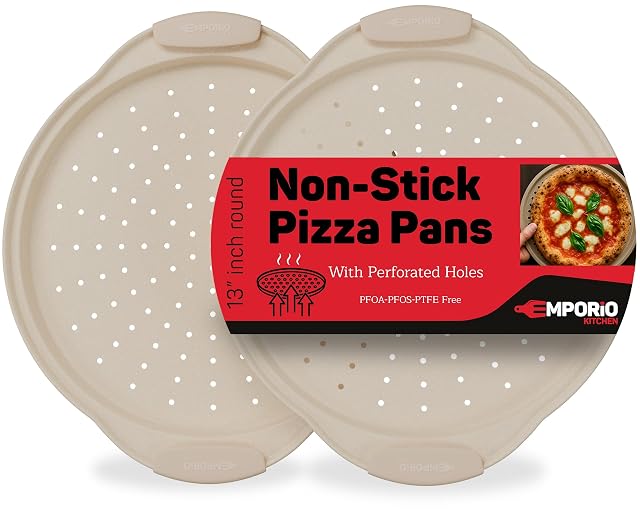
Two 13-inch round perforated carbon steel pizza pans in 0.02 in (0.5 mm) steel with silicone handles, non-stick inside and out, dishwasher safe and rated to 450 °F.
Best for: Thirteen-inch pizzas at 425 to 450 °F, lifted out by the handle
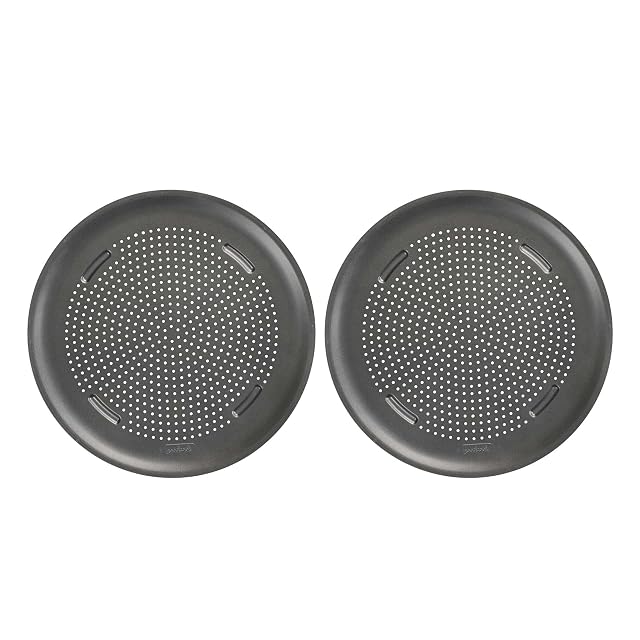
Two 15.75-inch air-insulated perforated carbon steel pizza pans with cutting guides and molded feet, in a non-stick finish.
Best for: Two large frozen or homemade pizzas at a time, cut on the pan
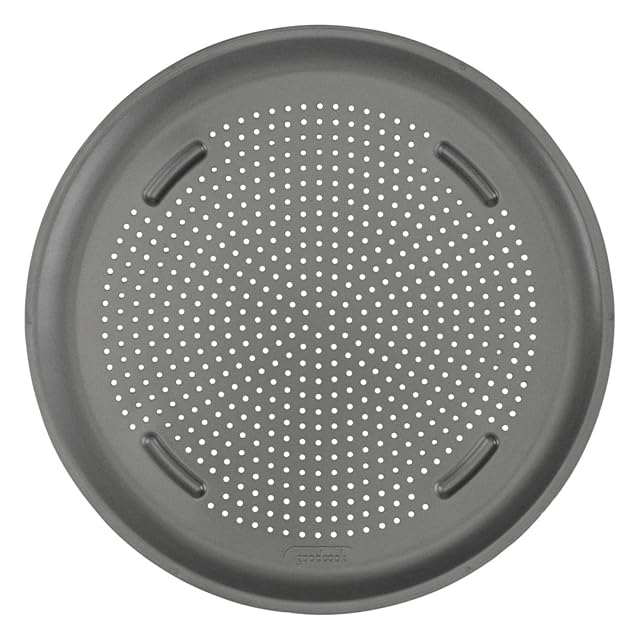
A 16-inch perforated carbon steel pizza pan with cutting guides, molded feet to keep it off the countertop and a non-stick coating.
Best for: A large pizza served in even slices without scorching the countertop
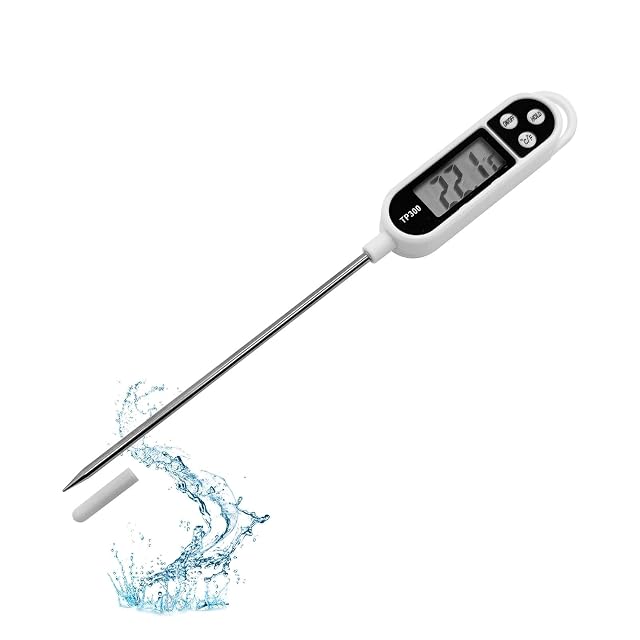
A digital instant-read thermometer stated to read in 2 to 3 seconds, to ±1 °C, from −58 to 572 °F, on a food-grade stainless probe, with a hold button, a probe cover and hanging holes. Sold on the European Amazon stores, not on Amazon.com.
Best for: A reader in Europe; in the United States, one of the thermometers sold on Amazon.com in this hub.
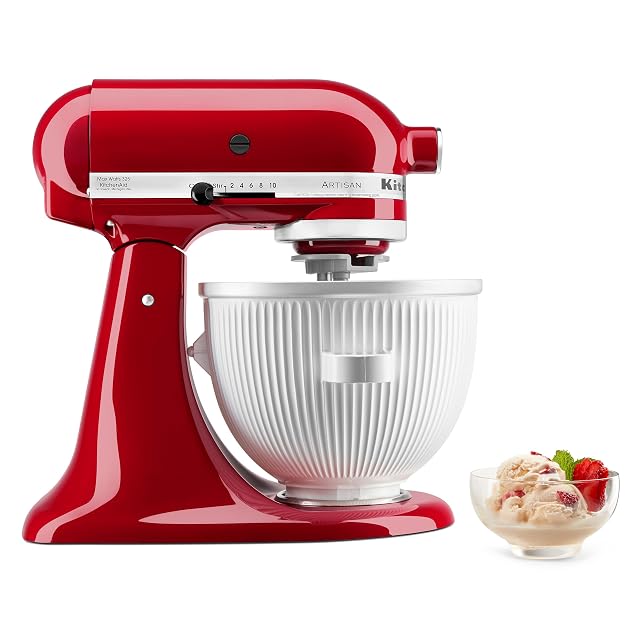
A two-quart freezer bowl, dasher and hub assembly that churns ice cream, gelato or sorbet in under thirty minutes.
Best for: A compatible KitchenAid and a freezer with room for the bowl to live in
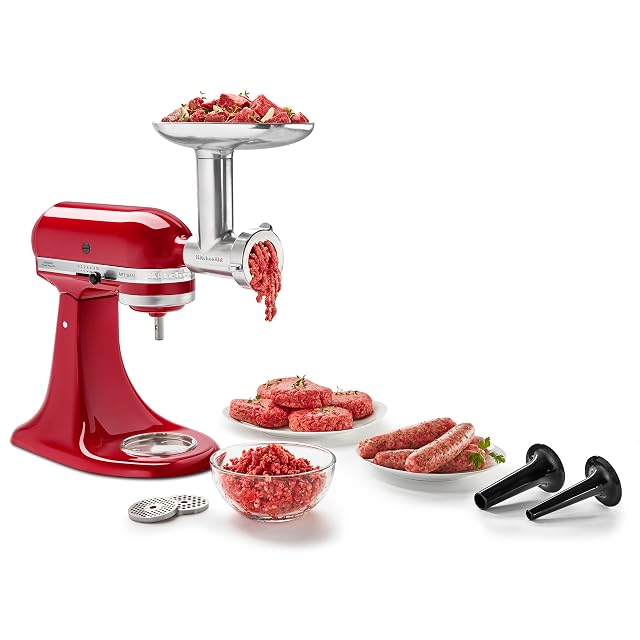
A metal food grinder for any KitchenAid mixer hub, with fine, medium and coarse plates and two sausage stuffer tubes.
Best for: Mincing your own meat for burgers and sausage, on a mixer you already own