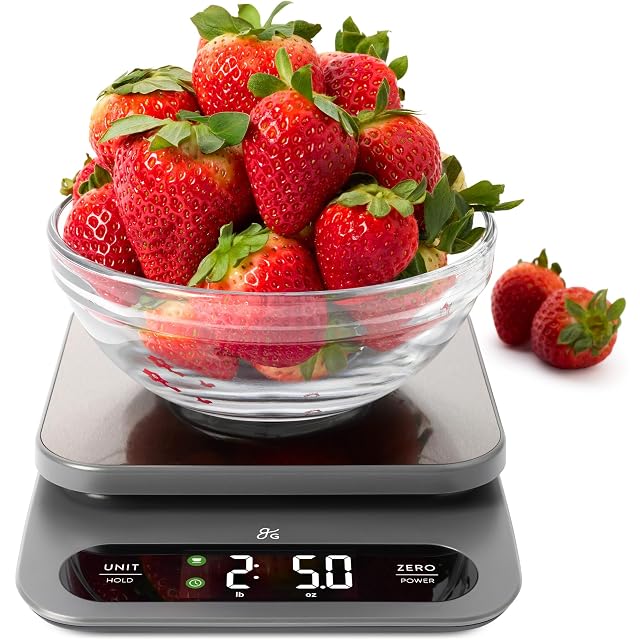
Best for: Bulk baking and meal prep, where a bowl sits on the scale for minutes at a time
≈ $25
Check price on Amazon A 5-minute HOLD, and it states its own limit
A 22-pound kitchen scale with 1-gram precision, six units, a Hi-Def display extending past the platform, a 5-minute HOLD, a 2-minute shutoff and a 5-year warranty.
Best for: Bulk baking and meal prep, where a bowl sits on the scale for minutes at a time
“Not for laboratory or microgram measurements.”
One sentence, and it is the only declared limit anywhere among the thirteen items here.
It is also accurate, which is why it is worth having. At least twelve of the fifteen scales on this shelf read in 1-gram steps — and twelve say nothing about the consequence.
The exception is the Letron at $34.99, which has two platforms: a mini one at 0.001 oz / 0.01 g up to 1.1 lb / 500 g, and a large one at 1 g up to 33 lb / 15 kg.
What one gram cannot do.
A sachet of dried yeast is about 7 g. At ±1 g that is ±14 percent — the difference between a dough that proves in an hour and one that takes three. Three grams of salt in a loaf is ±33 percent, and salt governs flavor and fermentation speed together. Baking powder, bicarbonate and ground spices are all in that range.
What one gram is exactly right for is everything else. 500 g of flour at ±1 g is ±0.2 percent — finer than any recipe needs — and the same for sugar, butter, water, meat, pasta and portions.
One gram is the resolution of flour, not of salt.
And the figure the disclaimer needs and does not give is the minimum weighable load.
Five scales here publish one: 2 g — the Amazon Basics at $11.14 (“2 grams minimum”), the Etekcity USB at $29.99 (“as light as 2 g”) · 3 g — the GGQ at $17.98 (“from 0.1oz/3g”), the Etekcity nutritional at $39.99 (“between 3 g - 5000 g”) · 0.01 g — the Letron’s mini platform.
Resolution is the step; the minimum is the floor. A 1-gram scale with a 2-gram floor shows 0 for 1.5 g — not approximately, but zero — and that is a refusal to weigh rather than an imprecision.
This page publishes the step and the honest caveat, and not the floor.
“Use HOLD to keep readings on screen for up to 5 minutes, or let auto shut-off after 2 minutes save battery life.”
It is the only HOLD on this shelf with a duration attached, and the pairing is the point.
Why a two-minute shutoff is otherwise a nuisance. A multi-ingredient recipe is weighed cumulatively: bowl on, zero, flour in, zero, sugar in, zero. Go to the cupboard between two additions and the scale has switched off and lost the zero — so the bowl comes off, the scale restarts, the bowl goes back, and the flour already in it becomes part of the tare.
HOLD freezes the number so the shutoff stops mattering.
The shutoffs on this shelf:
2 minutes — this, the SOYOK at $6.98, the GGQ at $17.98 3 minutes — the KitchenAid at $23.99 4 minutes — the Escali at $25 5 minutes — the Letron at $34.99 Unspecified — the Ultrean at $6.98 Nothing published — the Amazon Basics at $11.14, the Etekcity at $13.99, the Etekcity USB at $29.99, the Etekcity nutritional at $39.99, and both OXO scales
And the HOLD functions: this, with five minutes · the Etekcity USB at $29.99 — “Use the tare feature and hold function”, no duration given · ten scales with none at all.
The OXO 5 lb at $37.95 solves a different problem instead, and it is the only scale here to do so: “Convenient meter shows how much of Scale’s capacity remains” — the only capacity meter on this shelf.
The second use of HOLD, which this page does not name: weighing something that will not sit still, or reading a number you can only see with the bowl lifted off. Press, lift, read.
“The bright Hi-Def LCD display extends beyond the weighing platform for better visibility under large mixing bowls.”
This is the one genuine design problem of a kitchen scale, and at least three of the fifteen items here address it.
The platform sits above the display. A bowl wider than the body covers the number you need — and no backlight shines through a mixing bowl.
The three answers:
Extending the display past the platform — this Pulling the display out of the body — both OXO scales at $37.95 and $64.95: “Display pulls away from base to avoid shadowing from plates or bowls” A backlight, which does not solve the geometry at all — the SOYOK at $6.98, the Ultrean at $6.98, the Etekcity at $13.99, the OXO 5 lb
Nine scales ignore it entirely.
Which approach is better. A pull-out display reaches further and can be set clear of a Dutch oven, and it is a mechanism with a cable and a hinge to fail. An extended display has nothing to go wrong and reaches less far.
And bullet two names exactly the containers that cause the problem: “for use with meal prep containers, mixing bowls, and Dutch ovens.”
A Dutch oven is the hard case. Ten to twelve inches across, on a body 7.6 inches wide. Even an extended display disappears under a 12-inch pot — at which point the answer is HOLD, which this scale has and most of the shelf does not.
No display size or digit height is published, which is true of every scale on this shelf. “Hi-Def” here, “wide LCD screen” on the Amazon Basics, “large fonts” on the Etekcity, “large, easy-to-read numbers” on both OXO scales — and no figure anywhere.
The capacities here:
5 lb / 2.27 kg — the OXO pull-out at $37.95, the lowest on this shelf and dearer than ten of the thirteen 11 lb / 5 kg — eight scales, from $6.98 to $64.95 22 lb / 10 kg — this, and the Etekcity USB at $29.99 33 lb / 15 kg — the GGQ at $17.98, the Letron at $34.99
Twenty-two pounds is ten kilograms, and bullet one names the uses that need it: “meal prep, holiday baking, sourdough, or grilling.”
What actually hits the limit. A full stand-mixer bowl of dough — and a mixer bowl alone can be 1.5 kg before anything goes in. A turkey. A Dutch oven weighed with the contents in it — a cast-iron pot is 4 to 6 kg empty, which uses half of this scale’s capacity before any food arrives. Which is exactly why bullet two names Dutch ovens, and why 22 lb rather than 11 lb is the right choice for the use.
The quiet failure is overload. A strain-gauge scale measures the deflection of a beam, and pushing it past capacity bends the beam permanently — after which the scale reads consistently wrong rather than failing outright, which is far worse than a blank display.
Two scales on this shelf publish an overload warning: the SOYOK at $6.98 and the GGQ at $17.98. One publishes a capacity meter: the OXO 5 lb at $37.95. This page publishes neither — which on a scale whose selling point is high capacity, and which will spend its life near a cast-iron pot, is the omission to note.
At 367 grams it sits mid-shelf: Etekcity 200 g · SOYOK 222 g · GGQ 250 g · this 367 g · Amazon Basics 381 g · Escali 431 g · KitchenAid 535 g · Letron 544 g · Etekcity nutritional 544 g · OXO 5 lb 581 g · Etekcity USB 700 g · OXO 11 lb 816 g.
And 7.6 × 5.6 × 1.3 inches is published in the bullets, which only three other scales sold on Amazon.com manage: the Amazon Basics at $11.14 (8.3 × 7 × 1.3 in), the Escali at $25 (8.5 × 6 × 1.5 in) and the GGQ at $17.98, which publishes the platform rather than the body — “7.5” x 5.5"", the only platform figure on this shelf.
“Backed by a 5-year limited warranty and lifetime support from our St. Louis team”
It separates the two ideas properly, which is more than one rival manages.
The three items on this shelf that publish anything:
Escali, $25 — “Lifetime warranty”: the only lifetime term here, and the plainest sentence on the shelf this, $24.99 — a 5-year limited warranty, plus lifetime support GGQ, $17.98 — “12 Months Support”, which is a commitment to answer the telephone rather than to replace the scale
Ten publish nothing, including the OXO at $64.95 — the most expensive item here.
Why a term matters on a scale specifically. The failure modes are slow and silent. A bent load cell from one overload reads consistently wrong, and you will not notice for months. A corroded sensor lead drifts. A cracked platform mount shifts the zero.
None of that shows up on arrival, which is precisely the case a warranty beyond a return window exists for — and a scale that drifts rather than dies is the hardest thing to make a claim about.
Which is the practical argument for checking it yourself. Nothing on this shelf has a calibration function. Weigh a known mass now and again: a liter of water from the tap is 1,000 g to within a gram or two, and a sealed tin gives you a repeatable reference even if you do not know its true mass.
“Lifetime support” and “our St. Louis team” are the softer half of the claim and not nothing: a named location is a harder commitment than “trusted customer support team”, which is what the Ultrean at $6.98 offers.
And “touch-sensitive controls resist stains and buildup” is the other durability claim, in bullet four. It is sound reasoning: a touch panel has no button seams to admit flour or water — which is also why it does not work with wet or floury fingers. The GGQ at $17.98 publishes the same arrangement (“Screen touch and LCD display”); most of this shelf uses physical buttons.
Three AAA batteries, included, which matches the KitchenAid at $23.99. Four scales here use 2 AAA; two are rechargeable — the GGQ at $17.98 and the Etekcity USB at $29.99, which publishes “Type-C… comes with a USB-C charging cable”.
No minimum weighable load, as above — which is the figure the honest disclaimer in bullet one most needs.
No overload warning and no capacity meter, as above, on a high-capacity scale.
No water rating. One scale on this shelf publishes one: the Etekcity USB at $29.99, IPX6. Two claim waterproofing without a rating: the SOYOK at $6.98 and the GGQ at $17.98. One forbids immersion outright: the KitchenAid at $23.99 — “Hand wash only; do not immerse in water or put in dishwasher”. And both OXO scales remove the platform for washing. “Stainless steel and touch-sensitive controls resist stains and buildup” is a cleaning claim rather than a sealing one — so wipe it, keep water out of the battery hatch, and dry it.
No anti-slip feet, where the SOYOK at $6.98 publishes four and the GGQ at $17.98 “4 no-slip rubbers”. A strain-gauge scale measures a beam’s deflection, so a scale not resting evenly on all four feet reads wrong — and a scale that slides is a scale with a bowl on it being stirred.
No load-sensor count. Two scales here publish one: the GGQ at $17.98 and the Etekcity nutritional at $39.99, both with four. Four corner cells sum the load so the reading does not depend on where the bowl sits — which matters on a wide platform. The test you can run on any scale: put a full tin in the middle, note the number, then move it to each corner.
No milk volume mode. Five scales on this shelf offer one, applying a density of about 1.03 g/ml instead of water’s 1.00 — a three percent difference, and the whole content of the feature. This offers plain ml and fl oz, which is the more honest arrangement, because a milliliter reading on any scale here is a water reading. Weigh liquids in grams.
No country of manufacture, which no item on this shelf publishes.
Read on the day this page was built: $25 at the American Amazon shop.
Read from Keepa on the day this page was last revised; stock and price both move without notice.
Prices quoted in this text were read on 2026-10-17. The live price is at the top of the page.
Because it is a one-gram scale and the maker has decided to say so — and no other page on this shelf does. Bullet one: "This high-capacity kitchen scale weighs up to 22 lb (10 kg) with 1 g (0.04 oz) precision... Not for laboratory or microgram measurements." At least twelve of the fifteen scales here read in 1-gram steps, and twelve of the thirteen sold on Amazon.com say nothing about the consequence. The exception on resolution is the Letron at $34.99, which has two platforms: a mini one at 0.001 oz / 0.01 g up to 1.1 lb / 500 g, and a large one at 1 g (0.04 oz) up to 33 lb / 15 kg. What one gram cannot do. A sachet of dried yeast is about 7 g (0.2 oz). At ±1 g (0.04 oz) that is ±14 percent — the difference between a dough that proves in an hour and one that takes three. Three grams of salt in a loaf is ±33 percent, and salt governs flavor and fermentation speed together. Baking powder, bicarbonate and ground spices sit in the same range. What one gram is exactly right for is everything else. 500 g (17.6 oz) of flour at ±1 g (0.04 oz) is ±0.2 percent — finer than any recipe needs — and the same for sugar, butter, water, meat, pasta and portions. One gram is the resolution of flour, not of salt. And the figure the disclaimer needs and does not give is the minimum weighable load. Five scales on this shelf publish one: 2 g (0.1 oz) on the Amazon Basics at $11.14 and the Etekcity USB at $29.99, 3 g (0.1 oz) on the GGQ at $17.98 and the Etekcity nutritional at $39.99, 0.01 g on the Letron’s mini platform. A 1-gram scale with a 2-gram floor shows 0 for 1.5 g (0.1 oz) — not approximately, but zero. Resolution is the step; the minimum is the floor, and this page publishes the step and the honest caveat and not the floor.
The tare problem that a two-minute shutoff creates, and this is the only HOLD on this shelf with a duration attached. Bullet three: "Use HOLD to keep readings on screen for up to 5 minutes, or let auto shut-off after 2 minutes save battery life." Why that pairing matters. A multi-ingredient recipe is weighed cumulatively: bowl on, zero, flour in, zero, sugar in, zero. Go to the cupboard between two additions and a two-minute scale has switched off and lost the zero — so the bowl comes off, the scale restarts, the bowl goes back, and the flour already in it becomes part of the tare. HOLD freezes the number so the shutoff does not matter. The shutoffs on this shelf: 2 minutes — this, the SOYOK at $6.98, the GGQ at $17.98 · 3 minutes — the KitchenAid at $23.99 · 4 minutes — the Escali at $25 · 5 minutes — the Letron at $34.99 · unspecified — the Ultrean at $6.98 · nothing published — the Amazon Basics, the Etekcity at $13.99, the Etekcity USB, the Etekcity nutritional and both OXO scales. And the HOLD functions: this, with 5 minutes · the Etekcity USB at $29.99 — "Use the tare feature and hold function for added convenience", no duration · the OXO 5 lb at $37.95, which has no HOLD but publishes the only capacity meter on this shelf. Ten scales here have no HOLD at all. The second use of HOLD, which this page does not name: weighing something that will not sit still — a live reading on a wriggling load, or a bowl you need to lift off to see the display. Press, lift, read.
The one genuine design problem of a kitchen scale, and only at least three of the fifteen items here address it. Bullet three: "The bright Hi-Def LCD display extends beyond the weighing platform for better visibility under large mixing bowls." The problem. The platform sits above the display, so a bowl wider than the scale body covers the one number you need — and no backlight shines through a mixing bowl. Three answers on this shelf. Extending the display past the platform — this. Pulling the display out of the body altogether — both OXO scales at $37.95 and $64.95: "Display pulls away from base to avoid shadowing from plates or bowls." And a backlight, which does not solve the geometry at all — the SOYOK at $6.98 (a "night vision mode"), the Ultrean at $6.98 (a "negative white digital display"), the Etekcity at $13.99 ("Backlit LCD with large fonts") and the OXO 5 lb ("optional backlight"). Nine scales ignore it entirely. Which answer is better. A pull-out display reaches further — it can be set clear of a Dutch oven — and it is a mechanism, with a cable and a hinge to fail. An extended display has nothing to go wrong and reaches less far. Bullet two names exactly the containers that cause the problem: "for use with meal prep containers, mixing bowls, and Dutch ovens." A Dutch oven is the hard case: 10 to 12 inches across, on a body 7.6 inches wide. Even an extended display disappears under a 12-inch pot — at which point the workaround is the one no page here suggests: zero the scale, add the ingredient, then lift the pot to read, or use HOLD, which this scale has.
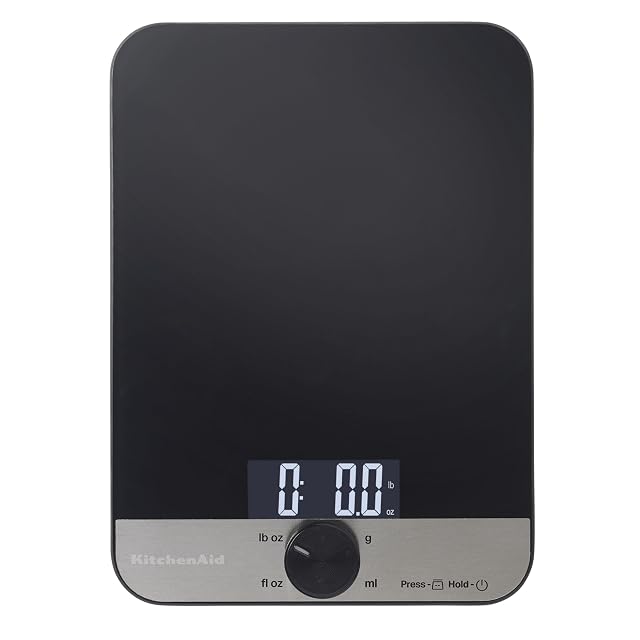
An 11-pound glass-surface kitchen scale with a rotating knob for units and tare, separate dry and liquid resolutions, a three-minute shutoff and hand-wash-only care.
Best for: A buyer who wants one-handed control and weighs liquids by volume
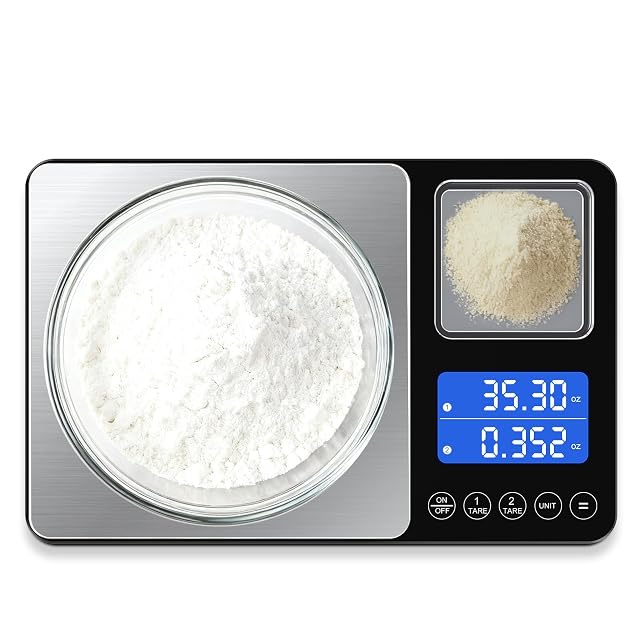
A dual-platform kitchen scale with a 33 lb / 1 g large platform and a 1.1 lb / 0.01 g mini platform, a dual-line display that adds both, and a five-minute shutoff.
Best for: Bread baking by percentage, where salt and yeast have to be weighed too
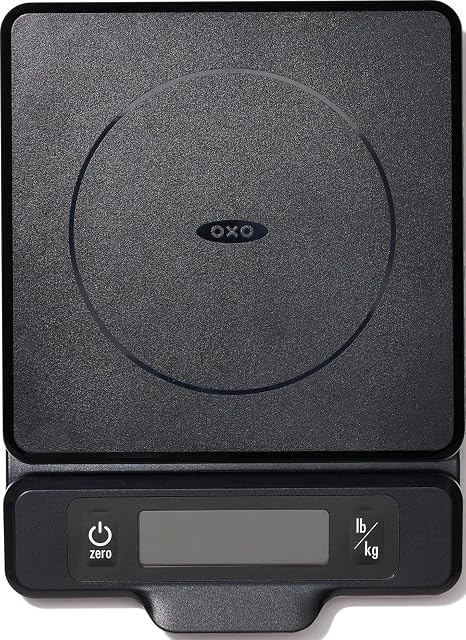
A 5-pound kitchen scale with a display that pulls away from the base, a removable platform, a capacity meter, an optional backlight and 1/8-ounce increments.
Best for: Baking in bowls, where reading the display matters more than capacity
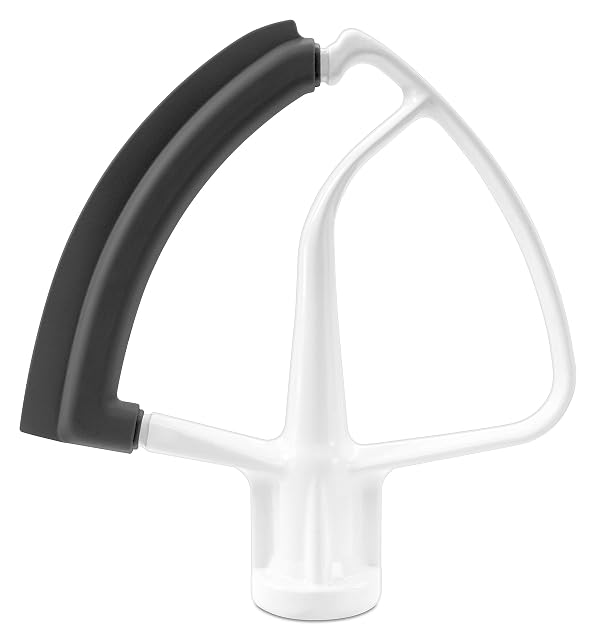
The maker’s flex edge beater for 4.5 and 5 quart tilt-head KitchenAid mixers, with a flexible edge that scrapes ingredients in, dishwasher safe, in white.
Best for: A 4.5 or 5 quart tilt-head KitchenAid, bought from the maker
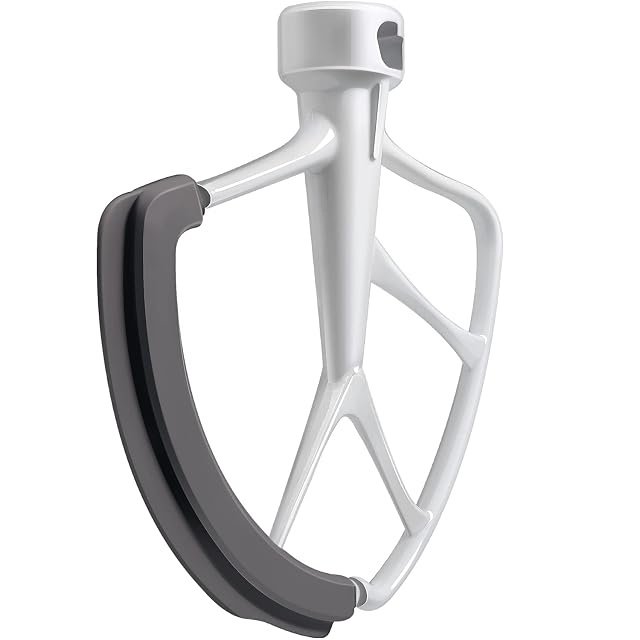
A coated-aluminum flex edge beater with silicone edges for 6 quart bowl-lift KitchenAid mixers, dishwasher safe, with its own dimensions and thirteen models published.
Best for: A 6 quart bowl-lift KitchenAid, or a Professional 5-Plus
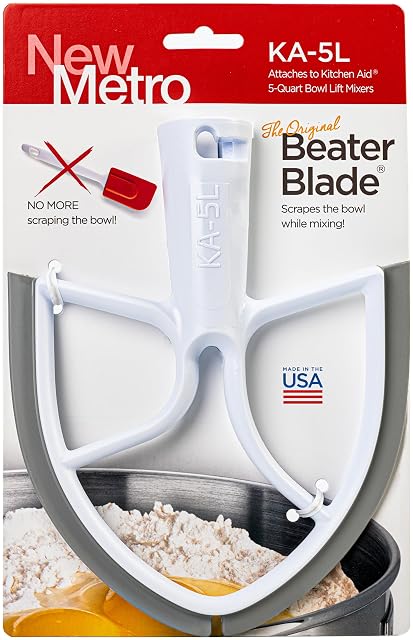
A USA-made high-impact plastic BeaterBlade for 5 quart bowl-lift KitchenAid mixers with stainless bowls of 8 to 8.5 inches, scraping to the dimple and dishwasher safe.
Best for: A 5 quart bowl-lift KitchenAid with a stainless bowl, measured first