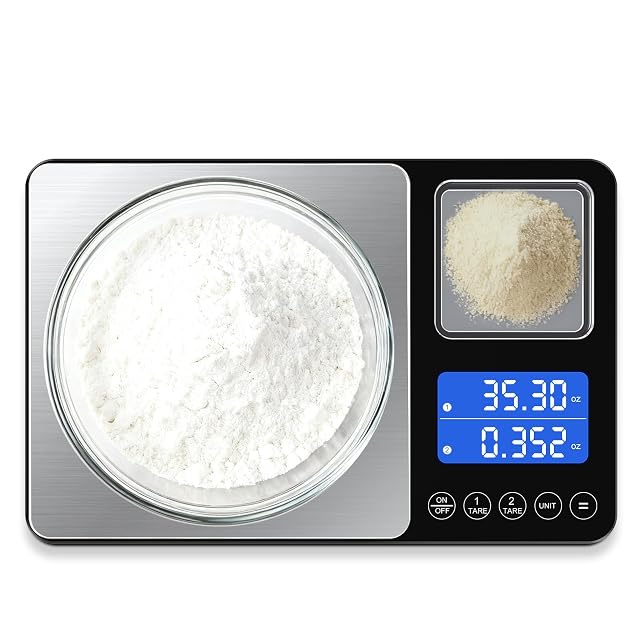
Best for: Bread baking by percentage, where salt and yeast have to be weighed too
≈ $35
Check price on Amazon 0.01 g on a second platform — unique here
A dual-platform kitchen scale with a 33 lb / 1 g large platform and a 1.1 lb / 0.01 g mini platform, a dual-line display that adds both, and a five-minute shutoff.
Best for: Bread baking by percentage, where salt and yeast have to be weighed too
Mini platform: 0.001 oz / 0.01 g, up to 1.1 lb / 500 g. Large platform: 0.05 oz / 1 g, up to 33 lb / 15 kg.
At least twelve of the fifteen scales here read in one-gram steps and nothing else reads finer.
The arithmetic that makes it matter.
A sachet of dried yeast is about 7 g. At ±1 g that is ±14 percent — the difference between a dough that proves in an hour and one that takes three. At 0.01 g it is ±0.14 percent. Three grams of salt in a loaf is ±33 percent at one gram, and salt governs both flavor and fermentation speed. Two grams of bicarbonate too much is a soapy cake. Spices are the same case — and the bullet names them first.
What one gram is exactly right for is everything else. 500 g of flour at ±1 g is ±0.2 percent, finer than any recipe needs — which is why the division of labor on this page is correct rather than a gimmick. The large platform does flour, meat and bulk; the mini does the ingredients a recipe measures in single grams.
The other twelve scales on this shelf:
1 g / 0.05 oz — nine of them, from $6.98 to $39.99 11 lb × 0.1 oz and 5,000 g × 1 g — the KitchenAid at $23.99, which also publishes a separate liquid step 1/8 ounce and 1 gram — both OXO scales at $37.95 and $64.95
And the only page here honest enough to state the limit is the Greater Goods at $24.99: “Not for laboratory or microgram measurements.”
The figure this page does not publish is the minimum weighable load, for either platform. Five scales on this shelf do: 2 g — the Amazon Basics at $11.14, the Etekcity USB at $29.99 · 3 g — the GGQ at $17.98, the Etekcity nutritional at $39.99.
And on a 0.01 g platform the floor is the question that matters. Resolution is the step; the minimum is the point below which the scale does not respond at all — so a 0.01 g step with a half-gram floor would still read zero for a pinch of saffron. The page gives the step and not the floor.
“One screen shows both platforms’ weights at the same time and even allows adding them together. Save time with complex recipes, multi-dish cooking, and meal prepping without switching scales.”
What it enables.
Bread by percentage. A bread recipe is a set of ratios against the flour weight: flour on the large platform, then water, then salt and yeast on the mini — and the sum gives you the total dough weight without moving anything or writing anything down. On any other scale on this shelf that is two scales and a pencil.
Parallel work. Two bowls, two ingredients, one reading each — which is what “multi-dish cooking” means here: not switching between measurements, but watching both.
And one the page does not name: comparison. Put the same thing on both platforms and the mini tells you what the large one is rounding. A 7 g yeast dose reads 7 on the large platform and 7.04 on the mini — which is how you find out what a one-gram step actually hides.
What is not published is how the addition works. Whether the sum replaces the two readings, whether it is a button or automatic, whether tare applies to one platform or both.
Nor is there a HOLD function. Three scales on this shelf have one: the Greater Goods at $24.99 — “keep readings on screen for up to 5 minutes”, the only duration published anywhere here — the Etekcity USB at $29.99, and not this.
So on a scale with two live readings, the shutoff is doing that work — and at five minutes it is the longest on this shelf.
The durations here: 2 minutes — the SOYOK at $6.98, the GGQ at $17.98, the Greater Goods at $24.99 · 3 minutes — the KitchenAid at $23.99, triggered by no change in weight rather than idleness · 4 minutes — the Escali at $25 · 5 minutes — this · unspecified or nothing — the other seven.
Why the figure is not a detail. A recipe is weighed cumulatively: bowl on, tare, flour in, tare. Go to the cupboard between two additions and a two-minute scale has switched off and lost the zero — so the bowl comes off, the scale restarts, and the flour already in it becomes part of the tare.
Five minutes is the right answer on a scale sold for “complex recipes”.
The capacities on this shelf:
5 lb / 2.27 kg — the OXO pull-out at $37.95, the lowest here, and dearer than ten of the thirteen 11 lb / 5 kg — eight scales, from $6.98 to $64.95 22 lb / 10 kg — the Greater Goods at $24.99, the Etekcity USB at $29.99 33 lb / 15 kg — this, and the GGQ at $17.98
What thirty-three pounds is for. A full stand-mixer bowl of dough — and a mixer bowl alone can be 1.5 kg before anything goes in. A turkey. A cast-iron Dutch oven weighed with the contents in it, which is 4 to 6 kg before any food. A batch of mince for the freezer.
And the footprint is what two platforms cost. The catalog gives 330 × 310 × 47 mm — about 13 × 12.2 × 1.9 inches.
Against the scales that publish a dimension: the Escali at $25 (8.5 × 6 × 1.5 in), the Amazon Basics at $11.14 (8.3 × 7 × 1.3 in), the Greater Goods at $24.99 (7.6 × 5.6 × 1.3 in), the GGQ at $17.98 (a 7.5” × 5.5” platform).
And by catalog body across the shelf: the SOYOK at $6.98 and the Ultrean at $6.98 at 180 × 140 mm, the Etekcity at $13.99 at 192 × 157 mm, the GGQ at 203 × 127 mm, the KitchenAid at $23.99 at 259 × 212 mm, the OXO 11 lb at $64.95 at 241 × 181 mm.
So this is roughly four times the plan area of the two cheapest scales. Thirteen inches square is a chopping board.
And at 47 mm thick it is the second tallest here, behind only the KitchenAid at 53 mm — so it will not go in a drawer. The slim scales on this shelf are 15 to 19 mm, and the Etekcity at $13.99 sells exactly that: “easily storable in cabinets”. The GGQ at $17.98 publishes a hanging hook, the only one here.
One thing a wide platform needs and this page does not address: corner sensing. A load cell is a strain gauge on a flexing beam, and with one cell under the center a load placed off-center acts on the beam as a lever — so the reading depends on where the bowl sits. Four cells, one per corner, sum the load and remove the problem.
Two scales on this shelf publish a sensor count: the GGQ at $17.98 (“four high-precision load sensors”) and the Etekcity nutritional at $39.99 (“4 high-precision sensors”). Eleven say nothing.
The test you can run on any of them: put a full tin in the middle, note the number, then move it to each corner. A scale that changes by more than a gram or two is not corner-compensated, and should always be loaded in the same place.
“Built with a stainless steel weighing platform and glass panel, this food scale is scratch-resistant, stain-resistant, and easy to wipe clean”
The shelf, by material:
304 stainless, grade named — the Ultrean at $6.98, the Etekcity at $13.99, the Etekcity nutritional at $39.99 Stainless, unqualified — the SOYOK at $6.98, the GGQ at $17.98, the Greater Goods at $24.99, the OXO at $64.95 (“Stainless Steel is smudge and fingerprint-resistant”) Glass alone — the KitchenAid at $23.99 Stainless and glass — this A steel platform on BPA-free plastic — the Amazon Basics at $11.14 “Chrome”, with no material named — the Escali at $25
And the two materials are doing different jobs, which is why the combination makes sense.
Steel takes the load. It is the platform, and it flexes and recovers under a 15-kilogram bowl without marking. Glass takes the display. It is chemically inert and perfectly non-porous, so nothing stains it — not turmeric, not beetroot, not tomato — and it is the right window to put a dual-line LCD behind.
What glass is bad at is impact. A dropped tin or a knocked corner is a crack, not a dent — where the SOYOK at $6.98 publishes a “rounded corner design” against edge collisions and the GGQ at $17.98 calls its own panel “Anti-collision”. On a 13-inch body there is more edge to knock.
And what no page on this shelf states is where water gets in. Not through the platform, which is a solid sheet. Through the button seams, the battery hatch and the join between platform and housing — and from there to the load cell. A damp cell drifts rather than dies, which is the worst way for a scale to fail.
The shelf, on water: a published rating — the Etekcity USB at $29.99 alone, IPX6 · a claim with no rating — the SOYOK, the GGQ · a sealed panel — the Escali at $25 · an explicit prohibition — the KitchenAid at $23.99: “Hand wash only; do not immerse in water or put in dishwasher” · a removable platform — both OXO scales: “Platform removes for hand washing” · silence — this, and five others.
“Easy to wipe clean” is the whole of the care instruction here. Treat it as the KitchenAid’s: wipe both surfaces, keep water out of the seams, dry it — and on a dual-platform scale there are two platform joins rather than one.
“Easily switch between grams, ounces, pounds, and kilograms for any recipe.”
Four is below the shelf average. Six — the SOYOK at $6.98, the Ultrean at $6.98, the Greater Goods at $24.99 · five — the Amazon Basics at $11.14, the Etekcity at $13.99, the GGQ at $17.98, the Etekcity USB at $29.99 · four — this · three — the Escali at $25, the fewest, and the scale with the only lifetime warranty here.
What is missing is volume: no milliliters, no fluid ounces.
Which is a defensible omission, because a scale cannot measure volume anyway. It measures mass and divides by an assumed density, and the assumption is water at 1.00 gram per milliliter. So every milliliter reading on this shelf is a water reading.
Five scales here compound it with a second density for milk, at about 1.03 g/ml: the SOYOK, the Ultrean (“Yes! It includes milk volume measurement”), the Etekcity USB (“milliliters (milk and water)”) and the Etekcity nutritional at $39.99. The entire content of that feature is a three percent difference — about 8 ml on 250, 30 ml on a liter.
And this scale does include kilograms, which matters on a 15 kg capacity: a 12-kilogram reading in grams is five digits, and kg gives 12.4.
What it does not include is lb:oz, which five scales on this shelf do and which is the unit an American recipe will actually ask for. “Pounds” alone gives 2.4 lb where “lb:oz” gives 2 lb 6 oz.
And the honest habit on any scale here: weigh in grams. An ounce step of 0.05 oz is about 1.4 g; 1/8 oz is about 3.5 g; 0.1 fl oz is about 3 g. Every non-metric reading on this shelf is a derived number with a coarser step — which on this scale means the mini platform’s 0.001 oz is the only imperial figure here fine enough to use.
No minimum weighable load for either platform, as above — and on the 0.01 g platform that is the figure that decides whether a pinch registers.
No backlight. Four scales here publish one: the SOYOK at $6.98 (a “night vision mode”), the Ultrean at $6.98 (a “negative white display”), the Etekcity at $13.99 (“Backlit LCD with large fonts”), the OXO 5 lb at $37.95 (“optional backlight”). On a dual-line display there is twice as much to read.
No answer to the shadow problem. The platform sits above the display, so a bowl wider than the body covers the number — and on a 330 mm body that is less likely than on a 180 mm one, which is a real if accidental advantage. Three scales address it directly: both OXO models — “Display pulls away from base to avoid shadowing from plates or bowls” — and the Greater Goods at $24.99 — “the display extends beyond the weighing platform”.
No HOLD function, as above.
No load-sensor count, as above.
No overload warning and no capacity meter. Two scales publish a warning — the SOYOK at $6.98 and the GGQ at $17.98 — and one a meter, the OXO 5 lb at $37.95 (“Convenient meter shows how much of Scale’s capacity remains”). It matters because of how a load cell fails: pushing a strain gauge past capacity bends the beam permanently, after which the scale reads consistently wrong rather than failing outright. On a 500 g mini platform that is easy to do by accident.
No battery type or power source at all. Four scales here use 2 AAA, two use 3 AAA, two are rechargeable — the GGQ at $17.98 and the Etekcity USB at $29.99 (Type-C, cable supplied). On a scale with two load cells and a dual-line display, the draw is higher than on a single-platform one.
No anti-slip feet, where the SOYOK publishes four and the GGQ “4 no-slip rubbers”. A strain-gauge scale measures a beam’s deflection, so a scale not resting evenly reads wrong — and on a 13-inch body sitting across a countertop seam that is a real risk.
No water rating or care instruction beyond “wipe clean”, as above.
No warranty. Three items on this shelf publish something: the Escali at $25 — a lifetime warranty, the only one here · the Greater Goods at $24.99 — 5 years limited plus “lifetime support from our St. Louis team” · the GGQ at $17.98 — “12 Months Support”. Ten publish nothing. And since nothing on this shelf has a calibration function, check it against a known mass now and again: a liter of water from the tap is 1,000 g to within a gram or two, and on the mini platform a new 20 gram coin or a packeted item of stated weight gives you a reference at the right end of the range.
No country of manufacture, which no item on this shelf publishes.
Read on the day this page was built: $35 at the American Amazon shop.
Read from Keepa on the day this page was last revised; stock and price both move without notice.
Prices quoted in this text were read on 2026-10-17. The live price is at the top of the page.
Because one gram cannot dose the small ingredients, and at least twelve of the fifteen scales here read in one-gram steps. Bullet one: "Mini scale offers 0.001 oz / 0.01 g accuracy up to 1.1 lb / 500 g for spices, yeast, or coffee grounds; large scale delivers 0.05 oz / 1 g accuracy up to 33 lb / 15 kg for flour, meat, and bulk ingredients." The arithmetic that makes it matter. A sachet of dried yeast is about 7 g (0.2 oz). At ±1 g (0.04 oz) that is ±14 percent — the difference between a dough that proves in an hour and one that takes three. Three grams of salt in a loaf is ±33 percent, and salt governs both flavor and fermentation speed. Baking powder and bicarbonate are in the same range, and two grams of bicarbonate too much is a soapy cake. At 0.01 g, a 7 g (0.2 oz) yeast dose is ±0.14 percent. What one gram is exactly right for is everything else. 500 g (17.6 oz) of flour at ±1 g (0.04 oz) is ±0.2 percent — finer than any recipe needs — which is why the large platform is specified the way it is, and why the division of labor on this page is the correct one. The other twelve scales: 1 g (0.04 oz) / 0.05 oz — nine of them · 11 lb × 0.1 oz and 5,000 g (176.4 oz) × 1 g (0.04 oz) — the KitchenAid at $23.99 · 1/8 ounce and 1 gram — both OXO scales at $37.95 and $64.95. And the only page on this shelf honest enough to state the limit is the Greater Goods at $24.99: "Not for laboratory or microgram measurements." The figure this page does not publish is the minimum weighable load for either platform — and five scales on this shelf do publish one, from 2 g (0.1 oz) to 3 g (0.1 oz). On a 0.01 g platform the floor is the question, because a 0.01 g step with a 0.5 g (0.02 oz) floor would still read zero for a pinch of saffron.
A running total across two resolutions at once, which no other scale here can do. Bullet two: "One screen shows both platforms’ weights at the same time and even allows adding them together. Save time with complex recipes, multi-dish cooking, and meal prepping without switching scales." What that enables in practice. A bread recipe is a set of percentages against the flour weight: flour on the large platform, then water, then salt and yeast on the mini platform — and the sum tells you the total dough weight without moving anything or writing anything down. On any other scale on this shelf you would need two scales and a pencil. The second use is parallel work. Two bowls, two ingredients, one reading each — which is what "multi-dish cooking" means: you are not switching between measurements, you are watching both. And the third is the one the page does not name: comparison. Put the same thing on both platforms and the mini tells you what the large one is rounding. A 7 g (0.2 oz) yeast dose reads 7 on the large platform and 7.04 on the mini — which is how you learn what a one-gram step is actually hiding. What the page does not publish is how the addition is displayed or controlled — whether the sum replaces the two readings, whether it is a button or automatic. Nor does it publish a HOLD function, which three scales here have: the Greater Goods at $24.99 (up to 5 minutes, the only duration on this shelf) and the Etekcity USB at $29.99. With two live readings and no hold, the five-minute shutoff is doing the work — and at five minutes it is the longest on this shelf, which on a scale built for complex recipes is the right choice.
Yes — it is the largest footprint on this shelf by a wide margin, and that is the price of two platforms. The catalog gives 330 × 310 × 47 mm (13 × 12.2 × 1.85 in), which is about 13 × 12.2 × 1.9 inches. Against the scales that publish a dimension: the Escali at $25 — 8.5 × 6 × 1.5 in · the Amazon Basics at $11.14 — 8.3 × 7 × 1.3 in · the Greater Goods at $24.99 — 7.6 × 5.6 × 1.3 in · the GGQ at $17.98 — a 7.5" × 5.5" platform. And by catalog body across the whole shelf: the Ultrean at $6.98 and the SOYOK at $6.98 at 180 × 140 mm (7.09 × 5.51 in), the Etekcity at $13.99 at 192 × 157 mm (7.56 × 6.18 in), the GGQ at 203 × 127 mm (7.99 × 5 in), the KitchenAid at $23.99 at 259 × 212 mm (10.2 × 8.35 in), the OXO 11 lb at $64.95 at 241 × 181 mm (9.49 × 7.13 in). So this is roughly four times the plan area of the two cheapest scales. Thirteen inches square is a chopping board, and at 47 mm (1.85 in) thick it is the second tallest here — behind only the KitchenAid at 53 mm (2.09 in) — so it will not go in a drawer. The slim scales on this shelf are 15 to 19 mm (0.59 to 0.75 in), and the Etekcity at $13.99 sells exactly that: "easily storable in cabinets". The GGQ at $17.98 publishes a hanging hook, the only one here. What the space buys. Thirty-three pounds of capacity on a platform wide enough for a mixer bowl, plus a second platform you never have to clear. And a wide platform needs corner sensing or it reads differently at the edges — which this page does not address, where the GGQ at $17.98 and the Etekcity nutritional at $39.99 both publish four load sensors. The test on any scale here: put a full tin in the middle, note the number, then move it to each corner.
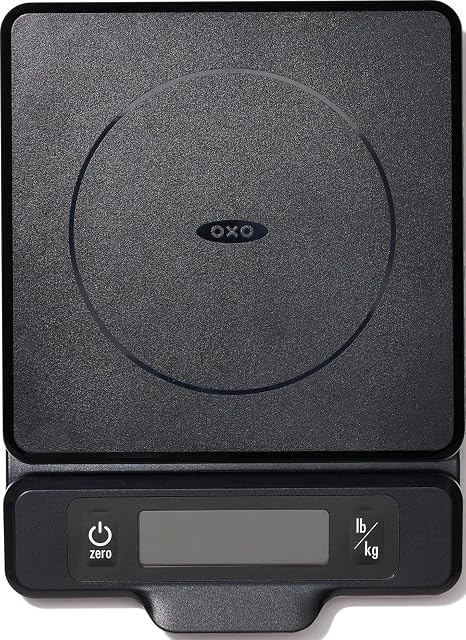
A 5-pound kitchen scale with a display that pulls away from the base, a removable platform, a capacity meter, an optional backlight and 1/8-ounce increments.
Best for: Baking in bowls, where reading the display matters more than capacity
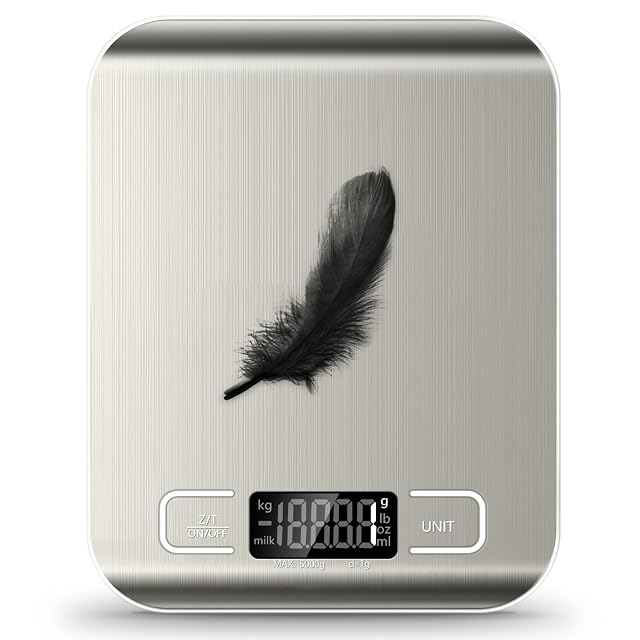
An 11-pound stainless kitchen scale reading to 1 g (0.04 oz) in six units, with tare, a backlit LCD, overload and low-battery warnings and a two-minute shutoff.
Best for: Flour, sugar and portions, at the lowest price on this shelf
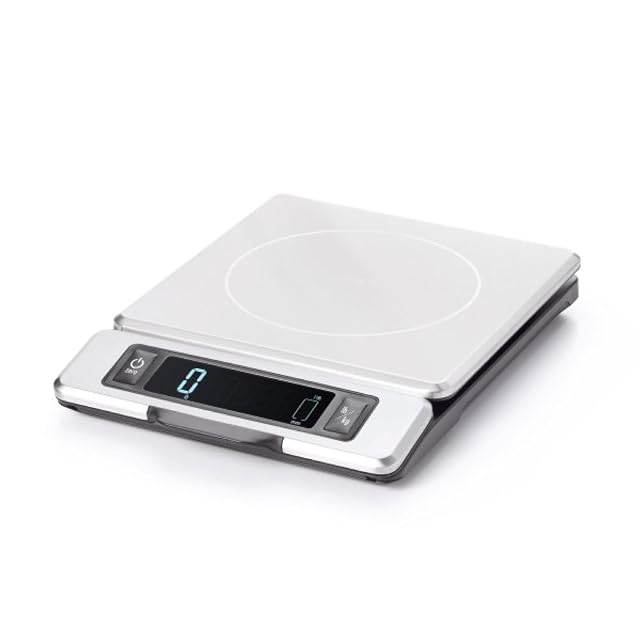
An 11-pound stainless steel food scale with a display that pulls away from the base, a removable platform, large digital numbers and a zero function.
Best for: A buyer who wants the display and the platform to be the whole specification
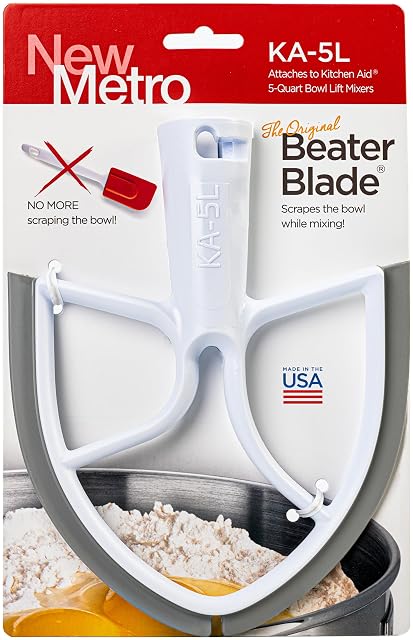
A USA-made high-impact plastic BeaterBlade for 5 quart bowl-lift KitchenAid mixers with stainless bowls of 8 to 8.5 inches, scraping to the dimple and dishwasher safe.
Best for: A 5 quart bowl-lift KitchenAid with a stainless bowl, measured first
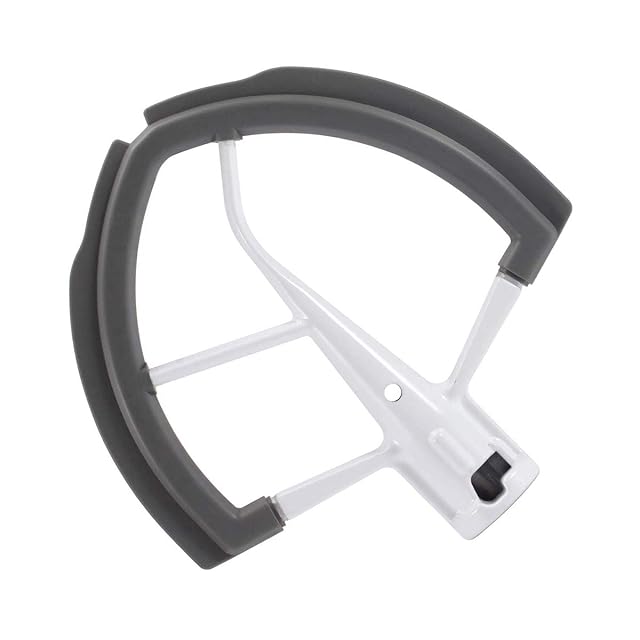
A coated-metal flex edge beater with silicone edges for 6 quart bowl-lift KitchenAid mixers, dishwasher safe, with the bowl size and exclusions published.
Best for: A 6 quart bowl-lift KitchenAid with a stainless bowl, measured first
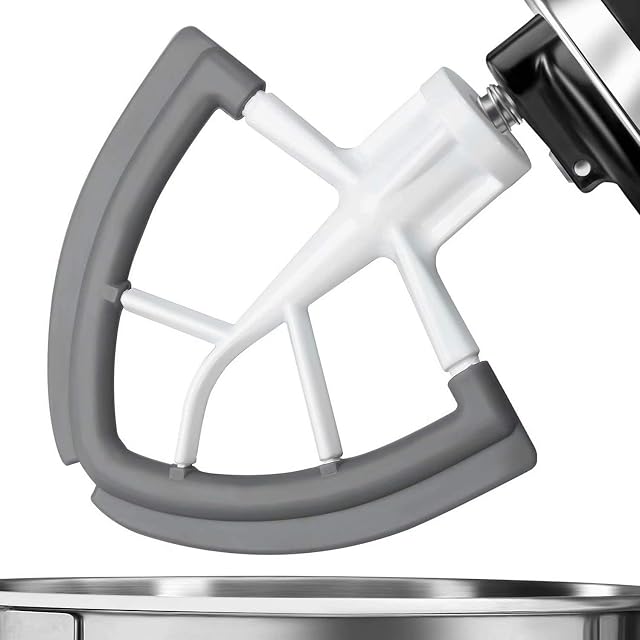
A die-cast aluminum flex edge beater with a Teflon coating and silicone edges for 4.5 and 5 quart tilt-head KitchenAid mixers, stated to cut mixing time by half.
Best for: A 4.5 or 5 quart tilt-head KitchenAid, for batters rather than dough