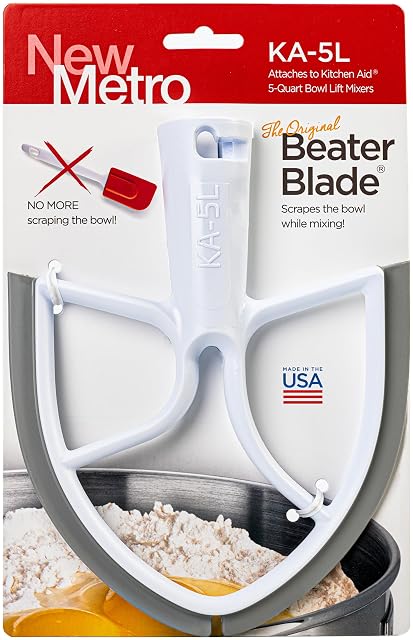
Best for: A 5 quart bowl-lift KitchenAid with a stainless bowl, measured first
≈ $29
Check price on Amazon Measure your bowl — the only page that says so
A USA-made high-impact plastic BeaterBlade for 5 quart bowl-lift KitchenAid mixers with stainless bowls of 8 to 8.5 inches, scraping to the dimple and dishwasher safe.
Best for: A 5 quart bowl-lift KitchenAid with a stainless bowl, measured first
“if your stand mixer bowl measures between 8 and 8.5-inches diameter, across the top of the bowl, this is the correct BeaterBlade to purchase”
One other page publishes a bowl figure: the Reikame at $14.99 — “Fit mixing bowl’s size: 9.75” diameter, 6.75” deep”, which is the 6 quart case.
Everybody else gives model lists, and the model lists on this shelf contradict one another.
The Professional 5-Plus is the clearest example.
this — excludes it by name, and dates the replacement: “(5-Plus BeaterBlade is coming in Fall 2022)” KITCHPOWER, $20.99 — includes it: “Professional 5-Plus: KV25GOX, KV25G8X” Wiselet, $25.79 — includes it: “Professional 5 Plus” XINBOOGQ, $24.99 — includes it: “5 Quart Pro 5 Plus Series: KP25M, KV25G”
Four pages, three yeses and one no, about the same machine. And this is the only one that tells you which it means by naming the part that would fit and when.
The codes differ too. KG25GOX here · KG25 on the XINBOOGQ and the Wiselet · KV25M, KV25G, KV25GOX, KV25G0 across four other pages for what is presumably one mixer.
Why the measurement beats the list. A BeaterBlade works by reaching the wall, and the wall is a dimension, not a badge. Warehouse-club editions put different bowls in the same body — the Reikame at $14.99 is the only other page to mention them: “NOT FOR costco, sams club mixers”.
Measure across the top, inside rim to inside rim. Eight to eight and a half inches is this blade. Nine and three quarters is the 6 quart one.
And the fifteen-model list is the longest 5 quart list on this shelf. KitchenAid’s own 5 quart beater, the K5AB at $24.95, lists seven — K4, K5, KP50, KSM5, KSM50, KSM500PS, KSM450 — and the two lists overlap on KSM5 and KSM500 and differ everywhere else, which tells you how little a model code settles.
Bullet one requires “a stainless steel bowl”. Bullet two states it as an exclusion: “does NOT work with 5 Quart Glass Bowls.”
The others:
Reikame, $14.99 — “NOT FIT… 6 quart glass bowl” KitchenAid Pastry Beater, $49.95 and $69.95 — “with Stainless Steel Bowls Only” KitchenAid KDF7B, $44.95 — “using stainless steel bowls only… not compatible with any model not listed”
Why glass does not work. A scraping blade is sized to the inside of the bowl within a millimeter or two — close enough to sweep the wall, and no closer.
A glass bowl of the same nominal capacity has thicker walls and a different curve, so the same blade either fouls the glass or stands off it and scrapes nothing — which is the whole function gone.
And glass chips. A steel bowl shrugs off contact; a glass one does not.
The consequence for the many bowl-lift owners who have two bowls — the steel one the machine came with and a glass one bought since — is that nothing on this shelf is for the glass one. Twelve items, and all twelve are for steel bowls or silent.
Which makes bullet one’s instruction doubly useful: measure the bowl you actually intend to use, because a glass 5 quart bowl and a steel 5 quart bowl are not the same internal shape.
“BeaterBlade pushes food down, not out of mixer; scrapes bowl all the way to the dimple and cuts mixing time by 50%”
Three claims, and two of them are more specific than anything else on this shelf.
“Pushes food down, not out.” A paddle turning in a bowl throws mixture outward and upward, which is how batter ends up on the rim and on the mixer head. A blade angled to drive it down keeps the mixture in the bowl — and that is a geometry claim no other page here makes.
“All the way to the dimple.” The dimple is the dished center of a KitchenAid bowl base, and it is where flour and butter collect and where a paddle set at the standard clearance never reaches. Naming it is the most precise fit claim on this shelf.
Fifty percent. At least three of the fourteen items here publish the figure: this, the Vaxaape at $9.99 (“as much as 50%”) and the KITCHPOWER at $20.99. KitchenAid’s own flex edge beater at $29.95 says only “Reduces mixing time.”
Where the saving comes from. A conventional flat beater leaves ingredients on the bowl wall, so the standard method is stop, scrape down, start again — two or three times in a cake batter. A scraping blade removes those stops.
And the Reikame at $14.99 draws the consequence nobody else does: “By eradicating the need to turn off and on the mixer… also reduces wear of the motor” — because every restart pulls a current surge through a loaded motor.
The spatula claim is the fourth. Three pages make it: this (“Use BeaterBlade as a hand held spatula to transfer batter”), the Vaxaape (“No Need For An Extra Tool”) and the KITCHPOWER (“can also double as a spatula”).
On a one-piece plastic blade that is the most natural of the three — there is no coating to lever against and no silicone strip to bend.
“do not use blade in an empty bowl”
At least two of the fourteen items on this shelf publish this warning. The other is the Vaxaape at $9.99: “Do Not Use Blade In a Dry Bowl.”
Ten pages say nothing.
Why it matters, and why it matters on plastic in particular. A scraping blade works by holding its edge against the bowl wall under light pressure — that is the mechanism.
With batter in the bowl, the batter is the lubricant. Dry, the blade drags on steel at speed, and friction generates heat at the thinnest part of the attachment.
On a silicone edge that means abrasion and a permanent set. On high-impact plastic it means the same thing and a lower threshold, because plastic softens before it abrades — and an edge that has lost its shape no longer reaches the wall, which is the one thing you bought it for.
Two seconds of a test spin is nothing. A minute running empty is not.
The habit that follows: ingredients in first, blade second.
And the same reasoning explains the dishwasher caution this page does not give. It claims “dishwasher safe” without qualification, where KitchenAid’s own KDF7B at $44.95 specifies “top-rack dishwasher-safe” — the bottom rack is nearest the element, and a one-piece plastic blade is the part on this shelf least happy about that. Top rack, regardless.
“Always made in the USA from high impact plastic”
It is the only country of manufacture published anywhere among the twelve items here, and the only plastic blade.
The three material camps on this shelf:
Coated aluminum with silicone edges — the Vaxaape at $9.99 (“Die-Cast Aluminum With White Ford Teflon Coating”), the Reikame at $14.99 (“non-stick coated metal”), the KITCHPOWER at $20.99 (“Food grade coated aluminum frame”) Solid stainless — the Wiselet at $25.79, the XINBOOGQ at $24.99 (“food grade 304”), both arguing against coatings: “never chip, flake, or peel into your dough”, “no need to worry about cracking and peeling paint” Plastic — this “Coated”, unqualified — KitchenAid’s K5AB at $24.95 Nothing at all — the KitchenAid KN256CBT at $24.95, the KFE5T at $29.95, the KDF7B at $44.95, both Pastry Beaters
What plastic buys.
Nothing to chip, because there is no coating: the blade is the material all the way through, which answers the steel pages’ argument from a different direction. No metal against your bowl, so no marking — which matters more here than it sounds, because this blade is required to be used in a stainless bowl, and a rigid steel paddle in a steel bowl has nothing soft between them. And lightness. 113 grams, the joint lightest item on this shelf with KitchenAid’s own K5AB at $24.95. For comparison the KN256CBT is 272 g and the Pastry Beater KSMPB7SS is 590 g. Less inertia on the planetary gear.
What it gives up is stiffness. In a dense cold mixture a plastic blade flexes, which is the same limitation a silicone edge has — and the two steel pages are selling precisely that rigidity.
And heat. No temperature limit is published, which on plastic is the figure to want.
“Always made in the USA” is the other half of the claim and it is worth something concrete: a part made to one specification in one place does not change between batches, which on a part whose whole function is a one-millimeter fit is the argument.
No silicone. The page calls it a BeaterBlade and never names a flexible edge material — so the scraping edge is the plastic itself. Which is consistent with the one-piece construction and the spatula use, and means there is no replaceable soft part. At least six of the fourteen items on this shelf have a named flexible edge: silicone on the Vaxaape, the Reikame and the KITCHPOWER, and a flex edge on KitchenAid’s own KFE5T at $29.95 and KDF7B at $44.95.
No temperature limit, as above, and no top-rack qualification on the dishwasher claim.
No dimensions. One item publishes its own: the KITCHPOWER at $20.99 — “6.7 x 7.1 x 1.4 inches”. The catalog here gives 194 × 156 × 38 mm, about 7.6 × 6.1 × 1.5 inches.
No hard-dough warning. One item publishes one: the Vaxaape at $9.99 — “But Not For Hard Dough.” A flat beater creams, aerates and combines; a dough hook kneads, and the motor bogs because the attachment is wrong rather than because it is weak. On a plastic blade that matters more than on steel, and two pages here claim dough work anyway: the XINBOOGQ at $24.99 (“knead bread dough, pizza dough”) and the Wiselet at $25.79 (“without bogging down your mixer’s motor”).
No beater-to-bowl clearance note. A KitchenAid’s gap is set by a screw in the base — the standard check is a dime laid in the bowl, which the paddle should just move. On a blade whose function is to reach the wall and the dimple, that adjustment is what makes the 50 percent claim true or false, and no page on this shelf mentions it.
No warranty, which no item on this shelf publishes. The nearest things are the Vaxaape’s “Refund Or Replacement Within 24 Hours”, the Wiselet’s “backed by Wiselet care” and the XINBOOGQ’s “Reliable after-sales service”.
No weight for the steel rivals to be compared against, which is not this page’s fault: both the Wiselet at $25.79 and the XINBOOGQ at $24.99 publish none, so the plastic-against-steel comparison can only be made one way round.
And a note on the shelf: it is named for bowls and beaters, and all twelve items are beaters. There is no bowl here at all — which matters most on this page, since it requires a stainless 5 quart bowl of 8 to 8.5 inches and cannot be used with the glass one.
Read on the day this page was built: $28 at the American Amazon shop.
Read from Keepa on the day this page was last revised; stock and price both move without notice.
Prices quoted in this text were read on 2026-10-17. The live price is at the top of the page.
Measure the bowl, and this is the only page on this shelf that tells you to. Bullet one: "BUY THE RIGHT SIZE: works with KitchenAid 5 Quart Bowl-Lift mixer with a stainless steel bowl, if your stand mixer bowl measures between 8 and 8.5-inches diameter, across the top of the bowl, this is the correct BeaterBlade to purchase." One other page publishes a bowl figure: the Reikame at $14.99 — "Fit mixing bowl’s size: 9.75" diameter, 6.75" deep", which is the 6 quart case. Everybody else gives model lists, and the model lists on this shelf contradict one another. The Professional 5-Plus is the clearest example. This page excludes it by name: "KA-5L does NOT work with 5 Quart Glass Bowls or the Professional 5-Plus mixer (5-Plus BeaterBlade is coming in Fall 2022)." And three pages include it: the KITCHPOWER at $20.99 ("Professional 5-Plus: KV25GOX, KV25G8X"), the Wiselet at $25.79 ("Professional 5 Plus") and the XINBOOGQ at $24.99 ("5 Quart Pro 5 Plus Series: KP25M, KV25G"). Four pages, three yeses and one no, about the same machine. And the model codes differ page to page for what is presumably the same mixer — KG25GOX here, KG25 on the XINBOOGQ, KG25 on the Wiselet. Why the measurement beats the list. A BeaterBlade works by reaching the wall, and the wall is a dimension, not a badge. Warehouse-club editions put different bowls in the same body — the Reikame at $14.99 is the only other page to say so: "NOT FOR costco, sams club mixers". Measure across the top, inside rim to inside rim. Eight to eight and a half inches is this blade. Nine and three quarters is the 6 quart one.
Different profile, different wall, and a hard plastic edge against glass is a chip risk — and at least four of the fourteen items on this shelf exclude glass or require steel. This page: "works with KitchenAid 5 Quart Bowl-Lift mixer with a stainless steel bowl"; and "KA-5L does NOT work with 5 Quart Glass Bowls." The Reikame at $14.99: "NOT FIT... 6 quart glass bowl." KitchenAid’s own Pastry Beaters at $49.95 and $69.95: "Fits KitchenAid Bowl-Lift Stand Mixers with Stainless Steel Bowls Only." KitchenAid’s own KDF7B at $44.95: "using stainless steel bowls only... not compatible with any model not listed." Why. A scraping blade is sized to the inside of the bowl within a millimeter or two — close enough to sweep the wall, and no closer. A glass bowl of the same nominal capacity has thicker walls and a different curve, so the same blade either fouls the glass or stands off it and scrapes nothing — which is the whole function gone. And glass chips. A steel bowl shrugs off contact; a glass one does not. The consequence for the many bowl-lift owners who have two bowls — the steel one the machine came with and a glass one bought since — is that nothing on this shelf is for the glass one. Twelve items, and all twelve are for steel bowls or silent on the question. Which makes the measurement bullet doubly useful: measure the bowl you actually intend to use, because a glass 5 quart bowl and a steel 5 quart bowl are not the same internal shape.
It is the third answer on this shelf to the material question, and it has one clear advantage and one clear limit. Bullet five: "Always made in the USA from high impact plastic; dishwasher safe." The three material camps here. Coated aluminum with silicone edges — the Vaxaape at $9.99 ("Die-Cast Aluminum With White Ford Teflon Coating"), the Reikame at $14.99, the KITCHPOWER at $20.99. Solid stainless — the Wiselet at $25.79 and the XINBOOGQ at $24.99 ("food grade 304"), both selling explicitly against coatings: "never chip, flake, or peel into your dough", "no need to worry about cracking and peeling paint". And plastic — this, at 113 grams, the joint lightest item on the shelf. What plastic buys. Nothing to chip, because there is no coating — the blade is the material all the way through. No metal touching your bowl, which on a stainless bowl means no marking and on any bowl means no galvanic worry. And it is the natural material for the spatula use the page sells: "Use BeaterBlade as a hand held spatula to transfer batter." What it gives up. Stiffness. In a dense cold mixture a plastic blade flexes, which is the same limitation a silicone edge has — and the two steel pages are selling exactly that rigidity. And heat. No temperature limit is published, and the dishwasher claim is unqualified where KitchenAid’s own KDF7B at $44.95 specifies top-rack only — the bottom rack is nearest the element, and a plastic blade is the part on this shelf least happy about that. Top rack, regardless of what the page says.
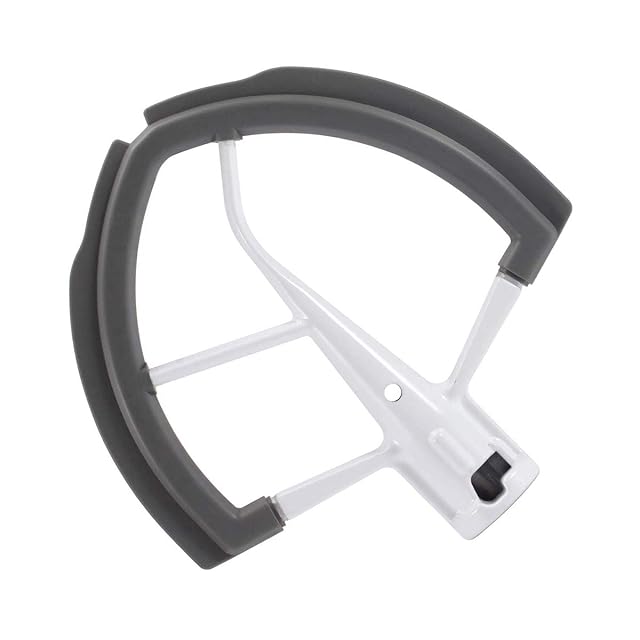
A coated-metal flex edge beater with silicone edges for 6 quart bowl-lift KitchenAid mixers, dishwasher safe, with the bowl size and exclusions published.
Best for: A 6 quart bowl-lift KitchenAid with a stainless bowl, measured first
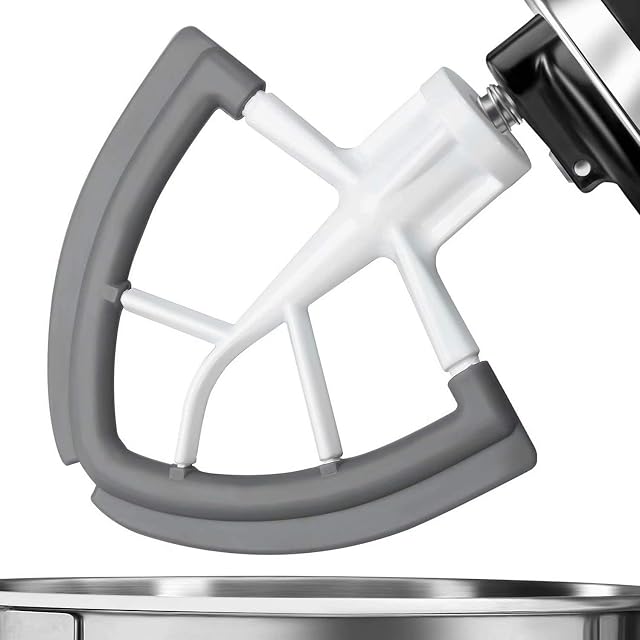
A die-cast aluminum flex edge beater with a Teflon coating and silicone edges for 4.5 and 5 quart tilt-head KitchenAid mixers, stated to cut mixing time by half.
Best for: A 4.5 or 5 quart tilt-head KitchenAid, for batters rather than dough
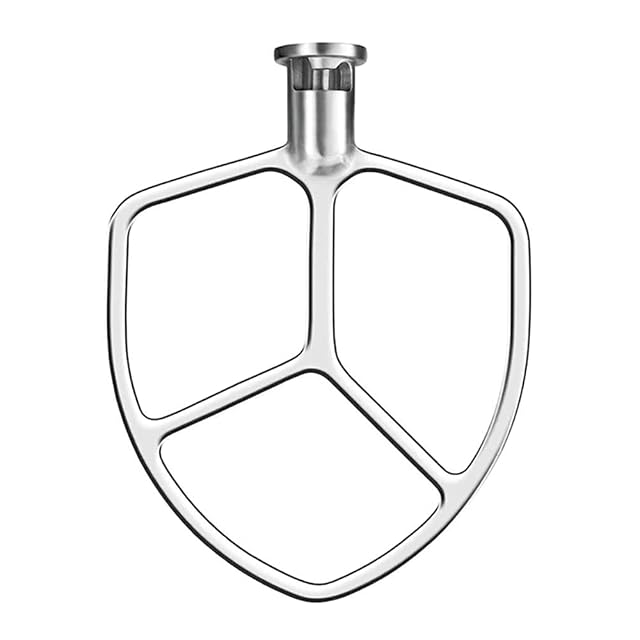
A solid food-grade stainless steel flat beater for 5 and 6 quart bowl-lift KitchenAid mixers, stated never to chip, flake or peel, rust-resistant and dishwasher safe.
Best for: A bowl-lift KitchenAid where a coating chipping is the thing you mind
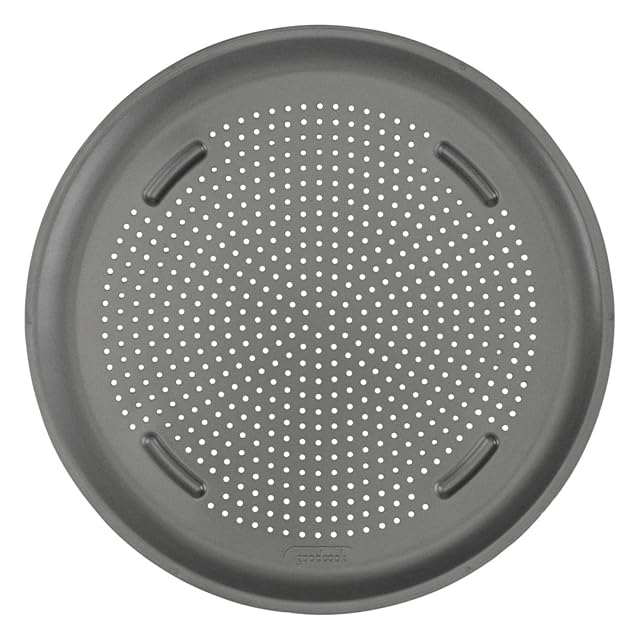
A 16-inch perforated carbon steel pizza pan with cutting guides, molded feet to keep it off the countertop and a non-stick coating.
Best for: A large pizza served in even slices without scorching the countertop
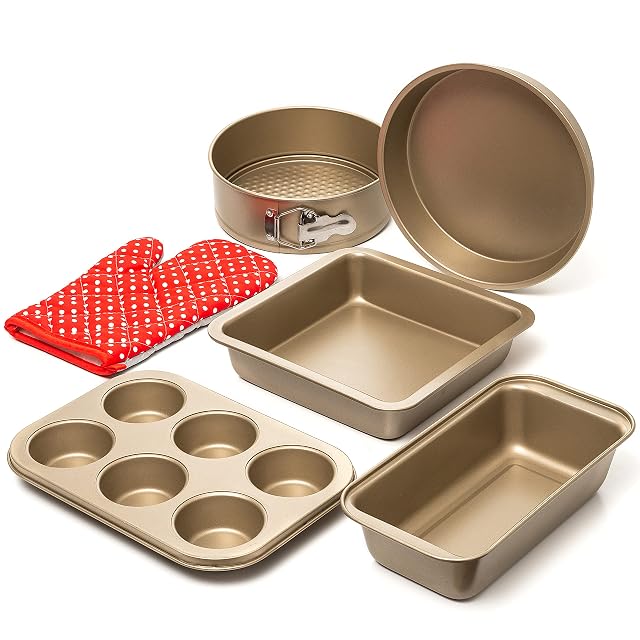
A five-piece carbon steel baking set with a PTFE non-stick coating, stackable for storage, oven safe to 450 °F, supplied with a red oven glove and a one-year warranty.
Best for: A first baking set, where the piece count matters more than the figures
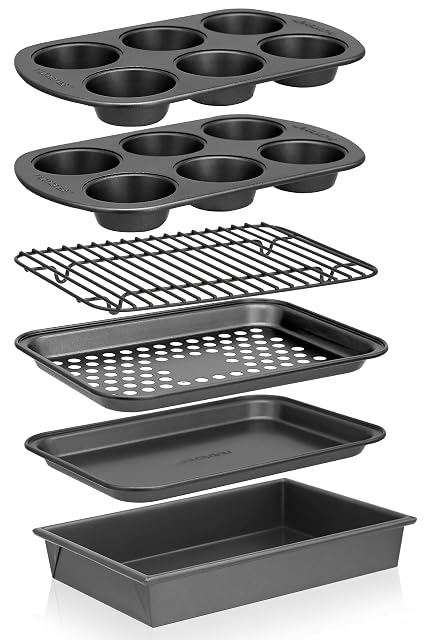
A six-piece stackable carbon steel bakeware set for toaster ovens with a roasting pan, muffin pans, a baking sheet, a rack and a perforated sheet, rated to 450 °F.
Best for: A toaster oven or a small kitchen, where the pieces have to fit a small cavity