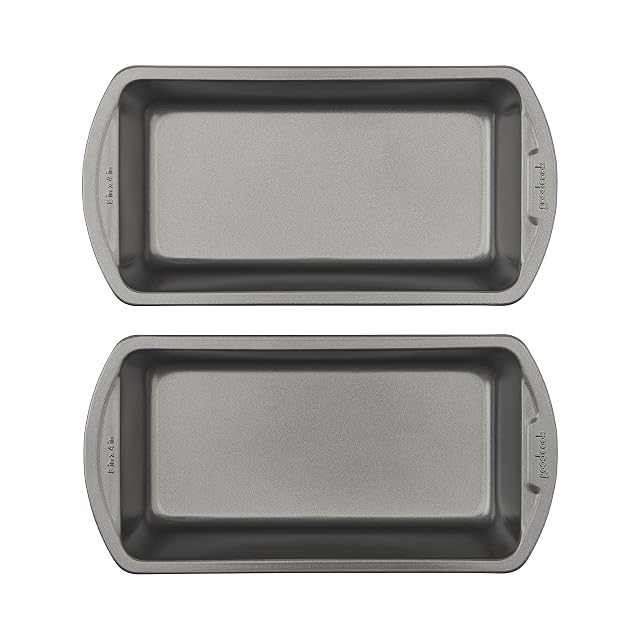
Best for: Two medium loaves at once, or a recipe halved into matching pans
≈ $12
Check price on Amazon Two pans, and a cent dearer per pan than the bigger one
Two 8 × 4 inch medium carbon steel loaf pans with scratch-resistant metal-spatula safe non-stick coating, oven and dishwasher safe.
Best for: Two medium loaves at once, or a recipe halved into matching pans
$11.99 for two is $6.00 each.
The same maker’s 9 × 5 loaf pan is $5.99 for one — a larger pan, a cent cheaper.
And the cheapest steel per piece on this shelf is a six-piece set: the Amazon Basics at $31.99 works out at $5.33 a piece.
The full per-piece ranking:
Waytiffer foil pie tins — 20 cents (50 for $9.99) Waytiffer foil loaf pans — 40 cents (25 for $9.99) Amazon Basics six-piece — $5.33 GoodCook 9 × 5 — $5.99 GoodCook 13 × 9 — $9.99 · MegaGrip 8 × 8 — $10.09 · Sur La Table 9 × 5 — $11.70 this — $6.00 Elbee eight-piece — $7.50 (8 for $59.99) KitchenAid 9 × 5 — $14.99 · KitchenAid 12-cup muffin — $21.99, which is four times the per-piece price of the six-piece set
So “set of two” is not where the saving is on this shelf. What you are paying for is the size.
And there is one argument the price comparison misses. Two matched pans bake two loaves identically, side by side on one shelf. Two pans bought separately may differ in color, depth and gauge — and on this shelf color alone changes the bake, since a dark pan browns faster than a light one.
8 × 4 is 32 square inches of base. The 9 × 5 standard is 45. This is 71 percent of the pan.
The difference shows up in height, not area. The same batter stands taller in an 8 × 4 and takes longer in the middle.
Which is exactly the use. A loaf recipe halved and put in a 9 × 5 bakes flat — it has nothing to rise against, the crust-to-crumb ratio goes wrong, and you get a slab. In an 8 × 4 a half recipe makes a loaf shape.
It is also the pan for enriched and sweet doughs, which rise less and benefit from narrower walls to climb — and bullet one names them: “sweet or savory breads, thick cakes or brownies”.
Across the shelf, by loaf size:
8 × 4 — 32 in², these two 8.5 × 4.5 — 38 in², the Waytiffer disposable at $9.99, rated “2Lb” — the only dough-weight capacity on this shelf 9 × 5 — 45 in², three pans: GoodCook $5.99, Sur La Table $11.70, KitchenAid $14.99, plus a fourth inside the Amazon Basics set
A 2 lb rating on an 8.5 × 4.5 implies roughly a 1.5 lb dough for an 8 × 4 — which is the figure this page should have given and does not. No steel pan on this shelf publishes a capacity.
And the practical reason for two: a loaf recipe usually makes more than one pan’s worth, and the second loaf freezes. A pair of matched 8 × 4 pans is the bake-one-freeze-one arrangement.
The catalog reads 102 × 259 × 102 mm — 4.0 × 10.2 × 4.0 inches.
Read it against the pans. The width, 102 mm, is 4.0 inches — exactly the published figure. The length, 259 mm, is 10.2 inches — about two inches over the published 8, the familiar loaf-pan rim flare. And the third figure is 102 mm again, 4.0 inches, which is far too deep for an 8 × 4 loaf pan and is consistent with two pans nested.
The shelf confirms how loaf pans behave. The GoodCook 9 × 5 and the KitchenAid 9 × 5 both catalog at 279 × 152 mm — 11.0 × 6.0 inches, two inches over each way, because the quoted size is the base and the walls flare so the loaf releases.
The flat pans do not do this. The GoodCook 13 × 9 reads 330 × 229 × 51 mm = 13.0 × 9.0 × 2.0 inches, exactly its label. The MegaGrip 8 × 8 reads 203 × 203 mm = 8.0 × 8.0, exactly.
What it costs you here: no single-pan depth is available from any source. For reference the GoodCook 9 × 5 catalogs at 65 mm and the KitchenAid 9 × 5 at 77 mm — a half-inch difference between two pans of the same nominal size — and no page on this shelf publishes a depth at all.
On the weight, the catalog is clearer: 408 g for the pair, 204 g each. Against 268 g for the maker’s 9 × 5 and 310 g for the MegaGrip 8 × 8. Per square inch of base that is 6.4 g for these, 6.0 for the 9 × 5 and 4.8 for the MegaGrip — which is the only thickness signal the shelf offers, since nobody publishes a gauge.
“is metal spatula safe so you can serve your baked goods right out of the pan without worry”
GoodCook claims it on three of its four pans here — this set, the 9 × 5 at $5.99 and the 13 × 9 at $9.99, where it is in the product name. Not on the MegaGrip 8 × 8 at $10.09, which says only “scratch-resistant”.
Nobody else on this shelf claims it at all. Not Sur La Table, not either KitchenAid, not Amazon Basics, not Elbee.
The failure of a non-stick pan is not wear. It is one cut. Once the film is broken, batter works under the edge, food sticks there permanently, and the break spreads from that point every time something scrapes past it.
On a loaf pan the cut comes from turning out, not from serving: a loaf that has caught at a corner gets a knife run round it. A pan rated for metal survives that; a pan that is not will carry the mark for the rest of its life.
The shelf hints at why only GoodCook grants it. The Sur La Table 9 × 5 at $11.70 publishes “PFOA, PFAS, PTFE Free” — a coating that is not a fluoropolymer, and ceramic-type films are hard but brittle. KitchenAid calls its coating “Swiss-engineered heavy-duty”, which names no material.
The honest limit: a spatula or a palette knife, not a serrated knife sawing on the base.
“Dishwasher safe for a quick and easy clean up, but hand-washing is recommended for longer-lasting results”
Note the “but”, which is stronger than the wording GoodCook uses on its other pans — the 9 × 5 and the MegaGrip both say “Hand washing is recommended” with no conjunction.
Both halves are true on different time scales. A dishwasher will not destroy the pan today. Over years the hot alkaline cycle attacks the coating, and carbon steel rusts wherever the coating is broken — which on a metal-spatula pan it eventually will be.
The shelf, on washing:
GoodCook — the caveat, on three pans GoodCook 13 × 9 — nothing at all KitchenAid, both pans — “DISHWASHER SAFE: for easy cleanup”, no caveat Amazon Basics, $31.99 — “Hand wash for best results”, and no dishwasher claim Elbee, $59.99 — “Dishwasher safe and rust resistant”, the shelf’s only mention of rust Sur La Table — nothing
Two pans in a set is the case where the dishwasher is most tempting, because two pans is a sink’s worth of washing up. The habit that matters more than the bullet: wash them warm, dry them immediately, and do not nest them wet — trapped water between two nested steel pans is where rust starts.
“Heavy-duty gauge steel resists warping and provides long-lasting durability”
Gauge is a number and no item on this shelf publishes one.
The shelf’s vocabulary: “heavy-duty gauge steel” (GoodCook, three pans) · “heavy-gauge steel” (MegaGrip) · “heavy-weight steel construction” (Amazon Basics) · “heavy-duty aluminized steel” and a “uniquely designed rim to prevent warping” (KitchenAid, two pans) · “carbon steel” plain (Sur La Table) · “rust resistant”, no material (Elbee).
Four phrases, zero numbers, behind warping promises made five times across the shelf.
Why it bites on a small pan. Warping is the hot part of a sheet expanding against the cool part past the yield point. A small pan has proportionally more edge — 32 square inches of base inside a 24-inch perimeter — so the wall-to-base junction carries more of the stress than on a 13 × 9. Once a loaf pan rocks, batter runs to one end and the loaf bakes wedge-shaped.
And the thing in your control is thermal shock: let the pan cool on the hob before it meets water. Nothing on this shelf says so.
No single-pan depth, as above, and this is the one item here whose catalog figure covers two pans at once.
No capacity. The only dough-weight capacity on this shelf is on a disposable — the Waytiffer foil loaf pan at $9.99 publishes “2Lb” for a 8.5 × 4.5 × 2.5 pan. A loaf pan is a volume and no steel pan here gives one.
No gauge or thickness, as above.
No oven temperature limit. Only the Amazon Basics set (428 °F, exactly 220 °C) and the Elbee set (420 °F, plus convection) publish one, and many bread recipes call for 450 °F, above both. Eleven of thirteen items here, including this, say nothing.
No coating composition. “Scratch-resistant nonstick” names a property. Only the Sur La Table says what its coating is free of, and only by negation.
No color in the bullets, though the product name gives Gray. A dark pan absorbs more radiant heat and browns faster than a light one — these are the darkest pans on a shelf whose lightest is the Linen White Sur La Table, and no page here mentions the effect.
No statement on nesting, on a set of two pans that plainly nest — which the catalog figure of 102 mm betrays and the page never mentions.
No warranty and no country of manufacture, which no item on this shelf publishes.
Read on the day this page was built: $12 at the American Amazon shop.
Read from Keepa on the day this page was last revised; stock and price both move without notice.
Prices quoted in this text were read on 2026-10-17. The live price is at the top of the page.
Because it is a different size, not a bulk deal — and the arithmetic on this shelf is worth doing before you buy. $11.99 for two is $6.00 a pan. The same maker’s 9 × 5 loaf pan is $5.99 for one — a larger pan, a cent cheaper. And the cheapest steel per piece on this shelf is not a single pan at all: the Amazon Basics six-piece set at $31.99 works out at $5.33 a piece, which beats both. The full per-piece ranking: Waytiffer foil pie tins, 20 cents (50 for $9.99) · Waytiffer foil loaf pans, 40 cents (25 for $9.99) · Amazon Basics, $5.33 (6 for $31.99) · GoodCook 9 × 5, $5.99 · this, $6.00 · Elbee, $7.50 (8 for $59.99) · and the single KitchenAid 12-cup muffin pan at $21.99, which costs four times the per-piece price of the six-piece set. So "set of two" on this shelf is not where the saving is. What you are actually paying for is the size. 8 × 4 has 32 square inches of base; 9 × 5 has 45 — this is 71 percent of the standard pan, which is the real reason to own one. And there is one argument the price comparison misses: two matched pans bake two loaves identically, side by side on one shelf, where two pans bought separately may differ in color, depth and gauge and give you two different loaves.
A smaller loaf, and specifically the one a halved recipe fits. 8 × 4 is 32 square inches of base; the 9 × 5 standard is 45. So this is 71 percent of the pan, and the difference shows up in height rather than area: the same quantity of batter stands taller in an 8 × 4 and takes longer in the middle. Which is the useful case. A loaf recipe halved and put in a 9 × 5 bakes flat — it has nothing to rise against, the crust-to-crumb ratio goes wrong, and you get a slab rather than a loaf. In an 8 × 4 a half recipe makes a loaf shape. It is also the pan for enriched and sweet doughs, which rise less and benefit from narrower walls to climb. For comparison across the shelf: the three 9 × 5 pans here (GoodCook $5.99, Sur La Table $11.70, KitchenAid $14.99) are the standard American loaf. The Waytiffer disposable at $9.99 is 8.5 × 4.5, which sits between the two and is rated "2Lb" — the only dough-weight capacity on this shelf. A 2 lb designation on an 8.5 × 4.5 implies roughly a 1.5 lb dough for this pan, which is the figure the page should have given and does not. And the practical reason for two: a loaf recipe usually makes more than one pan’s worth, and the second loaf freezes. A pair of matched 8 × 4 pans is the classic bake-one-freeze-one arrangement.
It is the pair stacked, not the depth of one pan — and it is the only item on this shelf where the catalog measures two things at once. The catalog reads 102 × 259 × 102 mm (4.02 × 10.2 × 4.02 in), which is 4.0 × 10.2 × 4.0 inches. Read it against the pans. The width is 102 mm (4.02 in), 4.0 inches — exactly the published 4-inch dimension. The length is 259 mm (10.2 in), 10.2 inches — about two inches over the published 8, which is the familiar loaf-pan rim flare: the quoted size is the base and the walls slope outwards so the loaf releases. And the third figure is 102 mm (4.02 in) again, 4.0 inches, which is far too deep for an 8 × 4 loaf pan and is consistent with two pans nested. The shelf confirms how loaf pans behave. The GoodCook 9 × 5 at $5.99 and the KitchenAid 9 × 5 at $14.99 both catalog at 279 × 152 mm (11 × 5.98 in) — 11.0 × 6.0 inches, two inches over each way. The flat pans do not do this: the GoodCook 13 × 9 reads 330 × 229 × 51 mm = 13.0 × 9.0 × 2.0 inches, exactly its label, and the MegaGrip 8 × 8 reads 203 × 203 mm = 8.0 × 8.0, exactly. What it costs you: no single-pan depth is available for this set from any source. For reference the GoodCook 9 × 5 catalogs at 65 mm (2.56 in) and the KitchenAid 9 × 5 at 77 mm (3.03 in) — a half-inch difference between two pans of the same nominal size, which is exactly the figure a bread recipe needs and which no page on this shelf publishes.
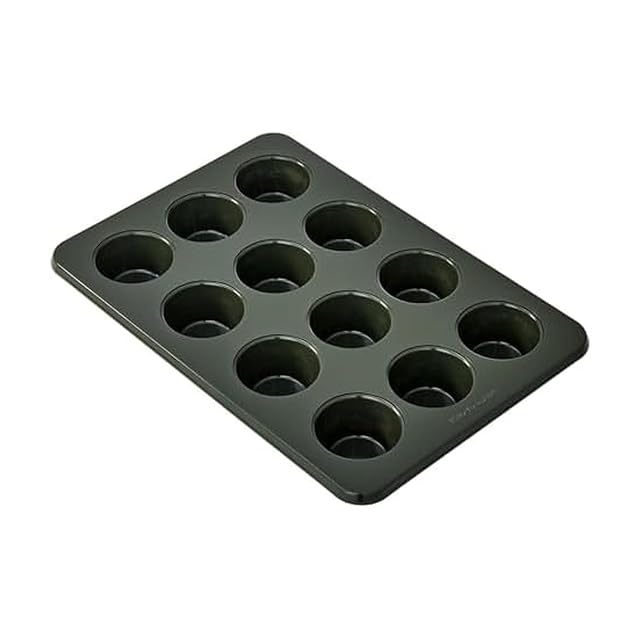
A 12-cup aluminized steel muffin pan with a Swiss-engineered non-stick coating, extended handles and an anti-warp rim, in Evergreen.
Best for: Twelve muffins in a pan heavy enough not to buckle
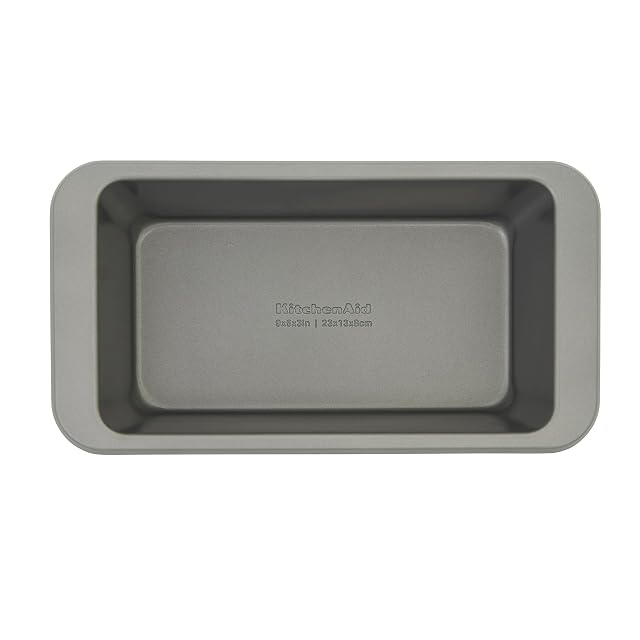
A 9 × 5 inch aluminized steel loaf pan with a Swiss-engineered non-stick coating, extended handles and a rim designed against warping.
Best for: A standard loaf in a pan that will not rust at the rim
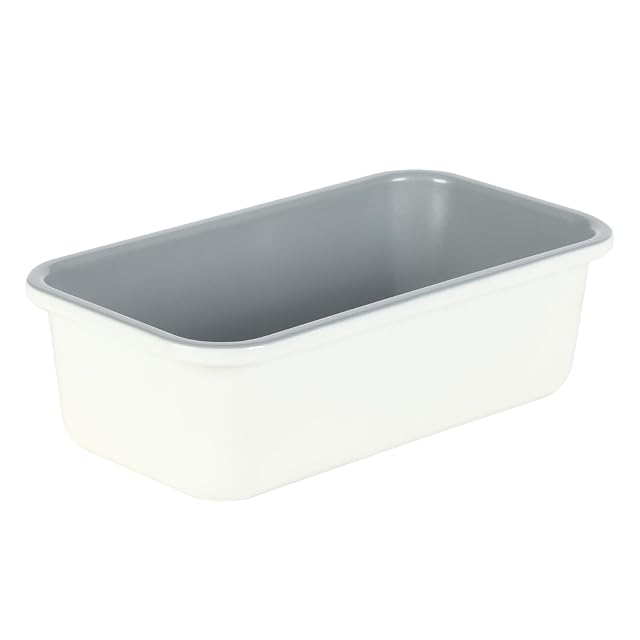
A 9 × 5 inch carbon steel loaf pan with a PFOA, PFAS and PTFE free non-stick interior and a linen white exterior.
Best for: A buyer who wants a 9 × 5 loaf pan with no fluoropolymer in it
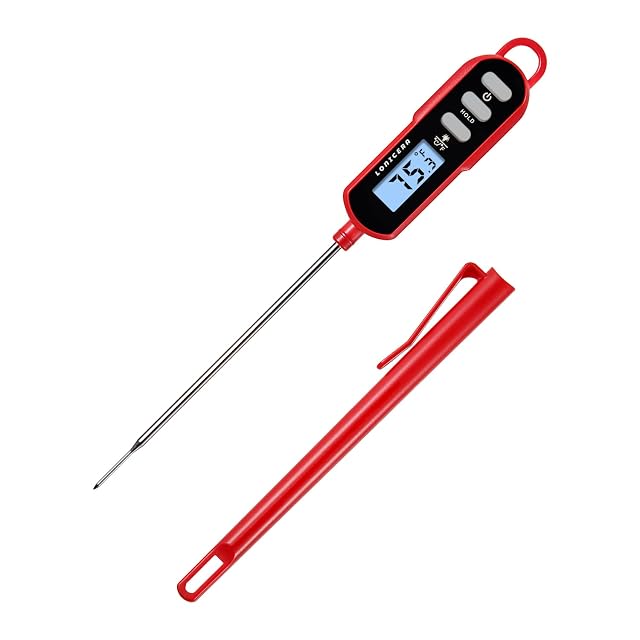
A one-to-two second thermometer accurate to ±1 °F with a 5-inch probe, IPX6 waterproof, a hold button, a magnet, and an 18-month warranty.
Best for: Bread and dough, where probe reach and a long warranty matter more than half a second
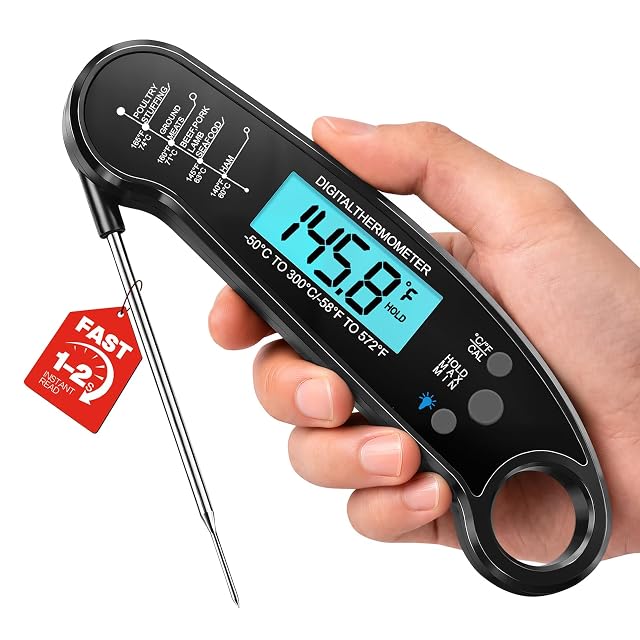
A one-to-two second instant-read thermometer accurate to ±1 °F, fully IP67 sealed, with calibration, a backlit LCD, a magnet and 4,000+ hours of battery.
Best for: The same job as its twin — a sealed, checkable thermometer on a magnet
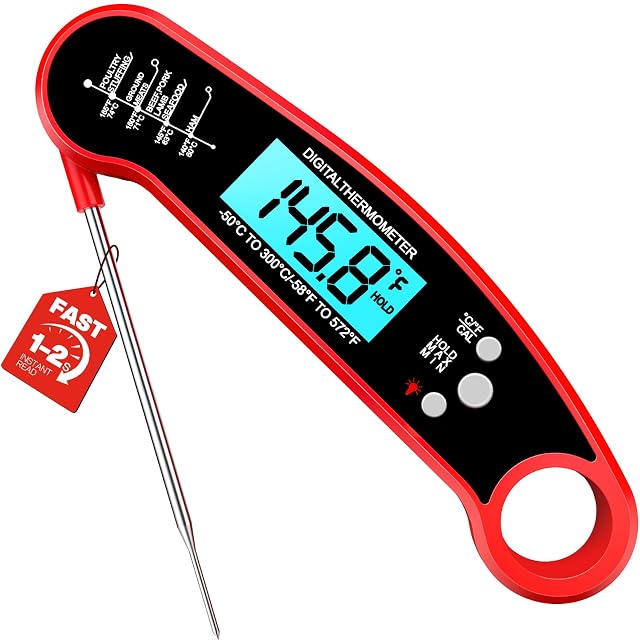
A one-to-two second instant-read thermometer accurate to ±1 °F, fully sealed to IP67, with calibration, a backlit LCD, a magnet and 4,000+ hours of battery.
Best for: A grill and kitchen thermometer that lives on the hood and gets rinsed