What the maker puts in writing
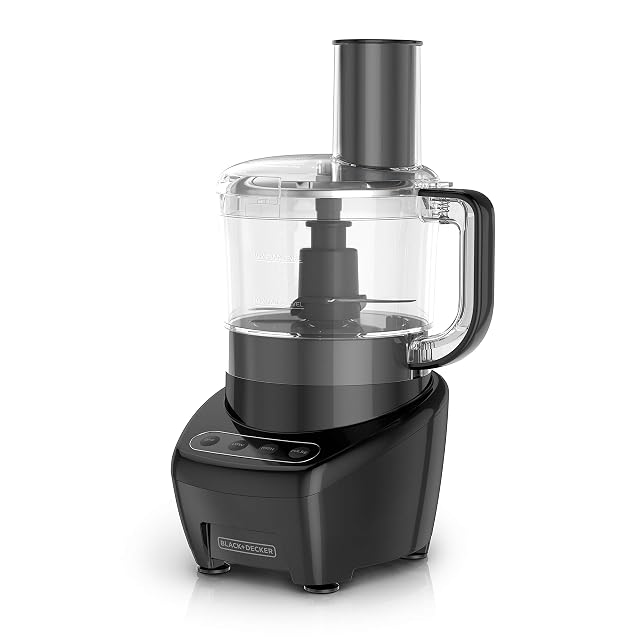
- “STACK AND SNAP TECHNOLOGY FOR EASY ASSEMBLY: …Stack & Snap technology provides easy assembly and removes the need for difficult twist-locking.”
- “12 CUP SEALED BOWL: Most food processors are too small for large processing jobs. This 12 cup sealed bowl fits large volumes of food all at once, and since it’s sealed in the center, there’s no messy leaks or spills”
- “BIG MOUTH CHUTE: Fit a whole potato or tomato right into the chute… saves prep time by reducing the need to pre-cut food”
- “SLICE, SHRED, CHOP, MIX AND PUREE WITH 2 VERSATILE ATTACHMENTS: …a chopping/pureeing blade and reversible stainless steel slicing/shredding disc”
- “QUICKLY POWERS THROUGH TOUGH INGREDIENTS WITH 450 WATT MOTOR… the suction cup feet prevent sliding for greater stability”
- “2-IN-1 CHUTE: Use the small chute and small pusher when you need to process thinner foods like carrots and celery — it holds them upright for better control and clean cuts.”
- “SIMPLE FUNCTION GUIDE: …you’ll always know which blade to use and which button to push.”
- “CONVENIENT POUR SPOUT” · “EASY TO CLEAN: All removable parts… dishwasher safe… all food zones are BPA-free”
- Reference 70725 · Catalog: 2980 g (105.1 oz), 243 × 223 × 413 mm (9.57 × 8.78 × 16.3 in)
The sealed bowl, which decides what twelve cups means
“since it’s sealed in the center, there’s no messy leaks or spills to clean up after processing.”
A processor bowl sits on a shaft that comes up through its base, and on an ordinary bowl that joint is simply a close fit. It holds dry food perfectly well — but liquid finds it.
So an unsealed 12-cup bowl holds about half that in salsa, soup base or batter before it weeps underneath and runs down the motor housing.
Which means the printed capacity is a dry figure on every other machine on this shelf — including its own stablemate, the Hamilton Beach 70730 at $52.95, which publishes “10 cup bowl capacity” and no seal.
A sealed bowl makes the wet figure the same as the dry one, and that is exactly what a large capacity is for: the jobs that need twelve cups are mostly wet. Salsa for a party, a batch of hummus, a soup base, a liter of pesto.
Elsewhere on this shelf the working rule is: fill to the blade for anything liquid, two-thirds for anything dry. Here you can fill it.
One limit still applies. Food above the blade is not being cut, which is why over-filling gives purée at the bottom and coarse pieces on top regardless of the seal — and why the 70730’s scraper is the complementary idea rather than a competing one.
Twelve cups is the largest bowl on this shelf. The ladder: 1.5 · 2.5 · 3 · 3.5 · 8 · 8 × 2 · 9 · 10 · 12. And the five smallest have no slicing disc at all.
Two chutes, because one cannot do both jobs
“Fit a whole potato or tomato right into the chute. The Big Mouth chute… reducing the need to pre-cut food.”
“Use the small chute and small pusher when you need to process thinner foods like carrots and celery — it holds them upright for better control and clean cuts.”
Both halves matter, and they solve opposite problems.
A wide chute means less knife work. A whole tomato goes in; a narrow chute means quartering it first — and quartering it is most of the job you bought the machine to avoid.
A narrow chute means better cuts on thin food. A carrot in a wide chute leans and rolls, so the disc catches it at a changing angle and you get wedges instead of coins. A narrow tube holds it upright against the disc, and every slice is the same.
Nothing else on this shelf has both. The 70730 claims a “large feed chute… reducing the need to pre-cut” and offers no small one. The BLACK+DECKER FP4200BC at $37.49 and the Ninja at $109.99 publish no chute dimensions at all.
And two pushers is the detail that makes it work. A pusher is a safety device before it is a convenience — the point is that your fingers never approach a disc turning at 450 watts — and a pusher sized for a potato is useless in a carrot tube.
No machine on this shelf publishes a cut thickness, which is the one disc figure a reader would want. For comparison, the KitchenAid slicer attachment on this site’s stand-mixer shelf publishes all three of its cuts: 3 mm, 4 mm and 6 mm.
Stack and Snap, and the problem two machines here lead on
“Stack & Snap technology provides easy assembly and removes the need for difficult twist-locking.”
It is the first bullet on the page, and the BLACK+DECKER FP4200BC at $37.49 also leads with the same complaint: “uses the lid as the locking mechanism. No more struggling to lock the bowl into place.”
Two of nine machines putting assembly first is a fair indication of where the frustration lies.
What normally happens: the bowl must be twisted onto the base until a tab engages a slot you cannot see, then the lid twisted onto the bowl until a second tab trips the safety interlock. Two blind alignments — and a processor that refuses to start because one is a few degrees out is the commonest complaint about the category.
The Ninja at $109.99 describes the same interlock as a feature rather than a nuisance: “Built-in safety mechanisms ensure the processor operates only when properly assembled.”
Three more small things on this page are worth separating, because each is published here and almost nowhere else:
Suction cup feet — “prevent sliding for greater stability on the countertop”. At 2980 grams and 450 watts, a processor working through carrot does move. Only the Sangcon at $49.99 also publishes suction feet.
A pour spout — which on a 12-cup bowl of soup base is the difference between pouring and slopping. Only the KitchenAid at $54.99 also has one, and it adds a locking blade so the blade does not come forward with the liquid; this page does not.
A printed function guide — “you’ll always know which blade to use and which button to push”. On a machine with two attachments, three controls and five claimed functions, a guide on the body is better than a leaflet in a drawer, because the leaflet is lost by the second use.
Four hundred and fifty watts, two speeds, and five functions from two parts
450 W is the shelf standard, published by four machines: this, the 70730, the BLACK+DECKER FP4200BC and the Ganiza at $55.99.
Below it: Cuisinart 250 W, BLACK+DECKER HC150B 150 W — both small-bowl choppers. No wattage at all: the KitchenAid and the Sangcon.
And the Ninja publishes 1000 “peak” watts — a different unit, being the momentary draw at startup or stall rather than sustained power, and the only use of that convention on this shelf. “1000PW” in the title, “1000-peak-watt” in bullet one.
“Slice, shred, chop, mix and puree with 2 versatile attachments” is the right way to count it: the reversible disc slices one way and shreds the other, the blade chops and purées, and “mix” is the blade at low speed. Two parts, five jobs — and two parts to store rather than six.
And “reversible” means one disc with two faces, so you flip it rather than keeping two. Fewer parts to lose, and one thickness per function rather than a choice.
2980 grams makes this the second heaviest machine here: HC150B 544 g · Cuisinart 998 g · KitchenAid 1225 g · Ganiza 2268 g · Sangcon 2495 g · 70730 2812 g · this 2980 g · Ninja 3470 g. A machine at three kilos lives on the counter, which is the honest trade for twelve cups.
Per cup it is mid-shelf: $5.83, against $4.69 (B+D FP4200BC), $5.30 (70730), $12.22 (Ninja) — and $9.63 to $15.71 for the three small choppers.
Pet food, which is an odd bullet and a sensible use
“PERFECT FOR PET FOODS: You can use it as a pet food maker… Control ingredients, portions and flavors to suit their dietary needs.”
The only mention of animals on this shelf, and it is a better fit than it first reads.
Home-made pet food is a twelve-cup job. It is batch-cooked, frozen in portions, and made of exactly what a processor handles well: cooked meat, offal, vegetables, rice. Nothing needs to look appetizing, so the uneven cut that spoils a salsa is irrelevant.
And it is wet, which brings the sealed bowl back into it — a batch of minced cooked chicken and stock is precisely the load that leaks out of an unsealed bowl.
The one caution the page does not give is the same as the one the Ganiza at $55.99 builds its whole design around: a bowl that has processed raw meat and a bowl that chops salad should not be the same bowl. The Ganiza ships two bowls in different materials — “glass and sus 304 stainless steel… to avoid confusion between bowls for different uses, meat chopper and vegetable chopper” — and it is the only machine on this shelf to think about it. Here you have one bowl, and the answer is the dishwasher.
Which this machine does claim, fully: “All removable parts… dishwasher safe… all food zones are BPA-free.” Eight of nine machines on this shelf claim dishwasher-safe parts; only the Ganiza does not.
What is not published
No bowl scraper, which is the one thing its cheaper stablemate has — and the single best idea on this shelf. The 70730 at $52.95 works its scraper “from side-to-side… while the food processor is running or the power is off — no need to remove the lid”, which addresses the universal fault: food at the wall stops being cut, and the usual remedy over-processes what was already done. Seventeen dollars separates the two machines, and this is what the seventeen dollars does not buy.
No run-time limit. Only the Sangcon at $49.99 publishes one anywhere here: “Limit each run to 60 seconds.” The Ganiza admits the constraint without a number. Seven of nine say nothing — and on a 12-cup batch of hummus, which is minutes of continuous running, a minute on and a minute off is the rhythm to borrow.
No warranty. Only the Cuisinart (18 months) and the Sangcon (2 years, plus ETL certification) publish either.
No chute dimensions, as above — “Big Mouth” and “small” are the whole of it.
No cut thickness, as above.
No dough blade, which only the Ninja at $109.99 has.
No locking blade, which the KitchenAid publishes — and which matters on a machine with a pour spout and twelve cups of liquid.
No oil hole or drizzle basin, which the three small choppers here all have. On a 12-cup bowl that is consistent: half a cup of mayonnaise would never reach the blade.
No country of manufacture, which nothing on this shelf publishes.
Availability
Read on the day this page was built: $70 at the American Amazon shop.
Read from Keepa on the day this page was last revised; stock and price both move without notice.
Prices quoted in this text were read on 2026-10-05. The live price is at the top of the page.