What the maker puts in writing
- “SUPERIOR FUNCTION: …an efficient 250-watt motor and patented reversible stainless steel blade to quickly chop herbs, dice vegetables, and grind hard cheese”
- “CONVENIENT CONTROL: The 24-ounce food chopper… features a push-button control panel and auto-reversing SmartPower blade for two powerful processing options—chop and grind (not recommended to grind beans as it chops)”
- “EASY CLEANUP: A dishwasher-safe bowl and lid… while the motor base can be wiped clean”
- “WHAT’S INCLUDED: …a 24-ounce work bowl with handle, stainless steel blade with sharp blunt edges, spatula, and instruction/recipe book”
- “LIMITED 18-MONTH WARRANTY: The BPA-free Cuisinart mini chopper comes with a limited 18-month warranty”
- Description: “The 3-cup work bowl is just right for making pesto or a salad dressing, and two receptacles in the lid have pinholes for one or two oils to stream into the bowl while the processor is blending a perfect emulsion” · “its blunt side can grind nuts, coffee beans, or cheese” · “Compact at just 9 inches high”
- Reference DLC-2ABC · Catalog: 998 g (35.2 oz), 127 × 178 × 235 mm (5 × 7.01 × 9.25 in)
The reversible blade, which nothing else here has
“patented reversible stainless steel blade” · “auto-reversing SmartPower blade for two powerful processing options—chop and grind” · “stainless steel blade with sharp blunt edges”
One blade, sharp on one side and blunt on the other, and a motor that runs either way.
Press chop and the sharp edge leads: it cuts — onion, herbs, breadcrumbs, cooked fruit.
Press grind and the blunt edge leads: it crushes — nuts, hard cheese, where a sharp edge would slice and skid rather than reducing.
That is a genuine mechanical idea, and it is the reason to buy this rather than another three-cup chopper. Every other machine on this shelf has a blade that turns one way and does one thing.
It is not a substitute for a disc, though. There is no slicing disc and no feed chute here, so no sliced cucumber and no shredded cheese.
At least five of the thirteen machines on this shelf are in the same position — this, the BLACK+DECKER HC150B at $14.44, the KitchenAid at $54.99, the Ganiza at $55.99 and the Sangcon at $49.99 — and the words “food processor” appear in eight of the nine titles.
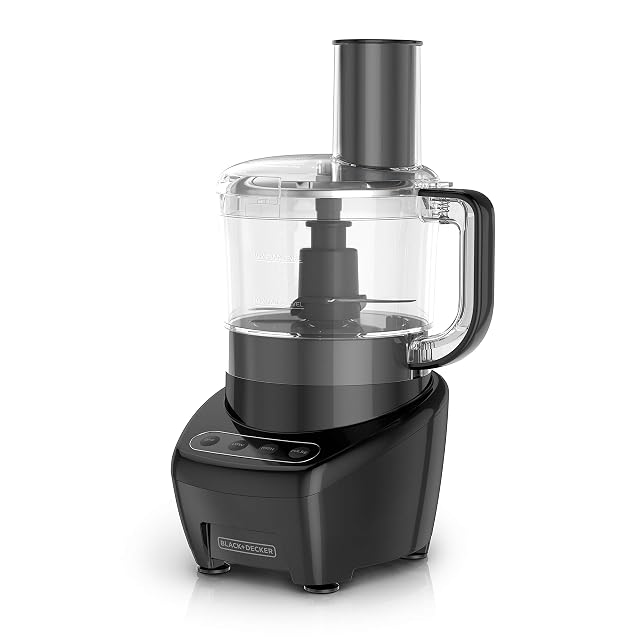
The four that genuinely slice: the BLACK+DECKER FP4200BC at $37.49, the Ninja at $109.99, and both Hamilton Beach machines at $52.95 and $69.99.
And then the page contradicts itself about beans
Bullet two: “chop and grind (not recommended to grind beans as it chops).”
The description: “its blunt side can grind nuts, coffee beans, or cheese.”
One sentence rules beans out; the other names coffee beans as a use.
The likely reconciliation is that the bullet means it chops beans rather than grinding them, which is a real distinction and an important one for coffee.
A burr grinder crushes beans between two surfaces at a set gap, so every particle comes out the same size. A blade grinder cuts whatever it strikes, so you get dust and boulders in one batch — and because extraction depends on particle size, dust over-extracts and turns bitter while boulders under-extract and turn sour. The cup is muddy whatever you then do with it.
So the bullet is the more useful of the two statements, and it should be read as a warning about quality rather than about damage.
Nuts and hard cheese are a different matter, because neither needs uniform particles, and both are what the blunt edge is genuinely good at.
One practical note the page omits: coffee oils are tenacious and will flavor a plastic bowl afterwards. A bowl used for beans should not then be used for a vinaigrette.
Two pinholes, which is the best emulsion arrangement here
“two receptacles in the lid have pinholes for one or two oils to stream into the bowl while the processor is blending a perfect emulsion.”
An emulsion is oil suspended in water, and it only forms if the oil goes in slowly while the blade turns. Pour it in at once and it sits on top; drip it in and the blade breaks it into droplets small enough to stay suspended. That is mayonnaise, aioli, a stable vinaigrette, the last stage of hummus.
This is the most explicit version of the feature on the shelf, and the only one that mentions two oils at once — which is how you make a dressing from a neutral oil and a finishing oil without emulsifying them separately.
Three of nine machines have this, and they are the three smallest:
this — two pinhole receptacles
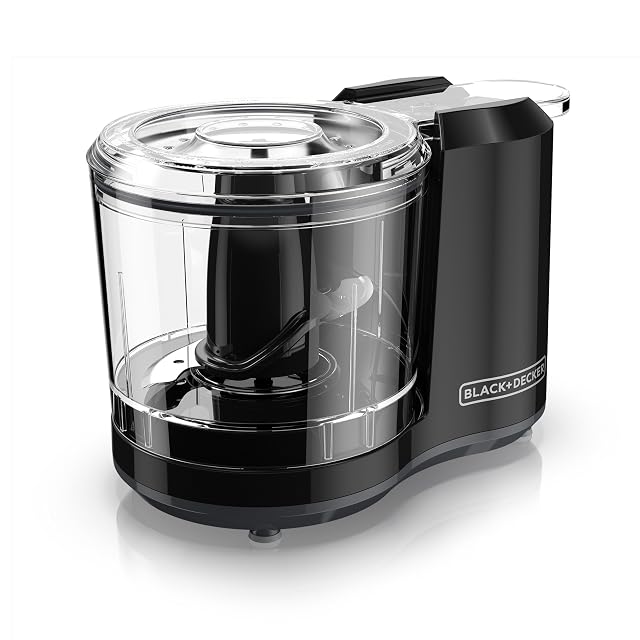
BLACK+DECKER HC150B, $14.44 — “oil holes… add oil to hummus and vinaigrette as you mix without making a mess”
KitchenAid, $54.99 — a “drizzle basin”
The six larger machines have none, and that is consistent rather than an oversight: half a cup of mayonnaise in a 12-cup bowl will never reach the blade.
And it explains what the page says this bowl is for: “just right for making pesto or a salad dressing”. Both are small, both are emulsions or near enough, and both are ruined by a bowl too large for them.
The title says 3 cups; bullets two and four say 24 ounces; the description says 3 cups.
Three US cups is 24 fluid ounces exactly, so all four statements agree — which on this shelf is worth remarking, since the BLACK+DECKER FP4200BC publishes no weight at all and the Ninja publishes its power in a unit nobody else uses.
What a small bowl does better than a large one is keep food in the blade’s path. A chopping blade cuts in a narrow band; a handful of basil in a 12-cup bowl gives you a few shredded leaves and many whole ones.
The ladder: 1.5 (HC150B) · 2.5 (Sangcon’s chopper bowl) · 3 (this) · 3.5 (KitchenAid) · 8 (B+D FP4200BC) · 8 × 2 (Ganiza) · 9 (Ninja) · 10 and 12 (Hamilton Beach).
What it costs is per-cup value: $13.32 a cup here, against $4.69 for the 8-cup BLACK+DECKER and $5.30 for the 10-cup Hamilton Beach. Every small bowl on this shelf costs two to three times per cup what the large ones do.
Which the page is honest about: “comes in handy when a full-size food processor is unnecessary.”
And at 9 inches high and 998 grams it stays out, which is the real argument. The weight ladder runs from 544 g to the Ninja’s 3470 g — and a three-and-a-half-kilo machine lives on the counter or does not get used at all.
Two hundred and fifty watts sits where it should for the bowl. Four machines on this shelf publish 450 W continuous, the HC150B publishes 150 W, the KitchenAid and Sangcon publish nothing, and the Ninja publishes 1000 “peak” watts — a different unit, being the momentary draw at startup or stall rather than sustained power, and the only use of that convention here.
Eighteen months, which is one of two warranties on this shelf
“LIMITED 18-MONTH WARRANTY.”
At least seven of the thirteen machines here publish none. The only other is the Sangcon at $49.99, with 2 years and a 24-hour response — and the Sangcon is also the only machine on the shelf with a certification, ETL.
Eighteen months is modest in absolute terms and generous for this shelf, and on a 250 W motor it covers the period in which a manufacturing fault shows.
What is in the box is the other quiet strength: “a 24-ounce work bowl with handle, stainless steel blade, spatula, and instruction/recipe book.”
The handle matters on a bowl you pour from. The spatula matters because a chopper has no scraper — and on a 3-cup bowl, scraping down is something you do every time. And a recipe book is the only one on this shelf, which on a machine whose selling point is an unusual two-mode blade is more useful than it sounds: the difference between chop and grind is not obvious until someone tells you what each is for.
Dishwasher-safe bowl and lid, with the base wiped — which is the standard arrangement, claimed by at least eight of the thirteen machines here. Only the Ganiza does not claim it.
BPA-free is stated, as on six of nine.
What is not published
No disc and no chute, as above — the division that governs this shelf.
No run-time limit. Only the Sangcon publishes one anywhere here: “limit each run to 60 seconds”. The Ganiza admits the same constraint without a number: “if the machine stops working, please wait a few minutes for the machine to cool down.” On a 250 W motor driving a sharp blade through nuts, a duty cycle is the figure you would most want, and seven of nine machines say nothing.
No speeds. Two buttons, chop and grind, and no low or high — where the KitchenAid, Ganiza, both Hamilton Beach machines and the Sangcon all have two speeds plus pulse, and the Ninja has four presets.
No pulse, which is the control that produces even chopping: it lets food fall back into the blade’s path between bursts. Push-button here means hold-to-run.
No bowl scraper, which only the Hamilton Beach 70730 at $52.95 has — usable “while the food processor is running… no need to remove the lid”. Hence the spatula in this box.
No locking blade, which the KitchenAid publishes: a blade that “locks in place for convenient pouring”. On a bowl with a handle and a pour spout, a blade that can fall out while you pour is the obvious hazard.
No cord wrap, which the KitchenAid also publishes.
No bean guidance beyond the contradiction, as above.
Availability
Read on the day this page was built: $29 at the American Amazon shop.
Read from Keepa on the day this page was last revised; stock and price both move without notice.
Prices quoted in this text were read on 2026-10-05. The live price is at the top of the page.