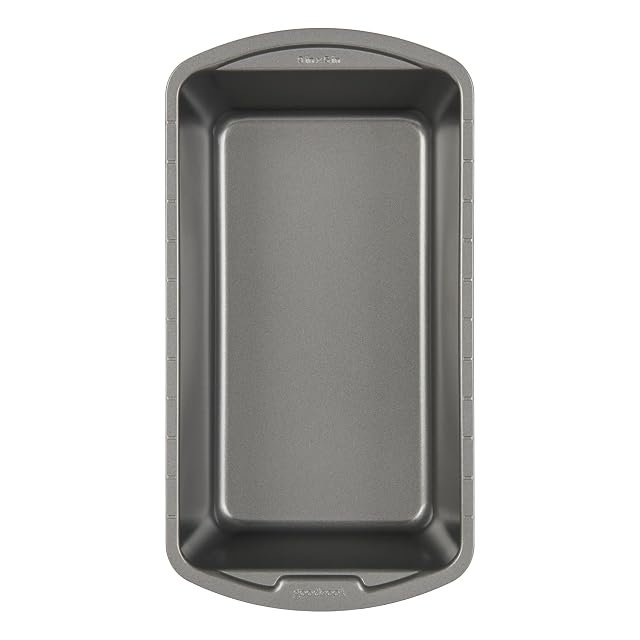
The cheapest single 9 × 5 here, and metal-spatula safe
GoodCook 9 × 5 in Nonstick Loaf Pan
A standard 9 × 5 inch carbon steel loaf pan with a scratch-resistant non-stick coating, metal-spatula safe and dishwasher safe.
Specifications
- Price per pan
- $5.99 — the cheapest single steel pan on this shelf
- Size
- 9 × 5 inches, the standard American loaf
- Occupies
- 11 × 6 inches of shelf — catalog 279 × 152 mm (11 × 5.98 in)
- Material
- Heavy-duty gauge carbon steel
- Metal spatula
- Stated safe — only GoodCook claims this
- Coating
- Scratch-resistant non-stick; composition not published
- Dishwasher
- Safe, with hand washing recommended for longer life
- Color
- Gray
- Weight
- 268 g (9.5 oz)
- Reference
- 04026
- Oven limit
- Not published — only two items on this shelf publish one
- Thickness or gauge
- Not published; "heavy-duty gauge" is the whole of it
- Depth
- Not published; the catalog figure is 65 mm (2.56 in)
- Warranty
- Not published
- Amazon reference
- B0026RHI64
- EAN
- 0074994324206
The plus side, and the minus
Strengths
- The cheapest single steel pan on the shelf, and only 66 cents dearer than a pan from the six-piece set
- Metal spatula safe, which neither 9 × 5 rival claims
- Dishwasher safe, with the honest caveat that hand washing lasts longer
Compromises
- No oven temperature limit published, on a bread pan
- No gauge and no thickness, behind five claims of durability
- The 9 × 5 label is the base — it needs 11 × 6 inches of oven shelf
What the maker puts in writing
- “STANDARD 9 x 5-INCH LOAF PAN: This standard loaf pan is perfect for baking meatloaf, sweet or savory breads, thick cakes or brownies, smaller portions of lasagnas or casseroles”
- “EVEN HEAT DISTRIBUTION: The heavy-duty carbon steel bread pan for baking ensures long-lasting durability and even heat distribution”
- “SCRATCH-RESISTANT STEEL: Constructed from heavy-duty steel, this bread baking pan resists warping and scratching”
- “NONSTICK COATING: …a scratch-resistant nonstick coating for a mess-free release to serve your baked goods directly from the pan.”
- “DISHWASHER SAFE: This non-stick baking pan is dishwasher safe for easy cleanup after use. Hand washing is recommended for longer-lasting use.”
- Description: “It is also metal spatula safe” · “made with heavy duty gauge steel with a gray f…”
- Reference 04026 · Catalog: 268 g (9.5 oz), 279 × 152 × 65 mm (11 × 5.98 × 2.56 in)
Four 9 × 5 loaf pans on this shelf, and this is the cheapest you can buy on its own
The same published format, four times, at four prices:
this — $5.99, carbon steel, gray, metal spatula safe Sur La Table — $11.70, carbon steel, Linen White, PFOA, PFAS, PTFE free KitchenAid — $14.99, aluminized steel, Contour Silver, extended handles and a fourth inside the Amazon Basics six-piece set at $31.99, which works out at $5.33 a piece
A 2.8 times spread on one published size, from $5.33 to $14.99.
And the cheapest is the only one of the three singles that claims metal-utensil safety, which is the claim that decides how you serve out of it.
What the extra money buys, item by item: the Sur La Table buys a coating that declares what it does not contain; the KitchenAid buys aluminized rather than plain carbon steel and a pair of extended handles; the set buys five more pans.
None of the three single pans publishes an oven temperature limit. Only two items on this shelf do — the Amazon Basics set at 428 °F, which covers the fourth 9 × 5, and the Elbee set at 420 °F — and both of those are sets, not single pans.
Eleven by six inches, which is what the label does not tell you
The catalog figure here is 279 × 152 mm — 11.0 × 6.0 inches.
The KitchenAid 9 × 5 at $14.99 publishes exactly the same: 279 × 152 mm. Two makers, two pans, one number.
A loaf pan is a tapered box. The quoted size is the base, where the loaf sits; the walls slope outwards so the loaf will release, and the rim is wider than the base. Add a rolled lip and grab points and you get two inches more each way.
The flat pans on this shelf prove it by not doing it:
GoodCook 13 × 9 bake & roast, $9.99 — catalog 330 × 229 × 51 mm = 13.0 × 9.0 × 2.0 inches, which is exactly what the bullet publishes GoodCook MegaGrip 8 × 8, $10.09 — catalog 203 × 203 mm = 8.0 × 8.0 inches, exactly Waytiffer disposable loaf, $9.99 — catalog 216 × 114 × 64 mm = 8.5 × 4.5 × 2.5 inches, exactly what its bullet publishes
A shallow pan with near-vertical walls measures what it says. A tapered loaf pan does not.
What it changes: fitting two of these side by side needs 11 × 6 inches each, not 9 × 5. On a 22-inch oven shelf that is two across with an inch to spare — which is why loaves baked in pairs so often touch.
The depth is not published either. The catalog says 65 mm, about 2.6 inches. The KitchenAid 9 × 5 catalogs at 77 mm, about 3.0 inches — so the two pans that share a plan figure differ by nearly half an inch in depth, and neither publishes it. On a loaf pan, depth is what decides whether a risen dough crowns above the rim or spills over it.
Metal spatula safe, and only GoodCook says it
“It is also metal spatula safe so you can serve your baked goods right out of the pan.”
GoodCook claims it on three of its four pans here — this one, the 13 × 9 (where it is in the product name) and the 8 × 4 set of two. Curiously not on the MegaGrip at $10.09, which claims only “scratch-resistant”.
Nobody else on this shelf claims it at all.
The failure mode of a non-stick pan is not wear. It is one cut. Once the film is broken, batter works under the edge, food sticks there permanently, and the break propagates from that point every time something scrapes past it.
A pan you must serve out of with silicone is a pan that will eventually be cut, because the moment somebody wants the corner piece they reach for a knife.
And the shelf hints at why only GoodCook grants it. The Sur La Table pan publishes “PFOA, PFAS, PTFE Free” — so its coating is not a fluoropolymer, and it makes no metal claim. KitchenAid calls its coating “Swiss-engineered heavy-duty”, which says nothing about what it is made of, and makes no metal claim either.
The honest limit on the claim: a spatula, not a serrated knife sawing on the base.
Heavy-duty gauge steel, with no gauge
Five durability claims on this page, and no number behind any of them:
“heavy-duty carbon steel… long-lasting durability” · “heavy-duty steel, this bread baking pan resists warping and scratching” · “heavy duty gauge steel”
Gauge is a number. Sheet steel is specified by it — a thinner gauge warps, a thicker one does not — and nothing on this shelf publishes one.
The whole shelf, on thickness:
GoodCook — “heavy-duty gauge steel”, on four pans MegaGrip — “heavy-gauge steel” Amazon Basics — “heavy-weight steel construction” KitchenAid — “heavy-duty aluminized steel” and a “uniquely designed rim to prevent warping” Sur La Table — “carbon steel”, with no adjective at all Elbee — no material statement, only “rust resistant”
Four phrases, zero numbers, and “resists warping” asserted five times across the shelf with no thickness anywhere.
What warping actually is, since every page here promises against it: a thin pan heats unevenly, the hot part expands against the cool part, and past the yield point the sheet takes a permanent set. Once a pan rocks on a flat surface, batter runs to one end and the loaf bakes wedge-shaped. The two things that cause it are thinness and thermal shock — a hot pan into cold water, or cold water into a hot pan.
The one habit no page here gives: let a pan cool on the hob before it meets the sink.
Gray, which is not only a color
This pan is gray. The Sur La Table is Linen White, the KitchenAid loaf Contour Silver, the KitchenAid muffin pan Evergreen.
A dark pan absorbs more radiant heat than a light one and browns the crust faster. Light or shiny aluminized surfaces reflect it, which is why a pale pan gives a paler bottom crust and a slower bake at the same oven setting.
It is a real baking variable, and the one page on this shelf that sells color as a feature says nothing about it: the Sur La Table bullet reads “VIBRANT EXTERIOR: colorful pieces inspire creativity in any kitchen”.
For this pan, gray and carbon steel is the browning end of the shelf, and the aluminized KitchenAid is the other.
What is not published
No oven temperature limit, on a bread pan. Only the Amazon Basics set at $31.99 (428 °F, which is exactly 220 °C) and the Elbee set at $59.99 (420 °F, plus convection) publish one — and many bread recipes call for 450 °F, above both. Eleven of thirteen items here, including this one, say nothing, and they are not necessarily better.
No gauge and no thickness, as above.
No depth, as above — the catalog says 65 mm.
No coating composition. “Scratch-resistant nonstick” names a property, not a material. Only the Sur La Table says what its coating is free of, and only by negation.
No capacity. The one capacity figure on this shelf is on a disposable: the Waytiffer foil loaf pan at $9.99 publishes “2Lb” for a pan of 8.5 × 4.5 × 2.5 inches. A loaf pan is a volume, and the steel pans here all give only a plan size.
No warranty, which no item on this shelf publishes.
No country of manufacture, which no item on this shelf publishes either.
Availability
Read on the day this page was built: $5 at the American Amazon shop.
Read from Keepa on the day this page was last revised; stock and price both move without notice.
Prices quoted in this text were read on 2026-10-17. The live price is at the top of the page.
What readers want to know
Why do the catalog dimensions say 11 × 6 when the pan is 9 × 5?
Because a loaf pan is measured at the base, and this shelf lets you prove it. The catalog figure here is 279 × 152 mm (11 × 5.98 in), which is 11.0 × 6.0 inches. The KitchenAid 9 × 5 loaf pan at $14.99 publishes the same figure — 279 × 152 mm (11 × 5.98 in), 11.0 × 6.0 inches. Two makers, two pans, one number. A loaf pan is a tapered box. The quoted size is the bottom, where the loaf sits; the walls slope outwards so the baked loaf will come out, and the rim is therefore wider than the base. Add a rolled lip and a pair of grab points and you arrive at two inches more in each direction. The flat pans on this shelf confirm it by not doing it. The GoodCook 13 × 9 bake & roast pan at $9.99 has a catalog figure of 330 × 229 × 51 mm (13 × 9.02 × 2.01 in) — exactly 13.0 × 9.0 × 2.0 inches, which is exactly what its bullet publishes. The GoodCook MegaGrip 8 × 8 at $10.09 reads 203 × 203 mm (7.99 × 7.99 in) — exactly 8.0 × 8.0 inches. A shallow pan with near-vertical walls measures what it says; a tapered loaf pan does not. What this changes in practice: if you are fitting two loaf pans side by side on one oven shelf, budget 11 × 6 inches each, not 9 × 5. On a standard 22-inch shelf that is two across with an inch to spare, which is tighter than the label suggests and is why loaves baked in pairs often touch.
What does "metal spatula safe" actually buy me?
The right to cut and serve in the pan, and on this shelf only GoodCook grants it. The description says it plainly: "It is also metal spatula safe so you can serve your baked goods right out of the pan." GoodCook repeats it on three of its four pans here — this one, the 13 × 9 bake & roast at $9.99 (where it is in the product name: "Scratch-Resistant Metal-Utensil Safe Nonstick") and the 8 × 4 set of two at $11.99. Nobody else on this shelf claims it. Not the Sur La Table 9 × 5 at $11.70, not either KitchenAid pan, not the Amazon Basics six-piece set at $31.99, not the Elbee eight-piece at $59.99. Why it matters more than it sounds. The failure mode of a non-stick pan is not the coating wearing thin — it is a single cut. Once the film is broken, batter gets under the edge, food sticks there permanently, and the break spreads from that point every time you scrape it. A pan you have to serve out of with a silicone spatula is a pan you will eventually cut, because the moment somebody wants the corner brownie they reach for a knife. And the shelf gives a clue as to why only GoodCook says it. The Sur La Table pan publishes "PFOA, PFAS, PTFE Free", which means its coating is not a fluoropolymer — and the ceramic-type coatings sold on that basis are harder but more brittle, which is consistent with no metal claim being made. The honest limit: metal-safe means a spatula, not a serrated knife sawing on the base.
Is the "dishwasher safe, but hand wash" bullet a contradiction?
No, and it is the most honest cleaning line on this shelf. The bullet says both things: "This non-stick baking pan is dishwasher safe for easy cleanup after use. Hand washing is recommended for longer-lasting use." Both are true and they are about different time scales. A dishwasher will not destroy the pan today. What it does over years is attack the coating and the steel: detergents are alkaline and abrasive, the cycle runs hot, and carbon steel rusts wherever the coating is broken — which on a pan you cut with a spatula it eventually will be. The shelf splits four ways on this. GoodCook publishes the caveat on three pans, verbatim. KitchenAid publishes "DISHWASHER SAFE: for easy cleanup" on both its pans with no caveat at all. Amazon Basics goes the other way and publishes only "Hand wash for best results" — no dishwasher claim on a $31.99 set. Elbee publishes "Dishwasher safe and rust resistant", and the second half of that is the part the others leave out. Two pans here publish nothing about washing at all: the GoodCook 13 × 9 and the Sur La Table. The practical habit for any of them: wash the pan warm and dry it immediately rather than letting it drain. A carbon steel pan left wet in a rack is the one that rusts, whatever the bullet says.
More pans & molds
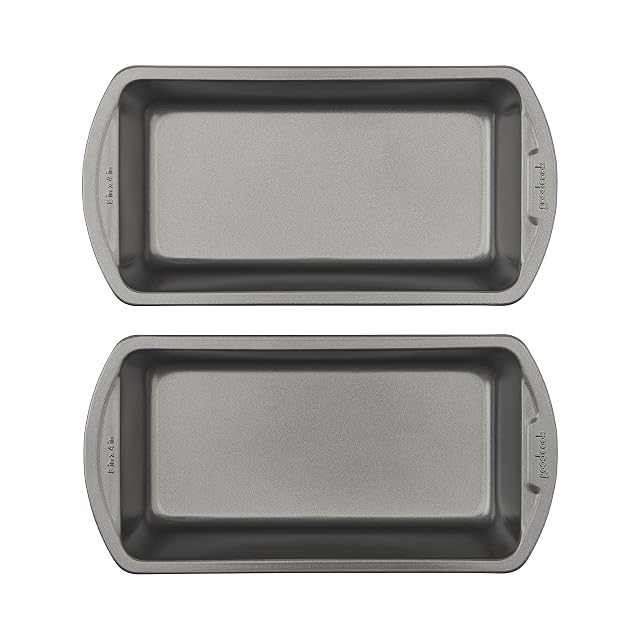
GoodCook 8 × 4 in Nonstick Loaf Pans, Set of 2
Two 8 × 4 inch medium carbon steel loaf pans with scratch-resistant metal-spatula safe non-stick coating, oven and dishwasher safe.
- Quantity
- Two pans — $6.00 each
- Size
- 8 × 4 inches each, the medium loaf
- Base area
- 32 square inches, against 45 for a 9 × 5
- Metal spatula
- Stated safe
- Material
- Heavy-duty gauge steel
- Weight
- 408 g (14.4 oz) for the pair — 204 g (7.2 oz) each
- Dishwasher
- Safe, with hand washing recommended for longer life
- Warping
- Stated to resist it
- Color
- Gray
- Reference
- 4244
- Dearer per pan
- Than the maker’s own 9 × 5 at $5.99
- Depth
- Not published; the catalog gives 102 mm (4.02 in) for a stack of two
- Oven limit
- Not published
- Thickness or gauge
- Not published
- Amazon reference
- B0B9J1NLLW
- EAN
- 0076753042444
- Two matched pans, so two loaves bake identically side by side
- Metal spatula safe, which no rival on this shelf claims
- Six dollars a pan, against $5.99 for the maker’s larger 9 × 5
Best for: Two medium loaves at once, or a recipe halved into matching pans
≈ $12Check price on Amazon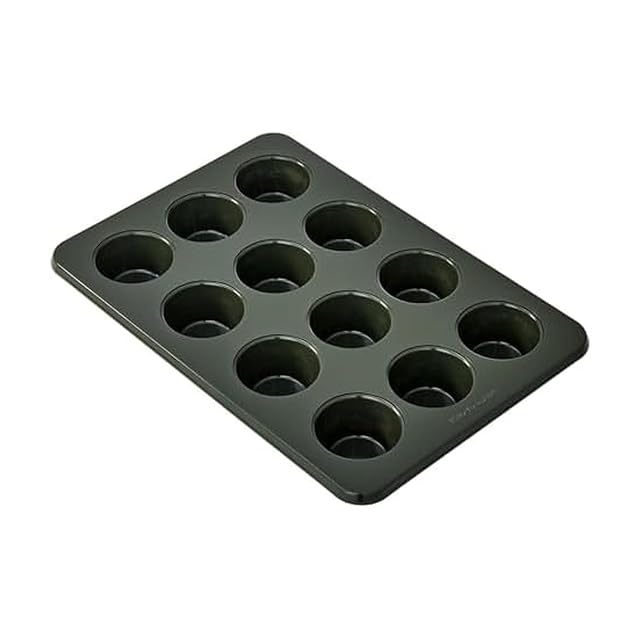
KitchenAid 12-Cup Nonstick Muffin Pan
A 12-cup aluminized steel muffin pan with a Swiss-engineered non-stick coating, extended handles and an anti-warp rim, in Evergreen.
- Cups
- Twelve, the standard tray
- Material
- Aluminized steel — carbon steel coated in aluminum alloy
- Overall size
- Catalog 422 × 290 × 40 mm = 16.6 × 11.4 × 1.6 inches
- Weight
- 794 g (28 oz) — the heaviest single pan on this shelf
- Extended handles
- Stated grippable in pot holders
- Anti-warp rim
- A uniquely designed rim is stated to prevent warping
- Also for
- Cupcakes and egg bites, both named in the description
- Dishwasher
- Safe, with no caveat
- Color
- Evergreen — the darkest pan on this shelf
- Reference
- KQ958OSFFA
- Cup diameter, depth or volume
- None of the three published
- Bullets
- The same five as the maker’s 9 × 5 loaf pan, verbatim
- Oven limit
- Not published — "stands up to high heat" with no figure
- Metal utensils
- Not claimed
- Amazon reference
- B0FBNFCLF1
- EAN
- 0015388082524
- Aluminized steel, the only coated steel on this shelf that resists rust where the coating breaks
- 794 grams, the heaviest single pan here, which is what keeps a twelve-cup tray flat
- Twenty-two dollars for one pan, against $5.33 a piece in the six-piece set that contains one
Best for: Twelve muffins in a pan heavy enough not to buckle
≈ $22Check price on Amazon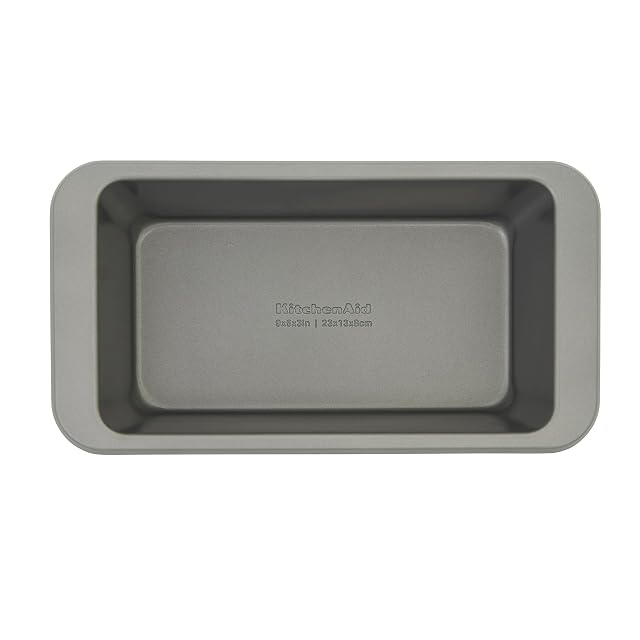
KitchenAid 9 × 5 in Nonstick Loaf Pan
A 9 × 5 inch aluminized steel loaf pan with a Swiss-engineered non-stick coating, extended handles and a rim designed against warping.
- Material
- Aluminized steel — carbon steel coated in aluminum alloy
- Size
- 9 × 5 inches
- Occupies
- 11 × 6 inches of shelf — catalog 279 × 152 mm (11 × 5.98 in)
- Depth
- Catalog 77 mm (3.03 in), about 3.0 inches — not published on the page
- Extended handles
- Stated grippable in pot holders
- Anti-warp rim
- A uniquely designed rim is stated to prevent warping
- Coating
- Swiss-engineered heavy-duty; composition not published
- Dishwasher
- Safe, with no caveat
- Color
- Contour Silver
- Reference
- KQ957OSNSA
- Bullets
- The same five as the maker’s 12-cup muffin pan, verbatim
- Metal utensils
- Not claimed
- Weight
- Not published
- Oven limit
- Not published — "stands up to high heat" with no figure
- Amazon reference
- B0CJP39XBY
- EAN
- 0015388080476
- Aluminized steel, which conducts better than plain carbon and does not rust where intact
- Extended handles, stated to be grippable in pot holders
- Five bullets identical to the maker’s muffin pan, promising jelly rolls and sheet cakes
Best for: A standard loaf in a pan that will not rust at the rim
≈ $15Check price on Amazon
Elsewhere in the kitchen drawer
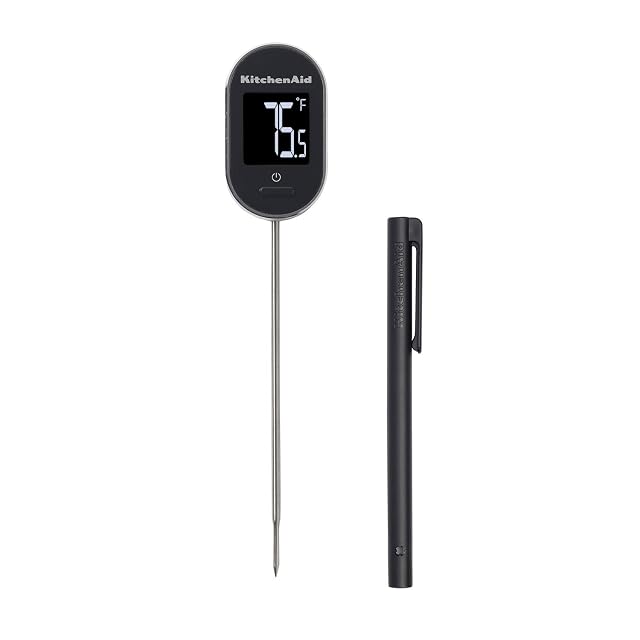
KitchenAid KQ904 Instant Read Food Thermometer
A digital thermistor thermometer reading in under six seconds from −40 to 482 °F, with an oversized pivoting backlit display and a battery included.
- Display
- Oversized and pivoting, readable from any angle
- Sensor
- A digital thermistor — one of only two sensors named among the items sold on Amazon.com
- Speed
- Less than 6 seconds — the slowest published here
- Range
- −40 to 482 °F (−40 to 250 °C)
- Backlight
- Yes, on the pivoting display
- Battery
- Included; type not stated
- Honest warning
- Never leave it in food while cooking — unique on this shelf
- Color
- Black
- Reference
- KQ904
- Catalog size
- 191 × 35 × 20 mm (7.52 × 1.38 × 0.79 in) — about 7.5 × 1.4 × 0.8 inches
- Accuracy
- Not published at all
- Waterproof rating
- None published
- Calibration
- None published
- Magnet, hook or lock
- None published
- Amazon reference
- B07YP943VT
- EAN
- 0077784035559
- A pivoting oversized display, which only one other item here approaches
- The only page on this shelf that warns you not to leave it in the food
- Under six seconds, which is six times the one-second thermometers at ten dollars
Best for: A reader who needs the display legible from any angle more than a fast reading
≈ $12Check price on Amazon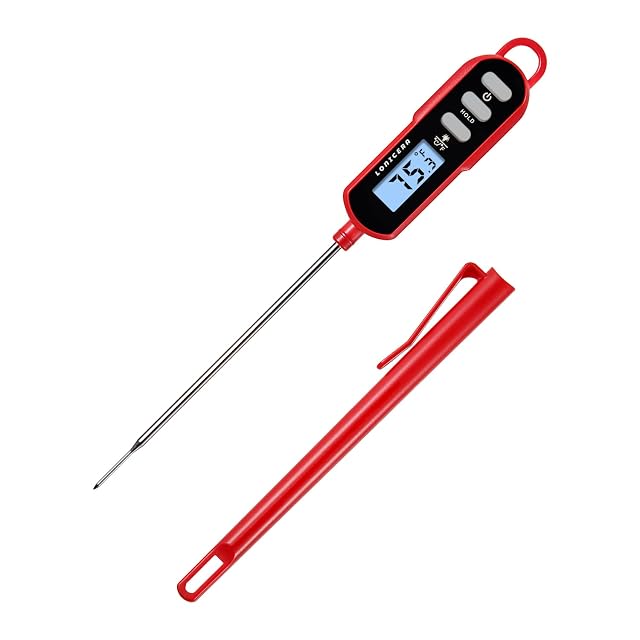
LONICERA DT-111 Digital Cooking Thermometer
A one-to-two second thermometer accurate to ±1 °F with a 5-inch probe, IPX6 waterproof, a hold button, a magnet, and an 18-month warranty.
- Warranty
- 18 months, plus a 60-day money-back guarantee
- Probe length
- 5 inches — one of four published on this shelf
- Accuracy
- ±1 °F
- Speed
- 1 to 2 seconds
- Waterproof
- IPX6 — high-pressure jets; dust is not rated
- Hold
- A hold button locks the reading
- Range
- −58 to 572 °F
- Written for
- Dough temperature during fermentation and proofing
- Magnet
- Built in
- Units
- An °F / °C switch
- Weight
- 40 g (1.4 oz) — 239 × 25 × 5 mm (9.41 × 0.98 × 0.20 in)
- Reference
- DT-111
- Calibration
- Not published
- Battery
- Not published
- Amazon reference
- B09MTX71VX
- EAN
- 0619185962807
- Eighteen months of warranty and sixty days to return it, the best cover on this shelf
- A measured 5-inch probe, which only three other items here publish
- No calibration function, so drift can be noticed and not corrected
Best for: Bread and dough, where probe reach and a long warranty matter more than half a second
≈ $13Check price on Amazon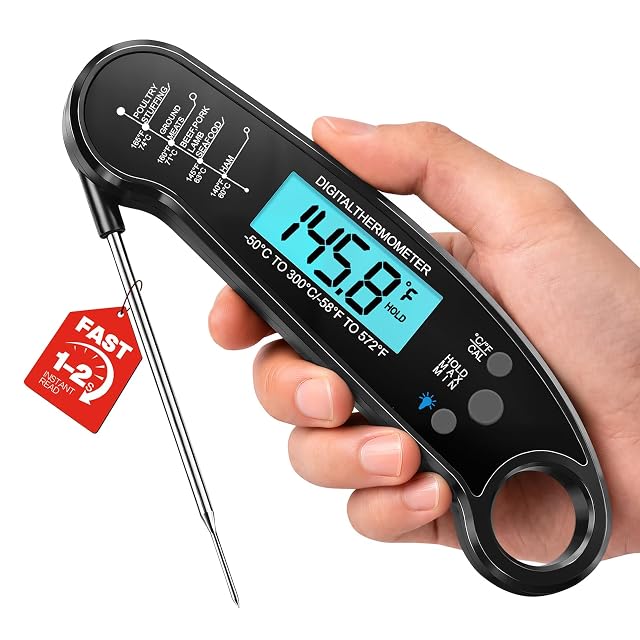
ONFIKY FM152 IP67 Digital Meat Thermometer
A one-to-two second instant-read thermometer accurate to ±1 °F, fully IP67 sealed, with calibration, a backlit LCD, a magnet and 4,000+ hours of battery.
- Waterproof
- IP67 — dust-tight and 30 minutes under a meter of water
- Accuracy
- ±1 °F
- Speed
- 1 to 2 seconds
- Calibration
- Published — one of only five sold on Amazon.com
- Battery life
- Over 4000 hours, with auto-sleep and motion wake
- Range
- −58 to 572 °F (−50 to 300 °C)
- Display
- Large bright LCD with backlight
- Body
- Shock-resistant ABS
- Magnet
- Built in
- Named uses
- Barbecue, smoking, baking, air frying, candy, liquids
- Reference
- FM152-Black-new
- Identical twin
- The FM152, a cent cheaper at $9.97, with the same specification
- Probe length
- Not published
- Warranty
- Not published
- Amazon reference
- B0H68MTJV6
- EAN
- 0799473210435
- IP67 sealing and calibration together, which nothing cheaper on this shelf offers
- One to two seconds at ±1 °F, beaten only by a thermometer at twice the price
- Indistinguishable from its own stablemate, a cent cheaper
Best for: The same job as its twin — a sealed, checkable thermometer on a magnet
≈ $10Check price on Amazon