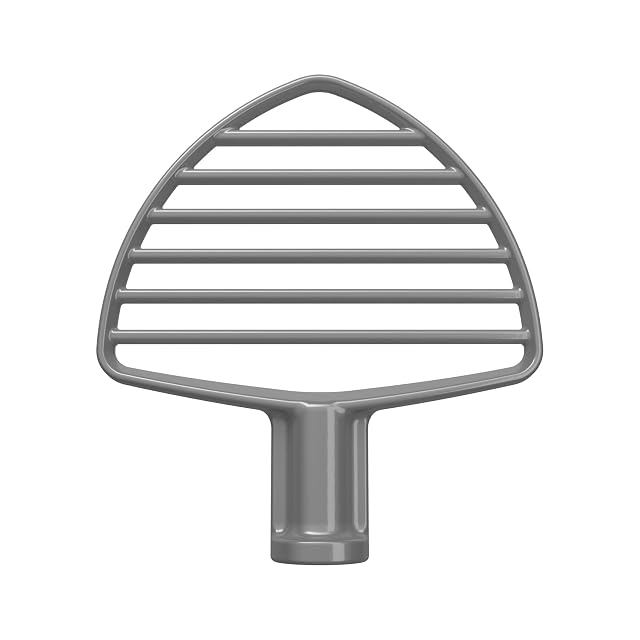
Best for: Pastry, biscuits and scones — cutting cold butter into flour in the bowl
≈ $50
Check price on Amazon It cuts butter into flour, and ships a scraper
A pastry beater for eighteen named bowl-lift KitchenAid mixers with stainless bowls, cutting cold butter into flour, supplied with a scraper and dishwasher safe.
Best for: Pastry, biscuits and scones — cutting cold butter into flour in the bowl
“The beater design works seamlessly with the bowl to break cold butter into small pieces, creating a consistent texture and even distribution, minimizing the risk of overmixing.”
Everything else on this shelf makes a claim. This one gives a reason.
Why pastry is a different problem from mixing. Flaky pastry depends on pieces of solid fat surviving into the oven. Steam from those pieces is what lifts the layers — so the goal is to coat flour around pea-sized lumps of cold butter and then stop.
Two things ruin it. Warmth, which smears the butter into the flour instead of cutting it. And time, which does the same and develops gluten besides.
Which is why “minimizing the risk of overmixing” is the operative phrase, and why no other page on this shelf has any reason to say it.
A flat beater does neither job well. A broad paddle creams rather than cuts — the action that makes a cake batter is the action that destroys pastry.
And a flex edge beater is worse. A silicone strip flexes away from cold butter rather than cutting it, which is exactly the failure a soft edge has in any stiff cold mixture. At least six of the fourteen items on this shelf have a flexible edge; this has none.
What it is, in effect, is a mechanical pastry blender — the hand tool with curved wires — driven by the mixer and sized to the bowl.
And bullet four is the unexpected second use: “shred meats and mash fruits and vegetables - great for applesauce, mashed pinto beans, chunky jam, egg salad, mashed potatoes.”
All five are the same action. Breaking solids into pieces without pureeing them — which is what a cutting beater does and a creaming paddle does not. “Chunky jam” is the clearest statement of it: you want fruit broken, not liquidized.
“Quickly and easily remove dough from the beater with the included scraper.” · “Model KSMPB7 includes (1) Pastry Beater (dishwasher-safe), (1) Scraper”
At least eleven of the fourteen items here ship a beater and nothing else. KitchenAid’s own KN256CBT at $24.95 says so plainly: “Model KN256CBT Includes: (1) Flat Beater.”
Why a pastry beater clogs, and why the scraper is part of the tool rather than an extra.
A cutting beater is a set of ribs with gaps between them, and the gaps are the design. They are what let flour and butter pass through and be cut rather than pushed round.
And the same gaps pack solid with half-made pastry dough — a short, fatty, barely hydrated mixture that sticks to metal and will not shake off.
A flat paddle has nowhere to trap dough. A cutting beater has nothing but places to trap it.
Three third-party pages on this shelf offer the reverse trick — the beater as the scraper: the Vaxaape at $9.99 (“The Flat Beater Can Also Double As a Spatula”), the KITCHPOWER at $20.99 (“can also double as a spatula”) and the New Metro Design at $28.99 (“Use BeaterBlade as a hand held spatula to transfer batter”).
That works on a solid blade and not on this one.
The habit nobody states: scrape it while the dough is still cold. Short pastry warms in the hand in a minute, and warm dough in the gaps of a cutting beater is far harder to remove than cold crumb.
It is the longest model list on this shelf, and it carries two exclusions, both stated.
The list: KV25G0, KP26M9, KP25M0, KP26M1, KSM758, KSM759, KSM6583, KSM500, KL26M8, KF26M22, KF26M1Q, KP26N9, KP26M8, KV25ME, KV25MC, KSM55, KSM60, KSM70.
Bowl-lift only, and bullet six states it from the other side: “Only approved for bowl-lift use with stainless steal - not intended for Tilt-Lift Stand mixers.”
Why that is absolute. A tilt-head hinges the head back to release the bowl; a bowl-lift raises the bowl on a lever into a fixed head. Different shaft heights, different bowl profiles, different clearances — a beater for one does not fit the other at all.
Two items on this shelf are tilt-head: the Vaxaape at $9.99 and KitchenAid’s own KFE5T at $29.95. Ten are bowl-lift.
Stainless bowls only, and this is the more interesting requirement — because bullet two tells you why without meaning to.
“The beater design works seamlessly with the bowl” means the cutting happens between the beater and the bowl wall, not within the beater. The clearance is the tool.
A glass bowl of the same nominal capacity has thicker walls and a different curve, so the gap changes — and a rigid cutting beater in a glass bowl either fouls the glass or stands off it and cuts nothing. Glass also chips where steel does not.
Four items on this shelf state the same requirement or the matching exclusion: this, its $69.95 sibling, the KDF7B at $44.95 (“using stainless steel bowls only… not compatible with any model not listed”), and the Reikame at $14.99 and New Metro Design at $28.99, which exclude glass bowls by name.
And the model codes on this shelf disagree across pages for what is presumably the same machine. KV25G0, KV25ME and KV25MC here · KV25M on the Reikame at $14.99 · KV25GOX and KV25G8X on the KITCHPOWER at $20.99 · KV25 on the Wiselet at $25.79 · KV25G on the XINBOOGQ at $24.99.
Which is why the two pages that publish a bowl measurement are worth more than any list. The Reikame at $14.99: “9.75” diameter, 6.75” deep.” The New Metro Design at $28.99: “between 8 and 8.5-inches diameter, across the top of the bowl.”
Check the badge against the eighteen, and check that the bowl is steel.
KitchenAid sells a KSMPB7SS on this shelf at $69.95, and the comparison is the sharpest thing here.
Identical eighteen-model list, word for word. Identical catalog dimensions: 36 × 164 × 182 mm. Six of the seven bullets identical — the dearer one omits only “Only approved for bowl-lift use with stainless steal - not intended for Tilt-Lift Stand mixers”. Both ship “(1) Pastry Beater (dishwasher-safe), (1) Scraper”.
And the weights are not close. This is 200 g. That is 590 g — nearly three times.
Twenty dollars more, and 390 grams more, and not one bullet of difference in what either claims to do.
The “SS” suffix suggests stainless steel, and this one is listed as “Silver”. Neither page publishes a material at all, which makes that an inference rather than a fact.
What 590 grams against 200 grams would mean if the inference is right. Solid stainless against a lighter casting — and aluminum is about a third the density of steel, which fits.
Why it would matter on this tool in particular. A cutting beater works by rigidity. Cold butter resists, and a beater that flexes smears instead of cutting — which is the whole argument for having no silicone on it. A heavier, stiffer beater cuts better.
And why it might not be worth twenty dollars. A cutting beater is not under the load a dough hook is, and 200 grams of rigid metal is already rigid. Mass also costs inertia on the planetary gear.
On the evidence published, the two pages give a buyer nothing to decide with except the weight — and the cheaper one has the extra bullet.
No material. This is the sharpest omission on this shelf and it is shared with three other KitchenAid parts: the KN256CBT at $24.95, the KDF7B at $44.95 and the $69.95 sibling. The K5AB at $24.95 manages “Coated”. Meanwhile the Vaxaape at $9.99 names its frame, coating and edge (“Die-Cast Aluminum With White Ford Teflon Coating And Silicone Flex Edge”), the Wiselet at $25.79 names “solid stainless steel”, the XINBOOGQ at $24.99 names “304”, and the New Metro Design at $28.99 names “high impact plastic”.
On a tool that cuts cold butter, the material is the function. A rigid steel cutter works; a coated aluminum one is softer and a plastic one would flex.
No dimensions. One item publishes its own: the KITCHPOWER at $20.99 — “6.7 x 7.1 x 1.4 inches”. The catalog here gives 36 × 164 × 182 mm, about 1.4 × 6.5 × 7.2 inches, which is almost exactly the KITCHPOWER’s figure.
No gap or clearance figure, which on a tool whose action is “between the beater and the bowl” is the specification. A KitchenAid’s beater-to-bowl gap is set by a screw in the base — the standard check is a dime laid in the bowl, which the paddle should just move — and no page on this shelf mentions it. On this tool, that adjustment is what decides whether it cuts.
No butter temperature. The page says “cold butter” and gives no figure — and the difference between butter at refrigerator temperature and butter at room temperature is the difference between pastry and a biscuit.
No batch size. Eighteen models spanning 5 to 7 quart bowls, and no statement of how much flour the tool handles at the bottom or the top of that range.
No time figure. Three items on this shelf publish 50 percent: the Vaxaape at $9.99, the KITCHPOWER at $20.99 and the New Metro Design at $28.99. This page says “with less effort” — which for a pastry beater is the right claim, since speed is not what you want.
No scraper material, on an included accessory.
No warranty, which no item on this shelf publishes.
No country of manufacture. One item on this shelf publishes one: the New Metro Design at $28.99 — “Always made in the USA from high impact plastic”.
And a note on the shelf: it is named for bowls and beaters, and all twelve items are beaters. There is no bowl here at all — which matters most on this page, since it requires a stainless bowl, “sold separately”, by its own first bullet.
Read on the day this page was built: $40 at the American Amazon shop.
Read from Keepa on the day this page was last revised; stock and price both move without notice.
Prices quoted in this text were read on 2026-10-17. The live price is at the top of the page.
Break cold butter into flour without warming it or overworking it — and this is the only page on this shelf that explains a mechanism at all. Bullet two: "The beater design works seamlessly with the bowl to break cold butter into small pieces, creating a consistent texture and even distribution, minimizing the risk of overmixing." Bullet three: "Easily cut butter into flour to make pastry dough for a variety of flaky dishes, such as biscuits, scones, tarts, empanadas, with less effort." Why pastry is a different problem from mixing. Flaky pastry depends on pieces of solid fat surviving into the oven. Steam from those pieces is what lifts the layers — so the goal is to coat flour around pea-sized lumps of cold butter and then stop. Two things ruin it. Warmth, which smears the butter into the flour instead of cutting it, and time, which does the same and develops gluten besides. A flat beater does neither job well. A broad paddle creams rather than cuts — the action that makes a cake batter is the action that destroys pastry — and a flex edge beater is worse still, because a silicone strip flexes away from cold butter rather than cutting it. Which is why this tool has no silicone on it at all, where at least six of the fourteen items on this shelf do. What it is, in effect, is a mechanical pastry blender — the hand tool with curved wires — driven by the mixer and sized to the bowl. And bullet four is the unexpected second use: "shred meats and mash fruits and vegetables - great for applesauce, mashed pinto beans, chunky jam, egg salad, and mashed potatoes." All five are the same action: breaking solids into pieces without pureeing them, which is exactly what a cutting beater does and a creaming paddle does not.
Because the thing it does best is also the thing that clogs it — and it is the only item on this shelf with anything in the box besides the beater. Bullet five: "Quickly and easily remove dough from the beater with the included scraper. Dishwasher-safe as well." Bullet seven: "Model KSMPB7 includes (1) Pastry Beater (dishwasher-safe), (1) Scraper." Why a pastry beater clogs. A cutting beater is a set of ribs or wires with gaps between them, and that is the whole design: the gaps are what let flour and butter pass through and be cut rather than pushed. And the same gaps pack solid with half-made pastry dough — which is a short, fatty, barely-hydrated mixture that sticks to metal and will not shake off. A flat paddle has nowhere to trap dough. A cutting beater has nothing but places to trap it. So the scraper is not an accessory, it is part of the tool. Compare the rest of the shelf. Eleven items ship a beater and nothing else. KitchenAid’s own KN256CBT at $24.95 states it: "Model KN256CBT Includes: (1) Flat Beater." And three third-party pages offer the reverse trick — the beater as the scraper: the Vaxaape at $9.99 ("The Flat Beater Can Also Double As a Spatula"), the KITCHPOWER at $20.99 and the New Metro Design at $28.99 ("Use BeaterBlade as a hand held spatula to transfer batter"). The practical habit nobody states: scrape it while the dough is still cold. Short pastry dough warms in the hand in a minute, and warm dough in the gaps of a cutting beater is far harder to get out than cold crumb.
Eighteen models, bowl-lift only, and a steel bowl is a requirement rather than a preference. Bullet one: "Fits KitchenAid Bowl-Lift Stand Mixers with Stainless Steel Bowls Only - models: KV25G0, KP26M9, KP25M0, KP26M1, KSM758, KSM759, KSM6583, KSM500, KL26M8, KF26M22, KF26M1Q, KP26N9, KP26M8, KV25ME, KV25MC, KSM55, KSM60, KSM70, sold separately." Bullet six states the other exclusion: "Only approved for bowl-lift use with stainless steal - not intended for Tilt-Lift Stand mixers." Why bowl-lift only, and it is absolute. A tilt-head hinges the head back to release the bowl; a bowl-lift raises the bowl on a lever into a fixed head. Different shaft heights, different bowl profiles, different clearances — a beater for one does not fit the other at all. Two items on this shelf are tilt-head: the Vaxaape at $9.99 and KitchenAid’s own KFE5T at $29.95. Ten are bowl-lift. Why stainless bowls only, and this is the more interesting requirement. Bullet two says the beater "works seamlessly with the bowl" — which means the cutting action is between the beater and the bowl wall, not within the beater itself. The clearance is the tool. A glass bowl of the same nominal capacity has thicker walls and a different curve, so the gap changes — and a rigid cutting beater in a glass bowl either fouls the glass or stands off it and cuts nothing. Glass also chips where steel does not. Four items on this shelf state the same requirement or exclusion: this, its $69.95 sibling, the KDF7B at $44.95 ("using stainless steel bowls only"), and the Reikame at $14.99 and New Metro Design at $28.99, which exclude glass bowls by name. So: check the badge against the eighteen, and check that the bowl is steel.
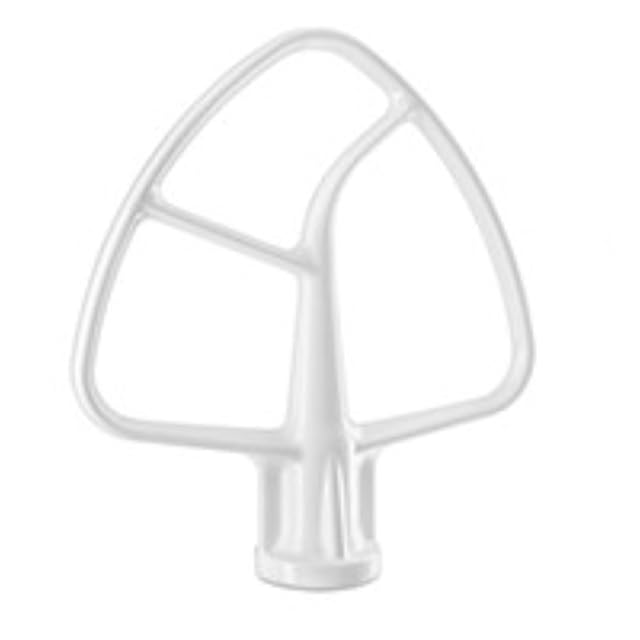
The maker’s own flat beater for 5 and 6 quart Professional bowl-lift KitchenAid stand mixers, supplied as one beater, stated for those mixers only.
Best for: A Professional 5 or 6 quart bowl-lift, bought from the maker
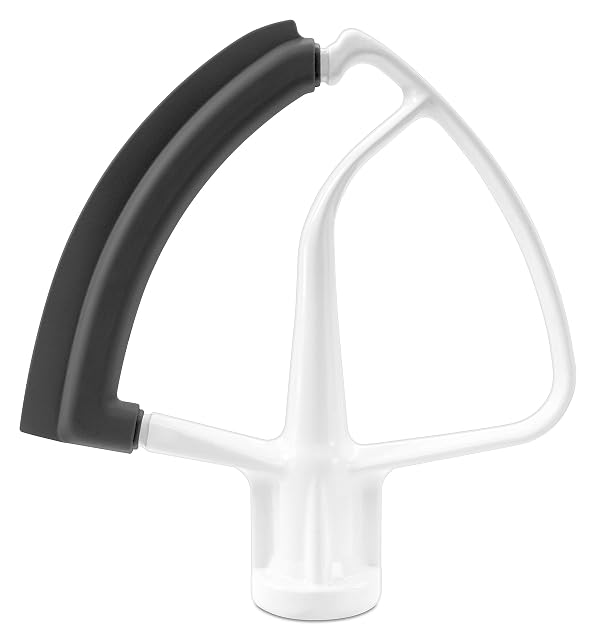
The maker’s flex edge beater for 4.5 and 5 quart tilt-head KitchenAid mixers, with a flexible edge that scrapes ingredients in, dishwasher safe, in white.
Best for: A 4.5 or 5 quart tilt-head KitchenAid, bought from the maker
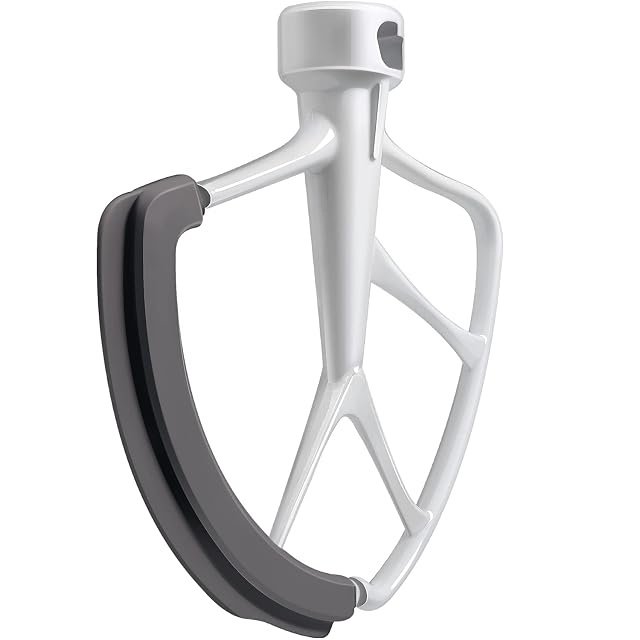
A coated-aluminum flex edge beater with silicone edges for 6 quart bowl-lift KitchenAid mixers, dishwasher safe, with its own dimensions and thirteen models published.
Best for: A 6 quart bowl-lift KitchenAid, or a Professional 5-Plus
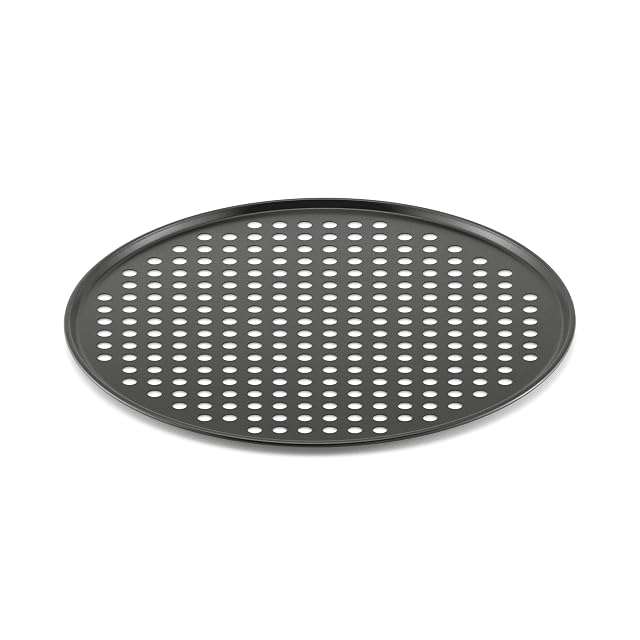
A 13-inch non-stick pizza crisper with 1/3 inch crisper holes, designed for four named Breville Smart Ovens and usable in a conventional wall oven.
Best for: A Breville Smart Oven, where the pan is sized to the cavity
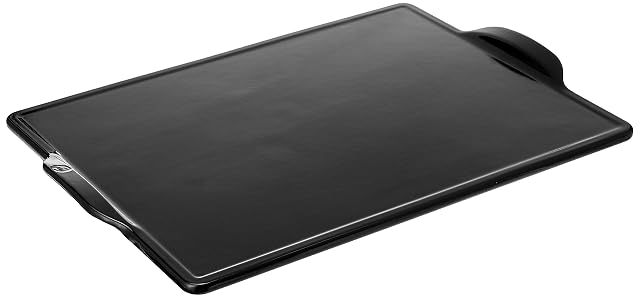
A rectangular BBQ ceramic grill and oven stone with handles, safe to 900 °F on gas, charcoal and wood grills, usable under a broiler, dishwasher safe and guaranteed ten years.
Best for: A grill or an oven, where the stone will be washed and will last
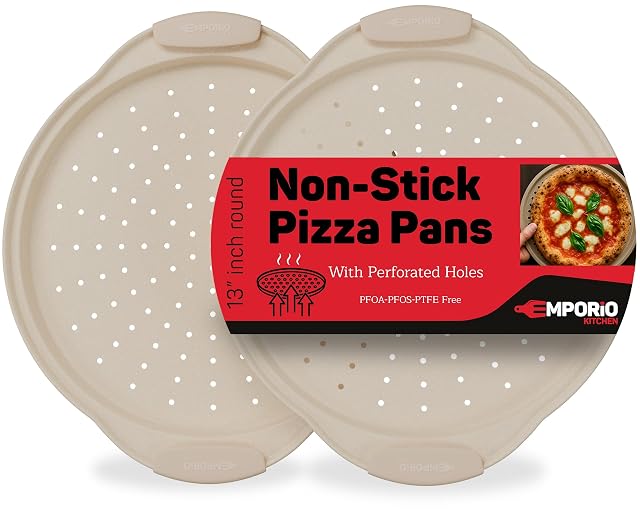
Two 13-inch round perforated carbon steel pizza pans in 0.02 in (0.5 mm) steel with silicone handles, non-stick inside and out, dishwasher safe and rated to 450 °F.
Best for: Thirteen-inch pizzas at 425 to 450 °F, lifted out by the handle