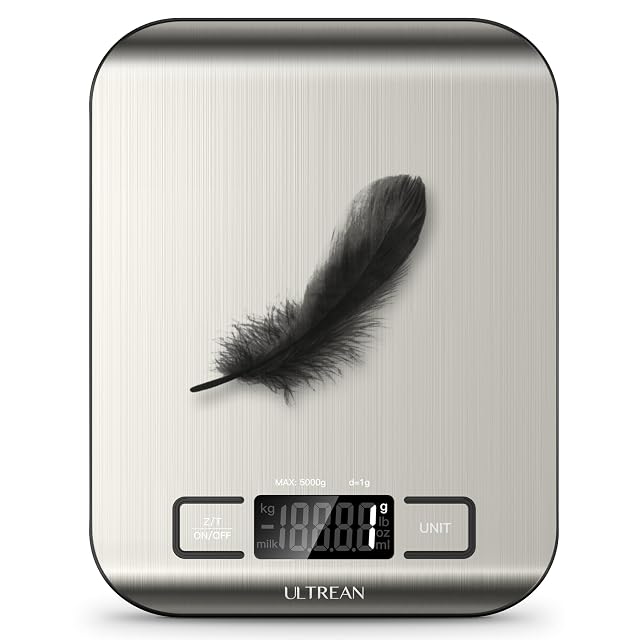
Best for: Everyday weighing where 304 steel and a legible display matter most
≈ $7
Check price on Amazon Six units and 304 steel, for seven dollars
An 11-pound 304 stainless kitchen scale with six units including milk volume, tare, a negative white backlit display and batteries included.
Best for: Everyday weighing where 304 steel and a legible display matter most
The bullets claim “accurate weight data” and “high precision sensors to ensure correct performance and readouts”, and publish no increment at all.
Every other scale here gives one:
1 g / 0.05 oz — the SOYOK at $6.98, the Amazon Basics at $11.14, the Etekcity at $13.99, the GGQ at $17.98, the Greater Goods at $24.99, the Escali at $25, the Etekcity USB at $29.99, the Etekcity nutritional at $39.99 11 lb × 0.1 oz and 5,000 g × 1 g — the KitchenAid at $23.99, which also publishes a separate liquid resolution 1/8 ounce and 1 gram — both OXO scales 0.01 g on one platform — the Letron at $34.99, the only scale here finer than a gram
What it almost certainly is: 1 gram. The sister product at the same price — the SOYOK at $6.98, with identical catalog dimensions of 180 × 140 × 15 mm — publishes 1 g / 0.05 oz.
So the figure is inferable and not published, which is a different thing from being absent.
Why it matters. One gram cannot dose yeast or salt. A 7 g sachet of yeast at ±1 g is ±14 percent — the difference between a dough that proves in an hour and one that takes three. Three grams of salt is ±33 percent, and salt governs both flavor and fermentation speed.
One gram is the resolution of flour, not of salt. 500 g of flour ±1 g is ±0.2 percent, which is beyond what any recipe needs.
And the Greater Goods at $24.99 is the only page on this shelf to state a limit of its own: “Not for laboratory or microgram measurements.”
The second missing figure is the minimum weighable load. Five scales here publish one: 2 g on the Amazon Basics at $11.14 and the Etekcity USB at $29.99, 3 g on the GGQ at $17.98 and the Etekcity nutritional at $39.99, 0.01 g on the Letron’s mini platform.
The consequence nobody writes down: a scale with a 2 gram threshold reads zero for 1.5 g of yeast. That is not imprecision, it is a refusal to weigh.
The product name gives the grade: 304 stainless steel.
Three scales on this shelf name it: this, the Etekcity at $13.99 (“304 food-grade stainless steel surfaces”) and the Etekcity nutritional at $39.99 (“food-grade 304 stainless steel weighing platform”).
The rest: “stainless steel”, unqualified — the SOYOK at $6.98, the GGQ at $17.98, the Greater Goods at $24.99, the OXO at $64.95 · glass — the KitchenAid at $23.99 · stainless and glass — the Letron at $34.99 · “food-safe, BPA-free plastic components” with a stainless platform — the Amazon Basics at $11.14 · “Chrome”, with no material stated — the Escali at $25.
What 304 is. An austenitic stainless with roughly 18 percent chromium and 8 percent nickel — the standard food-contact grade, and the one that does not pit or stain from acids.
Which matters on a scale platform because of what lands on it: lemon juice, vinegar, brine, raw meat. A lower grade marks; 304 does not.
What it does not change is the reading. The load cell is underneath and the platform is a cover — so 304 buys a surface that still looks new in five years, not a better measurement.
And the caution the KitchenAid page states and this one does not: a stainless top is not a sealed body. The KitchenAid at $23.99 publishes “Hand wash only; do not immerse in water or put in dishwasher; for best results, wipe with a damp cloth and dry thoroughly.”
Only one scale on this shelf publishes a water rating: the Etekcity USB at $29.99 — “IPX6 waterproof design, allowing you to easily measure liquids and wipe the scale clean”.
Two claim waterproofing without a rating: the SOYOK at $6.98 (“more waterproof and wear-resistant”) and the GGQ at $17.98 (“waterproof Anti-collision glass weighing panel”).
And both OXO scales answer it differently: “Platform removes for hand washing.”
For this one: wipe the platform, keep water out of the button seams and the battery hatch, dry it.
“g / kg/lb/oz/ml/milk ml; Yes! It includes milk volume measurement”
Six is the most on this shelf, shared with the SOYOK at $6.98. The fewest is three — the Escali at $25: oz, lb:oz, g — and that scale carries the only lifetime warranty here.
What “milk ml” actually is, since five pages on this shelf sell it and none explains it.
A scale cannot measure volume. It measures mass and divides by an assumed density.
Water is 1.00 gram per milliliter, so 250 ml of water weighs 250 g and the conversion is invisible. Milk is about 1.03 g per milliliter, because of its dissolved sugars, proteins and minerals. So “milk ml” applies the other divisor.
The whole content of the feature is a three percent difference. On 250 ml that is about 8 ml, which nothing will notice. On a liter it is 30 ml, which a custard might.
The other pages that sell it: the SOYOK at $6.98 · the Etekcity USB at $29.99 — “milliliters (milk and water), and fluid ounces (milk and water)” · the Etekcity nutritional at $39.99 — “g (water & milk)/ml (water & milk)” · and the GGQ at $17.98, water only.
The better habit, which no page here suggests: weigh liquids in grams and ignore the volume units. A mass in grams can be checked against the packet; a converted volume cannot.
One caution on one-button unit switching, which this page implies and does not state. The unit does not necessarily reset on power-up — so check the display before you trust the number, particularly if somebody else used the scale last.
“The unit has a negative white digital display so it is easy to read and see even in not well-lit rooms”
A negative display is light digits on a dark field, rather than the usual dark digits on a pale grey one.
Which matters more on a kitchen scale than on most instruments, for a reason this page half-states and the better scales on this shelf address directly: the platform sits above the display. Put a large bowl on the scale and it shadows the one number you need.
Two scales here attack that problem properly, and nine ignore it:
Both OXO scales — $37.95 and $64.95 — “Display pulls away from base to avoid shadowing from plates or bowls”: the display physically leaves the body Greater Goods, $24.99 — “the bright Hi-Def LCD display extends beyond the weighing platform for better visibility under large mixing bowls”
And four publish a backlight: this, the SOYOK at $6.98 (a “night vision mode”), the Etekcity at $13.99 (“Backlit LCD screen with large fonts”) and the OXO 5 lb at $37.95 (“optional backlight”).
A backlight and a negative field do the same job for a tenth of the engineering of a pull-out display, and neither solves the geometry: a bowl wider than the body still covers the screen.
No display size or digit height is published here, which is true of every scale on this shelf. “Large fonts” (Etekcity), “wide LCD screen” (Amazon Basics), “Hi-Def” (Greater Goods) and “large, easy-to-read numbers” (both OXO) are the vocabulary, and no item gives a figure.
“Plus it has an auto shut off feature”
The durations published on this shelf:
2 minutes — the SOYOK at $6.98, the GGQ at $17.98, the Greater Goods at $24.99 3 minutes — the KitchenAid at $23.99 4 minutes — the Escali at $25 5 minutes — the Letron at $34.99 Unspecified — this Nothing published — the Amazon Basics at $11.14, the Etekcity at $13.99, the Etekcity USB at $29.99, the Etekcity nutritional at $39.99, and both OXO scales
Why the number is not a detail. A multi-ingredient recipe is weighed cumulatively: bowl on, tare, flour in, tare, sugar in, tare. Go to the cupboard between two of those and a two-minute scale has switched off and lost the zero — so the bowl comes off, the scale restarts, the bowl goes back, and the flour already in it is now part of the tare.
Four minutes, which the Escali publishes, is the figure that makes that workflow survivable. Five, which the Letron publishes, is comfortable.
And one scale answers it a different way: the Greater Goods at $24.99 pairs a two-minute shutoff with the only timed HOLD here — “keep readings on screen for up to 5 minutes”.
The practical habit on an unstated shutoff: lay out every ingredient before you start weighing. It is good practice anyway, and it removes the problem entirely.
The battery is included and the type is not named, where the SOYOK publishes 2 AAA, the Amazon Basics and the Etekcity at $13.99 publish 2 AAA, and the Greater Goods and KitchenAid publish 3 AAA. Two scales here are rechargeable instead: the Etekcity USB at $29.99 (Type-C, cable included) and the GGQ at $17.98.
And the first-use bullet is the one genuinely helpful line on the page: “Remove the plastic wrapping from the batteries before use.” It is the second of two such instructions on this shelf — the SOYOK tells you to “tear off the blue protective film” from the platform — and the other eleven pages give none.
No resolution, as above, uniquely on this shelf.
No minimum weighable load, as above, where five scales here publish one.
No shutoff duration, as above.
No platform size. One scale publishes its platform as distinct from its body: the GGQ at $17.98 — “7.5” x 5.5” in stainless steel panel provide more stability and space for larger containers”. Three publish overall dimensions: the Amazon Basics (8.3 × 7 × 1.3 in), the Greater Goods (7.6 × 5.6 × 1.3 in), the Escali (8.5 × 6 × 1.5 in). The catalog here is 180 × 140 mm — about 7.1 × 5.5 inches — which is the body, not the platform.
No credible weight. The catalog reads 5 g, which is impossible for a stainless body of 180 × 140 × 15 mm. The SOYOK, with identical dimensions, catalogs at 222 g, which is the realistic order. For comparison on this shelf: Etekcity 200 g, GGQ 250 g, Greater Goods 367 g, Amazon Basics 381 g, Escali 431 g, KitchenAid 535 g, Letron 544 g, Etekcity nutritional 544 g, OXO 5 lb 581 g, Etekcity USB 700 g, OXO 11 lb 816 g. A heavy scale does not slide when you stir a bowl standing on it.
No warranty. “After Sales Support, and Trusted Customer Support Team” is a sentence rather than a term. Three items on this shelf publish one: the Escali at $25 — a lifetime warranty, the only one here · the Greater Goods at $24.99 — a 5-year limited warranty plus “lifetime support from our St. Louis team” · the GGQ at $17.98 — “12 Months Support”. Ten publish nothing, including the $64.95 OXO.
No overload or low-battery warning, where two scales here publish both: the SOYOK at $6.98 and the GGQ at $17.98. An overload warning protects the load cell — pushing a strain gauge past its capacity bends it permanently, after which the scale reads consistently wrong rather than failing, which is worse.
No HOLD function, where three scales here have one.
No anti-slip feet, where the SOYOK publishes four and the GGQ “4 no-slip rubbers”. A strain-gauge scale measures a beam’s deflection, and a scale that is not sitting flat on all four feet reads wrong.
No country of manufacture, which no item on this shelf publishes.
Read on the day this page was built: $7 at the American Amazon shop.
Read from Keepa on the day this page was last revised; stock and price both move without notice.
Prices quoted in this text were read on 2026-10-17. The live price is at the top of the page.
It does not, and it is the only scale on this shelf that omits the figure. The bullets claim "accurate weight data" and "high precision sensors to ensure correct performance and readouts" — and publish no increment. Every other scale here gives one. 1 g (0.04 oz) / 0.05 oz — the SOYOK at $6.98, the Amazon Basics at $11.14, the Etekcity at $13.99, the GGQ at $17.98, the Greater Goods at $24.99, the KitchenAid at $23.99 ("11 LB X 0.1 Oz and 5000 grams x 1 gram"), the Escali at $25, the Etekcity USB at $29.99, the Etekcity nutritional at $39.99. 1/8 ounce and 1 gram — both OXO scales. And 0.01 g on one platform — the Letron at $34.99, the only scale here that reads finer than a gram. What it almost certainly is. An 11-pound scale in this class reads to 1 g (0.04 oz), and the sister product at the same price — the SOYOK at $6.98, with identical catalog dimensions of 180 × 140 × 15 mm (7.09 × 5.51 × 0.59 in) — publishes exactly that: 1 g (0.04 oz) / 0.05 oz. So the figure is inferable and not published, which is a different thing. Why it matters. One gram cannot dose yeast or salt. A 7 g (0.2 oz) sachet of yeast at ±1 g (0.04 oz) is ±14 percent; 3 g (0.1 oz) of salt is ±33 percent. One gram is the resolution of flour, not of salt — and the Greater Goods at $24.99 is the only page on this shelf to state a limit at all: "Not for laboratory or microgram measurements." The second missing figure is the minimum weighable load, which five scales here publish, from 2 g (0.1 oz) to 3 g (0.1 oz). A scale with a 2 gram threshold reads zero for 1.5 g (0.1 oz) of yeast.
A specific grade, and it is the one material claim this page makes that the sister does not. The bullets say "Made of Stainless Steel Material" and the product name says "304 Stainless Steel". Three scales on this shelf name the grade: this, the Etekcity at $13.99 — "304 food-grade stainless steel surfaces" — and the Etekcity nutritional at $39.99 — "food-grade 304 stainless steel weighing platform". The others say "stainless steel" (the SOYOK at $6.98, the GGQ at $17.98, the Greater Goods at $24.99, the Letron at $34.99, the OXO at $64.95) or name something else entirely: the KitchenAid at $23.99 is glass, the Letron combines stainless and glass, the Amazon Basics at $11.14 is "food-safe, BPA-free plastic components" with a stainless platform, and the Escali at $25 is "Chrome" with no material named. What 304 is. An austenitic stainless with roughly 18 percent chromium and 8 percent nickel — the standard food-contact grade, and the one that does not pit or stain from acids. On a kitchen scale the platform meets lemon juice, vinegar, brine and raw meat, and a lower grade will mark. What it does not change is the reading. The load cell is underneath, and the platform is a cover — so 304 buys you a surface that still looks new in five years, not a better measurement. And the practical caution is the one the KitchenAid page states and this one does not: a stainless top is not a sealed body. Wipe the platform; keep water out of the button seams and the battery hatch.
They look like the same scale from two brands, and the SOYOK publishes more. The catalog dimensions are identical: 180 × 140 × 15 mm (7.09 × 5.51 × 0.59 in). Both are 11 lb. Both offer the same six units — g, kg, lb, oz, ml and milk ml. Both include batteries. Both have tare, a backlight and an auto shutoff. What the SOYOK at $6.98 publishes and this does not: the resolution — 1 g (0.04 oz) / 0.05 oz · a two-minute shutoff duration · an overload warning · a low-battery warning · four anti-slip bases and rounded corners · a step-by-step first-use procedure, starting with "tear off the blue protective film" · and a credible catalog weight of 222 g (7.8 oz). What this page publishes and the SOYOK does not: 304 as the steel grade · a "negative white digital display" · and "After Sales Support, and Trusted Customer Support Team". One figure here is not credible. The catalog weight reads 5 g (0.2 oz), which is impossible for a stainless body of 180 × 140 × 15 mm (7.09 × 5.51 × 0.59 in) — the SOYOK’s 222 g (7.8 oz) is the realistic order for both. The honest recommendation: they cost the same, and the SOYOK’s page is the better-documented product. If you want the grade named, this is the one that names it. And neither publishes a warranty — where the Escali at $25 publishes a lifetime one and the Greater Goods at $24.99 a 5-year limited warranty with "lifetime support from our St. Louis team". "After sales support" is a sentence, not a term.
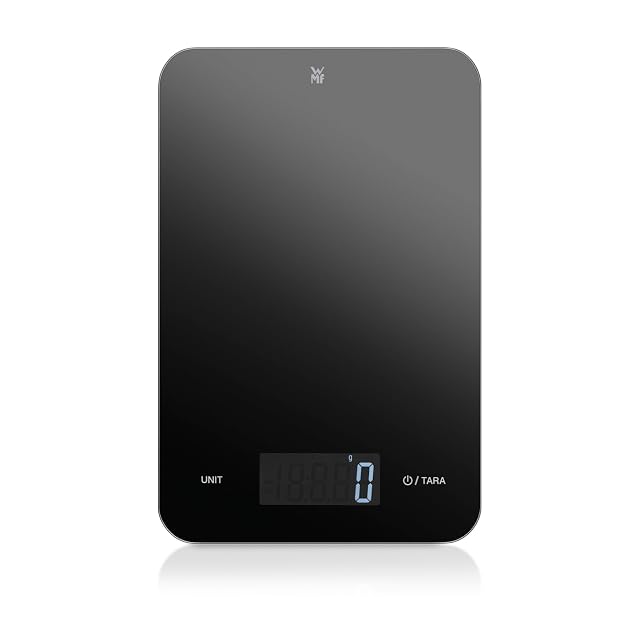
Eleven pounds in one-gram steps on a 9.1 by 5.9 inch safety-glass surface, with four units — milliliters, grams, fluid ounces and pounds-ounces — so liquids are weighed by volume. Tare, battery indicator, automatic shut-off, and a CR2032 cell in the box.
Best for: Baking where liquids are measured by volume and the scale lives on the countertop.
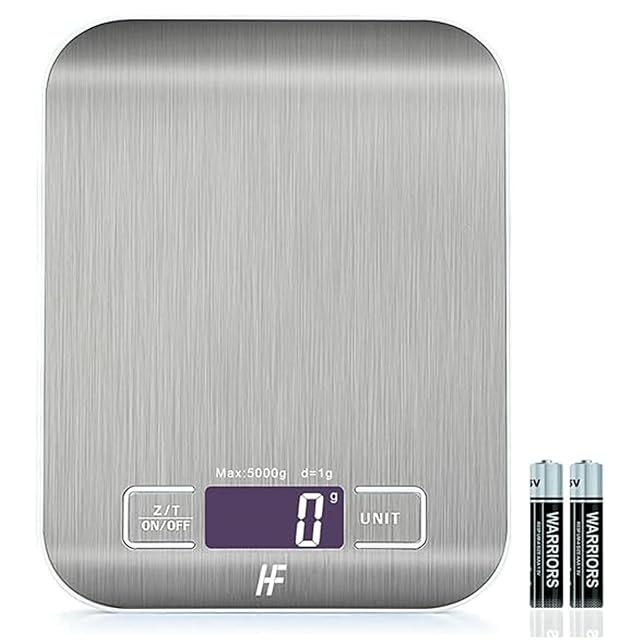
Eleven pounds (5 kg) of capacity graduated in one gram, on a 7.1 × 5.5 in (18 × 14 cm) stainless platform. HomeFashion publishes a backlit display, a tare function, five units, automatic shut-off, a battery indicator, and two AAA cells in the box.
Best for: Everyday baking, weighed in a bowl that is not too wide.
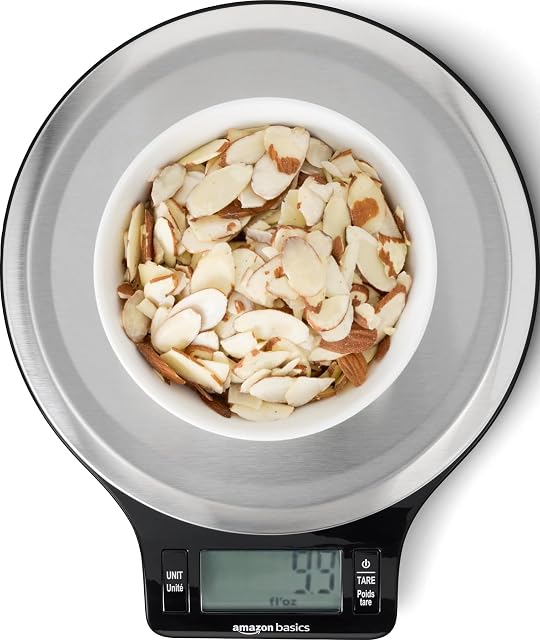
An 11-pound kitchen scale with a stainless platform, a wide LCD, five units, tare, a published 2-gram minimum and two AAA batteries included.
Best for: Everyday weighing on a wide platform, with the threshold stated
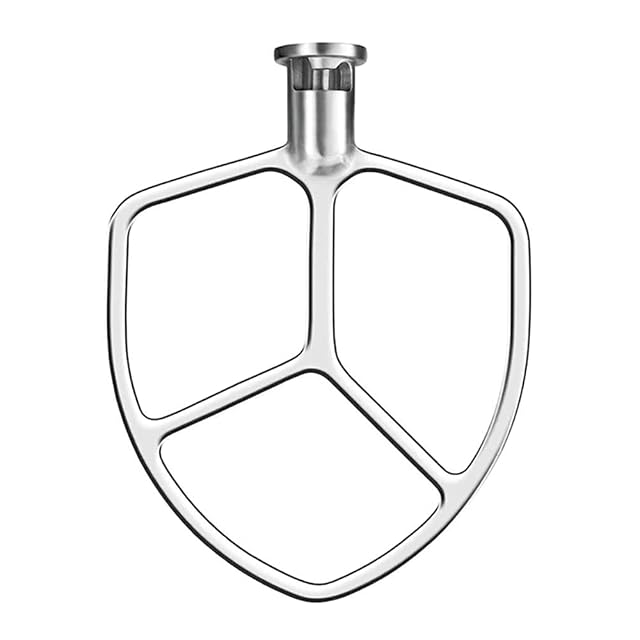
A solid food-grade stainless steel flat beater for 5 and 6 quart bowl-lift KitchenAid mixers, stated never to chip, flake or peel, rust-resistant and dishwasher safe.
Best for: A bowl-lift KitchenAid where a coating chipping is the thing you mind
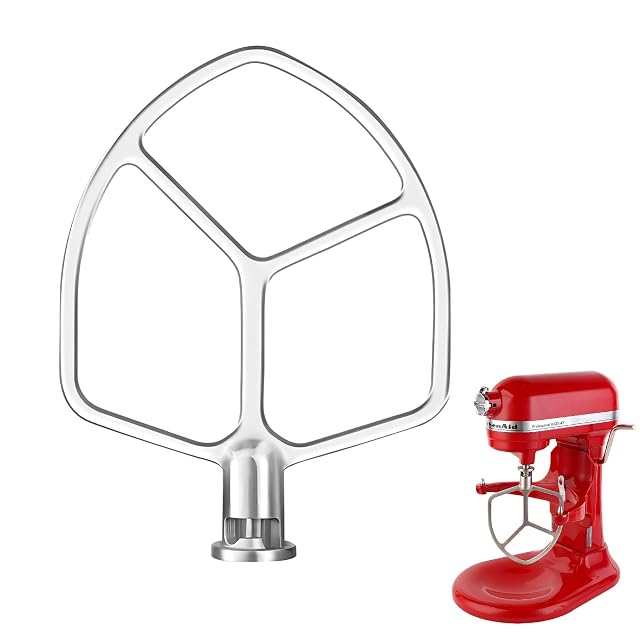
A 304 stainless steel flat beater for nine named KitchenAid bowl-lift series from 5 to 6 quart, rust-resistant with no coating to peel, dishwasher safe.
Best for: A 5 to 6 quart bowl-lift KitchenAid where a coating chipping is the concern
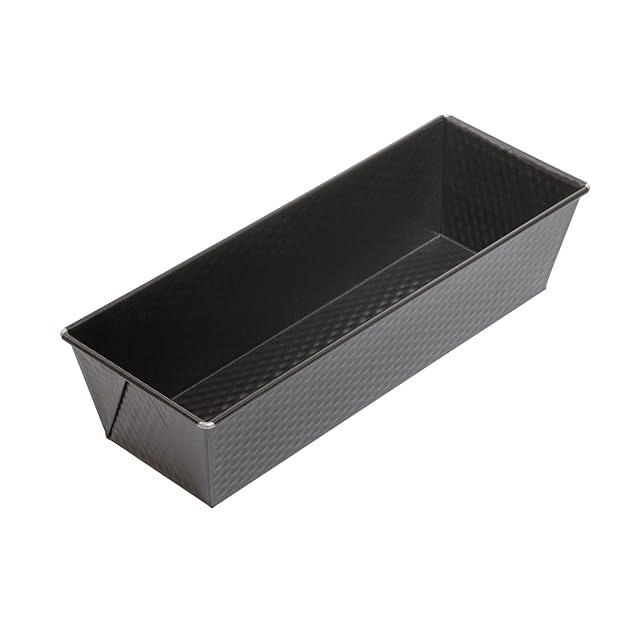
A classic coated steel loaf pan, published at 11.8 by 4.3 by 3.1 inches (30 × 11 × 8 cm) and 2.2 quarts (2.1 L). Kaiser states a single-layer PES coating with a small PTFE content, sourdough resistance, good heat conduction for even baking, and its own manufacture in Germany.
Best for: Bread and cakes where a browned, even crust matters, in a full-size oven.