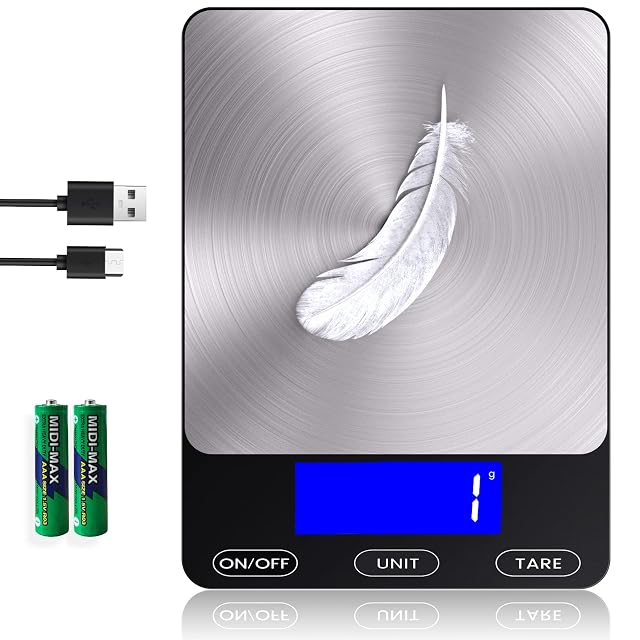
Best for: Bulk weighing — dough, meat, batches — where capacity and platform matter
≈ $18
Check price on Amazon 33 lb, four sensors and a published platform
A 33-pound rechargeable kitchen scale with four load sensors, a 7.5 × 5.5 inch stainless platform, five units, overload and low-battery alarms and a hanging hook.
Best for: Bulk weighing — dough, meat, batches — where capacity and platform matter
It is one of only two scales on this shelf to reach 33 lb — the other is the Letron at $34.99 — and one of only five sold on Amazon.com to publish a minimum weighable load.
The capacities here:
5 lb / 2.27 kg — the OXO pull-out at $37.95, the lowest on this shelf, costing more than ten of the thirteen 11 lb / 5 kg — eight scales, from $6.98 to $64.95 22 lb / 10 kg — the Greater Goods at $24.99, the Etekcity USB at $29.99 33 lb / 15 kg — this, and the Letron at $34.99
The minima:
2 g — the Amazon Basics at $11.14 (“2 grams minimum”), the Etekcity USB at $29.99 3 g / 0.1 oz — this, and the Etekcity nutritional at $39.99 0.01 g — the Letron’s mini platform Unpublished — the other eight
Why the floor is a different thing from the resolution. Resolution is the step — how finely the display changes, which here is 1 g. The minimum is the point below which the scale does not respond at all.
So a pinch of salt, a gram of saffron, 1.5 g of yeast: not low, but zero. That is a refusal to weigh rather than an imprecision, and eight pages on this shelf leave the threshold unstated.
And one gram is the resolution of at least twelve of the fifteen scales here. Only the Letron at $34.99 reads finer, at 0.01 g on a second platform.
A 7 g sachet of yeast at ±1 g is ±14 percent. Three grams of salt is ±33 percent. 500 g of flour at ±1 g is ±0.2 percent. One gram is the resolution of flour, not of salt — and the only page here to state its own limit is the Greater Goods at $24.99: “Not for laboratory or microgram measurements.”
What 33 pounds is actually for. A full stand-mixer bowl of dough — and a mixer bowl alone can be 1.5 kg before anything goes in. A turkey. A stockpot weighed with the stock in it. A batch of mince for the freezer. Eleven pounds goes faster than it looks.
“four high-precision load sensors” and “7.5” x 5.5” in stainless steel panel provide more stability and space for larger containers”
Those two claims belong together, and the page is right to pair them.
How a scale works. A load cell is a strain gauge on a flexing beam: weight bends the beam, the gauge changes resistance, the circuit reads the change.
With one cell under the center, a load placed off-center acts on the beam as a lever — so the reading depends on where the weight sits. Single-cell scales correct for that with a rigid platform on a central post, which works until the platform gets large.
Four cells, one per corner, sum the load. Put the bowl anywhere and the total is the same, because every corner reports its share.
Two scales on this shelf publish a sensor count: this, and the Etekcity nutritional at $39.99 — “Equipped with 4 high-precision sensors”. The other eleven say nothing, though the Ultrean at $6.98 claims “high precision sensors” in the plural with no number.
And this is the only scale on this shelf that publishes its platform as distinct from its body. 7.5 × 5.5 inches is about 41 square inches of panel, on a body the catalog gives as 203 × 127 mm — 8 × 5 inches.
Three others publish overall dimensions and no platform: the Amazon Basics at $11.14 (8.3 × 7 × 1.3 in), the Escali at $25 (8.5 × 6 × 1.5 in), the Greater Goods at $24.99 (7.6 × 5.6 × 1.3 in). Nine publish nothing at all.
Why platform width matters. A mixing bowl is wider than it is deep, and a bowl that overhangs and touches the countertop takes part of the load off the scale — the reading drops with no warning. That is the quietest error a kitchen scale produces.
The test you can run on any scale here: put a full tin in the middle, note the number, then move it to each corner. A scale that changes by more than a gram or two is not corner-compensated, and should always be loaded in the same place.
“Power-low alarm and overload remind. Hanging hook and 4 no-slip rubbers.”
Four features in one bullet, and three of them are rare on this shelf.
The overload warning. Two scales here publish one: this and the SOYOK at $6.98. It matters because of how a load cell fails. Pushing a strain gauge past its capacity bends the beam permanently, and afterwards the scale reads consistently wrong rather than failing outright — which is far worse than a blank display, because you keep trusting it.
The better answer to the same problem is on one scale only: the OXO 5 lb at $37.95 publishes “Convenient meter shows how much of Scale’s capacity remains” — the only capacity meter on this shelf, and it warns you before you get there rather than after.
The low-battery alarm. Again this and the SOYOK alone. A dying cell on a strain-gauge scale makes it drift rather than go blank, so a warning is the only way to know the number is suspect.
The hanging hook is unique on this shelf. A 250-gram scale 18 mm thick hangs on a cup hook inside a cupboard door — which is the one storage solution that does not use any shelf at all. The nearest alternatives are the Etekcity at $13.99 (“easily storable in cabinets”, at 19 mm) and the Greater Goods at $24.99 (7.6 × 5.6 × 1.3 in).
And four no-slip rubbers, which only the SOYOK at $6.98 also publishes (“four anti-slip bases” and a “rounded corner design” against edge collisions).
That is not cosmetic. A strain-gauge scale measures a beam’s deflection, so a scale not resting evenly on all four feet reads wrong — consistently, and without telling you. And a scale that slides is a scale being used with a bowl on it that somebody is stirring.
The product name publishes it: “Rechargeable”.
The power arrangements on this shelf:
2 AAA, included — the SOYOK at $6.98, the Ultrean at $6.98, the Amazon Basics at $11.14, the Etekcity at $13.99 3 AAA, included — the Greater Goods at $24.99, the KitchenAid at $23.99 Rechargeable — this, and the Etekcity USB at $29.99, which publishes the detail: “Type-C Rechargeable Battery… comes with a USB-C charging cable” Not published — the Escali at $25, the Letron at $34.99, the Etekcity nutritional at $39.99, and both OXO scales
What rechargeable buys on a kitchen scale. A scale used twice a week does not die of use, it dies of standby — and three AAA cells in a drawer for two years is the commonest reason a scale is dead when you want it.
What it costs is that you cannot fix it in thirty seconds. A flat AAA is replaced from any drawer in the house; a flat internal cell needs a cable and an hour.
And this page does not say what the charging connector is, which the Etekcity USB does. Nor does it publish a charge time or a run time, which nothing on this shelf does.
So the power-low alarm in bullet four does double duty here: on a rechargeable scale a warning is not a convenience, it is the only thing between you and an hour’s wait mid-recipe.
Three claims in this page that need qualifying.
“waterproof Anti-collision glass weighing panel” — and no rating is given.
One scale on this shelf publishes a water rating: the Etekcity USB at $29.99 — “IPX6 waterproof design, allowing you to easily measure liquids and wipe the scale clean”. Two claim waterproofing without one: this, and the SOYOK at $6.98 (“more waterproof and wear-resistant”). One forbids it outright: the KitchenAid at $23.99 — “Hand wash only; do not immerse in water or put in dishwasher”. And both OXO scales solve it mechanically: “Platform removes for hand washing.”
Note also that bullet one calls the panel glass and bullet two calls it stainless steel. The likely arrangement is a stainless panel with a glass or glass-faced section, and the page does not reconcile them. The Letron at $34.99 publishes the same combination deliberately: “Built with a stainless steel weighing platform and glass panel… scratch-resistant, stain-resistant.”
“Anti-collision” is the more interesting word, and it pairs with the four rubber feet and the hook: the failure this page is designing against is the scale being knocked, which is what puts a load cell out of true.
“With a 2min Auto-off function, no need to worry about power consumption.”
Two minutes is the shortest on this shelf, shared with the SOYOK at $6.98 and the Greater Goods at $24.99. The rest: 3 minutes — the KitchenAid at $23.99 · 4 minutes — the Escali at $25 · 5 minutes — the Letron at $34.99 · unspecified or nothing — the other seven.
And two minutes is a nuisance rather than an economy, because of the tare. A recipe is weighed cumulatively — bowl on, tare, flour in, tare, sugar in, tare — and going to the cupboard between two additions costs you the zero, so the bowl comes off, the scale restarts, and the flour already in it becomes part of the tare.
On a rechargeable scale the economy argument is weaker still.
One scale answers it properly: the Greater Goods at $24.99 pairs the same two-minute shutoff with the only timed HOLD on this shelf — “keep readings on screen for up to 5 minutes”.
The habit here: lay out every ingredient before you start weighing.
No warranty. “12 Months Support” is a commitment to answer the telephone, not to replace the scale. Three items on this shelf publish something: the Escali at $25 — a lifetime warranty, the only one here · the Greater Goods at $24.99 — a 5-year limited warranty plus “lifetime support from our St. Louis team”, which separates the two ideas properly · and this. Ten publish nothing, including the $64.95 OXO.
Why a term matters on a scale: the failure modes are slow and silent. A bent load cell reads consistently wrong, a corroded lead drifts, a cracked mount shifts the zero — and none of it shows up on arrival. Nothing on this shelf has a calibration function, so check it against a known mass now and again: a liter of water from the tap is 1000 g to within a gram or two.
No HOLD function, where three scales here have one.
No pull-out or extended display. The platform sits above the display, so a bowl wider than the body covers the number. Two scales attack it: both OXO models — “Display pulls away from base to avoid shadowing from plates or bowls” — and the Greater Goods at $24.99 — “the display extends beyond the weighing platform for better visibility under large mixing bowls”. On a scale sold for “larger containers”, that is the omission that bites.
No backlight. Four scales here publish one, and this page offers “Screen touch and LCD display” instead. A touch panel is the other half of the waterproof claim — there are no button seams to admit water — and it is also the thing that does not work with wet or floury fingers.
No water rating, as above.
No charge time, run time or connector type, as above.
No milk volume mode. Five scales on this shelf offer one, applying a density of about 1.03 g/ml instead of water’s 1.00 — a three percent difference and the whole content of the feature. This publishes plain ml, which is the more honest arrangement: a milliliter reading on any scale here is a water reading. Weigh liquids in grams.
No country of manufacture, which no item on this shelf publishes.
Read on the day this page was built: $18 at the American Amazon shop.
Read from Keepa on the day this page was last revised; stock and price both move without notice.
Prices quoted in this text were read on 2026-10-17. The live price is at the top of the page.
Spread the measurement across the platform, which is what lets a wide panel read correctly wherever you put the bowl. Bullet one: "Our Food Kitchen Scale equips four high-precision load sensors, waterproof Anti-collision glass weighing panel." How a scale works. A load cell is a strain gauge on a flexing beam — weight bends the beam, the gauge changes resistance, and the circuit reads the change. With one cell under the center, a load placed off-center loads the beam as a lever, and the reading depends on where the weight sits. Cheap single-cell scales correct for this mechanically with a rigid platform on a central post, which works until the platform is large. Four cells, one at each corner, sum the load. Put the bowl anywhere and the total is the same, because every corner reports its share. Which is exactly why this page pairs the claim with the platform size: "7.5" x 5.5" in stainless steel panel provide more stability and space for larger containers." A big platform needs corner sensing or it reads differently at the edges. Two scales on this shelf publish a sensor count: this, and the Etekcity nutritional at $39.99 — "Equipped with 4 high-precision sensors, the scale can weigh your foods between 3 g (0.1 oz) - 5000 g (176.4 oz) in 1 g increment." The other eleven say nothing, though the Ultrean at $6.98 claims "high precision sensors" in the plural without a number. The practical test you can run on any scale here: put a full tin of beans in the middle, note the number, then move it to each corner. A scale that changes by more than a gram or two is not corner-compensated, and you should always load it in the same place.
For bread, meat and batch cooking, yes — and this is one of only two scales here that reaches it. The capacities on this shelf: 5 lb / 2.27 kg — the OXO pull-out at $37.95, the lowest here, and it costs more than ten of the thirteen · 11 lb / 5 kg — eight scales, from $6.98 to $64.95 · 22 lb / 10 kg — the Greater Goods at $24.99 and the Etekcity USB at $29.99 · 33 lb / 15 kg — this and the Letron at $34.99. What actually hits 11 pounds. A full stand-mixer bowl of bread dough. A turkey. A stockpot you want to weigh with the stock in it. A batch of mince for the freezer. Eleven pounds is 5 kilograms, and a mixer bowl alone can be 1.5 kg (3.3 lb) before anything goes in it — so the headroom disappears faster than it looks. And the quiet failure is overload. A strain-gauge scale measures the deflection of a beam, and pushing it past capacity bends the beam permanently — after which the scale reads consistently wrong rather than failing outright, which is far worse than a blank display. Which is why the overload warning in bullet four matters: "Power-low alarm and overload remind." Two scales on this shelf publish an overload warning: this and the SOYOK at $6.98. The other eleven do not — including the OXO 5 lb at $37.95, which instead publishes the only capacity meter here: "Convenient meter shows how much of Scale’s capacity remains", which is the better answer because it warns you before you get there rather than after.
No, and the distinction is worth making because two scales on this shelf publish real terms. Bullet five in full: "12 Months Support. We cherish every customer, your satisfaction are priority. Feel free to contact us, we will take every consultation and question seriously." That is a commitment to answer the telephone, not to replace the scale. The three items on this shelf that publish anything: the Escali at $25 — "Lifetime warranty", the only lifetime term here and the plainest sentence on the shelf · the Greater Goods at $24.99 — "Backed by a 5-year limited warranty and lifetime support from our St. Louis team", which separates the two ideas properly · and this, which offers the support half alone. Ten scales publish nothing, including the OXO at $64.95, the most expensive item here. Why a term matters on a scale specifically. The failure modes are slow and silent. A bent load cell from one overload reads consistently wrong, and you will not notice for months. A corroded sensor lead drifts. A cracked platform mount shifts the zero. None of those shows up on arrival, which is exactly the case a warranty beyond a return window exists for — and a scale that drifts rather than dies is the hardest thing to make a claim about. Which is also the practical argument for checking it. Weigh a known mass now and again: a sealed tin or a liter of water from the tap — 1,000 g (35.3 oz) to within a gram or two. A scale that has drifted will tell you, and nothing on this shelf has a calibration function.
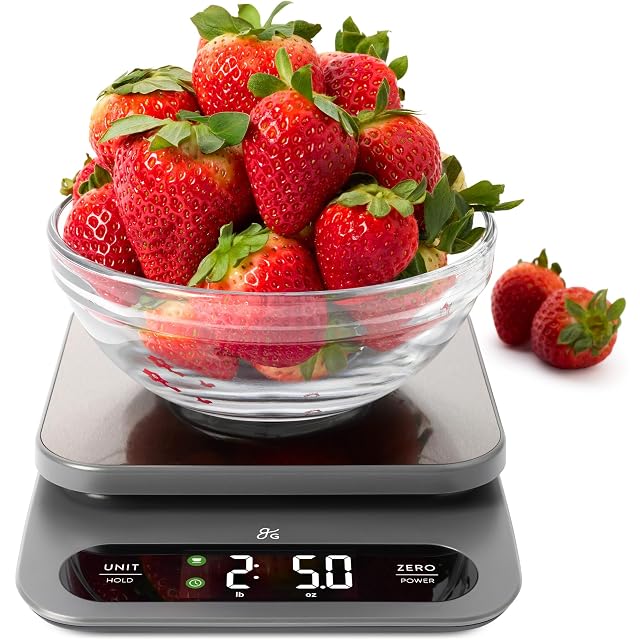
A 22-pound kitchen scale with 1-gram precision, six units, a Hi-Def display extending past the platform, a 5-minute HOLD, a 2-minute shutoff and a 5-year warranty.
Best for: Bulk baking and meal prep, where a bowl sits on the scale for minutes at a time
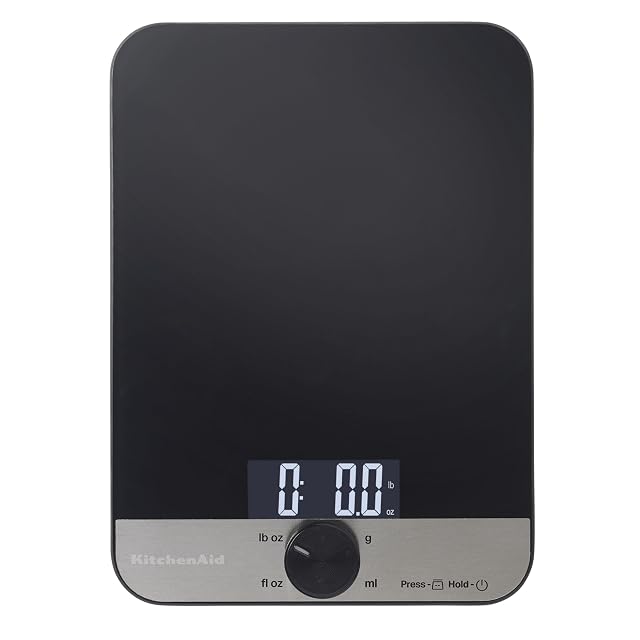
An 11-pound glass-surface kitchen scale with a rotating knob for units and tare, separate dry and liquid resolutions, a three-minute shutoff and hand-wash-only care.
Best for: A buyer who wants one-handed control and weighs liquids by volume
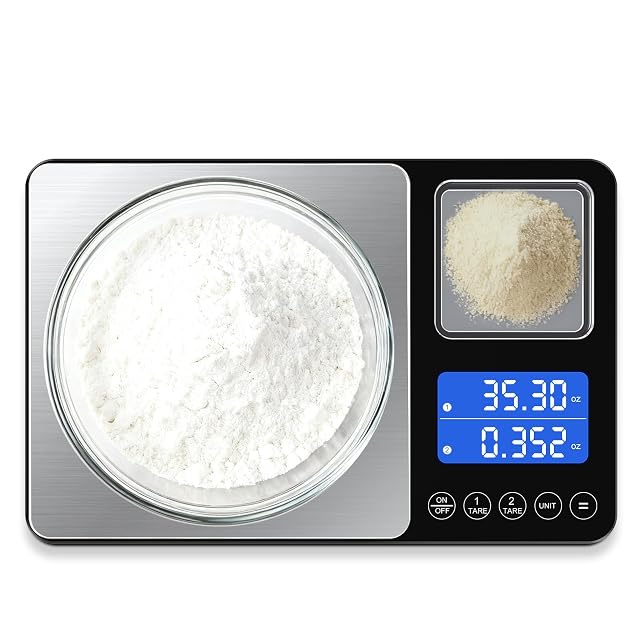
A dual-platform kitchen scale with a 33 lb / 1 g large platform and a 1.1 lb / 0.01 g mini platform, a dual-line display that adds both, and a five-minute shutoff.
Best for: Bread baking by percentage, where salt and yeast have to be weighed too
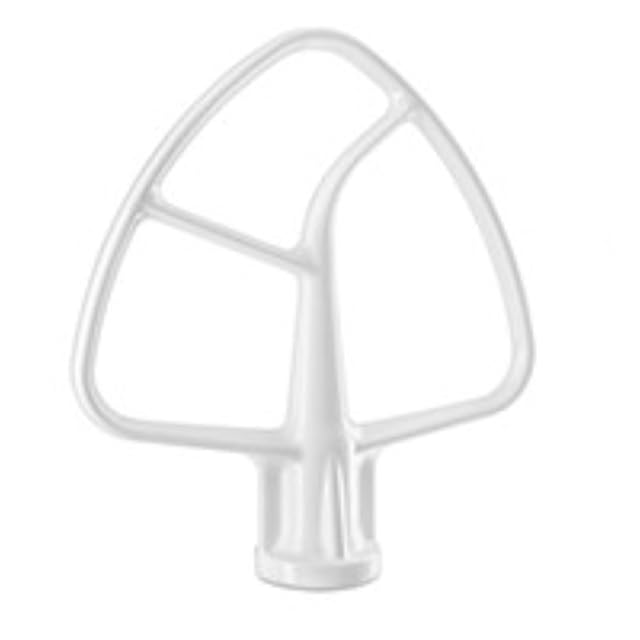
The maker’s own flat beater for 5 and 6 quart Professional bowl-lift KitchenAid stand mixers, supplied as one beater, stated for those mixers only.
Best for: A Professional 5 or 6 quart bowl-lift, bought from the maker
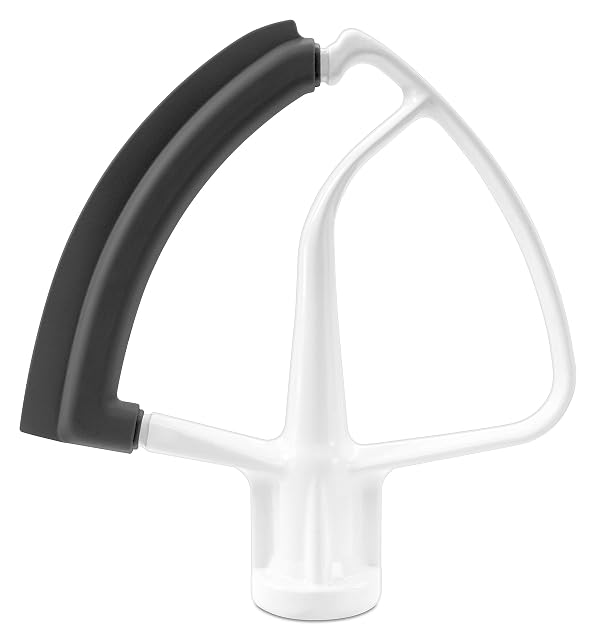
The maker’s flex edge beater for 4.5 and 5 quart tilt-head KitchenAid mixers, with a flexible edge that scrapes ingredients in, dishwasher safe, in white.
Best for: A 4.5 or 5 quart tilt-head KitchenAid, bought from the maker
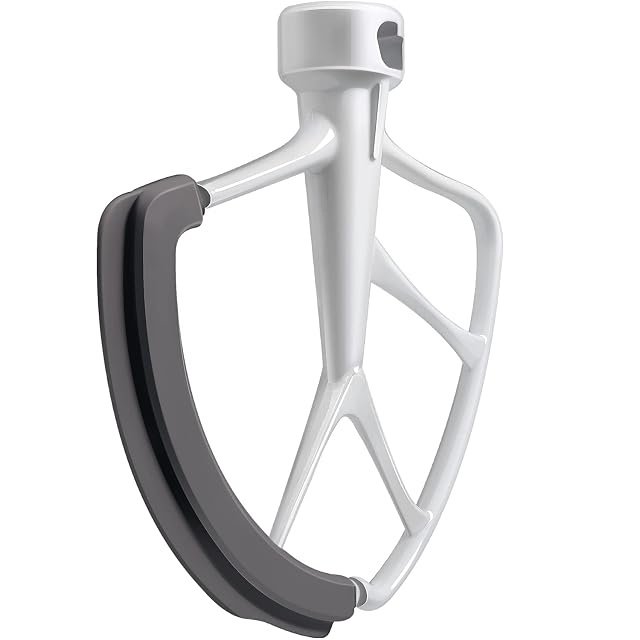
A coated-aluminum flex edge beater with silicone edges for 6 quart bowl-lift KitchenAid mixers, dishwasher safe, with its own dimensions and thirteen models published.
Best for: A 6 quart bowl-lift KitchenAid, or a Professional 5-Plus