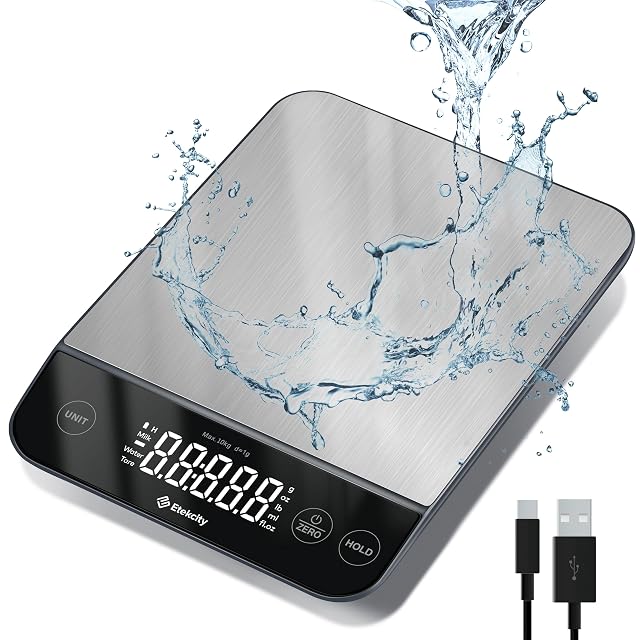
IPX6, and the only USB-C here
Etekcity EKS-L221 22 lb Rechargeable Kitchen Scale
A 22-pound kitchen scale rated IPX6 waterproof with a USB-C rechargeable battery, a published 2-gram minimum, five units, tare and a hold function.
Specifications
- Water rating
- IPX6 — the only rated scale on this shelf
- Power
- A rechargeable battery with a USB-C cable supplied
- Capacity
- 22 lb / 10 kg
- Minimum weighable load
- 2 grams, published
- Resolution
- 1 g (0.04 oz) increments
- Units
- Five — g, oz, lb:oz, ml and fl oz, with milk and water modes
- Tare
- Published
- Hold
- Published, with no duration
- Measures liquids
- Explicitly, as part of the IPX6 claim
- Weight
- 700 g (24.7 oz) — the second heaviest scale here
- Catalog
- 206 × 50 × 307 mm (8.11 × 1.97 × 12.1 in)
- Reference
- EKS-L221
- Auto shutoff
- Not published
- Warranty
- Not published
- Amazon reference
- B09HM2TN5Z
- EAN
- 0810043375252
The plus side, and the minus
Strengths
- IPX6, so it can be wiped under water — unique on this shelf
- A USB-C rechargeable battery with the cable supplied
- Both the capacity and the 2-gram floor published, which eight scales here omit
Compromises
- A flat internal cell cannot be replaced in thirty seconds like a AAA
- No shutoff duration, no hold duration and no warranty
- Five bullets, and no platform size, material or sensor count
What the maker puts in writing
- “Max Capacity: Weigh objects as heavy as 22 lb/10 kg and as light as 2 g (0.1 oz) in increments of 1 g (0.04 oz)”
- “IPX6 Waterproof Design: Features an IPX6 waterproof design, allowing you to easily measure liquids and wipe the scale clean”
- “Type-C Rechargeable Battery: The scale features a rechargeable battery and comes with a USB-C charging cable”
- “5 Units: Choose between grams, ounces, pounds and ounces, milliliters (milk and water), and fluid ounces (milk and water)”
- “Bonus Features: Use the tare feature and hold function for added convenience”
- Reference EKS-L221 · Catalog: 700 g (24.7 oz), 206 × 50 × 307 mm (8.11 × 1.97 × 12.1 in)
The only rated scale on this shelf
“Features an IPX6 waterproof design, allowing you to easily measure liquids and wipe the scale clean”
What the code means, since no page here explains it. An IP code has two digits: solids first, water second. IPX6 declares water resistance to high-pressure jets and leaves solids unrated — that is what the X stands for.
So against a rinse under the tap it is strong. Against flour and kitchen dust it says nothing.
The shelf, on water:
A published rating — this, alone A claim with no rating — the SOYOK at $6.98 (“more waterproof and wear-resistant”), the GGQ at $17.98 (“waterproof Anti-collision glass weighing panel”) A mechanical answer — both OXO scales at $37.95 and $64.95: “Platform removes for hand washing” An explicit prohibition — the KitchenAid at $23.99: “Hand wash only; do not immerse in water or put in dishwasher; wipe with a damp cloth and dry thoroughly” A sealed panel — the Escali at $25: “Display and controls are sealed under a protective shield to guard against accidental spills” Silence — the other six
Why it matters more on a scale than it looks. Water does not get in through the platform, which is a solid sheet. It gets in through the button seams, the battery hatch and the join between platform and housing — and from there it reaches the load cell.
A damp cell drifts rather than dies, which is the worst way for a scale to fail: you keep trusting the number.
And the rechargeable design helps here too. A sealed body has no battery hatch to open, which removes one of the three paths — so the IPX6 claim and the USB-C cell are the same design decision rather than two features.
What IPX6 does not license is submersion. That is IP67, and no scale on this shelf claims it. Wipe it, rinse it, do not leave it in the sink.
USB-C, which two scales here are and nine are not
“The scale features a rechargeable battery and comes with a USB-C charging cable”
The power arrangements on this shelf:
2 AAA, included — the SOYOK at $6.98, the Ultrean at $6.98, the Amazon Basics at $11.14, the Etekcity at $13.99 3 AAA, included — the Greater Goods at $24.99, the KitchenAid at $23.99 Rechargeable — this, and the GGQ at $17.98, which says so only in its product name Not published — the Escali at $25, the Letron at $34.99, the Etekcity nutritional at $39.99, and both OXO scales
What rechargeable buys. A scale used twice a week does not die of use, it dies of standby — and three AAA cells left in a drawer for two years is the commonest reason a kitchen scale is flat when you want it.
What it costs is immediacy. A flat AAA is replaced from any drawer in the house in thirty seconds. A flat internal cell needs a cable and an hour — and mid-recipe that is the difference between an annoyance and a stop.
And this page publishes no charge time, no run time and no low-battery warning.
Two scales on this shelf warn: the SOYOK at $6.98 and the GGQ at $17.98, both with a “power-low alarm”. On a rechargeable scale a warning is not a convenience, it is the only thing between you and the wait — and the GGQ, the other rechargeable here, publishes one while this does not.
The habit that follows: charge it when you put it away, not when it stops.
USB-C is the right connector to have chosen. It is reversible, it is the cable already on the countertop for a phone, and it is the one standard that will still be in the drawer in five years. The page says the cable is supplied and does not say whether a charger is — which, on USB-C, usually means any phone charger will do.
Twenty-two pounds and two grams, both published
“as heavy as 22 lb/10 kg and as light as 2 g in increments of 1 g”
Three figures in one sentence, which is more than most of this shelf manages.
The capacities here:
5 lb / 2.27 kg — the OXO pull-out at $37.95, the lowest on this shelf and dearer than ten of the thirteen 11 lb / 5 kg — eight scales, from $6.98 to $64.95 22 lb / 10 kg — this, and the Greater Goods at $24.99 33 lb / 15 kg — the GGQ at $17.98, the Letron at $34.99
The published minima:
2 g — this, and the Amazon Basics at $11.14 (“2 grams minimum”) 3 g / 0.1 oz — the GGQ at $17.98, the Etekcity nutritional at $39.99 0.01 g — the Letron’s mini platform, which is the only reading finer than a gram anywhere on this shelf Unpublished — the other eight
Why the floor is a different thing from the step. Resolution is how finely the display changes — 1 g here. The minimum is the point below which the scale does not respond at all.
So a 1-gram scale with a 2-gram floor shows 0 for 1.5 g, and jumps to 2 g at the threshold. A pinch of salt, a gram of saffron, half a sachet of yeast: not low, but zero.
That is a refusal to weigh rather than an imprecision — and eight pages on this shelf leave the threshold unstated.
And one gram is the resolution of at least twelve of the fifteen scales here. A 7 g sachet of yeast at ±1 g is ±14 percent — the difference between a dough that proves in an hour and one that takes three. Three grams of salt is ±33 percent. 500 g of flour is ±0.2 percent.
One gram is the resolution of flour, not of salt. The only page on this shelf to say so is the Greater Goods at $24.99: “Not for laboratory or microgram measurements.”
What twenty-two pounds is for. A full stand-mixer bowl of dough — and a mixer bowl alone can be 1.5 kg before anything goes in. A turkey. A stockpot weighed with the stock in it — and that is the case this scale is built for, since it is also the one you can wipe afterwards.
The quiet failure is overload. A strain-gauge scale measures the deflection of a beam, and pushing it past capacity bends the beam permanently — after which the scale reads consistently wrong rather than failing outright. Two scales here publish an overload warning — the SOYOK at $6.98 and the GGQ at $17.98 — and one a capacity meter, the OXO 5 lb at $37.95. This publishes neither.
Five units, and three of them carry two density assumptions
“grams, ounces, pounds and ounces, milliliters (milk and water), and fluid ounces (milk and water)”
It is one of five scales on this shelf with a milk mode, and one of only two to apply it to fluid ounces as well as milliliters.
What a scale is actually doing with volume. It cannot measure volume. It measures mass and divides by an assumed density.
Water is 1.00 gram per milliliter, so 250 ml of water weighs 250 g and the conversion is invisible. Milk is about 1.03 g per milliliter, because of its dissolved sugars, proteins and minerals.
So “milk ml” applies the other divisor, and the entire content of the feature is a three percent difference — about 8 ml on 250, 30 ml on a liter.
The five that offer it: the SOYOK at $6.98 and the Ultrean at $6.98 (“Yes! It includes milk volume measurement”), both as a sixth unit · the Etekcity nutritional at $39.99 (“g (water & milk)/ml (water & milk)”) · and this.
The ones that do not: the Amazon Basics at $11.14 and the Etekcity at $13.99 (plain ml and fl oz) · the GGQ at $17.98 (ml, water) · the Greater Goods at $24.99 (ml and fl oz) · the KitchenAid at $23.99, which instead publishes a separate liquid specification: 5000 ml × 1 ml and 176 fl oz × 0.1 fl oz · the Escali at $25, with three units and no volume at all · the Letron at $34.99 (g, oz, lb, kg) · both OXO scales.
And the arithmetic worth knowing on any of them. A US fluid ounce of water is about 29.6 grams, so a 0.1 fl oz step is roughly 3 grams — which means a fluid-ounce display rounds a 1-gram measurement into 3-gram jumps. The same applies to ounces: 0.05 oz is about 1.4 g.
So the honest habit, which no page on this shelf states: weigh in grams. Every ounce and every milliliter reading here is derived, coarser, and for volume rests on an assumed density.
Seven hundred grams, and the tare and hold do what you expect
The shelf, by weight:
Etekcity 200 g · SOYOK 222 g · GGQ 250 g · Greater Goods 367 g · Amazon Basics 381 g · Escali 431 g · KitchenAid 535 g · Letron 544 g · Etekcity nutritional 544 g · OXO 5 lb 581 g · this 700 g · OXO 11 lb 816 g
So this is the second heaviest scale on this shelf, and some of that is the sealed body and the internal cell rather than a bigger platform.
Which is a real advantage in use. A kitchen scale is routinely used with a bowl on it that you then pour into and stir — and a 700-gram scale stays where it is put. The Etekcity at $13.99, at 200 g, does not.
Two scales on this shelf address that mechanically instead: the SOYOK at $6.98 with “four anti-slip bases” and the GGQ at $17.98 with “4 no-slip rubbers”. This page publishes neither feet nor platform size, and the catalog 206 × 50 × 307 mm is a carton rather than a usable body figure.
Why it matters beyond convenience: a strain-gauge scale measures a beam’s deflection, so a scale not resting evenly on all four feet reads wrong — consistently, and without saying so.
And bullet five is the shortest feature list on the page: “Use the tare feature and hold function for added convenience.”
Tare is universal here — all thirteen scales have it. Hold is not: three do.
this — no duration published Greater Goods, $24.99 — “keep readings on screen for up to 5 minutes”, the only duration on this shelf, paired with a two-minute shutoff OXO 5 lb, $37.95 — no hold, but the only capacity meter here
What hold is for, and this page does not say. The platform sits above the display, so a bowl wider than the body covers the number — and hold lets you freeze the reading, lift the bowl, and read it. Three items on this shelf solve the same problem by moving the display instead: both OXO scales pull it out of the body, and the Greater Goods extends it past the platform.
The other use of hold is the shutoff. A recipe is weighed cumulatively, and a scale that switches off between two additions loses the tare — so a hold is the workaround. Except that no shutoff duration is published here at all, which makes the hold harder to plan around than the Greater Goods pairing.
What is not published
No auto shutoff duration. The figures on this shelf vary by a factor of two and a half: 2 minutes — the SOYOK at $6.98, the GGQ at $17.98, the Greater Goods at $24.99 · 3 minutes — the KitchenAid at $23.99, triggered by no change in weight rather than idleness · 4 minutes — the Escali at $25 · 5 minutes — the Letron at $34.99 · nothing — this and five others.
No hold duration, as above.
No low-battery warning, as above — on a rechargeable scale, where it matters most.
No charge time or run time.
No platform size or overall dimensions. Four scales on this shelf publish a figure: the Amazon Basics at $11.14 (8.3 × 7 × 1.3 in), the Escali at $25 (8.5 × 6 × 1.5 in), the Greater Goods at $24.99 (7.6 × 5.6 × 1.3 in), and the GGQ at $17.98, the only one to publish the platform itself: “7.5” x 5.5"".
No material. Three scales here name 304 stainless — the Ultrean at $6.98, the Etekcity at $13.99, the Etekcity nutritional at $39.99 — and others name glass, chrome or plastic. On an IPX6 scale, what the platform is bonded to is the question a buyer would ask.
No load-sensor count, where the GGQ and the Etekcity nutritional both publish four. Four corner cells sum the load so the reading does not depend on where the bowl sits. The test on any scale: put a full tin in the middle, note the number, then move it to each corner.
No backlight. Four scales here publish one: the SOYOK, the Ultrean, the Etekcity at $13.99 and the OXO 5 lb at $37.95.
No overload warning and no capacity meter, as above.
No anti-slip feet, as above.
No warranty. Three items on this shelf publish something: the Escali at $25 — a lifetime warranty, the only one here · the Greater Goods at $24.99 — 5 years limited plus “lifetime support from our St. Louis team” · the GGQ at $17.98 — “12 Months Support”. Ten publish nothing. And since nothing on this shelf has a calibration function, check it against a known mass now and again: a liter of water from the tap is 1,000 g to within a gram or two.
No country of manufacture, which no item on this shelf publishes.
Availability
Read on the day this page was built: $30 at the American Amazon shop.
Read from Keepa on the day this page was last revised; stock and price both move without notice.
Prices quoted in this text were read on 2026-10-17. The live price is at the top of the page.
What readers want to know
What does IPX6 let you do that no other scale here can?
Rinse it, and this is the only rated scale on the shelf. Bullet two: "Features an IPX6 waterproof design, allowing you to easily measure liquids and wipe the scale clean." What the code means, since no page here explains it. An IP code has two digits: solids first, water second. IPX6 declares water resistance to high-pressure jets and leaves solids unrated — that is what the X stands for. So against a rinse under the tap it is strong; against flour and kitchen dust it says nothing. The shelf, on water: a published rating — this alone · a claim with no rating — the SOYOK at $6.98 ("more waterproof and wear-resistant") and the GGQ at $17.98 ("waterproof Anti-collision glass weighing panel") · a mechanical answer — both OXO scales at $37.95 and $64.95: "Platform removes for hand washing" · an explicit prohibition — the KitchenAid at $23.99: "Hand wash only; do not immerse in water or put in dishwasher" · a sealed panel — the Escali at $25: "Display and controls are sealed under a protective shield to guard against accidental spills" · and silence — the other six. Why it matters more on a scale than it looks. Water does not get in through the platform, which is a solid sheet. It gets in through the button seams, the battery hatch and the join between platform and housing — and then it reaches the load cell. A damp cell drifts rather than dies, which is the worst way for a scale to fail, because you keep trusting the number. And the rechargeable design helps here too: a sealed body has no battery hatch to open, which removes one of the three paths. The one thing IPX6 does not license: submersion. That is IP67, and no scale on this shelf claims it.
Is a rechargeable battery better than AAA cells?
It removes the commonest reason a scale is dead, and it adds a new one. Bullet three: "The scale features a rechargeable battery and comes with a USB-C charging cable." The power arrangements on this shelf: 2 AAA, included — the SOYOK at $6.98, the Ultrean at $6.98, the Amazon Basics at $11.14, the Etekcity at $13.99 · 3 AAA, included — the Greater Goods at $24.99, the KitchenAid at $23.99 · rechargeable — this, and the GGQ at $17.98, which says so only in its product name · not published — the Escali at $25, the Letron at $34.99, the Etekcity nutritional at $39.99, and both OXO scales. What rechargeable buys. A scale used twice a week does not die of use, it dies of standby — and three AAA cells left in a drawer for two years is the commonest reason a scale is flat when you want it. A sealed cell also closes a water path, which is the other half of the IPX6 claim. What it costs is immediacy. A flat AAA is replaced from any drawer in the house in thirty seconds. A flat internal cell needs a cable and an hour — mid-recipe, that is the difference between an annoyance and a stop. And this page publishes no charge time, no run time and no low-battery warning. Two scales on this shelf do warn: the SOYOK at $6.98 and the GGQ at $17.98, both with a "power-low alarm". On a rechargeable scale a warning is not a convenience, it is the only thing between you and the wait — and the GGQ, the other rechargeable here, publishes one while this does not. The practical habit: charge it when you put it away, not when it stops.
Why does it publish both a 22-pound maximum and a 2-gram minimum?
Because they are the two ends of what it can do, and only five scales on this shelf publish the lower one. Bullet one: "Weigh objects as heavy as 22 lb/10 kg and as light as 2 g (0.1 oz) in increments of 1 g (0.04 oz)." Three figures in one sentence, which is more than most of this shelf manages. The capacities here: 5 lb — the OXO pull-out at $37.95, the lowest, and dearer than ten of the thirteen · 11 lb / 5 kg — eight scales, from $6.98 to $64.95 · 22 lb / 10 kg — this and the Greater Goods at $24.99 · 33 lb / 15 kg — the GGQ at $17.98 and the Letron at $34.99. The published minima: 2 g (0.1 oz) — this and the Amazon Basics at $11.14 ("2 grams minimum") · 3 g (0.1 oz) — the GGQ at $17.98 ("from 0.1oz/3g") and the Etekcity nutritional at $39.99 · 0.01 g — the Letron’s mini platform · unpublished — the other eight. Why the floor is not the same as the step. Resolution is how finely the display changes — 1 g (0.04 oz) here. The minimum is the point below which the scale does not respond at all. So a 1-gram scale with a 2-gram floor shows 0 for 1.5 g (0.1 oz), and jumps to 2 g (0.1 oz) at the threshold. A pinch of salt, a gram of saffron, half a sachet of yeast: not low, but zero. That is a refusal to weigh rather than an imprecision. And one gram is the resolution of at least twelve of the fifteen scales here. A 7 g (0.2 oz) sachet of yeast at ±1 g (0.04 oz) is ±14 percent; 3 g (0.1 oz) of salt is ±33 percent; 500 g (17.6 oz) of flour is ±0.2 percent. One gram is the resolution of flour, not of salt — and the only page here to say so is the Greater Goods at $24.99: "Not for laboratory or microgram measurements."
More kitchen scales
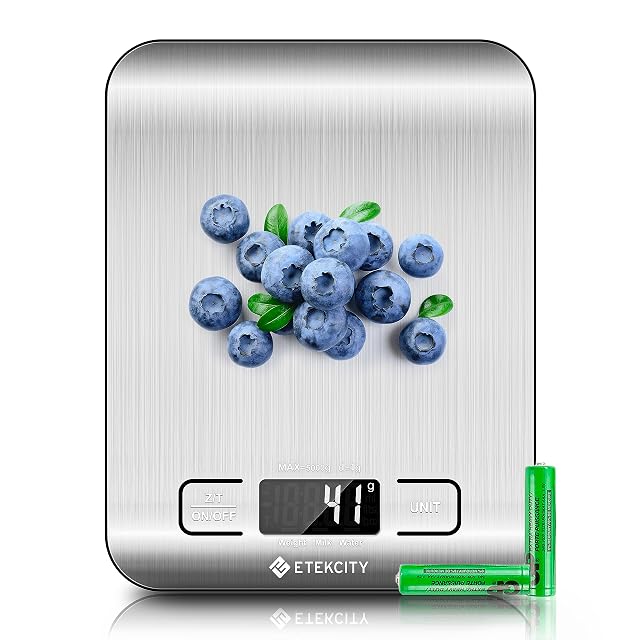
Etekcity EK6015 11 lb Stainless Kitchen Scale
An 11-pound 304 stainless kitchen scale reading in 1-gram increments across five units, with tare, a backlit LCD with large fonts and batteries included.
- Resolution
- 1 g (0.04 oz) increments
- Capacity
- 11 lb / 5 kg
- Units
- Five — oz, lb:oz, fl oz, g, ml
- Material
- 304 food-grade stainless steel
- Display
- Backlit LCD with large fonts
- Tare
- Published
- Battery
- 2 AAA, included
- Weight
- 200 g (7.1 oz) — the lightest scale on this shelf
- Catalog
- 192 × 157 × 19 mm (7.56 × 6.18 × 0.75 in)
- Reference
- EK6015
- Storage
- Sold on fitting in a cabinet
- Minimum weighable load
- Not published
- Auto shutoff
- Not published
- Warranty
- Not published
- Amazon reference
- B0113UZJE2
- EAN
- 0679113377950
- Two hundred grams and 19 millimeters thick, the slimmest scale here
- 304 food-grade steel named, which only two other scales state
- The lightest scale here is also the one most likely to slide under a stirred bowl
Best for: A small kitchen, where the scale lives in a cupboard between uses
≈ $14Check price on Amazon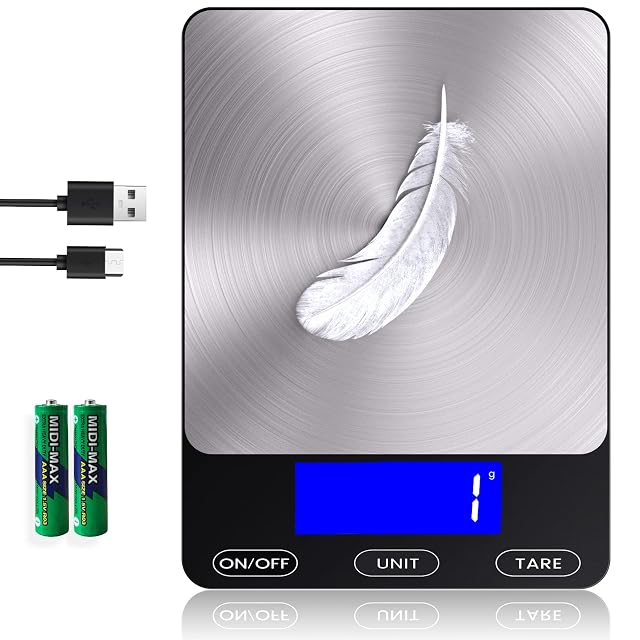
GGQ 33 lb Rechargeable Kitchen Scale
A 33-pound rechargeable kitchen scale with four load sensors, a 7.5 × 5.5 inch stainless platform, five units, overload and low-battery alarms and a hanging hook.
- Capacity
- 33 lb / 15 kg — the joint highest on this shelf
- Minimum weighable load
- 3 g (0.1 oz) / 0.1 oz, published
- Resolution
- 1 g (0.04 oz) graduations
- Load sensors
- Four, published
- Platform
- 7.5 × 5.5 inches — the only platform size on this shelf
- Units
- Five — g, kg, lb:oz, oz, ml
- Warnings
- Power-low alarm and overload reminder
- Auto-off
- Two minutes
- Storage
- A hanging hook — the only one here
- Feet
- Four no-slip rubbers
- Power
- Rechargeable
- Panel
- Waterproof anti-collision glass, no rating given
- Weight
- 250 g (8.8 oz) — 203 × 127 × 18 mm (7.99 × 5 × 0.71 in)
- Support
- 12 months, stated as support rather than a warranty
- Amazon reference
- B0BYN6Q8L7
- EAN
- 8712962728848
- Thirty-three pounds and a three-gram floor, both published
- The only scale here that publishes its platform size — 7.5 × 5.5 inches
- A two-minute auto-off, the joint-shortest on this shelf, with no HOLD
Best for: Bulk weighing — dough, meat, batches — where capacity and platform matter
≈ $18Check price on Amazon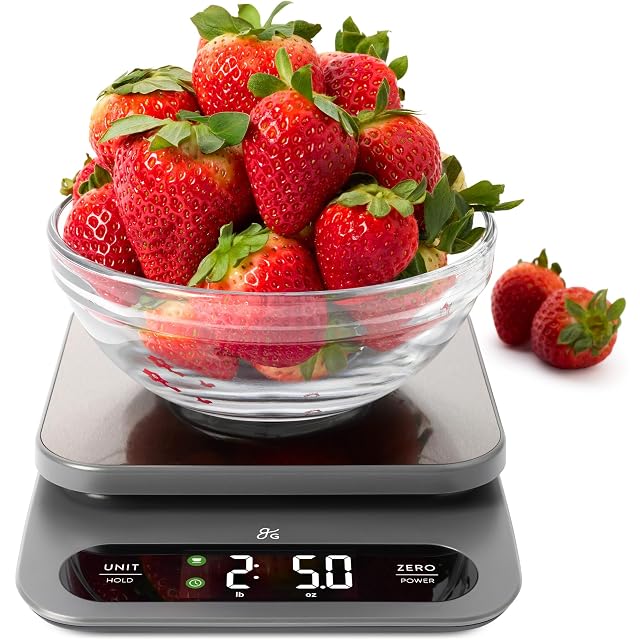
Greater Goods 0471 22 lb Digital Food Scale
A 22-pound kitchen scale with 1-gram precision, six units, a Hi-Def display extending past the platform, a 5-minute HOLD, a 2-minute shutoff and a 5-year warranty.
- Stated limit
- Not for laboratory or microgram measurements — unique here
- HOLD
- Keeps the reading on screen for up to 5 minutes
- Display
- Extends beyond the platform, for reading under a bowl
- Capacity
- 22 lb / 10 kg
- Resolution
- 1 g (0.04 oz)
- Units
- Six — g, ml, fl oz, oz, lb and lb:oz
- Zero function
- Resets instantly, named for bowls and Dutch ovens
- Auto shutoff
- Two minutes
- Controls
- Touch-sensitive, on stainless steel
- Battery
- 3 AAA, included
- Size
- 7.6 × 5.6 × 1.3 inches
- Warranty
- 5-year limited, plus lifetime support from St. Louis
- Weight
- 367 g (12.9 oz)
- Minimum weighable load
- Not published
- Amazon reference
- B09QFWXSD8
- EAN
- 0875011004718
- The only scale here that states what it cannot measure
- A five-minute HOLD against a two-minute shutoff, which solves the tare problem
- A two-minute auto shutoff, the joint-shortest on this shelf
Best for: Bulk baking and meal prep, where a bowl sits on the scale for minutes at a time
≈ $25Check price on Amazon
Elsewhere in the kitchen drawer
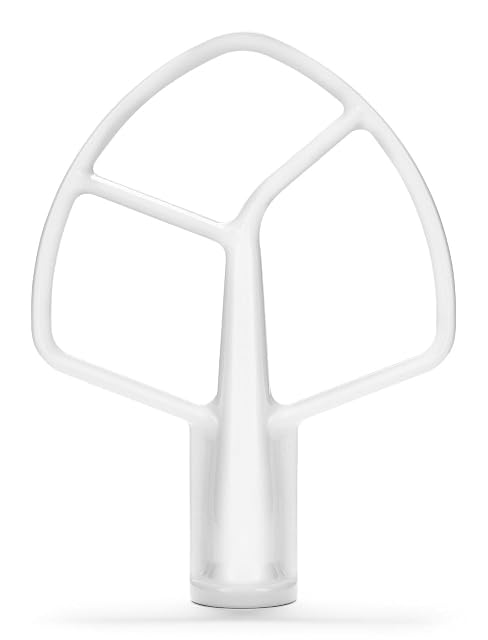
KitchenAid K5AB Flat Beater for 5 Qt Bowl-Lift Mixers
A coated flat beater for 5 quart bowl-lift KitchenAid mixers in white, fitting K4, K5, KP50, KSM5, KSM50, KSM500PS and KSM450.
- Fits
- K4, K5, KP50, KSM5, KSM50, KSM500PS, KSM450 — 5 qt bowl-lift
- Material
- "Coated" — the substrate is not named
- Color
- White
- Provenance
- Designed, engineered and tested by KitchenAid
- Weight
- 113 g (4 oz) — the joint lightest on this shelf
- Package size
- 11.684 × 18.796 × 11.785 cm (4.6 × 7.4 × 4.6 in), published
- Catalog
- 127 × 38 × 188 mm (5 × 1.50 × 7.40 in)
- Reference
- K5AB
- Flexible edge
- None — it is a plain flat beater
- Dishwasher
- Not published
- Beater dimensions
- Not published; the package size is
- Time claim
- None published
- Bowl requirement
- Not stated; four items here require a stainless bowl
- Warranty
- Not published; no item on this shelf publishes one
- Amazon reference
- B002S0NS9A
- EAN
- 0050946000633
- A seven-model list, which the maker’s 5–6 quart sibling does not give at all
- A hundred and thirteen grams, the joint lightest attachment here
- "Coated" names a property and not a material, where five rivals name theirs
Best for: An older 5 quart bowl-lift KitchenAid — a K4, K5, KP50 or KSM50
≈ $25Check price on Amazon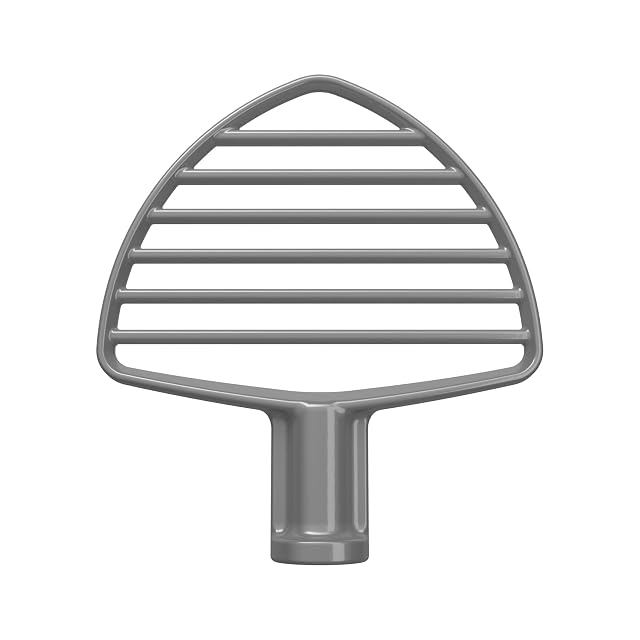
KitchenAid KSMPB7 Pastry Beater for Bowl-Lift Mixers
A pastry beater for eighteen named bowl-lift KitchenAid mixers with stainless bowls, cutting cold butter into flour, supplied with a scraper and dishwasher safe.
- What it does
- Breaks cold butter into small pieces and cuts it into flour
- Overmixing
- Stated to minimize the risk of it
- In the box
- One pastry beater and one scraper — unique on this shelf
- Fits
- Eighteen bowl-lift models, from KV25G0 to KSM70
- Bowl requirement
- Stainless steel bowls only
- Not for
- Tilt-head stand mixers, stated
- Also does
- Shredded meats, applesauce, mashed beans, chunky jam, egg salad
- Dishwasher
- Stated safe, beater and scraper
- Weight
- 200 g (7.1 oz)
- Catalog
- 36 × 164 × 182 mm (1.42 × 6.46 × 7.17 in)
- Reference
- KSMPB7
- Color
- Silver
- Material
- Not published
- Sibling
- The KSMPB7SS at $69.95 — same list, same bullets, 590 g (20.8 oz)
- Amazon reference
- B09GYQWXTB
- EAN
- 0883049623610
- The only page on this shelf that explains a mechanism rather than a claim
- A scraper in the box, which nothing else here includes
- No material at all, where five rivals name theirs
Best for: Pastry, biscuits and scones — cutting cold butter into flour in the bowl
≈ $50Check price on Amazon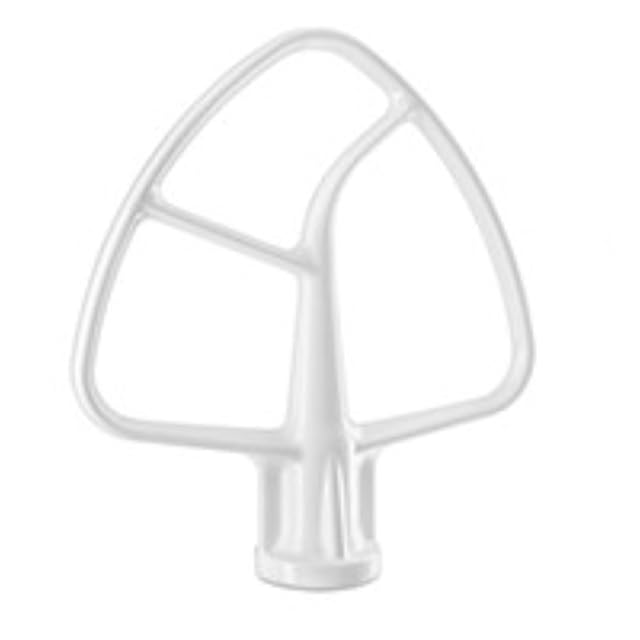
KitchenAid KN256CBT Flat Beater for 5–6 Qt Pro Bowl-Lift
The maker’s own flat beater for 5 and 6 quart Professional bowl-lift KitchenAid stand mixers, supplied as one beater, stated for those mixers only.
- Fits
- Bowl-lift Professional 5 qt and 6 qt stand mixers only
- In the box
- One flat beater
- Provenance
- Designed, engineered and tested by KitchenAid
- Weight
- 272 g (9.6 oz) — the heaviest plain paddle on this shelf
- Catalog
- 36 × 163 × 180 mm (1.42 × 6.42 × 7.09 in)
- Reference
- KN256CBT
- Material
- Not published
- Dishwasher
- Not published
- Dimensions
- Not published
- Flexible edge
- None — it is a plain flat beater
- Model list
- None; series only
- Time claim
- None published
- Bowl requirement
- Not stated; four items here require a stainless bowl
- Warranty
- Not published; no item on this shelf publishes one
- Amazon reference
- B00014W9K4
- EAN
- 0050946962665
- The maker’s own part, with the fit stated as 5 and 6 quart Professional bowl-lift only
- Two hundred and seventy-two grams, the heaviest plain paddle here
- Four bullets, two of which repeat each other
Best for: A Professional 5 or 6 quart bowl-lift, bought from the maker
≈ $25Check price on Amazon