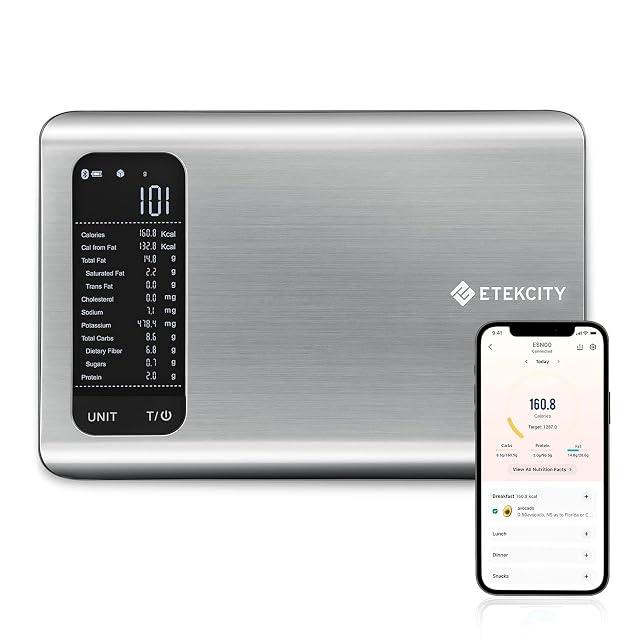
Best for: Tracking intake, where the database matters more than the last gram
≈ $40
Check price on Amazon Nineteen nutrients, on a one-gram scale
An 11-pound scale with four sensors, a 3-gram floor and 1-gram steps, tracking up to 19 nutrients through the Vesync app with Apple Health and Fitbit links.
Best for: Tracking intake, where the database matters more than the last gram
The weighing specification is in bullet five: 3 g to 5,000 g, in 1 g increments, on four sensors.
Where one gram is comfortably fine. A 150 g chicken breast at ±1 g is ±0.7 percent — about 1 kcal on 165. A 200 g portion of rice, a 300 g bowl of pasta, a 250 g yoghurt: all well under one percent.
For the bulk of a diet, one gram is finer than the labels themselves, which round protein and carbohydrate to the nearest gram anyway.
Where it is not fine: fat. Fat carries about 9 kcal per gram, so ±1 g on oil is ±9 kcal. A teaspoon of olive oil is about 4.5 g, or 40 kcal — and ±1 g on that is ±22 percent, on the single densest thing in most meals. Nuts, butter, cheese and nut butters are the same case.
And the floor compounds it. Three grams is the minimum this scale responds to at all, so a 2 g drizzle of oil reads zero — not approximately, but zero.
Resolution is the step; the minimum is the floor. Only five scales on this shelf publish the latter:
2 g — the Amazon Basics at $11.14 (“2 grams minimum”), the Etekcity USB at $29.99 (“as light as 2 g”) 3 g — this, and the GGQ at $17.98 (“from 0.1oz/3g”) 0.01 g — the Letron at $34.99, on a second platform of 500 g capacity: the only sub-gram reading on this shelf
At least twelve of the fifteen scales here read in one-gram steps. The only page honest enough to state the limit is the Greater Goods at $24.99: “Not for laboratory or microgram measurements.”
So the honest summary: this scale tracks meals well and condiments badly.
The workaround nobody on this shelf suggests: weigh the bottle before and after. Pouring 20 g of oil out of a bottle and reading the difference is far more accurate than weighing 20 g into a spoon — and it works on any scale here, including this one.
“track your intake of up to 19 nutrients, monitor trends, create daily, weekly and monthly nutrition reports… by connecting to the free Vesync app, Apple Health and Fitbit” · “Supported by Nutritionix, which holds about 1 million food data. You can add and customize your own food data”
How it works. You pick the food in the app, put it on the platform, and the app multiplies the weight by the per-gram figures from the database. The scale measures; the app does the arithmetic.
What is genuinely good here.
Nineteen nutrients is more than calories and macros — it reaches fiber, sugars, sodium and the common micronutrients, which is where doing it by hand becomes tedious. A million entries means most branded foods are already in it. Custom entries mean the ones that are not can be added once. And Apple Health and Fitbit links mean the numbers go where the rest of your data already is, rather than into a silo nobody opens.
What the page does not publish.
Whether the scale displays and tares without the phone. Almost certainly yes — it has a platform, a display and a tare button — but it is not stated, and on the one app-dependent item on this shelf that is the question to want answered. Whether the app is free permanently or free to download. What connection it uses, and whether the database is cached offline.
And this is the only item on this shelf with software in it at all. Which means it is the only one whose usefulness depends on something that can be discontinued — a risk you are taking at forty dollars that you are not taking at the $6.98 end.
No warranty is published, where three items here do: the Escali at $25 — a lifetime warranty, the only one on this shelf · the Greater Goods at $24.99 — 5 years limited plus “lifetime support from our St. Louis team” · the GGQ at $17.98 — “12 Months Support”. Ten publish nothing.
“Equipped with 4 high-precision sensors”
The other is the GGQ at $17.98 — “four high-precision load sensors” — paired with a 7.5” × 5.5” platform sold on “more stability and space for larger containers”.
How a scale works. A load cell is a strain gauge on a flexing beam: weight bends the beam, the gauge changes resistance, the circuit reads the change.
With one cell under the center, a load placed off-center acts on the beam as a lever — so the reading depends on where the weight sits. Single-cell scales compensate with a rigid platform on a central post, which works until the platform is large.
Four cells, one per corner, sum the load. Put the bowl anywhere and the total is the same, because every corner reports its share.
Why it matters on this scale in particular. Nutrition tracking is comparative. You are weighing the same foods over weeks and watching a trend. A reading that shifts because the plate landed differently is noise in exactly the measurement the app is plotting — and a trend built on inconsistent placement is a trend that is not there.
The test you can run on any scale here: put a full tin in the middle, note the number, then move it to each corner. A scale that changes by more than a gram or two is not corner-compensated, and should always be loaded in the same place.
Eleven scales on this shelf publish nothing about sensors, though the Ultrean at $6.98 claims “high precision sensors” in the plural without a number.
And one thing four sensors do not fix is drift. Nothing on this shelf has a calibration function. Check it against a known mass now and again: a liter of water from the tap is 1,000 g to within a gram or two — and on a scale whose whole purpose is a trend over weeks, that check is worth more than on any other item here.
“The food-grade 304 stainless steel weighing platform combines durability and easy-to-clean design”
Three scales on this shelf name the grade: this, the Ultrean at $6.98, and the Etekcity at $13.99 (“304 food-grade stainless steel surfaces”).
The rest: stainless, unqualified — the SOYOK at $6.98, the GGQ at $17.98, the Greater Goods at $24.99, the OXO at $64.95 (“Stainless Steel is smudge and fingerprint-resistant”) · glass — the KitchenAid at $23.99 · stainless and glass — the Letron at $34.99 · a steel platform on BPA-free plastic — the Amazon Basics at $11.14 · “Chrome”, with no material named — the Escali at $25.
What 304 is. An austenitic stainless with roughly 18 percent chromium and 8 percent nickel — the standard food-contact grade, and the one that does not pit or stain from acid.
Which matters because of what lands on a platform used for tracking: lemon juice, vinegar, brine, raw meat, and whatever is being weighed straight onto the steel rather than into a bowl. A lesser grade marks. 304 does not.
What it does not change is the reading. The load cells are underneath; the platform is a cover.
And the catalog gives the body at 234 × 160 × 15 mm — about 9.2 × 6.3 × 0.6 inches.
Fifteen millimeters is the joint slimmest on this shelf, with the SOYOK at $6.98 and the Ultrean at $6.98. The others: the GGQ at 18 mm, the Etekcity at $13.99 at 19 mm, the Escali at 30 mm, the Amazon Basics at 32 mm, the Greater Goods at 37 mm, the OXO 5 lb at 46 mm, the Letron at 47 mm, the KitchenAid at 53 mm.
So a forty-dollar scale that goes in a drawer, which the Etekcity at $13.99 sells explicitly (“easily storable in cabinets”) and the thicker scales here cannot.
At 544 grams it is in the upper half by weight: Etekcity 200 g · SOYOK 222 g · GGQ 250 g · Greater Goods 367 g · Amazon Basics 381 g · Escali 431 g · KitchenAid 535 g · this 544 g and the Letron 544 g · OXO 5 lb 581 g · Etekcity USB 700 g · OXO 11 lb 816 g.
And weight is not nothing: a heavier scale slides less when you stir a bowl standing on it.
“Choose units from oz/lb:oz/g (water & milk)/ml (water & milk)”
It is one of five scales on this shelf with a milk mode.
What a scale is doing with volume. It cannot measure volume. It measures mass and divides by an assumed density.
Water is 1.00 gram per milliliter, so 250 ml of water weighs 250 g and the conversion is invisible. Milk is about 1.03 g per milliliter, because of its dissolved sugars, proteins and minerals.
So the milk mode applies the other divisor, and the entire content of the feature is a three percent difference — about 8 ml on 250, 30 ml on a liter.
The five that offer one: the SOYOK at $6.98 and the Ultrean at $6.98 (“Yes! It includes milk volume measurement”), the Etekcity USB at $29.99 (“milliliters (milk and water)”), and this.
And the odd part of this page’s list is that the milk mode is attached to grams as well as milliliters — “g (water & milk)”. A gram is a gram regardless of what is on the platform, so that reading is presumably a labeling of the same mass rather than a conversion.
For a nutrition scale the right habit is plainer than any of it: weigh in grams, always. A nutrient database is per 100 grams, so a mass in grams goes straight into the calculation while a volume has to be converted back through a density the app and the scale may not agree on.
On unit count across the shelf: six — the SOYOK, the Ultrean, the Greater Goods at $24.99 · five — the Amazon Basics at $11.14, the Etekcity at $13.99, the GGQ at $17.98, the Etekcity USB at $29.99 · four — this, and the Letron at $34.99 · three — the Escali at $25.
And the tare bullet states the use correctly: “the Tare button tells the exact weight of your food without container” — which on a tracking scale is the whole workflow: plate on, tare, food on, read, log.
No auto shutoff. The durations on this shelf run from two to five minutes: 2 minutes — the SOYOK at $6.98, the GGQ at $17.98, the Greater Goods at $24.99 · 3 minutes — the KitchenAid at $23.99, triggered by no change in weight rather than idleness · 4 minutes — the Escali at $25 · 5 minutes — the Letron at $34.99. Six scales, including this, publish none. Why it matters: a meal is weighed component by component, and a scale that switches off between two items loses the tare.
No HOLD function. Three scales here have one: the Greater Goods at $24.99 — “keep readings on screen for up to 5 minutes”, the only duration published anywhere here — and the Etekcity USB at $29.99. On a scale you read into a phone, a hold would let you lift the plate and still see the number.
No backlight. Four scales here publish one: the SOYOK at $6.98 (a “night vision mode”), the Ultrean at $6.98 (a “negative white display”), the Etekcity at $13.99 (“Backlit LCD with large fonts”), the OXO 5 lb at $37.95 (“optional backlight”).
No answer to the shadow problem. The platform sits above the display, so a bowl or plate wider than the body covers the number. Three scales address it: both OXO models — “Display pulls away from base to avoid shadowing from plates or bowls” — and the Greater Goods at $24.99 — “the display extends beyond the weighing platform for better visibility under large mixing bowls”. On a scale used with dinner plates, that is the omission that bites.
No overload warning and no capacity meter. Two scales publish a warning — the SOYOK at $6.98 and the GGQ at $17.98 — and one a meter, the OXO 5 lb at $37.95. It matters because of how a load cell fails: pushing a strain gauge past capacity bends the beam permanently, after which the scale reads consistently wrong rather than failing outright — which on a scale plotting a trend is the worst possible failure.
No anti-slip feet, where the SOYOK publishes four and the GGQ “4 no-slip rubbers”. A strain-gauge scale measures a beam’s deflection, so a scale not resting evenly on all four feet reads wrong.
No water rating or care instruction beyond “easy-to-clean”. One scale on this shelf publishes a rating: the Etekcity USB at $29.99, IPX6. One forbids immersion outright: the KitchenAid at $23.99 — “Hand wash only; do not immerse in water or put in dishwasher”. And both OXO scales remove the platform for washing. Wipe it; keep water out of the seams and the battery hatch; dry it.
No battery type or battery life, on a scale that has to stay awake long enough to talk to a phone. Four scales here use 2 AAA, two use 3 AAA, two are rechargeable.
No app subscription terms, offline behavior or standalone operation, as above.
No warranty, as above.
No country of manufacture, which no item on this shelf publishes.
Read on the day this page was built: $40 at the American Amazon shop.
Read from Keepa on the day this page was last revised; stock and price both move without notice.
Prices quoted in this text were read on 2026-10-17. The live price is at the top of the page.
For a portion, comfortably. For fats and oils, not really — and the arithmetic is worth doing before you buy. Bullet five publishes the specification: "Equipped with 4 high-precision sensors, the scale can weigh your foods between 3 g (0.1 oz) - 5000 g (176.4 oz) in 1 g increment." Where one gram is fine. A 150 g (5.3 oz) chicken breast at ±1 g (0.04 oz) is ±0.7 percent — about 1 kcal on 165. A 200 g (7.1 oz) portion of rice, a 300 g (10.6 oz) bowl of pasta, a 250 g (8.8 oz) yoghurt: all well under one percent. For the bulk of a diet, one gram is far finer than the food labels themselves, which round to the nearest gram of protein and carbohydrate anyway. Where it is not fine. Fat carries about 9 kcal per gram, so ±1 g (0.04 oz) on oil is ±9 kcal — and a teaspoon of olive oil is about 4.5 g (0.2 oz), or 40 kcal. At ±1 g (0.04 oz) that is ±22 percent on the single densest thing in most meals. Nuts, butter, cheese and nut butters are the same case. And the floor compounds it. Three grams is the minimum this scale responds to at all, so a 2 g (0.1 oz) drizzle of oil reads zero — not approximately, but zero. Resolution is the step; the minimum is the floor, and only five scales on this shelf publish the latter: 2 g (0.1 oz) — the Amazon Basics at $11.14, the Etekcity USB at $29.99 · 3 g (0.1 oz) — this, and the GGQ at $17.98 · 0.01 g — the Letron at $34.99, on a second platform, which is the only sub-gram reading on this shelf. So the honest summary: this scale tracks meals well and condiments badly. The workaround nobody here suggests: weigh the bottle before and after. Pouring 20 g (0.7 oz) of oil out of a bottle and reading the difference is far more accurate than weighing 20 g (0.7 oz) into a spoon.
It turns a weight into a nutrient breakdown, and the page does not say whether the scale works alone. Bullets one and two: "Easily track your intake of up to 19 nutrients, monitor trends, create daily, weekly and monthly nutrition reports and more by connecting to the free Vesync app, Apple Health and Fitbit"; "Supported by Nutritionix, which holds about 1 million food data. You can add and customize your own food data as needed as well." How it works in use. You pick the food in the app, put it on the platform, and the app multiplies the weight by the per-gram figures from the database. The scale measures; the app does the arithmetic. What is genuinely good here. Nineteen nutrients is more than calories and macros — it reaches into fiber, sugars, sodium and the common micronutrients, which is where a spreadsheet gets tedious. A million entries means most branded foods are already in it. Custom entries mean the ones that are not can be added once. And Apple Health and Fitbit links mean the numbers go where the rest of your data already is, rather than into a silo. What the page does not publish. Whether the scale displays and tares without the phone — almost certainly yes, since it has a platform, a display and a tare button, but it is not stated. Whether the app is free permanently or free to download. What connection it uses. Whether the database is cached offline. And no warranty, where three items on this shelf publish one. This is the only item on this shelf with an app of any kind, which means it is the only one whose usefulness depends on software that can be discontinued — and that is the risk a buyer is taking at forty dollars that they are not taking at seven.
Make the reading independent of where you put the bowl, and only two scales on this shelf publish a count. Bullet five: "Equipped with 4 high-precision sensors." The other is the GGQ at $17.98: "four high-precision load sensors", paired with a 7.5" × 5.5" platform sold on "more stability and space for larger containers". How a scale works. A load cell is a strain gauge on a flexing beam: weight bends the beam, the gauge changes resistance, the circuit reads the change. With one cell under the center, a load placed off-center acts on the beam as a lever — so the reading depends on where the weight sits. Single-cell scales correct for that with a rigid platform on a central post, which works until the platform gets large. Four cells, one per corner, sum the load. Put the bowl anywhere and the total is the same, because every corner reports its share. Why it matters on this scale in particular. Nutrition tracking is comparative: you are weighing the same foods over weeks and watching a trend. A reading that shifts because the plate landed differently is noise in exactly the measurement the app is plotting — and a trend built on inconsistent placement is a trend that is not there. The test you can run on any scale here: put a full tin in the middle, note the number, then move it to each corner. A scale that changes by more than a gram or two is not corner-compensated, and should always be loaded in the same place. Eleven scales on this shelf publish nothing about sensors, though the Ultrean at $6.98 claims "high precision sensors" in the plural with no number.
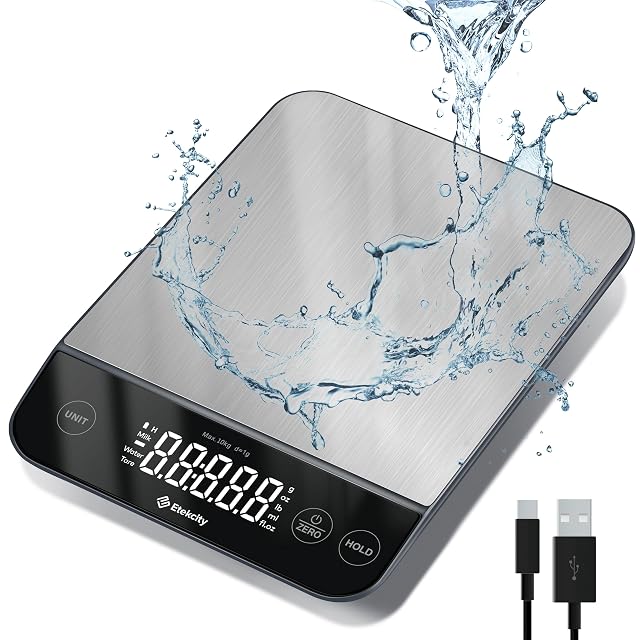
A 22-pound kitchen scale rated IPX6 waterproof with a USB-C rechargeable battery, a published 2-gram minimum, five units, tare and a hold function.
Best for: A wet kitchen, where the scale meets liquids and gets rinsed
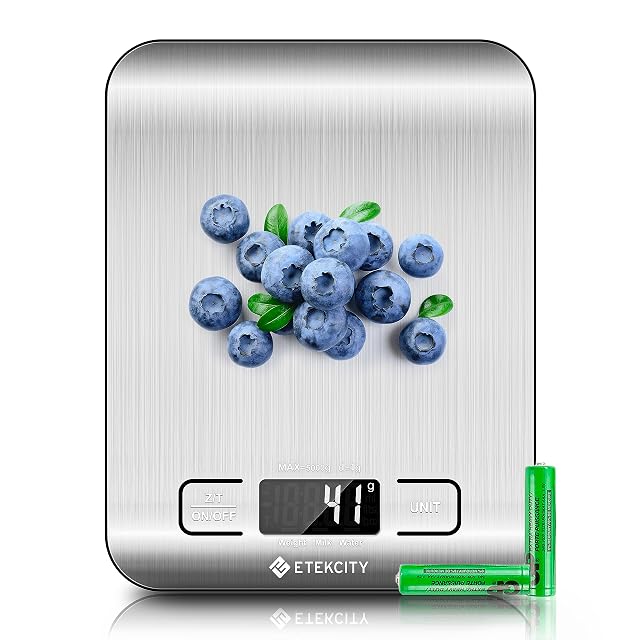
An 11-pound 304 stainless kitchen scale reading in 1-gram increments across five units, with tare, a backlit LCD with large fonts and batteries included.
Best for: A small kitchen, where the scale lives in a cupboard between uses
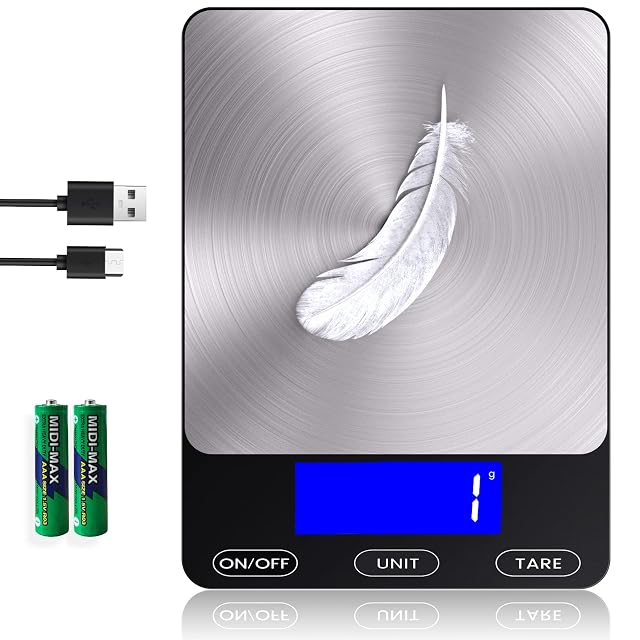
A 33-pound rechargeable kitchen scale with four load sensors, a 7.5 × 5.5 inch stainless platform, five units, overload and low-battery alarms and a hanging hook.
Best for: Bulk weighing — dough, meat, batches — where capacity and platform matter
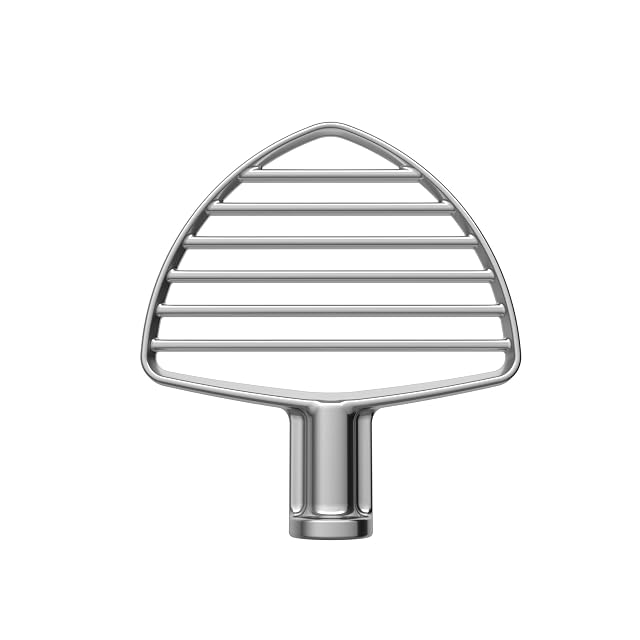
A pastry beater for eighteen named bowl-lift KitchenAid mixers with stainless bowls, cutting cold butter into flour, supplied with a scraper and dishwasher safe.
Best for: Pastry in a bowl-lift KitchenAid, if the weight is the thing you want
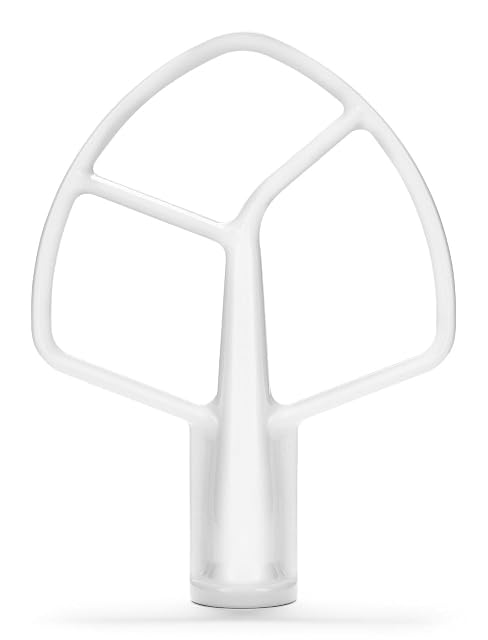
A coated flat beater for 5 quart bowl-lift KitchenAid mixers in white, fitting K4, K5, KP50, KSM5, KSM50, KSM500PS and KSM450.
Best for: An older 5 quart bowl-lift KitchenAid — a K4, K5, KP50 or KSM50
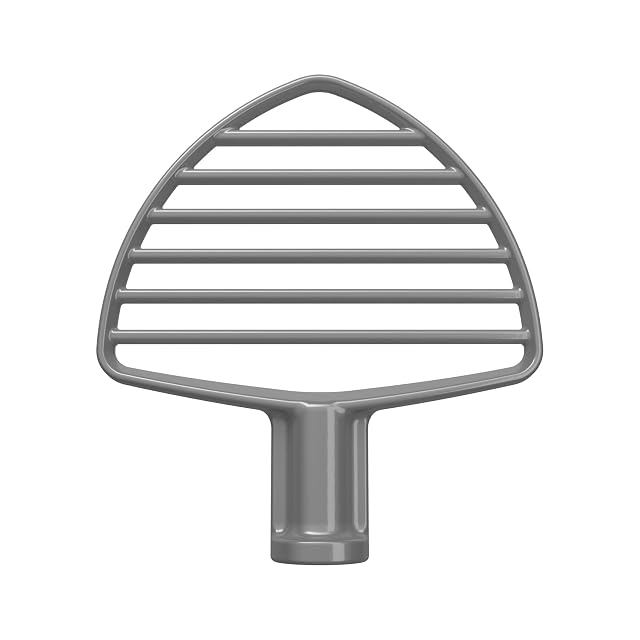
A pastry beater for eighteen named bowl-lift KitchenAid mixers with stainless bowls, cutting cold butter into flour, supplied with a scraper and dishwasher safe.
Best for: Pastry, biscuits and scones — cutting cold butter into flour in the bowl