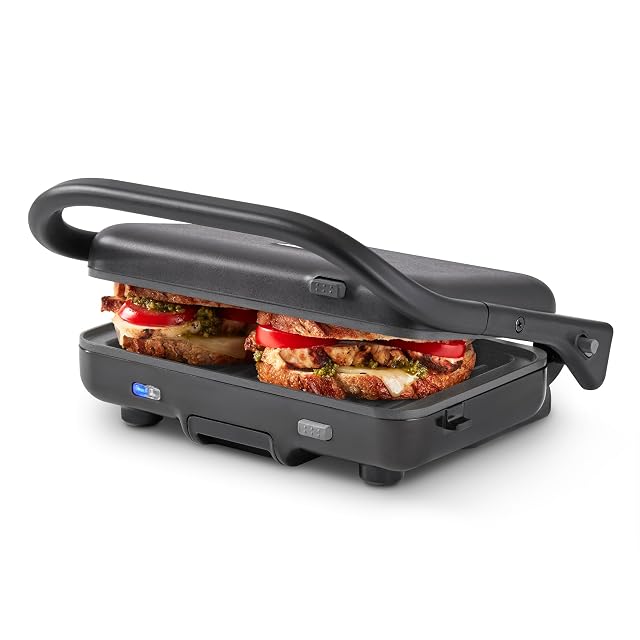
Best for: Paninis and a flat griddle for pancakes and eggs, with waffles added later
≈ $35
Check price on Amazon Opens flat, and has no switch
A 180-degree hinged press with removable grill and griddle plates, an 8 × 5 inch surface, a drip tray and no on/off switch, with waffle plates sold separately.
Best for: Paninis and a flat griddle for pancakes and eggs, with waffles added later
Both catalog identically — 2,268 g, 251 × 277 × 90 mm — and the references differ by two digits.
this, Forged Iron, DIG024GBGY04, $34.99 — two Grill Plates and two Griddle Plates, with “Compatible Waffle Plates are sold separately” Graphite, DIG014GBGT04, $49.74 — grill and waffle: “swap between grill and waffle maker”, no griddle mentioned
And the waffle plates are on this shelf at $13.49.
So this machine plus the waffle pack is $48.48 for three plate sets. The Graphite is $49.74 for two. So the three-set route is a dollar twenty-six cheaper, not dearer — and it is the only arithmetic on this shelf.
Which route to take turns on what a griddle plate is. A griddle is flat; a grill is ribbed.
Ribbed gives sear marks and lets fat drain away — which is what bullet five sells: “Sear smash burgers and chicken”. Flat gives full contact, which pancakes, eggs, onions and anything small need so they do not fall between the ridges — and the same bullet sells that too: “flip to the Griddle for pancakes, eggs, and bacon”.
The honest reading: if you want breakfast, the griddle is the plate you cannot do without, because almost nothing else on this shelf gives you a flat plate at all. If you only want waffles and sandwiches, the Graphite saves a purchase.
“opens a full 180 degrees to lie flat, creating an indoor grill on your countertop”
A press cooks between two 8 × 5 plates — 40 square inches of contact. Laid flat you get both plates side by side as one surface: 80 square inches.
And they are two different ways of cooking. A press cooks from both sides at once and compresses — right for a panini, a toasted sandwich, a quesadilla, a cheesesteak. A flat griddle cooks from one side and you turn the food — right for pancakes, eggs, bacon, anything with a top you want to keep. You cannot press an egg.
The shelf divides sharply on this.
Both Dash Flex Press machines open flat — this and the Graphite at $49.74, whose page repeats it: “The 180° Hinged Lid design lies flat for indoor flat top grilling or pulls down to press paninis” The BLACK+DECKER at $48.99 explicitly forbids it: “Always operate the unit in the closed position on a stable, level, heat-resistant surface” The OSTBA at $29.99, the Aigostar at $39.99 and the Metine at $49.99 say nothing, and all three are closed presses by description The GreenPan at $299.95 is a waffle maker only
So two of the twelve items sold on Amazon.com give you a flat griddle, and both are this machine.
One caution the page does not give. Laid flat, fat has nowhere to drain. A ribbed grill plate sheds fat into its channels and on into the drip tray; a flat plate at 180 degrees pools it — so bacon on the griddle wants blotting rather than tilting.
Eight by five inches is the second largest published surface here. The Metine at $49.99 publishes 10.8 × 5.5 inches per plate — about 59 square inches, half again as much. The Dash Mini plate pack at $9.99 is 4 inches. The GreenPan says “4-Square” with no dimension, and at least seven of the fourteen items on this shelf publish no surface at all.
“No on/off switch to fuss with; plug in and the 8 x 5-inch Cooking Surface heats up fast”
There is no way to turn it off except to pull the plug, and no way to turn it down at all.
The plates reach whatever the internal thermostat sets and stay there until the lead comes out of the wall.
The rest of the shelf, on control:
Metine, $49.99 — five browning levels: “1–2 for gentle warming, 3–5 for toasting and searing (from light toast to juicy steak)” GreenPan, $299.95 — “ADJUSTABLE SHADE & CRUNCH CONTROL”, an XL LCD display and a one-touch dial with presets BLACK+DECKER, $48.99 — a green ready light that “cycles on and off with the thermostat during use”, with “wait for the green light before adding food” Aigostar, $39.99 — a red power light and a green preheat light OSTBA, $29.99, the Graphite at $49.74, and this — nothing at all
So five of the seven machines sold on Amazon.com have no browning control, and three have no indicator either.
Three habits follow, and the page gives none of them.
Preheat by the clock — about five minutes from plugging in. A press used cold gives a pale sandwich and a waffle that sticks. Cook by the clock. The Metine page is the only one on this shelf that publishes times — “level 3 for about 8 minutes and level 5 for about 5 minutes” — and its own warning applies here: “we bake our waffles by time, not by the indicator light.” Unplug it when you finish, which on this machine is not advice but the only option there is.
No wattage is published either. Three of the seven machines sold on Amazon.com give one: 1200 W on the Metine, 750 W on the OSTBA at $29.99 and on the Aigostar at $39.99, which adds 120 V. Power is what decides how fast the plates recover after the lid opens, and on a machine sold for “heats up fast” it is the figure that would support the claim.
“the Drip Tray channels grease away, so scrubbing a sandwich press is off your to-do list”
No other item here publishes one, and the use list is exactly why it is needed: “smash burgers”, “chicken”, “bacon”, “fajitas”.
A smash burger renders a great deal of fat in a very short time, and on a closed press that fat has one of two destinations: a channel out to a tray, or the seam between the plates and the body.
Which is also the argument for the ribbed grill plate over the flat griddle for anything fatty. Ribs drain; flats pool.
And the tray is the part the page does not describe. No capacity, no statement that it is removable, no statement that it is dishwasher safe — where the plates are explicitly all three: “Removable Plates pop out and go straight into the dishwasher.”
Which is the strongest cleaning claim on the shelf, and it is near-universal here: all twelve items say dishwasher safe. Two qualify it:
GVODE, $38.99 — “Most of time, recommend hand wash with soap to protect the non-stick for long term use” BLACK+DECKER, $48.99 — the only care warning on this shelf: “Avoid metal utensils, abrasive cleaners, and aerosol cooking sprays to help protect the coating”
That last item is the one nobody else mentions and the most useful. Aerosol cooking sprays carry propellant and lecithin, which polymerize on a hot non-stick plate into a varnish no dishwasher removes. Brush melted butter instead.
And the metal-utensil point bites hard on a press sold for smash burgers. A burger that catches gets a metal turner to it — and one cut in a non-stick film propagates from that point for the rest of the plate’s life.
One habit no page here gives: let the plates cool before pulling them out. Thermal shock from a hot plate into cold water is what crazes a coating.
“this small Grill locks closed to store away”
Four machines here publish an upright or locked storage claim: this, the Aigostar at $39.99 (“locks shut and has a collectable cord”), the Metine at $49.99 (“stands upright for neat storage”) and the OSTBA at $29.99 (“compact and upright storage-friendly”).
At 2,268 grams and 251 × 277 × 90 mm this is about ten by eleven inches in plan and three and a half deep — and on its end it takes the shelf space of a thick book.
But a plate-swapping machine has a storage problem the page does not solve. Two sets in the box means one set is always out of the machine, and three sets means two are.
Only one item on this shelf answers it. The GreenPan at $299.95: “SIMPLE STORAGE: Belgian and Classic Waffle Plates store in the bottom of the unit.” The Dash waffle pack at $13.49 at least claims its plates “stack neatly in cabinets or drawers”.
Which is worth factoring into the arithmetic above. The route to three plate sets on this machine — $48.48 — means four loose plates in a cupboard, and nothing on this shelf holds them except the GreenPan, at more than eight times the price.
No wattage, as above.
No browning control and no indicator light, as above — and no switch, which makes this the least regulated machine on the shelf.
No moat. Two items here solve the characteristic failure of a waffle plate: the Breville at $64.95 — “the no-mess moat design feature prevents excess waffle batter spilling out and onto your counter top” — and the GreenPan at $299.95 — “EXTRA-LARGE MOAT… frames the plates on all sides”. The OSTBA at $29.99 names the consequence instead: “Avoid overfilling the sandwich press to prevent latch damage.” That matters here because this machine’s waffle plates are a separate purchase, and waffle batter expands as it cooks — the steam that makes a waffle light pushes it outward, and batter forced into a hinge sets hard.
No batter quantity, which no item on this shelf publishes.
No waffle specification on the separate pack either. The $13.49 Dash pack says “thick, fluffy waffles” and gives no thickness and no count, where the Cuisinart at $56.26 and the GVODE at $38.99 both publish “4 deep pocketed, 3/4-inch thick Belgian waffles” — the only thickness figure on this shelf.
No plate material. Two items name one: the GVODE’s “food grade aluminum” and the GreenPan’s “CAST PLATES… optimal heat conduction”. Mass is what keeps a plate hot when cold food lands on it — and at 2,268 g for the whole machine, these plates are pressed rather than cast.
No coating chemistry. Three items on this shelf publish some: GVODE names “double-layer TEflon” and “BPA free”, Aigostar names “teflon”, and GreenPan names “Thermolon Volt, a diamond-infused ceramic… free of PFAS, PFOA, lead or cadmium” — the only non-fluoropolymer plate here.
No drip tray detail, as above.
No cool-touch handle, where three machines publish one: the OSTBA at $29.99, the Aigostar at $39.99 and the BLACK+DECKER at $48.99. On a machine with no switch, the body is hot from the moment it is plugged in — and its own page never says so, where the OSTBA does: “The outer surface gets hot during use—handle with care.”
No warranty, which no item on this shelf publishes.
No country of manufacture, which no item on this shelf publishes either.
Read on the day this page was built: $38 at the American Amazon shop.
Read from Keepa on the day this page was last revised; stock and price both move without notice.
Prices quoted in this text were read on 2026-10-17. The live price is at the top of the page.
They are the same machine with different plates, and the arithmetic decides it. Both catalog identically — 2,268 g (80 oz), 251 × 277 × 90 mm (9.88 × 10.9 × 3.54 in) — and their references differ by two digits. This, Forged Iron, DIG024GBGY04, $34.99 ships two Grill Plates and two Griddle Plates, and says "Compatible Waffle Plates are sold separately". The Graphite, DIG014GBGT04, $49.74 ships grill and waffle: "lets you swap between grill and waffle maker", with no griddle mentioned. And the waffle plates are on this shelf at $13.49. So this machine plus the waffle pack is $48.48 for three plate sets — grill, griddle and waffle. The Graphite is $49.74 for two — grill and waffle. So the three-set route is a dollar twenty-six cheaper, not dearer. Which way round depends on what a griddle plate is for. A griddle is flat; a grill is ribbed. Ribbed gives sear marks and lets fat drain away from the meat — and this page sells exactly that: "Sear smash burgers and chicken". Flat gives full contact, which pancakes, eggs, onions and anything small need so it does not fall between the ridges — and the page sells that too: "flip to the Griddle for pancakes, eggs, and bacon". So the honest reading: if you want breakfast, the griddle plate is the one you cannot do without, because nothing else on this shelf gives you a flat plate at all except the Metine and the three-in-one presses. If you only want waffles and sandwiches, the Graphite saves a purchase, for a dollar twenty-six more.
Twice the cooking area, and only the two Dash machines on this shelf do it. Bullet one: "The Hinged Lid pulls down to press bistro-style paninis and melty grilled cheese, then opens a full 180 degrees to lie flat, creating an indoor grill on your countertop." Why it matters. A press cooks between two 8 × 5 plates — 40 square inches of contact. Laid flat you get both plates side by side as one surface: 80 square inches, heated from below, which is a griddle rather than a press. Those are two different ways of cooking. A press cooks from both sides at once and compresses — right for a panini, a toasted sandwich, a quesadilla. A flat griddle cooks from one side and you turn the food — right for pancakes, eggs, bacon, anything with a top you want to keep. You cannot press an egg. The rest of the shelf divides sharply on this. The BLACK+DECKER at $48.99 explicitly forbids it: "Always operate the unit in the closed position on a stable, level, heat-resistant surface." The OSTBA at $29.99, the Aigostar at $39.99 and the Metine at $49.99 say nothing — all three are closed presses by description. The GreenPan at $299.95 is a waffle maker only. So two of the twelve items sold on Amazon.com give you a flat griddle, and both are this machine. One caution the page does not give: laid flat, the fat has nowhere to drain. A ribbed grill plate sheds fat into the channels and then into the drip tray; a flat plate at 180 degrees pools it — so bacon on the flat griddle wants blotting, not tilting.
Because the design makes a virtue of simplicity, and it is the one feature on this shelf that is also a real limitation. Bullet two: "Plug In and Press: No on/off switch to fuss with; plug in and the 8 x 5-inch Cooking Surface heats up fast." What that means in use. There is no way to turn it off except to pull the plug, and no way to turn it down at all. The plates reach whatever temperature the internal thermostat sets and stay there until the lead comes out of the wall. Compare the rest of the shelf. Two machines regulate browning: the Metine at $49.99 with five levels — "1–2 for gentle warming, 3–5 for toasting and searing" — and the GreenPan at $299.95 with "ADJUSTABLE SHADE & CRUNCH CONTROL", an XL LCD and a one-touch dial. Two publish an indicator light: the BLACK+DECKER at $48.99, whose green light "cycles on and off with the thermostat during use" with the instruction "wait for the green light before adding food", and the Aigostar at $39.99 with a red power light and a green preheat light. This machine publishes neither a light nor a control nor a wattage. So three habits follow. Preheat by the clock — about five minutes from plugging in — because a press used cold gives a pale sandwich and a waffle that sticks. Cook by the clock too: the Metine page is the only one on this shelf that gives times, and its own advice applies here — "we bake our waffles by time, not by the indicator light". And unplug it when you finish, which on this machine is not advice but the only option available.
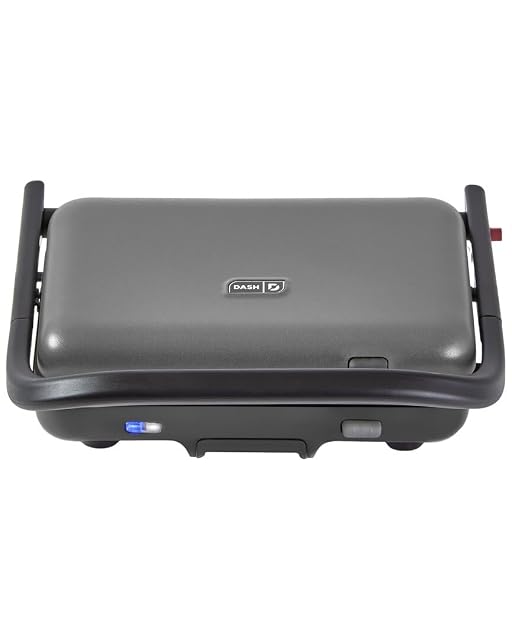
A 180-degree hinged press with removable grill and waffle plates, flat-top grilling, dishwasher-safe plates and a compact countertop footprint.
Best for: Waffles and paninis from one machine, with no further purchases
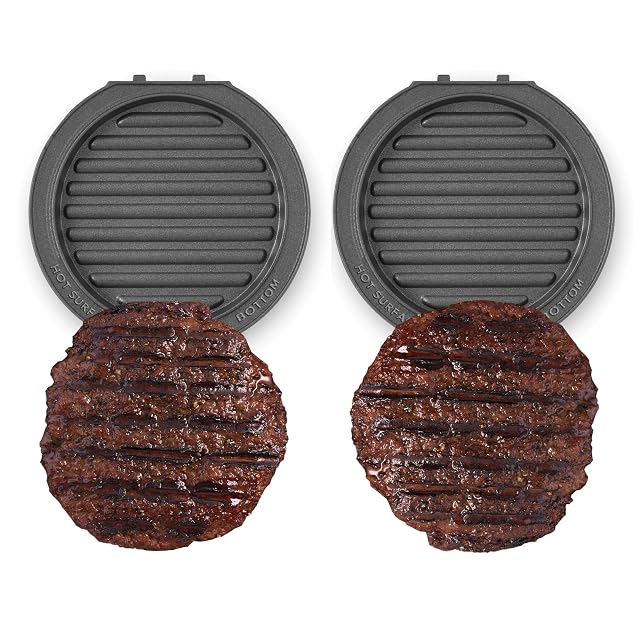
A two-pack of 4-inch removable non-stick plates for the Dash MultiMaker Mini system, dishwasher safe, with the maker sold separately.
Best for: An existing Dash MultiMaker Mini, when you want a second pattern
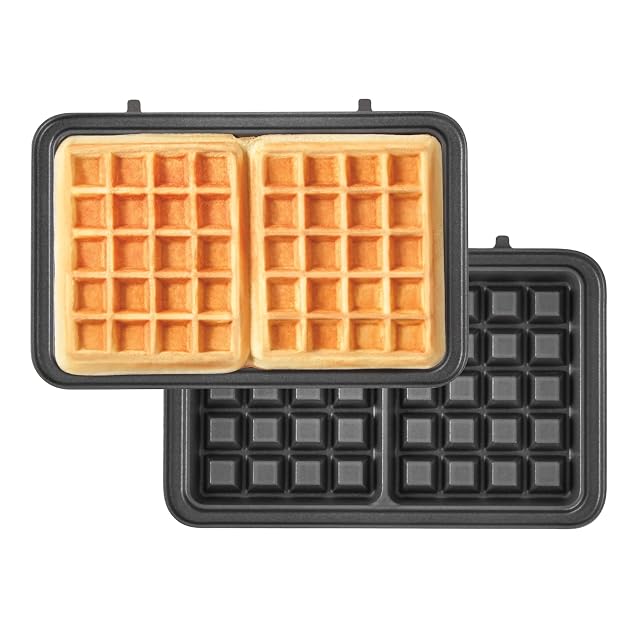
A two-plate waffle set for the Dash MultiMaker Flex Press Grill System, removable, non-stick, dishwasher safe and stackable for storage.
Best for: An existing Dash Flex Press that came with grill and griddle plates
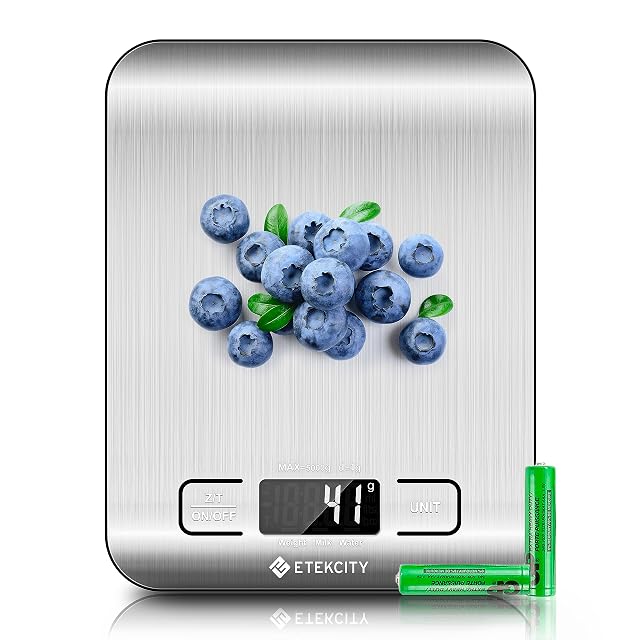
An 11-pound 304 stainless kitchen scale reading in 1-gram increments across five units, with tare, a backlit LCD with large fonts and batteries included.
Best for: A small kitchen, where the scale lives in a cupboard between uses
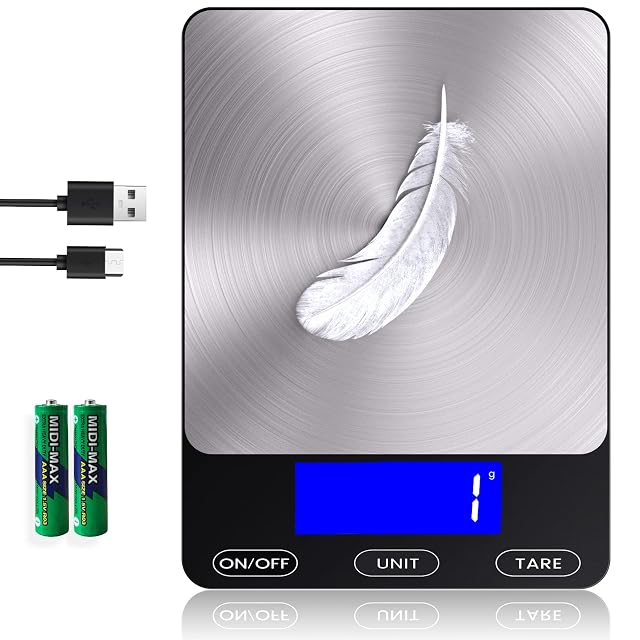
A 33-pound rechargeable kitchen scale with four load sensors, a 7.5 × 5.5 inch stainless platform, five units, overload and low-battery alarms and a hanging hook.
Best for: Bulk weighing — dough, meat, batches — where capacity and platform matter
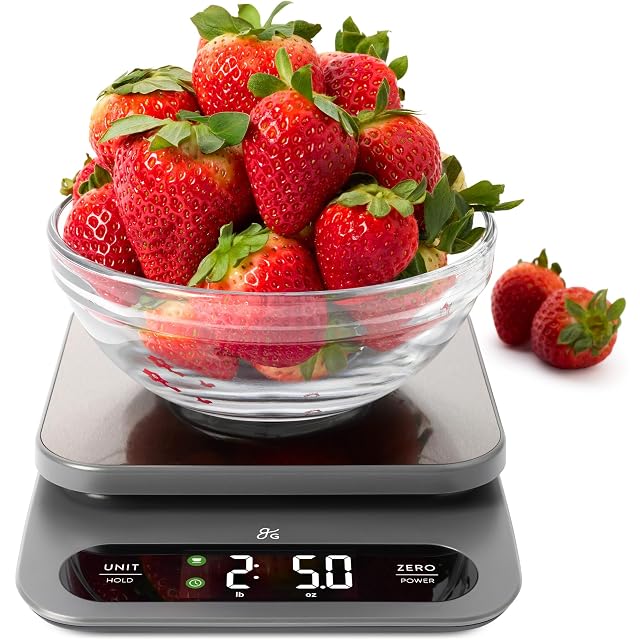
A 22-pound kitchen scale with 1-gram precision, six units, a Hi-Def display extending past the platform, a 5-minute HOLD, a 2-minute shutoff and a 5-year warranty.
Best for: Bulk baking and meal prep, where a bowl sits on the scale for minutes at a time