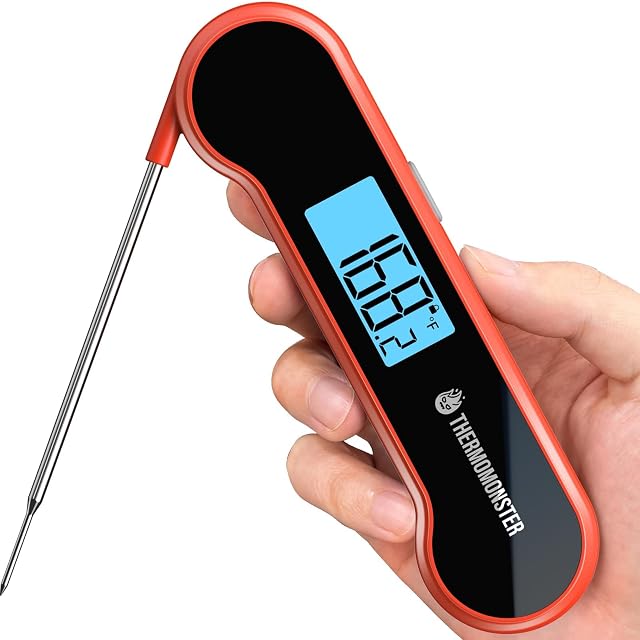
Best for: Thin cuts, fast reads and anyone who holds a thermometer in the left hand
≈ $17
Check price on Amazon A thermocouple, ±0.5 °F, and half a second
A thermocouple thermometer with NIST-certified ±0.5 °F accuracy in half a second, a 4-inch probe, a temperature lock, an auto-flip display and motion wake.
Best for: Thin cuts, fast reads and anyone who holds a thermometer in the left hand
“an industrial-leading professional thermocouple sensor… ±0.5℉ precision… in just 0.5 Seconds”
Only one other page here names its sensor, and it is the opposite extreme. The KitchenAid at $11.99: “Digital thermistor reads internal food temperatures… in less than 6 seconds.”
Twelve times slower, and the one word is the whole explanation.
A thermistor is a bead of semiconductor whose resistance changes with temperature — cheap, stable, accurate, and possessed of thermal mass: the bead must come up to the food’s temperature before it can report it.
A thermocouple is a junction of two dissimilar metals that generates a voltage directly proportional to temperature. It can be made as thin as a wire, so there is almost nothing to heat.
Which is why the shelf sorts the way it does:
0.5 s — this, at $16.99, a thermocouple 1 s — all three TempPro instant-reads, from $9.99 1–2 s — both ONFIKY units at $9.97 and $9.98, the LONICERA at $12.99, the Alpha Grillers at $14.97 3 s — the ANDAXIN at $9.99 under 6 s — the KitchenAid at $11.99, a thermistor under half a second — the Etekcity at $18.99, which reads surfaces and cannot read inside anything
And the difference matters most on thin food. A pork chop or a fish fillet is an inch thick, and a probe that takes six seconds is a probe whose own temperature is still climbing while the food keeps cooking. On a thick roast six seconds is tolerable. On a scallop it is useless.
The second place it matters is the number of readings. A joint should be checked in two or three places, because it is not uniform and the thin end finishes first. Three half-second readings is nothing. Three six-second ones is eighteen seconds with the oven door open.
NIST is the United States National Institute of Standards and Technology, which maintains the physical reference standards the country’s measurements trace back to. A NIST-traceable instrument has been checked against a chain of calibrations leading to one of those standards — which is what turns a tolerance from an assertion into a claim with an authority behind it.
The shelf, on accuracy:
±0.5 °F — this, with NIST cited ±0.9 °F — the TempPro TP-02S at $9.99, the TP03A at $9.99 ±1 °F — the ANDAXIN at $9.99, both ONFIKY units at $9.97 and $9.98, the LONICERA at $12.99 ±1.8 °F / 1 °C — the TempPro TempTrack at $19.99
Seven of the fourteen items sold on Amazon.com publish nothing at all: the KitchenAid at $11.99, both Taylor units at $18.99 and $24.24, the Alpha Grillers at $14.97 (“advanced, highly accurate technology”), the Etekcity at $18.99 (“Better Accuracy”) and the TempPro TP03H at $9.98.
The only other certifications anywhere here are the ANDAXIN’s CE and RoHS, which are compliance marks rather than accuracy statements.
What half a degree buys over one degree, honestly.
For meat, almost nothing. Chicken is safe at 165 °F; beef runs through rare 125, medium rare 135, medium 145; pork is safe at 145 °F with a rest. A degree either way changes nothing you could taste.
For sugar and chocolate it is real. Tempering chocolate works in bands two or three degrees wide. A sugar syrup at 240 °F is a soft ball and at 250 °F a firm one — and a custard splits within a few degrees of setting.
And the honest gap is a feature, not a number. This page publishes no calibration function, so the tightest accuracy claim on the shelf has no published means of being restored if it drifts — where five items here do have one, including the ANDAXIN at $9.99, both ONFIKY units at $9.97 and $9.98, the TempPro TP03H at $9.98 and the Alpha Grillers at $14.97, which adds that it “comes pre-calibrated”.
The free check still works: crushed ice topped with water, stirred, holds 32 °F / 0 °C while ice remains; boiling water is 212 °F at sea level, falling about 1 °F per 500 feet of altitude. On this thermometer an error can be noticed and not corrected.
“an innovative auto flip large LCD screen with exceptional brightness… perfect for both left and right hand users outdoors and at night.”
A thermometer is read along the axis of its probe, so with the probe in a roast the display faces wherever the body points. Turn it over to hold it in the other hand and the digits are upside down — and on a fixed screen you read it backwards or rotate the tool in the heat.
One other item tackles it, mechanically. The KitchenAid at $11.99 has an “Oversized, pivoting backlit display” readable “from any angle”: the screen itself moves, which additionally lets you angle it away from a flame.
An auto-flip rotates the digits in software when the body turns over — the lighter solution, with no hinge to wear.
The other twelve items offer a backlight and nothing more. Nine of the fourteen items sold on Amazon.com mention one, which tells you what the shelf thinks the problem is: darkness, not geometry.
And this page pairs the flip with the cheap answer to the same problem. Bullet two: “With a 4 inch long probe and the temperature lock, you can easily measure and read the temperature away from the heat.”
Five items on this shelf publish a lock: this, the ANDAXIN at $9.99, the LONICERA at $12.99, the Taylor Compact at $18.99, and both leave-in units by their nature.
Having both is the complete answer: the lock frees you from reading it in place, and the flip frees you from which hand you hold it in.
No display size is published, which is true of every item on this shelf — “large”, “oversized”, “large bright” are the vocabulary and no figure appears anywhere.
The four items on this shelf that publish a probe length:
6.5 inches — the TempPro TempTrack at $19.99, a leave-in unit, with a “stepdown tip” 5.3 inches — the TempPro TP-02S at $9.99, rigid 5 inches — the LONICERA at $12.99 4 inches — this
Ten publish nothing, including both Taylor units, the KitchenAid, the Alpha Grillers and both ONFIKY units.
Four inches is adequate and it is not generous, and the trade is a real one.
What it covers. A roast wants the tip at the center, which on most domestic joints is two to three inches in. A chicken thigh, a steak, a chop, a loaf — all well inside four inches.
What it does not. A stock pot or a deep fryer puts six inches of hot liquid between your hand and the measurement — the TempPro TP-02S sells its 5.3 inches on exactly that: “keeps your hands away from the heat and avoid dangerous situations”. A large turkey or a whole ham can want more than four inches.
And the lock is what makes four inches workable, because the time your hand is close is half a second plus a button press rather than a wait.
Two things a thermocouple probe does well that the page does not mention. A thermocouple junction sits at the very tip, so the reading is of one small point rather than an average along the shaft — which matters when you are looking for the coldest part of a joint. And a thin probe leaves a small hole, so less juice escapes from a steak you check twice.
What is absent is a stepdown tip, which only the TempTrack publishes: a shaft that narrows at the end reaches temperature faster still and leaves a smaller wound.
“the thermometer will wake up instantly when you pick it up and auto-sleep after seconds if no operation were made”
Three items on this shelf use motion sensing: this, and both ONFIKY units at $9.97 and $9.98, which pair it with the shelf’s only battery-life figure — “4000+ Hour Battery Life”.
Two use a timer instead: the TempPro TP-02S at $9.99 and the Taylor Compact at $18.99, both ten minutes.
Nine items publish no power management at all.
Motion sensing is better for two reasons. A timer still burns ten minutes after every use, and a timed thermometer has to be switched on by hand — which on a tool you pick up with one greasy hand while holding tongs in the other is the whole friction.
What this page does not publish is the cell. Only one item here makes an argument of it, and it is a good one: the TempPro TP03A at $9.99 — “1 AAA battery instead of a button cell; this digital thermometer lasts twice as long and makes battery replacement easier.” A CR2032 holds about 220 milliamp hours against roughly 1000 for a AAA, and a AAA is in every drawer in the house.
On a thermocouple instrument the question has a sharper edge, because a thermocouple produces a tiny voltage that has to be amplified — which is more electronics than a thermistor needs, and more electronics draws more current.
“With upgraded 100% waterproof design, you can easily wash and clean your thermometer under running water.”
It is a claim and not a tested rating, and four items on this shelf publish one of those.
IP67 — both ONFIKY units at $9.97 and $9.98 and the Alpha Grillers at $14.97: dust-tight and thirty minutes submerged under a meter, the only three sold on Amazon.com that survive a washing-up bowl, four with the European ThermoMaven IP65 — the ANDAXIN at $9.99: dust-tight, low-pressure jets only IPX6 — the TempPro TP03H at $9.98, the LONICERA at $12.99: high-pressure jets, dust not rated at all, which is what the X means Unrated claims — this, and the Taylor Compact at $18.99 (“splashes & quick rinses”) Nothing — six items
“100 percent waterproof” is the strongest-sounding and least specific phrase on the shelf. The Taylor Compact’s “splashes and quick rinses” says less and tells you more, because it draws a line.
Why sealing matters on a thermometer at all. The probe goes into raw chicken. The part that needs washing is not the probe — smooth stainless wipes clean in a second — but the seam where the probe enters the housing, a crevice no cloth reaches.
And on this instrument there is a second reason. A thermocouple’s signal is measured in microvolts, and moisture across a connection is exactly the kind of fault that shifts a small voltage. A damp board on a ±0.5 °F instrument reads wrong for weeks before it fails, which is worse than a clean death.
The practical rule: rinse it, dry it, and do not leave it in the sink.
No temperature range at all, where ten of the fourteen items sold on Amazon.com publish one — six of them the identical −58 to 572 °F, the widest being the Etekcity’s −58 to 842 °F and the narrowest the Taylor’s 32 to 392 °F. On a page whose first bullet is about precision, the span over which that precision holds is the obvious companion figure.
No calibration function, as above, on the shelf’s tightest accuracy claim.
No IP code, as above.
No weight and no dimensions, where seven items here have a catalog weight — from 23 g to 113 g.
No battery type and no battery life, as above.
No display size, which no item on this shelf publishes.
No named uses. The ONFIKY pair lists seven — grilling, barbecue, smoking, air frying, baking, candy making, liquids — and the Alpha Grillers eight. This page names none, which on the one thermometer here precise enough for sugar and chocolate work is a missed argument.
No warranty. Three items on this shelf publish one: the LONICERA at $12.99 — 18 months plus a 60-day money-back guarantee, the longest term here, on an item costing two thirds of this — the ANDAXIN at $9.99 (one year, with CE and RoHS) and the Taylor at $24.24 (one year limited). Eleven publish none.
No warning against leaving it in the food, which only the KitchenAid publishes: “Digital thermometers are not meant to be left in food during cooking. The plastic and electronic components could be damaged with excessive heat.” It applies here in full — and the two leave-in units on this shelf, at $19.99 and $24.24, are the ones built to do it.
No country of manufacture, which no item on this shelf publishes.
Read on the day this page was built: $20 at the American Amazon shop.
Read from Keepa on the day this page was last revised; stock and price both move without notice.
Prices quoted in this text were read on 2026-10-17. The live price is at the top of the page.
React almost instantly, and this shelf lets you see the difference in a single pair of numbers. Bullet one: "Upgraded with an industrial-leading professional thermocouple sensor... ±0.5℉ precision provides you the accurate temperature of your food in just 0.5 Seconds." The only other page here that names a sensor is the KitchenAid at $11.99: "Digital thermistor reads internal food temperatures... in less than 6 seconds." Twelve times slower, and the one word is the whole reason. A thermistor is a bead of semiconductor whose resistance changes with temperature. It is cheap, stable and accurate — and it has thermal mass: the bead has to come up to the food’s temperature before it can report it. A thermocouple is a junction of two dissimilar metals that generates a voltage directly proportional to temperature. It can be made as thin as a wire, so there is almost nothing to heat. Which is why the fast thermometers on this shelf cost more: 0.5 s here at $16.99 · 1 s on three TempPro models from $9.98 · 1–2 s on four items · 3 s on the ANDAXIN at $9.99 · under 6 s on the KitchenAid. And why the difference matters on thin food most of all. A pork chop or a fish fillet is an inch thick, and a probe that takes six seconds is a probe whose own temperature is still climbing while the food keeps cooking. On a thick roast, six seconds is tolerable. On a scallop it is useless. The second place it matters is the number of readings: a joint wants two or three places checked, and three half-second readings is nothing where three six-second ones is eighteen seconds with the oven open.
That the accuracy figure is traceable to a national standard, and no other page on this shelf cites anything at all. NIST is the United States National Institute of Standards and Technology, which maintains the physical reference standards the country’s measurements trace back to. A NIST-traceable instrument has been checked against a chain of calibrations leading to one of those standards — which is what turns a tolerance from a manufacturer’s assertion into a claim with an authority behind it. The shelf, on accuracy: ±0.5 °F — this, with NIST cited · ±0.9 °F — the TempPro TP-02S at $9.99 and TP03A at $9.99 · ±1 °F — the ANDAXIN at $9.99, both ONFIKY units at $9.97 and $9.98, the LONICERA at $12.99 · ±1.8 °F — the TempPro TempTrack at $19.99. Seven of the fourteen items sold on Amazon.com publish nothing, including the KitchenAid at $11.99, both Taylor units at $18.99 and $24.24, the Alpha Grillers at $14.97 and the Etekcity at $18.99. The only other certifications anywhere on this shelf are the ANDAXIN’s CE and RoHS, which are compliance marks rather than accuracy statements. What half a degree buys over one degree. For meat, almost nothing — chicken is safe at 165 °F, beef moves through rare to medium in 5 °F bands, and a degree either way changes nothing you could taste. For sugar and chocolate it is real: tempering chocolate works in bands two or three degrees wide, and a sugar syrup at 240 °F is a soft ball while 250 °F is a firm one. And the honest gap: this page publishes no calibration function, so the tightest figure on the shelf has no means of being restored if it drifts.
Because half the people reading a thermometer are holding it in the other hand, and this is the only page on the shelf that says so. Bullet three: "an innovative auto flip large LCD screen with exceptional brightness, this food thermometer is perfect for both left and right hand users outdoors and at night." The problem. A thermometer is read along the axis of its probe, so with the probe in a roast the display faces wherever the body points. Turn the tool over to hold it in the other hand and the digits are upside down. On a pen-style unit with a fixed screen you read it backwards or rotate the thing in the heat. One other item tackles it, mechanically: the KitchenAid at $11.99 has an "Oversized, pivoting backlit display" readable "from any angle" — the screen itself moves, which also lets you angle it away from a flame. An auto-flip rotates the digits in software when the body turns over, which is the lighter solution and needs no hinge to wear out. The other twelve items offer a backlight and nothing more — nine of the fourteen items sold on Amazon.com mention one, which tells you the shelf believes the problem is darkness rather than geometry. And the cheap answer to the same problem is a hold button, on five items here: the ANDAXIN at $9.99, the LONICERA at $12.99, the Taylor Compact at $18.99, this one, and both leave-in units. A lock freezes the reading so you read it wherever you like. This thermometer has both the flip and the lock, which is the complete answer — and bullet two states it plainly: "With a 4 inch long probe and the temperature lock, you can easily measure and read the temperature away from the heat."
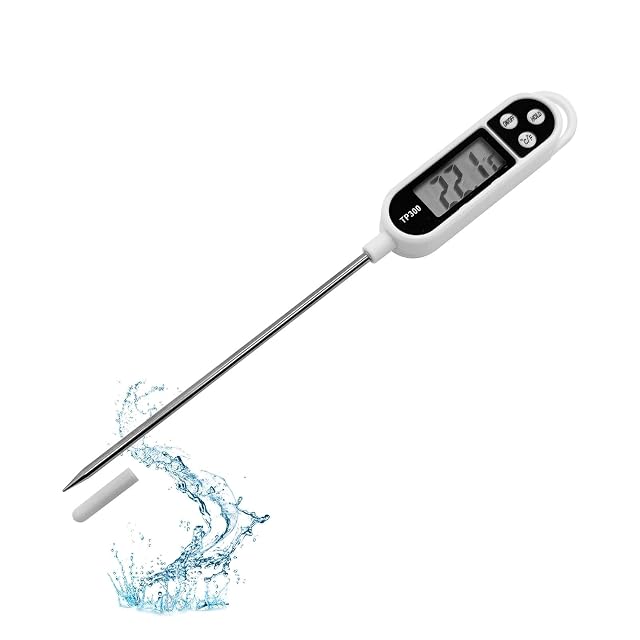
A digital instant-read thermometer stated to read in 2 to 3 seconds, to ±1 °C, from −58 to 572 °F, on a food-grade stainless probe, with a hold button, a probe cover and hanging holes. Sold on the European Amazon stores, not on Amazon.com.
Best for: A reader in Europe; in the United States, one of the thermometers sold on Amazon.com in this hub.
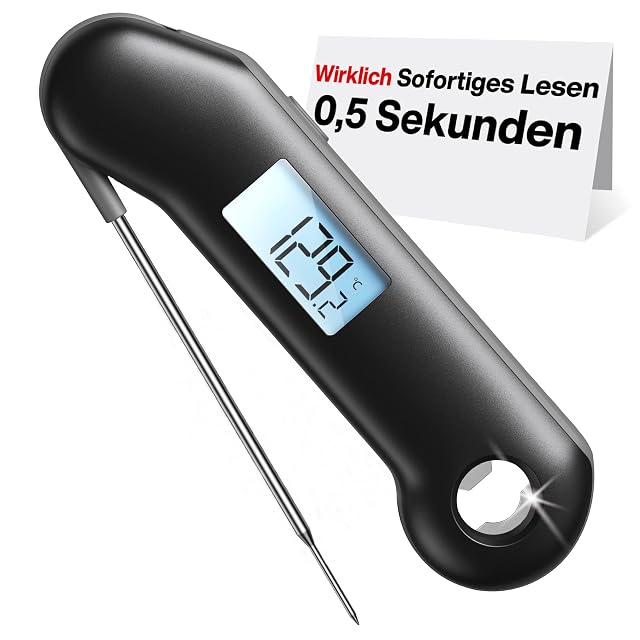
A thermocouple instant-read thermometer stated at 0.5 seconds and ±0.5 °F, NIST certified with a calibration certificate in the box, NSF listed, IP67 waterproof, with an auto-rotating backlit display, lift-to-wake, a magnet and a hanging hook.
Best for: Anyone cooking to a temperature rather than to a time.
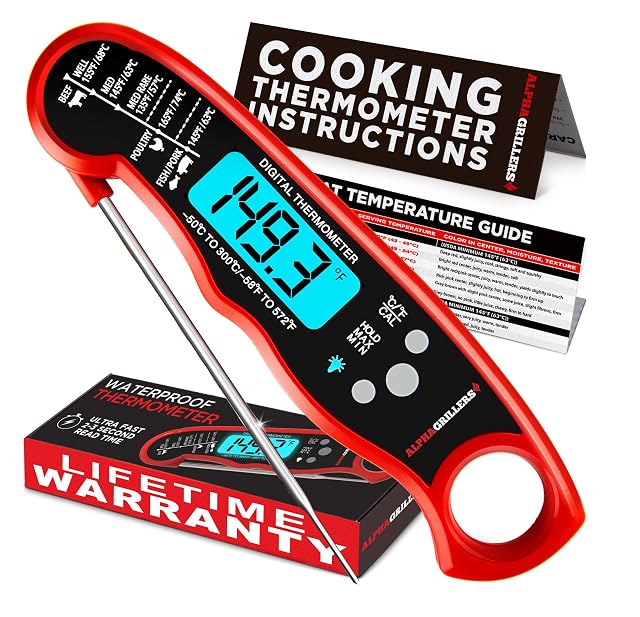
A one-to-two second instant-read thermometer, IP67 waterproof, supplied pre-calibrated with a recalibration function, a meat temperature chart and instructions in a gift box.
Best for: A first thermometer, or a gift, where the chart and the calibration matter most
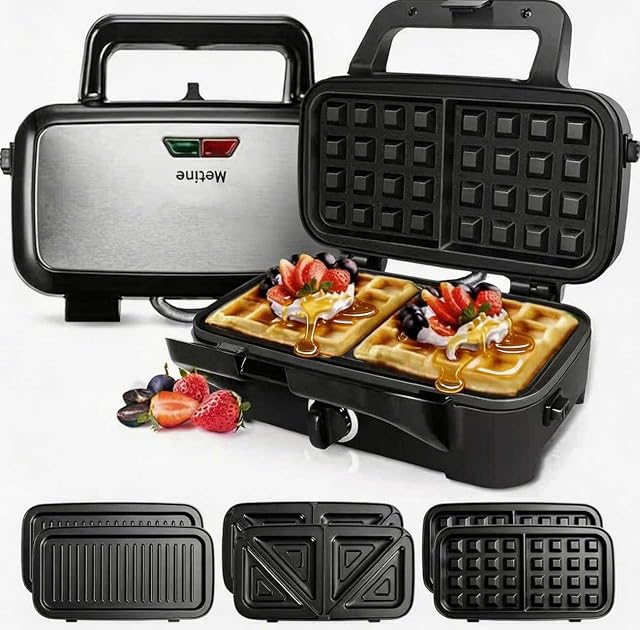
A 1,200-watt three-in-one with waffle, sandwich and grill plates each 10.8 × 5.5 inches, five browning levels, a ready light and published cooking times.
Best for: A household that wants control and repeatability from a three-in-one press
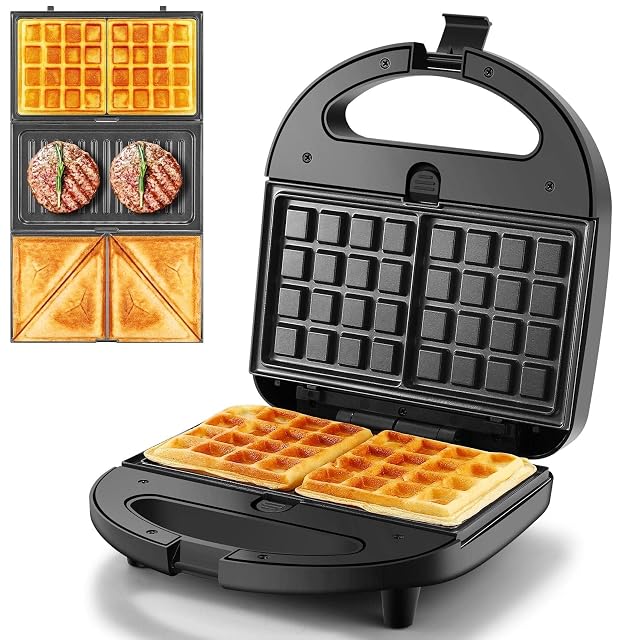
A 750-watt three-in-one sandwich, waffle and grill press with interchangeable non-stick plates, a cool-touch handle, anti-slip feet and upright storage.
Best for: A first three-in-one press, where price and plate count matter most
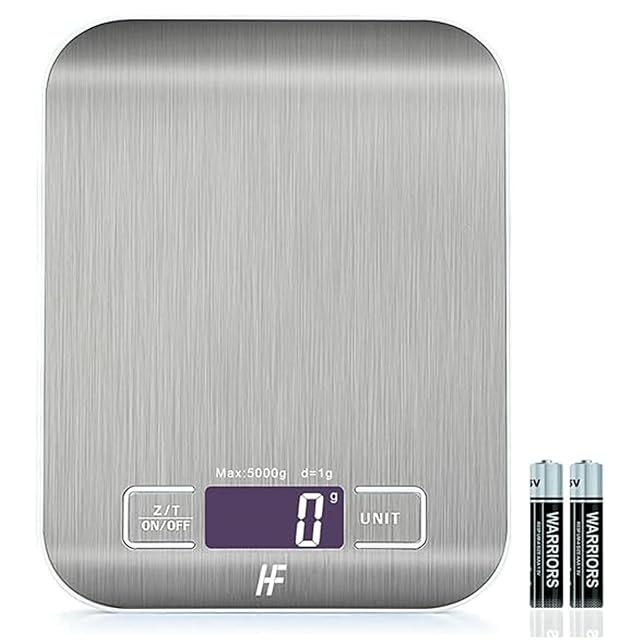
Eleven pounds (5 kg) of capacity graduated in one gram, on a 7.1 × 5.5 in (18 × 14 cm) stainless platform. HomeFashion publishes a backlit display, a tare function, five units, automatic shut-off, a battery indicator, and two AAA cells in the box.
Best for: Everyday baking, weighed in a bowl that is not too wide.