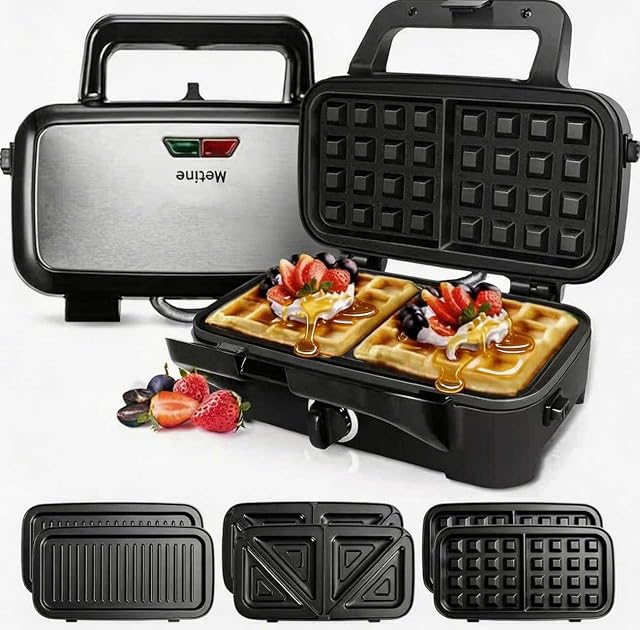
Best for: A household that wants control and repeatability from a three-in-one press
≈ $50
Check price on Amazon Five levels, 1,200 watts, and real times
A 1,200-watt three-in-one with waffle, sandwich and grill plates each 10.8 × 5.5 inches, five browning levels, a ready light and published cooking times.
Best for: A household that wants control and repeatability from a three-in-one press
“we bake our waffles by time, not by the indicator light. The green light going off does NOT mean your waffle is ready – it’s just a signal. Always follow the timer.”
A thermostatted press lets the plates fall a few degrees and reheats them, so the light cycles throughout the cook.
The BLACK+DECKER at $48.99 describes that mechanism correctly — its green light “illuminates when the correct cooking temperature is reached and cycles on and off with the thermostat during use”, with “Wait for the green light before adding food”. The Aigostar at $39.99 separates the two signals — “a red power light and a green preheat light”, the clearest signaling under sixty-five dollars.
But neither says what this page says: that the cycling light has nothing to do with the food.
And this is the only page on this shelf with actual times. “we use level 3 for about 8 minutes and level 5 for about 5 minutes — but feel free to adjust the time based on your personal taste.”
Plus a recovery instruction nobody else gives: “Not crispy enough after opening? Just close the lid and toast for 1–2 more minutes for perfect results.”
Which is worth borrowing for every other machine on this shelf. Three of the seven have no light at all — the OSTBA at $29.99 and both Dash Flex Press units, and the Forged Iron at $34.99 has no on/off switch either: “No on/off switch to fuss with; plug in and the… Cooking Surface heats up fast.”
On any of them, your stopwatch and your notes are the only repeatability there is.
“Levels 1–2 for gentle warming, levels 3–5 for toasting and searing (from light toast to juicy steak)”
That is more useful than a dial marked one to five, because it says the bottom two settings are not weak versions of the top three. They are a different function.
Warming at 1 to 2 holds food without cooking it further — which is what a press is otherwise bad at, having only one state. Toasting and searing at 3 to 5 is the cooking range, and browning does not begin below about 140 °C, so a steak needs the top of it.
Only at least two of the fourteen machines on this shelf regulate anything.
this — five levels GreenPan, $299.95 — “ADJUSTABLE SHADE & CRUNCH CONTROL”, an XL LCD DISPLAY and a ONE-TOUCH DIAL with presets OSTBA $29.99, Aigostar $39.99, BLACK+DECKER $48.99, both Dash Flex Press — nothing
What control is worth on a waffle specifically. A waffle is a crust-versus-interior problem: too cool and it is pale and soft; too hot and the shell sets before the inside cooks. With five levels and published times you can find a setting and repeat it. With one fixed temperature and no light you cannot.
And bullet three makes an honest comparison of its own: “Unlike traditional cast iron waffle irons, this modern design gives you both warming and toasting in one appliance.” A cast-iron iron on a hob has no setting at all — which is true, and is the same limitation five of the seven electric machines here share.
At 120 volts, 1,200 watts draws 10 amperes. A 15-amp circuit supplies about 1,800 watts, so this leaves roughly a third spare — enough for a kettle only on a different run.
The wattages on this shelf:
1,200 W — this 750 W — the OSTBA at $29.99, and the Aigostar at $39.99, the only page here to publish the voltage too: “120V and 750W”, 6.25 amperes None — both Dash Flex Press machines, the BLACK+DECKER at $48.99, and the GreenPan at $299.95
So the most expensive machine on this shelf publishes no power figure and this one does.
Wattage does not set the final temperature — a thermostat does — but it sets how fast the plates reach it and how fast they recover. A press loses heat every time the lid opens and every time cold food lands on it, and 1200 against 750 watts is a sixty percent difference in that recovery.
Which is the mechanical reason this machine can offer five levels and the 750-watt presses cannot. A control is only meaningful if the machine can hold the setting, and holding a high setting under load takes power.
It is also why the plates can be the largest here. A bigger plate needs more watts to hold its temperature.
And “dual-sided heat conduction” is the other half of the claim. Both plates heated means the food cooks from above and below at once, which is the whole difference between a press and a pan. Only this and the OSTBA at $29.99 state it explicitly, though a hinged press that heated one face would be a remarkable thing to sell.
The one caution: on a shared kitchen circuit, do not run this and a toaster together.
59 square inches each, measured and published.
The cooking surfaces on this shelf:
10.8 × 5.5 inches — this, about 59 in² 8 × 5 inches — both Dash Flex Press machines, 40 in² 4 inches — the Dash Mini plate pack at $9.99, about 12.6 in² as a round plate “4-Square” — the GreenPan at $299.95, with no dimension at all Nothing — the remaining eight items, including the Breville plates at $64.95, the BLACK+DECKER at $48.99, the OSTBA at $29.99 and the Aigostar at $39.99
So this is half again the area of the next largest machine, and the only three-in-one here whose plates can be compared with anything.
And all three plates are the same size, which is the sensible arrangement: the sandwich, grill and waffle patterns occupy one footprint, so the machine’s thermostat sees the same mass every time.
At 3,602 grams it is the second heaviest item sold on Amazon.com here: Aigostar 1,814 g · both Dash Flex Press 2,268 g · OSTBA 2,313 g · BLACK+DECKER 2,812 g · this 3,602 g · GreenPan 8,165 g.
The catalog footprint is 343 × 152 × 152 mm — about 13.5 × 6 × 6 inches — which is a carton shaped for a machine stored on its end, and bullet five claims exactly that: “stands upright for neat storage.”
Four machines here publish an upright or locking storage claim: this, the OSTBA at $29.99, the Aigostar at $39.99 (“locks shut and has a collectable cord”) and the Dash Forged Iron at $34.99 (“locks closed to store away”).
But three plate sets means two sets are always out of the machine, and only the GreenPan solves where they live: “SIMPLE STORAGE: Belgian and Classic Waffle Plates store in the bottom of the unit.” Three Metine plates at 10.8 × 5.5 inches is a real amount of cupboard.
“wipe with a soft cloth or place plates directly in the dishwasher” · “Crafted from durable, BPA-free materials and tested for safety and quality”
at least twelve of the fourteen items on this shelf claim dishwasher safety. Two qualify it.
GVODE, $38.99 — “Most of time, recommend hand wash with soap to protect the non-stick for long term use” BLACK+DECKER, $48.99 — the only care warning here: “Avoid metal utensils, abrasive cleaners, and aerosol cooking sprays to help protect the coating”
Both apply to these plates in full, and the aerosol point is the one to take seriously. A spray can carries a propellant and usually lecithin, and on a hot non-stick surface the lecithin polymerizes into a hard brown-gold varnish bonded to the coating. It is not grease and it does not wash off — and on a waffle pattern it builds in the pockets where nothing reaches. Brush melted butter instead.
And the metal-utensil point bites on a press sold for steak. A steak that catches gets a metal turner to it, and one cut in a non-stick film propagates from that point for the rest of the plate’s life.
“BPA free” is the chemistry claim here, and it is about the body rather than the plates. BPA is a bisphenol used in some polycarbonates — a plastics question, not a non-stick question.
Three items on this shelf publish actual coating chemistry:
GVODE, $38.99 — “double-layer TEflon”, and “BPA free” Aigostar, $39.99 — “non-stick/teflon” GreenPan, $299.95 — “Thermolon Volt, a diamond-infused ceramic nonstick… free of PFAS, PFOA, lead or cadmium” — the only non-fluoropolymer plate on this shelf
This page names neither the coating nor the plate material. Two items name a material: the GVODE’s “food grade aluminum” and the GreenPan’s “CAST PLATES… optimal heat conduction and superior performance”. Mass is what keeps a plate hot when cold batter lands on it, and at 3,602 g for a whole machine with three plates, these are pressed rather than cast.
One habit no page on this shelf gives: let the plates cool before pulling them out. Thermal shock from a hot plate into cold water is what crazes a coating.
No moat, which is the characteristic failure of a waffle plate and the sharpest omission on an otherwise well-documented page. Two items here solve it: the Breville at $64.95 — “the no-mess moat design feature prevents excess waffle batter spilling out and onto your counter top” — and the GreenPan at $299.95 — “EXTRA-LARGE MOAT… frames the plates on all sides”. The OSTBA at $29.99 names the consequence: “Avoid overfilling the sandwich press to prevent latch damage.”
Waffle batter expands as it cooks — the steam that lightens it pushes it outward — so a plate filled level with the pattern overflows when the lid comes down. On a 10.8 × 5.5-inch plate there is more of it to go wrong.
No batter quantity, which no item on this shelf publishes. Underfill the first one deliberately and use it as your measure — and this page at least gives you the times to go with it.
No waffle thickness and no count. The Cuisinart at $56.26 and the GVODE at $38.99 both publish “4 deep pocketed, 3/4-inch thick Belgian waffles” — the only thickness on this shelf — and the GreenPan ships two sets, “classic American-style” and “thicker Belgian”. On the largest plate here, how many waffles it makes is the obvious figure.
No plate material and no coating chemistry, as above.
No 180-degree hinge. Both Dash Flex Press machines open flat — “creating an indoor grill on your countertop”, which doubles the surface — and the BLACK+DECKER explicitly forbids it: “Always operate the unit in the closed position.” This page says nothing, and a press described throughout as closing is presumably a closed press. On a 59-square-inch plate, a flat mode would have given 118.
No drip tray, where the Dash Forged Iron at $34.99 publishes one. On a machine sold for “juicy steak”, the fat goes somewhere.
No cool-touch handle, where three machines here publish one — and the OSTBA is the only page on this shelf to say the body gets hot at all.
No fitting procedure, where the BLACK+DECKER publishes the only one: “attach both cooking plates while the appliance is cool, then close the lid before plugging it in.”
No warranty, which no item on this shelf publishes.
No country of manufacture, which no item on this shelf publishes either.
Read on the day this page was last revised: $50 at the American Amazon shop.
Read from Keepa on the day this page was last revised; stock and price both move without notice.
Prices quoted in this text were read on 2026-10-17. The live price is at the top of the page.
Because a thermostat light signals plate temperature and buyers read it as doneness — and this is the only page on this shelf to say so. The last bullet: "Remember: we bake our waffles by time, not by the indicator light. The green light going off does NOT mean your waffle is ready – it’s just a signal. Always follow the timer." What the light actually does. A thermostatted press lets the plates fall a few degrees and reheats them, so the light cycles throughout the cook. The BLACK+DECKER at $48.99 describes the mechanism correctly: its green light "illuminates when the correct cooking temperature is reached and cycles on and off with the thermostat during use", with "Wait for the green light before adding food". The Aigostar at $39.99 goes further and separates the two signals — "a red power light and a green preheat light" — which is the clearest signaling under sixty-five dollars. But none of them says what this page says, which is that the cycling light has nothing to do with the food. And this is the only page on this shelf with times: "we use level 3 for about 8 minutes and level 5 for about 5 minutes — but feel free to adjust the time based on your personal taste", plus a recovery instruction most pages omit: "Not crispy enough after opening? Just close the lid and toast for 1–2 more minutes." Which is the thing to borrow for every other machine here. Three machines on this shelf have no light at all — the OSTBA at $29.99 and both Dash Flex Press units, the Forged Iron of which has no on/off switch either. On any of them your stopwatch and your notes are the only repeatability you get.
Plate temperature, and the page splits the range into two jobs rather than a vague scale. Bullet three: "5-Level Warming & Toasting Control – Levels 1–2 for gentle warming, levels 3–5 for toasting and searing (from light toast to juicy steak)." That is a more useful description than a dial marked one to five, because it tells you the bottom two settings are not weak versions of the top three: they are a different function. Warming at levels 1 to 2 holds food without cooking it further — which is what a press is otherwise bad at, since it has only one state. Toasting and searing at 3 to 5 is the cooking range, and a steak needs a plate hot enough to brown, which does not begin below about 140 °C (284 °F). Only at least two of the fourteen machines on this shelf regulate anything. This, and the GreenPan at $299.95 with "ADJUSTABLE SHADE & CRUNCH CONTROL", an XL LCD display and a one-touch dial with presets. The other five have nothing: the OSTBA at $29.99, the Aigostar at $39.99, the BLACK+DECKER at $48.99 and both Dash Flex Press units — and the Dash Forged Iron at $34.99 has no switch at all: "No on/off switch to fuss with; plug in and the... Cooking Surface heats up fast." What control is worth on a waffle in particular. A waffle is a crust-versus-interior problem: too cool and it is pale and soft, too hot and the shell sets before the inside cooks. With five levels and published times you can find a setting and repeat it. With one fixed temperature and no light, you cannot.
It is ten amperes, which is most of a circuit — and it is what buys the control. At 120 volts, 1,200 watts draws 10 amperes. A standard American 15-amp circuit supplies about 1,800 watts, so this leaves roughly a third spare — enough for a kettle only if the kettle is on a different run. The wattages on this shelf: 1,200 W — this · 750 W — the OSTBA at $29.99 and the Aigostar at $39.99, which is the only page here to publish the voltage too: "120V and 750W", 6.25 amperes · none — both Dash Flex Press machines, the BLACK+DECKER at $48.99 and the GreenPan at $299.95. So the most expensive machine on this shelf publishes no power figure and this one does. What wattage governs is not the final temperature — a thermostat sets that — but how fast the plates reach it and how fast they recover. A press loses heat every time the lid opens and every time cold food lands on it, and 1200 against 750 watts is a sixty percent difference in recovery. Which is the mechanical reason this machine can offer five browning levels and the 750-watt presses offer none: a control is only meaningful if the machine can hold the setting, and holding a high setting under load takes power. It is also why the plates are the largest here. 10.8 × 5.5 inches each is about 59 square inches — half again the 8 × 5 inches, 40 square inches, of both Dash Flex Press machines — and a bigger plate needs more watts to hold its temperature. The one caution: on a shared kitchen circuit, do not run this and a toaster together.
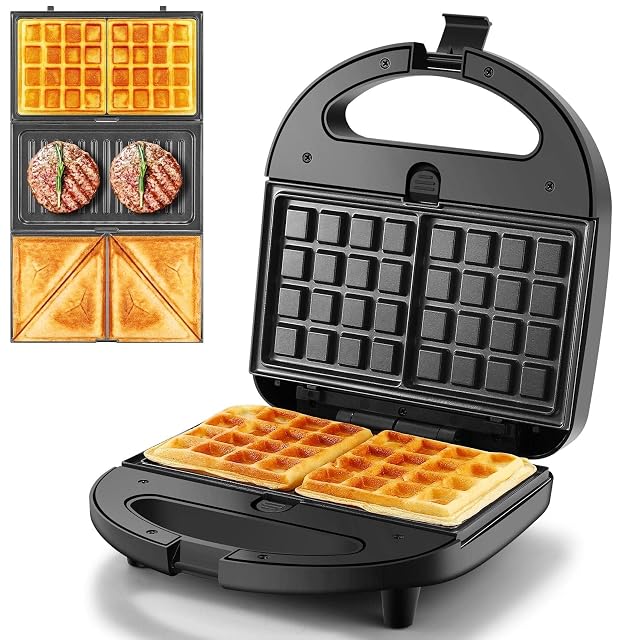
A 750-watt three-in-one sandwich, waffle and grill press with interchangeable non-stick plates, a cool-touch handle, anti-slip feet and upright storage.
Best for: A first three-in-one press, where price and plate count matter most
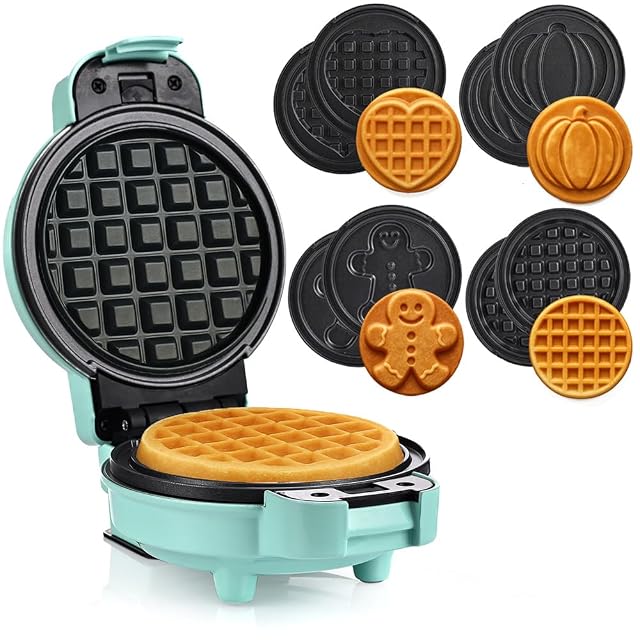
Four interchangeable waffle plates — heart, classic, pumpkin and gingerbread — on a compact 490 W mini iron. LEHMANN publishes a 4.9 in (12.5 cm) plate size and a non-stick, BPA-free coating. It is a 230 V European appliance: the Amazon.com listing gives 230 volts and shows it as currently unavailable.
Best for: A European household that wants four waffle shapes and does not already own an iron.
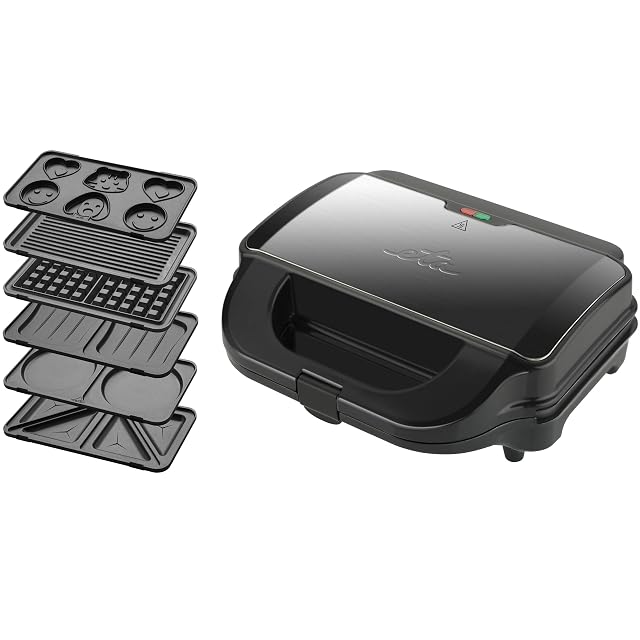
Six interchangeable plate sets on one 900 W body: waffle, grill, pancake, children’s shapes and two sandwich patterns, all stated non-stick. It is a 230 V European appliance: the Amazon.com listing gives 230 volts and shows it as currently unavailable.
Best for: A European household that wants waffles, paninis and pancakes without three appliances.
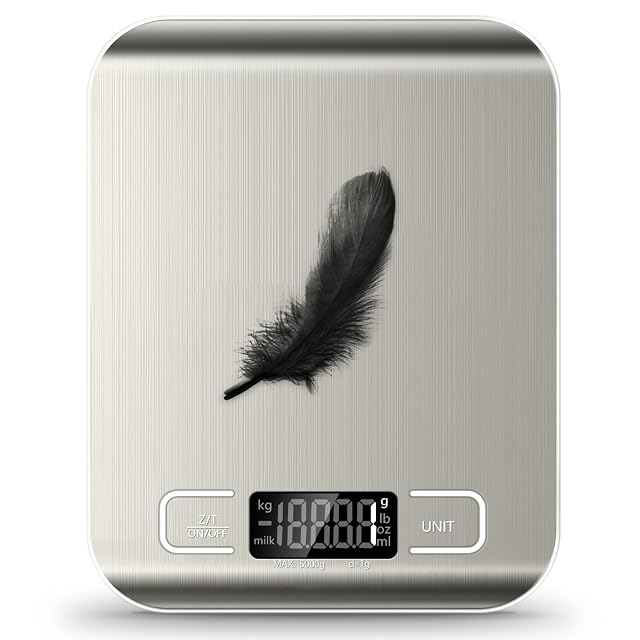
An 11-pound stainless kitchen scale reading to 1 g (0.04 oz) in six units, with tare, a backlit LCD, overload and low-battery warnings and a two-minute shutoff.
Best for: Flour, sugar and portions, at the lowest price on this shelf
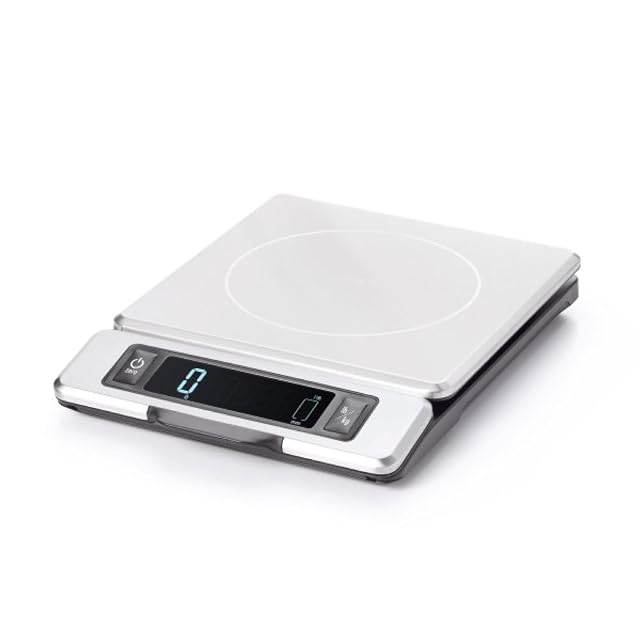
An 11-pound stainless steel food scale with a display that pulls away from the base, a removable platform, large digital numbers and a zero function.
Best for: A buyer who wants the display and the platform to be the whole specification
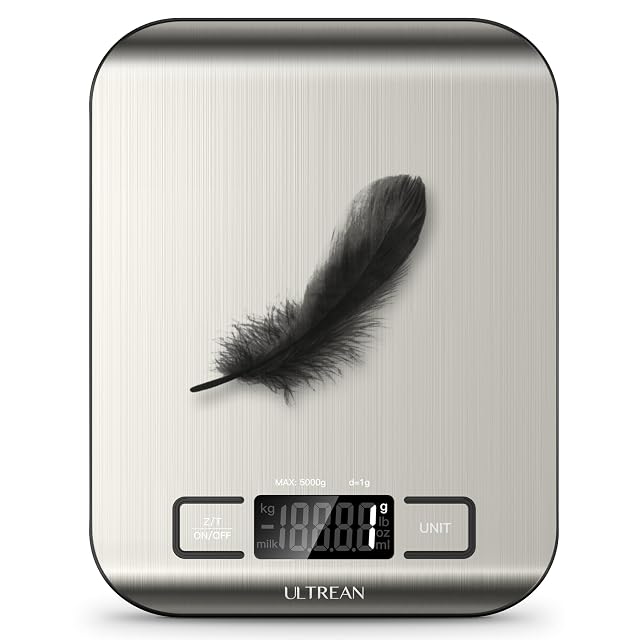
An 11-pound 304 stainless kitchen scale with six units including milk volume, tare, a negative white backlit display and batteries included.
Best for: Everyday weighing where 304 steel and a legible display matter most