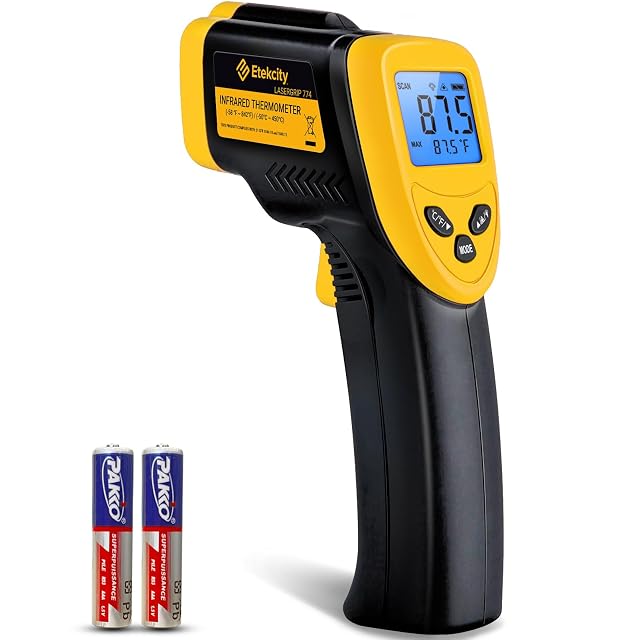
Best for: Pans, pizza stones, griddles and oil — the surfaces a probe cannot read
≈ $19
Check price on Amazon Surfaces only — and it says so
An infrared surface thermometer reading −58 to 842 °F in under half a second, with a 12:1 distance-to-spot ratio, a backlit LCD and a maximum display.
Best for: Pans, pizza stones, griddles and oil — the surfaces a probe cannot read
This shelf sells three different instruments and they do not substitute for each other.
Eleven instant-read probes sold on Amazon.com, from $9.97, plus two European ones, which read the center of the food in one to six seconds. Two leave-in probes with a cable and an alarm — the TempPro TempTrack at $19.99 with a 40 inch mesh cable and USDA presets, and the Taylor at $24.24 with a 4-foot silicone cord — which stay in the meat with the oven door shut. And this, which touches nothing.
An infrared thermometer measures the radiation leaving a surface. It cannot see through anything.
Which rules out doneness. Chicken is safe at 165 °F at the thickest part of the thigh, pork at 145 °F with a rest, beef through 125 to 145 °F rare to medium, brisket at 195 to 205 °F. None of those is a surface temperature — and a chicken skin at 300 °F can sit over flesh that is still raw.
So bullet one, which lists “meat” among the uses, is the misleading line on this page. Read it as the temperature of the outside of meat, which is a real thing to want when searing and no help at all when judging whether to serve it.
And bullet five is unusually honest for this category: the reading reflects “the average temperature within the circular area targeted by the infrared sensor — not a single point.”
Most infrared thermometers leave that out, and it is the fact that explains almost every wrong reading people get from one.
“12:1 distance-to-spot ratio… position the thermometer approximately 14.17 inches / 36 centimeters away from the target.”
The sensor sees a cone. At twelve units of distance, the circle it reads is one unit across.
So at the recommended 14.17 inches the spot is about 1.2 inches wide — the circle of a large coin.
Double the distance and the spot doubles. At four feet it is four inches across, which on a hob means you are averaging the pan, the trivet and the countertop into one number.
That is what bullet five’s “average” means in practice: a cold spot inside the circle pulls the reading down and you never know it was there.
Which gives the one habit this page supplies and almost nobody follows: get close. Fourteen inches is closer than feels natural, and most bad infrared readings are taken at arm’s length across a countertop.
The laser is a pointer, not the sensor. It marks the center of the circle and tells you nothing about its size — so on a small target, close the distance until the spot is smaller than the thing you want. On a two-inch patch, that means under two feet.
The maximum temperature display is the companion feature and it is the right one. Scanning a griddle while holding the trigger and then reading the max is how you find the hot spot in one pass rather than twelve separate readings.
−58 to 842 °F is −50 to 450 °C.
The shelf, by range:
−58 to 842 °F — this −58 to 572 °F — six items: the TempPro TP-02S at $9.99 and TP03A at $9.99, the ANDAXIN at $9.99, both ONFIKY units at $9.97 and $9.98, the LONICERA at $12.99 −40 to 482 °F — the KitchenAid at $11.99 −40 to 450 °F — the Taylor Compact at $18.99 32 to 572 °F — the TempPro TempTrack at $19.99, with probe and wire rated to 716 °F 32 to 392 °F — the Taylor at $24.24, the narrowest on the shelf and the most expensive item here No range published — the ThermoMonster at $16.99, the Alpha Grillers at $14.97, the TempPro TP03H at $9.98
And unlike the probes, this instrument has uses that need the top end.
A pizza stone wants 450 to 500 °F. A cast-iron pan for a steak crust runs 400 to 450 °F at the surface. A grill grate over hot coals goes well past 600 °F. No probe on this shelf can measure any of those — a probe laid on a dry hot surface reads the probe, not the surface, because there is nothing conducting heat into it.
The 842 °F figure is therefore not padding. It is the one range on the shelf matched to what the instrument is for.
And the bottom end has three uses this page names and no probe does better: refrigerators — a fridge should be below 40 °F and a freezer at 0 °F — A/C vents, and automotive.
“watch as your result appears on the bright LCD display in less than half a second”
For comparison with the probes, which measure something else:
0.5 s — the ThermoMonster at $16.99, the only thermocouple on this shelf 1 s — all three TempPro instant-reads 1–2 s — both ONFIKY units, the LONICERA, the Alpha Grillers 3 s — the ANDAXIN at $9.99 under 6 s — the KitchenAid at $11.99, a “Digital thermistor”
The reason an infrared gun is fast is that nothing has to heat up. A probe works by bringing a sensor to the temperature of the food, which takes time proportional to the sensor’s thermal mass — that is the whole difference between the KitchenAid’s thermistor at six seconds and the ThermoMonster’s thermocouple at half a second. An infrared sensor reads radiation that is already arriving, so the limit is the electronics.
Which makes it the right tool for scanning rather than measuring. Ten readings across a griddle in ten seconds is a thing no probe can do, and it is how you find out that your grill has a cold corner or your oven runs hot at the back.
At 113 grams it is the heaviest handheld on this shelf — against 68 g for the Alpha Grillers, 51 g and 48 g for the folding TempPro models, 40 g for the LONICERA, 31 g for the Taylor Compact and 23 g for the TempPro TP-02S. Two AAA cells account for about 23 grams of that, and a pistol grip accounts for the rest.
And the battery is the one detail this page shares with the better-documented probes. 2 AAA, included — where only the TempPro TP03A at $9.99 makes the argument explicitly: “1 AAA battery instead of a button cell… lasts twice as long and makes battery replacement easier.” Nine items on this shelf name no cell at all.
Anything shiny.
An infrared reading depends on how well a surface radiates, and that property — emissivity — varies enormously. Matt, dark and rough surfaces radiate well. Polished steel, clean aluminum and foil radiate very poorly, and what the sensor sees instead is reflections of the room.
So a bare stainless pan or a sheet of foil will read far too cool, sometimes by a hundred degrees or more, and nothing on the display warns you.
No emissivity setting is published on this page, which means the correction is not available — professional guns let you dial it, and this one does not say whether it can.
Two fixes, neither of them on the page. Put a strip of matt masking tape on the spot and read the tape, which sits at the surface’s temperature and radiates properly. Or read the food rather than the pan, since food is matt and wet and radiates close to ideally.
The other blind spot is steam and smoke. A cloud between the gun and the target is a surface too, and the sensor will happily read it. Point it at a boiling pan and you may be measuring the steam.
And glass is the third. An oven door reads the glass, not the inside — to check an oven’s calibration with this, open the door and read the floor or the back wall, quickly, which is a genuinely useful thing no probe on this shelf can do.
No accuracy figure. Bullet two is headed “Better Accuracy” and what follows is a distance-to-spot ratio, which is a geometry specification and not a tolerance. Seven of the fourteen items sold on Amazon.com publish a tolerance: ±0.5 °F (ThermoMonster, with NIST cited), ±0.9 °F (two TempPro models from $9.99), ±1 °F (four items), ±1.8 °F (the TempTrack). This is one of the seven that does not.
No emissivity, as above — and on an infrared instrument that is the figure that governs every reading.
No response distance limit. The page gives a recommended 14.17 inches and no maximum; the spot grows at 1:12 forever, so the real limit is the size of what you are measuring.
No laser class or power, on an instrument with a laser pointer. The sensible habit is the one the page does not give: do not point it at anyone’s face, and remember the laser is only a sight.
No warranty. Three items on this shelf publish one: the LONICERA at $12.99 — 18 months plus a 60-day money-back guarantee, the longest here — the ANDAXIN at $9.99 (one year, with CE and RoHS) and the Taylor at $24.24 (one year limited). Eleven publish none, and this is one.
No waterproof rating. Four items here publish IP67 or IPX6, one IP65. On an instrument that never touches food, that matters far less — but a kitchen is a wet place and a pistol grip on a countertop is as likely to be splashed as anything else.
No dimensions. 113 grams and nothing else, where seven items here have a catalog weight and several have measured bodies.
No country of manufacture, which no item on this shelf publishes.
Read on the day this page was built: $19 at the American Amazon shop.
Read from Keepa on the day this page was last revised; stock and price both move without notice.
Prices quoted in this text were read on 2026-10-17. The live price is at the top of the page.
No, and that is the single most important thing to understand about it. Its own bullets say what it does: "Scan the surface of your object", and bullet five goes further — the reading reflects "the average temperature within the circular area targeted by the infrared sensor — not a single point." An infrared thermometer measures the radiation leaving a surface. It has no way to see through anything. A chicken skin at 300 °F can sit over flesh that is still raw, and a joint rested on a board shows a surface that has cooled while the center is still climbing. Doneness lives inside: chicken is safe at 165 °F at the thickest part of the thigh, pork at 145 °F with a rest, beef through 125 to 145 °F rare to medium, brisket at 195 to 205 °F. None of those is a surface temperature. So bullet one, which lists "meat" among its uses, is the misleading line on this page — and the honest reading of it is that the gun will tell you the temperature of the outside of meat, which is a real thing to want when you are searing and not when you are judging doneness. What this shelf sells is three different instruments. Eleven instant-read probes sold on Amazon.com, from $9.97, plus two European ones, which read the center in one to six seconds. Two leave-in probes with a cable and an alarm — the TempPro TempTrack at $19.99 and the Taylor at $24.24 — which stay in the meat with the oven shut. And this. A complete kitchen is a probe plus one of the other two, and this one is the third tool, not the first.
The rule that decides whether you are measuring what you think you are measuring, and it is the most useful number on this page. Bullet two: "The Lasergrip’s 12:1 distance-to-spot ratio enables you to accurately measure temperatures from a comfortable distance. For best results, position the thermometer approximately 14.17 inches / 36 centimeters away from the target." What it means. The sensor sees a cone, not a line. At a distance of twelve units, the circle it reads is one unit across. So at the recommended 14.17 inches, the spot is about 1.2 inches wide — roughly the circle of a large coin. Double the distance and the spot doubles. At four feet the spot is four inches across, which on a hob means you are reading the pan, the trivet and the countertop averaged together. And bullet five is the honest part, which most infrared thermometers leave out: the number is "the average temperature within the circular area... not a single point". A cold spot inside the circle pulls the reading down and you never know it was there. Which leads to the one habit this page gives you and almost nobody follows: get close. Fourteen inches is closer than it feels natural to stand, and most wrong infrared readings are taken from arm’s length across a countertop. The laser is a pointer, not the sensor — it marks the center of the circle and tells you nothing about its size. For a small target, close the distance until the spot is smaller than the thing: on a two-inch patch, that is under two feet.
Everything a probe cannot touch, which is more than it sounds, and it does those jobs faster than anything else on this shelf. A pan before the oil goes in. A steak sears at a surface temperature, not an oil temperature — around 400 to 450 °F for a crust — and a probe laid on a dry pan reads the probe, not the pan. A pizza stone. A stone wants 450 to 500 °F, and no probe can tell you when it is there; 842 °F of range covers it with room. A griddle or a plancha, where the whole point is a uniform surface and this gun will find the cold corner in three readings. Shallow oil, where a probe tip has to be held in moving fat. And the inside of an oven, by reading the floor or the back wall, which is how you find out that a dial marked 400 reads 370 — an error that no probe on this shelf can detect. Three of the named uses are not cooking at all and are worth having: refrigerators — checking a fridge is below 40 °F and a freezer at 0 °F — A/C vents, and automotive. What it is bad at: anything shiny. A reading depends on how well the surface radiates, and polished steel and clean aluminum radiate poorly — so a bare stainless pan or a sheet of foil will read far too cool, sometimes by a hundred degrees, because the sensor is seeing reflections of the room. No emissivity setting is published on this page, which means the correction is not available: the fix is a strip of matt masking tape on the spot, or read the food rather than the pan.
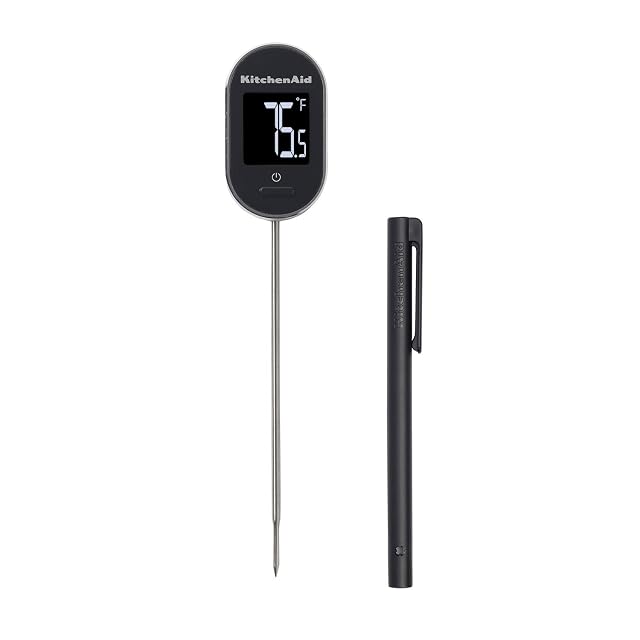
A digital thermistor thermometer reading in under six seconds from −40 to 482 °F, with an oversized pivoting backlit display and a battery included.
Best for: A reader who needs the display legible from any angle more than a fast reading
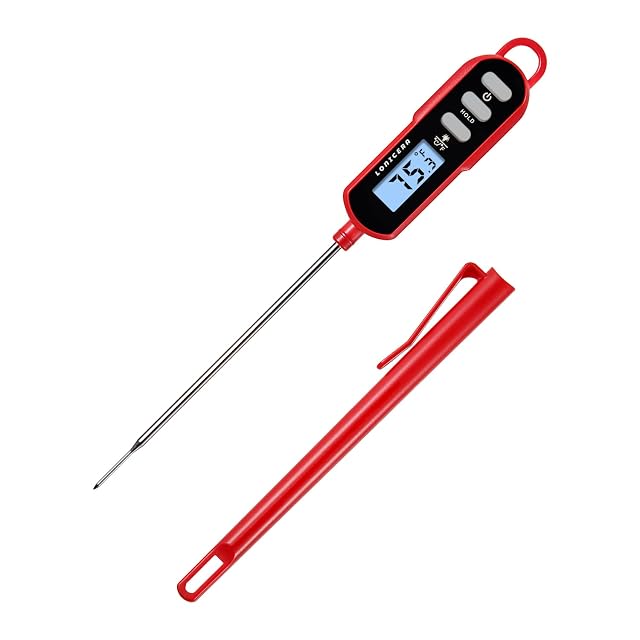
A one-to-two second thermometer accurate to ±1 °F with a 5-inch probe, IPX6 waterproof, a hold button, a magnet, and an 18-month warranty.
Best for: Bread and dough, where probe reach and a long warranty matter more than half a second
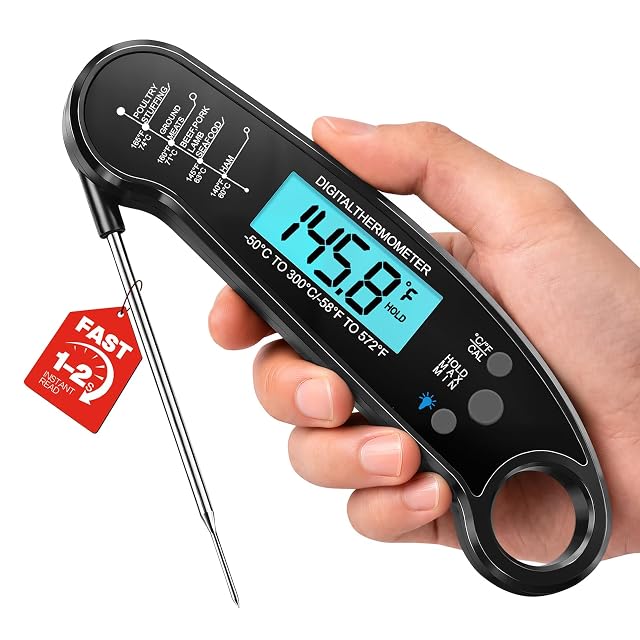
A one-to-two second instant-read thermometer accurate to ±1 °F, fully IP67 sealed, with calibration, a backlit LCD, a magnet and 4,000+ hours of battery.
Best for: The same job as its twin — a sealed, checkable thermometer on a magnet
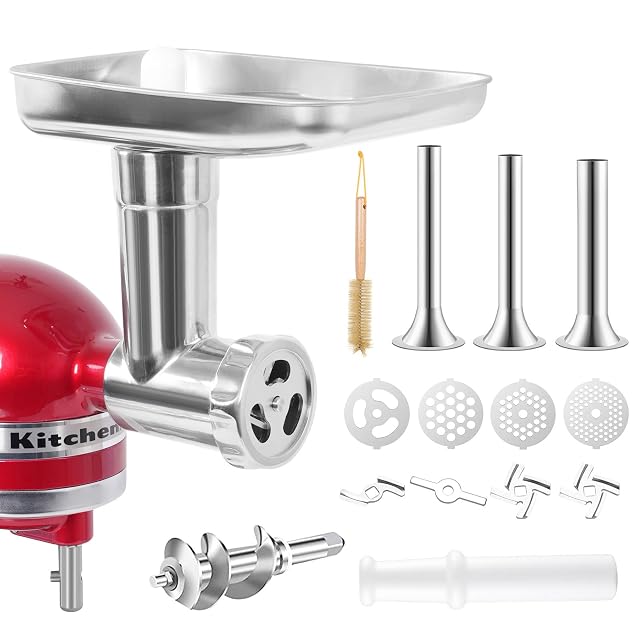
A third-party meat grinder attachment in stainless steel, stated to fit all KitchenAid stand mixers and the Cuisinart SM-50 series. Gdrtwwh lists four grinding plates, two blades and three sausage tubes, dishwasher-safe parts, and uses covering mince, sausages and breadcrumbs.
Best for: A KitchenAid owner who wants a metal grinder and a sausage kit in one box.
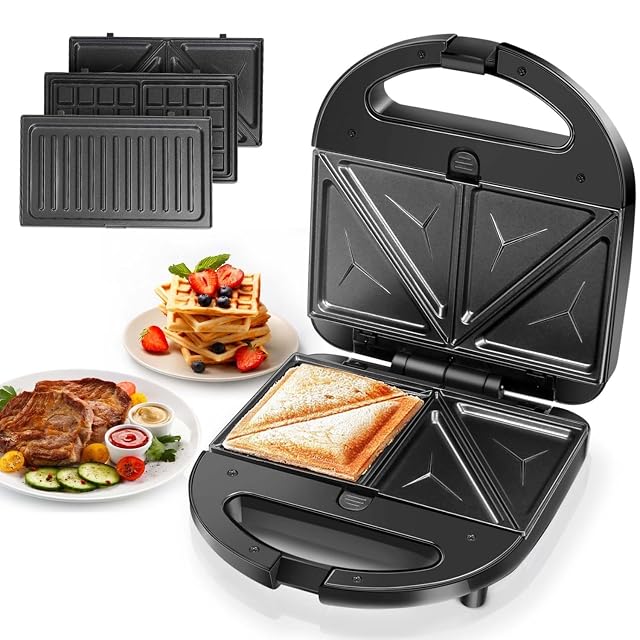
A 750-watt, 120-volt three-in-one panini, grill and waffle press with detachable Teflon plates, a red power light, a green preheat light and upright locking storage.
Best for: A dorm room, an office or a van, where weight and locking storage matter
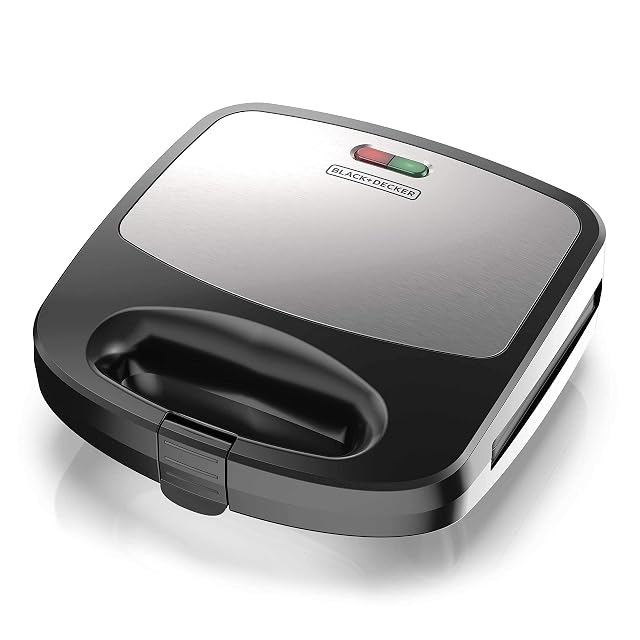
A three-in-one waffle, grill and sandwich press in stainless steel with snap-in non-stick plates, a thermostatted green ready light and a heat-resistant handle.
Best for: A buyer who wants the coating to last, and will read the instructions