What the maker puts in writing
- ”𝗦𝗼𝘂𝘀 𝗩𝗶𝗱𝗲 𝗖𝗼𝗼𝗸𝗲𝗿 𝗚𝟯𝟮𝟬 𝗔𝘄𝗮𝗿𝗱𝗲𝗱 𝟮𝟬𝟮𝟭 𝗥𝗲𝗱-𝗗𝗼𝘁-𝘄𝗶𝗻𝗻𝗲𝗿 𝗽𝗿𝗼𝗱𝘂𝗰𝘁”
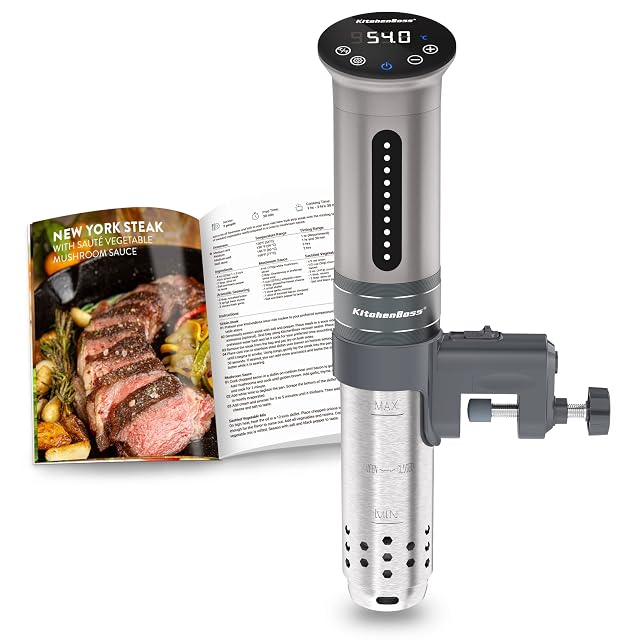
- “WiFi APP Control: Download and connect to the “KitchenBoss” app for your sous vide machine. No matter where you are, easily set and monitor your WiFi sous vide cooker through your phone. Regular updates ensure access to the latest advancements in sous vide technology.”
- “Sous Vide with Color TFT Recipes: Enjoy an ultra-clear TFT display featuring 25 original healthy recipes crafted by renowned chefs, plus 4 custom recipes for hot spring eggs, steaks, lamb chops, lobster, bacon, and baked goods. The built-in programs prevent overcooking…”
- “Quiet Brushless DC Motors: …The impeller design, angled at 135 degrees, pairs with an oval hole in the sleeve to minimize noise during cooking.”
- “Thermostatic Control System: …Adjust temperatures to within 0.1°F/0.2 °F (0.1 °C), with a range from 104°F to 194°F (40°C to 90°C)…”
- “Food-Grade Materials & IPX7 Waterproof: Made from food-grade SUS304 stainless steel… The G320PS circulator is IPX7 waterproof certified… Its removable stainless steel sleeve allows for thorough stain removal.”
- “Super Strong Water Flow: This precision sous vide cooker boasts a powerful 20L/min immersion circulator and a unique 3D spiral structure design. With a motor speed of 3800r/min…”
- “Sleek Aesthetics: …an elegantly molded case and panel… Magnetic knobs add a distinctive touch…”
- Reference G320PS · Catalog: 1243 g (43.8 oz), 85 × 85 × 381 mm (3.35 × 3.35 × 15 in)
Thirty dollars above an identical sibling
At least five of the eighteen items on this shelf are KitchenBoss, and they publish the same heater and the same thermal envelope in identical words.
1100 W · 104–194 °F (40–90 °C) · a 0.1 ° setting · SUS304 stainless · IPX7 · laser welding · a brushless DC motor
And they split into exactly two pump specifications.
3800 r/min, 20 L/min, a “3D spiral structure” — this at $159.99, the G322PT at $129.99, the G330 at $169.99
2900 r/min, 16 L/min — the G310PS at $112.52, the G300S at $105.99
So this unit and the G322PT at $129.99 agree on everything that touches the cooking. Same power, same range, same resolution, same pump, same materials, same waterproofing, same sleeve, same motor, same 25 recipes and 4 custom modes on a TFT screen.
Identical, line for line, $30 apart.
What this page has that the G322PT does not:
“an elegantly molded case and panel, seamlessly integrated for a sophisticated look. Magnetic knobs add a distinctive touch while ensuring effortless functionality”
A 2021 Red Dot
What the G322PT at $129.99 has that this does not:
A published bath limit — “works perfectly with containers within 50L capacity”
A safety statement — “built with overheating protection and auto shut-off for safe use”
A dishwasher claim on the sleeve — “the detachable sleeve is dishwasher safe”, where this page says only “removable”
The only sentence on this shelf declaring the WiFi optional — “does not require mandatory WiFi or APP for basic operation”
A carbon fiber texture, if you prefer it
So the cheaper sibling publishes three real things this one does not, and this one publishes a finish.
On magnetic knobs: it is a genuine detail rather than nothing. A magnetically retained control can be sealed behind a solid panel with no shaft through the case — which on an IPX7 device is the better way to make a knob, because a rotating shaft is a place water gets in, and the family’s whole sealing argument rests on laser-welded joints.
The page does not make that argument. It says “a distinctive touch”.
On the Red Dot: it is a design award, judged on appearance and user experience, and the family says so plainly. The G330 at $169.99 describes its own 2023 award as being for “premium appearance and user experience”. It is not a performance finding.
“a powerful 20L/min immersion circulator and a unique 3D spiral structure design. With a motor speed of 3800r/min, it enhances water flow, ensuring even heating throughout your food”
The shelf, on flow:
20 L/min — this, the G322PT at $129.99, the G330 at $169.99
16 L/min — the G310PS at $112.52, the G300S at $105.99
8.5 L/min (2.25 gal/min) — the Monoprice at $44.99
8 L/min — the Anova Precision Cooker 2.0 at $117.99
Nothing — the other six circulators, including the Anova Pro at $271 with its hundred-liter claim
So the fastest published pump on this shelf is 2.5 times the slowest.
What flow actually buys: it is how fast the whole bath turns over. 20 L/min in a 12-liter bath is a full turnover every 36 seconds; 8 L/min is every 90.
And turnover is what decides whether the bath is one temperature or several — because a heater makes a hot plume, and a thermostat reading one point in a stratified bath is reading one point.
When 20 L/min earns its keep: a full container with several bags in it. The G322PT at $129.99 is the only unit in the family to publish the matching figure — “containers within 50L capacity” — and 20 L/min in 50 liters is a turnover every two and a half minutes.
When it does not: one steak in a small pot, which is most home cooking. At that scale 8 L/min is plenty.
But the real limit is not the pump, and no page on this shelf says so.
A bag resting on the bottom of the container has no water under it. Its underside is heated by conduction through plastic rather than by the bath, and no amount of flow reaches it.
The fix is a rack, and the only item on this shelf that supplies one is the container kit at $54.99 — a 304 stainless rack whose stated job is “keeping the food bags from floating” and putting “some space between the bottom of the container and the food bags”, because “this elevation allows more circulation of the hot water.”
A rack and a lid will do more for bath uniformity than the difference between 8 and 20 liters a minute.
And no bath limit is published here. The shelf: 100 L on the Anova Pro at $271 “when in a covered container” — a parenthesis doing all the work, since 1200 W into 100 liters is about 0.17 °C a minute at best; 50 L on the G322PT at $129.99; 15 L on Greater Goods at $89.99 and the Inkbird at $95.99; and 2.6 to 4.0 gallons of pot on the Monoprice at $44.99, which is the only version you can check before you buy.
One hundred and four degrees, which is the highest floor on this shelf
104–194 °F is 40–90 °C, and it is the family figure for all five KitchenBoss units.
The shelf, on range:
32–197 °F (0–92 °C) — the Anova Nano at $68.28
41–212 °F (5–100 °C) — the Monoprice at $44.99
68–203 °F (20–95 °C) — Greater Goods at $89.99
77–210 °F (25–99 °C) — the Inkbird at $95.99
104–194 °F (40–90 °C) — this, and its four siblings
Not published — the Anova 2.0 at $117.99, the Anova 3.0 at $169.99, the Anova Pro at $271, the Breville at $149.95
The floor is the only one on this shelf that genuinely excludes anything. A circulator cannot cool water, so a floor below room temperature is unreachable by definition — which makes the Anova Nano’s 32 °F (the freezing point of water) and the Monoprice’s 41 °F decorative.
104 °F is above room temperature, and it rules out chocolate work in the high 80s and low 90s. Every other circulator here can reach it; none of the five KitchenBoss units can.
What it does not rule out is any ordinary sous vide cooking. Fish runs 104 to 130 °F, beef 129 to 140, pork 135 to 145, chicken 145 to 155, eggs 145 to 167, tough cuts 155 to 185, root vegetables 183 to 185. The technique lives inside this range — and the page’s own list of custom recipes names hot spring eggs, steaks, lamb chops, lobster, bacon and baked goods, all of which fit.
The ceiling at 194 °F is the lowest published here, and what it costs you is using a circulator as a general water bath — blanching, holding stock near a boil — which the Monoprice’s 212 °F and the Inkbird’s 210 °F allow.
And “adjust temperatures to within 0.1°F/0.1°C” is a display resolution rather than a justness claim.
The distinction worth carrying across this shelf: stability is how steadily a machine holds a reading; justness is whether the reading is right. A probe that reads 1.5 °C high holds 1.5 °C high all day and the display never flickers.
Only two items here let you correct it: Greater Goods at $89.99 (“built-in calibration lets you fine-tune the reading against a trusted thermometer”) and the Inkbird at $95.99 (“adjustable from -10F to +10F”). No KitchenBoss on this shelf has one.
Greater Goods is also the only page here to separate the three figures honestly: 0.5 °F setting increments, a 0.1 °F readout, and a calibration — because a setting step finer than the bath’s own uniformity is a false precision.
The impeller at a hundred and thirty-five degrees, and the oval hole
“The impeller design, angled at 135 degrees, pairs with an oval hole in the sleeve to minimize noise during cooking.”
This family describes the mechanism of its own quietness in more detail than anything else on this shelf.
this — an impeller at 135 degrees, an oval hole in the sleeve
G300S, $105.99 — a “double-sided inclined 45-degree angle spiral design” with a “diamond-shaped water inlet”
G330, $169.99 — “45 degree angled double sided” with a “diamond water inlet”, “to prevent the spread of noise maximum”
G310PS, $112.52 — a “double-sided inclined spiral design”, plus the only mute mode on this shelf (press and hold the time mode three seconds)
G322PT, $129.99 — “The optimized impeller structure greatly reduces running sound, supporting safe unattended cooking and overnight temperature holding”
What makes the noise, and why geometry is the right place to attack it.
It is the impeller, not the heater. A heating element is silent; a pump moving 20 liters a minute is not.
A pump makes two kinds of sound: the blade passing the housing, which is a tone, and turbulence at the inlet, which is a hiss. An angled blade and a shaped inlet both attack the first, by making the blade-passing event less abrupt.
Which is real engineering described in a sales bullet, and the detail is to the family’s credit.
What is missing is a figure.
One item on this shelf publishes one. The Inkbird at $95.99: “it operates quietly at less than 40dB, letting you cook overnight or during family time without disturbance.” Under 40 dB is quieter than a refrigerator.
Six items here name a brushless DC motor — these five and Greater Goods at $89.99 — and none of the six gives a number. No Anova mentions its motor at all; the Breville at $149.95 publishes nothing of any kind.
And why it matters: sous vide’s best cooks are its longest. Brisket at 155 °F for 24 to 36 hours. Short ribs for 48. Tough cuts for 72. Those run overnight in whatever room the kitchen is, and a pump that whines is a pump you turn off.
A brushless DC motor is quieter than a brushed one and lasts longer, because there are no carbon brushes to wear. It is a real distinction, claimed here without a number.
Twenty-five recipes on the screen, and four you can set yourself
“Enjoy an ultra-clear TFT display featuring 25 original healthy recipes crafted by renowned chefs, plus 4 custom recipes for hot spring eggs, steaks, lamb chops, lobster, bacon, and baked goods. The built-in programs prevent overcooking, preserving essential nutrients and vitamins…”
Four of the five KitchenBoss units here do this: this one, the G310PS at $112.52, the G322PT at $129.99 and the G330 at $169.99.
What a preset actually is: a temperature and a time. Which is the whole of sous vide — and that is both why the presets are useful and why they are not a feature in any deep sense.
A preset saves you looking up that salmon is 122 °F and chicken breast 149 °F. It does not cook anything differently.
Where it genuinely helps is the first month, and where it stops helping is the moment you know your own numbers — which is why the 4 customizable modes matter more than the 25 fixed ones.
“The built-in programs prevent overcooking” is a true statement about the technique rather than about the programs. A bath held at the target temperature cannot overcook, because the bath is the ceiling — which is exactly the premise, and it holds whether you set the number by hand or pick it off a list.
The one machine on this shelf that gives that premise up is the Breville Joule Turbo at $149.95, whose Turbo mode runs the bath hotter than the target to get there faster — “powered by complex algorithms and powerful cloud computing”. That mode can overcook, because overshoot is the mechanism being managed.
And the Breville does one thing with presets that nothing else here does: it lets you choose the outcome instead of the ingredient. “VISUAL DONENESS: Select desired doneness results before you begin… Rare, Medium, Well Done, and everything in between.” Which answers the question the temperature-to-doneness map actually poses.
How the rest of the shelf handles recipes. The four Anovas sell a library — free app for time and temperature, $1.99 a month or $9.99 a year for the recipe content and your own cook history, the only recurring cost disclosed anywhere on this shelf. The Inkbird at $95.99 includes a printed guide. The container kit at $54.99 includes a cookbook. Greater Goods at $89.99 gives you a dial and expects you to know what to set it to.
The feature this page does not have, which its most expensive sibling does: languages. The G330 at $169.99 publishes six — “English, German, French, Spanish, Italian, Japanese”. On a machine whose screen is its selling point, that list is worth checking before you buy.
What is not published
No maximum bath volume, as above — the figure its $30-cheaper sibling publishes.
No safety statement. The G322PT at $129.99 is the only unit in this family to publish one: “built with overheating protection and auto shut-off for safe use.” Which on a 1100 W element designed to run unattended for days is the specification you would most want, and four of the five pages omit it.
No timer. Three items on this shelf publish a range: 1 minute to 99 hours on Greater Goods at $89.99 with an audible alert and an overtime counter, up to 99 hours on the Inkbird at $95.99, and up to 99 hours 59 minutes on the G330 at $169.99 — this unit’s own sibling. The long cooks are the reason to own a circulator, and this page does not say whether it can time one, nor what it does when the timer expires. Only Greater Goods states that behavior: it holds temperature and counts the overtime rather than switching off — which is correct, because switching off a bath with food in it is a food-safety problem.
No dishwasher claim on the sleeve, as above — “removable” where the G322PT says “dishwasher safe”.
No calibration, as above.
No noise figure, as above, on the page that describes its impeller geometry in the most detail.
No minimum water depth, which no item on this shelf publishes — the Anova 3.0 at $169.99 refers to “the minimum water depth requirements” without giving one, and the G322PT at $129.99 says “low minimum water depth” without a number. This body is 381 mm overall, the family figure, against 304 mm for the Breville, the shortest here.
No account of the weight. 1243 g against 1569 g and 1633 g for siblings of the same dimensions and the same stated materials — a 326-gram difference the page does not explain.
No warranty. One item on this shelf publishes one: Greater Goods at $89.99, “5-year coverage” with a “St. Louis-based support team”. Thirteen publish nothing, this included — and the nearest thing here is the Anova Pro’s design claim at $271, “run for a minimum of 10,000 hours straight”, which is about 416 days of continuous running and is not a commitment.
No bag sealing. Not at least one of the eighteen items on this shelf is or includes a vacuum sealer, and the technique needs the food sealed and the air out: a bag with air in it floats, and the part above the water is not cooking. The Inkbird at $95.99 is the only page here to offer an alternative — “a sealed bag or glass jar” — and the container kit at $54.99 is the only item that addresses flotation.
No cord length, which no item on this shelf publishes.
Availability
Read on the day this page was built: $160 at the American Amazon shop.
Read from Keepa on the day this page was last revised; stock and price both move without notice.
Prices quoted in this text were read on 2026-10-05. The live price is at the top of the page.