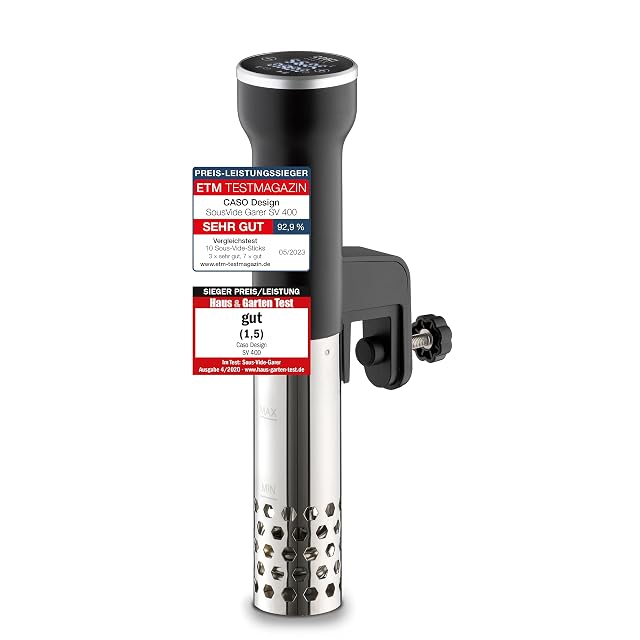
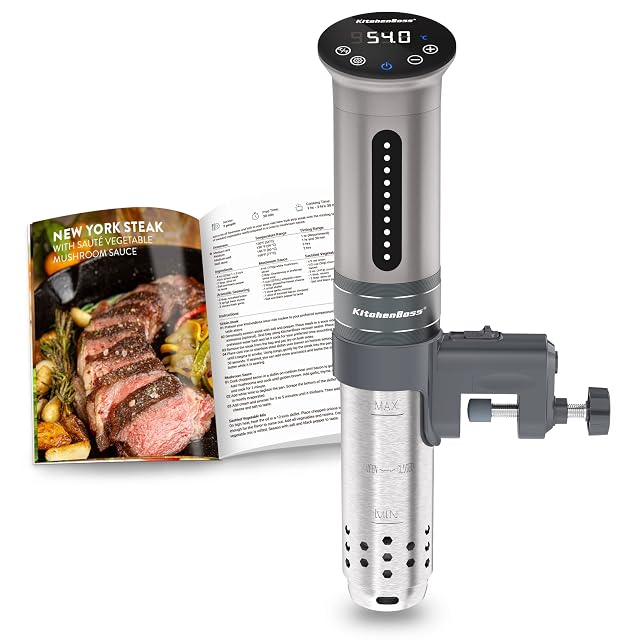
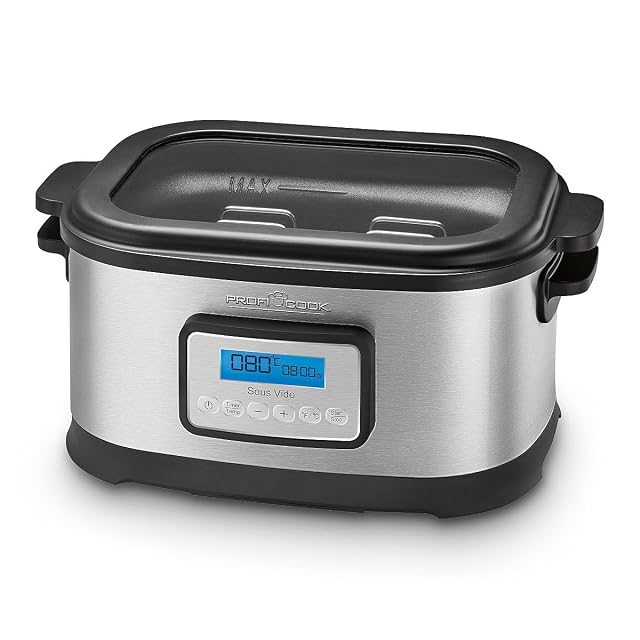
What the maker puts in writing
- “Pros have been doing it for years, and now you can too. Sous vide… is a cooking technique that utilizes highly precise temperature control in a circulating bath of water to deliver consistent, edge-to-edge perfect results, with virtually no risk of overcooking your food.”
- “Our best-seller, only better. The first Anova Precision Cooker launched in 2014 and started a home-cooking revolution… This third generation of our flagship sous vide circulator adds key improvements… What’s different: 1) We upgraded to use dual band WiFi for improved connectivity. 2) A two-line touch screen display allows you to quickly view time and temperature.”
- “The adjustable clamp makes it an ideal fit on nearly any pot that is deep enough to meet the minimum water depth requirements. A removable stainless steel skirt on the cooker’s lower half makes it easy as a twist of the wrist to detach and clean the skirt either by hand or in the dishwasher.”
- “Anova App (free): Control your time and temp directly on the Anova app or directly on the cooker itself.”
- “Anova App (subscription): For $1.99 a month or $9.99 a year (cancel subscription at anytime), get access to the ultimate sous vide educational content and cooking guides… Two week free trial included.”
- From the name: “3.0 (WiFi)”, “1100 Watts”, “Stainless Steel”
- Reference AN525-US00 · Catalog: 871 g (30.7 oz), 325 × 78 × 140 mm (12.8 × 3.07 × 5.51 in)
A skirt that comes off, which is the better answer to cleaning
“A removable stainless steel skirt on the cooker’s lower half makes it easy as a twist of the wrist to detach and clean the skirt either by hand or in the dishwasher.”
What actually gets dirty. A bath that has had bags in it for hours has fat in it. And the heating element collects mineral scale, which is the normal end of a circulator’s life — scale insulates the element from the water, the element runs hotter to compensate, and eventually it fails.
Both of those happen under the skirt.
The alternative answer is an immersion rating, and six items on this shelf publish one.
IPX7 — all five KitchenBoss units, and the Anova Pro at $271, which adds drop tested
“Water resistant for when accidents happen in the kitchen” — the Anova 2.0 at $117.99, which is not a rating
Nothing — this, the Anova Nano at $68.28, the Breville at $149.95, Greater Goods at $89.99, the Inkbird at $95.99, the Monoprice at $44.99
On five of those six IPX7 pages, the rating is used for exactly one purpose: you can wash the whole thing. The KitchenBoss G300S at $105.99: “can be cleaned by putting the entire body in water, allowing you to deep clean every crevice of oil stains.”
Which works, and puts the control board in the sink.
A removable skirt does not. It takes off the shroud, the impeller housing and the element, which go under a tap or into a dishwasher, and leaves the display and the board dry.
The four items on this shelf with one:
this — a removable stainless steel skirt, dishwasher safe
Greater Goods, $89.99 — “a removable, dishwasher-safe stainless-steel housing”
KitchenBoss G322PT, $129.99 — “the detachable sleeve is dishwasher safe”
KitchenBoss G320PS at $159.99 and G310PS at $112.52 — a removable stainless steel sleeve, without the dishwasher claim
And this is the only Anova on this shelf with one. The Nano at $68.28 is “constructed of super durable plastic that’s easy to clean”. The 2.0 at $117.99 is “water resistant for when accidents happen”. The Pro at $271 is stainless and IPX-7 with no removable part named.
“Easy as a twist of the wrist” is the detail that makes it a feature rather than a possibility. A skirt held by screws is a skirt that never comes off.
The descaling habit is worth stating because no page on this shelf gives it: a cycle of water and white vinegar held warm for half an hour will take scale off an element no cloth can reach. With a skirt that comes off, you can see whether it worked.
Dual-band WiFi, which nothing else here publishes
“What’s different: 1) We upgraded to use dual band WiFi for improved connectivity. 2) A two-line touch screen display allows you to quickly view time and temperature.”
Nine items on this shelf have an app and only this one publishes dual band.
One other publishes a band at all: the Inkbird at $95.99 — “Once connected to your 2.4GHz WiFi network.” The four KitchenBoss units with WiFi and the Anova 2.0 at $117.99 say WiFi and stop. The Breville Joule Turbo at $149.95 names an app and no network.
Why it is a real improvement rather than a specification flourish. 2.4 GHz has the range and the wall penetration; 5 GHz is faster and shorter. For a device sending a temperature reading, either is more than enough.
The problem dual band solves is at setup. A combined-band router that advertises one network name can make a 2.4-only device awkward or impossible to pair — because the phone is on 5 GHz and the appliance cannot see the network it is being handed.
“Improved connectivity” is the honest description of what it fixes: not speed, but the chance that it will connect at all.
The two-line display is the other listed improvement and it is a better one than it sounds. Time and temperature at once, rather than one of them and a mode button — which matters on a tool where both numbers are the recipe.
Greater Goods at $89.99 attacks the same problem differently, and names it: “A large, bright LED display sits at a 45° angle toward you, keeping your settings easy to see right from the counter without hovering over the pot.” Which is the reason people reach for a phone in the first place: a vertical screen on a shaft sticking out of a pot is unreadable from standing height.
And four KitchenBoss units go the other way with a color TFT screen carrying 25 chef recipes and 4 custom modes — the G330 at $169.99, the G322PT at $129.99, the G320PS at $159.99, the G310PS at $112.52.
What remote monitoring actually tells you is that the water is still the temperature you set it to, which is the one thing a thermostat is for. The useful direction is the other one: starting a bath before you get home. The Inkbird at $95.99 is the only page here to state that outright — “start or stop your cook from anywhere.”
The position worth weighing before buying any connected circulator: an app can be renamed, replaced or retired. The KitchenBoss G330 at $169.99 is the example on this very shelf — it names the “VeSync” app where three of its siblings name “KitchenBoss”. The G322PT at $129.99 is the only item here to foreclose the risk in writing: “does not require mandatory WiFi or APP for basic operation.” And Greater Goods at $89.99 puts the whole argument in its product title: “No App or WiFi Needed.”
This page does not state whether it works without the app. Bullet four implies it does — “Control your time and temp directly on the Anova app or directly on the cooker itself” — and that is the sentence to rely on.
No temperature range and no accuracy, which the sixty-eight-dollar Nano gives
The four Anovas on this shelf, in price order:
Nano 2.0, $68.28 — “Temperature : 0˚-92˚C (32˚-197˚F) | +/- 0.1˚C (0.2˚F) accuracy”, 12.8 inches, a fixed clamp, plastic, no wattage
Precision Cooker 2.0, $117.99 — no range, no accuracy; 1000 W in its title and “Power 1100 Watts.Power 1100 Watts” in its first bullet; an adjustable clamp, water resistant, 8 L/min
this, $169.99 — no range, no accuracy; 1100 W, dual-band WiFi, a two-line touch screen, an adjustable clamp, a removable dishwasher-safe stainless skirt
Precision Cooker Pro, $271 — no range, no accuracy; 1200 W, stainless, 100 L, a minimum of 10,000 hours, drop tested, IPX-7
So the cheapest Anova is the only one that publishes a temperature specification at all.
Across the whole shelf, four items publish no range: three Anovas and the Breville Joule Turbo at $149.95, which publishes no number of any kind.
What the other five publish:
32–197 °F (0–92 °C) — the Anova Nano at $68.28
41–212 °F (5–100 °C) — the Monoprice at $44.99
68–203 °F (20–95 °C) — Greater Goods at $89.99
77–210 °F (25–99 °C) — the Inkbird at $95.99
104–194 °F (40–90 °C) — all five KitchenBoss units, the narrowest here
Why the pattern is not sinister. A maker publishes the number it is selling on. At $68 the argument is “this is a real precision cooker” and the figure proves it; at $271 the argument is durability, and hours and IPX-7 prove that instead.
This unit, in the upper middle of the line, publishes convenience: a radio, a screen and a skirt. Which are genuine improvements, and none of them is a thermal specification.
What the page offers instead is the best description of the technique on this shelf. “Sous vide… utilizes highly precise temperature control in a circulating bath of water to deliver consistent, edge-to-edge perfect results, with virtually no risk of overcooking your food.”
“Edge-to-edge” and “virtually no risk of overcooking” are the two things that actually distinguish the method, and they are the same thing said twice: the bath is the ceiling, so the center and the surface arrive at the same temperature and neither goes past it.
Which is exactly the premise the one machine on this shelf gives up. The Breville Joule Turbo at $149.95 runs the bath hotter than the target to get there faster — “complex algorithms and powerful cloud computing” — and that mode can overcook, because overshoot is the mechanism being managed.
And the omission that matters more than the range is calibration. Stability is how steadily a machine holds a reading; justness is whether the reading is right. A probe that reads 1.5 °C high holds 1.5 °C high all day and the display never flickers.
Only two items on this shelf let you correct it. Greater Goods at $89.99 — “built-in calibration lets you fine-tune the reading against a trusted thermometer.” The Inkbird at $95.99 — “a calibration function (adjustable from -10F to +10F).” No Anova has one.
It names the minimum water depth, and does not give it
“The adjustable clamp makes it an ideal fit on nearly any pot that is deep enough to meet the minimum water depth requirements.”
The clearest statement on this shelf that the figure exists, from the page that comes closest to publishing it.
The only other gesture at it is the KitchenBoss G322PT at $129.99: “Compact size is easy to store with low minimum water depth.” Also no number.
Fourteen items, no figure — on the specification that decides whether a circulator will run in your pot at all, because below the minimum mark the heater cuts out.
What the figure is for. A circulator has an intake low on the body and an outlet above it, and both have to be under water. Too little water and the pump draws air, the heater runs in a dry pocket, and the low-water cutout fires.
Greater Goods at $89.99 is the only page here to describe that behavior, and it solves the problem a better way — with lines on the body: “Clearly marked MIN/MAX lines show where to fill, and if water runs low, heating stops as the status light turns red; simply refill and reconfirm your settings to continue.”
Lines you can see while you fill are a better answer than a figure in a specification — and the “reconfirm your settings” detail is the one worth knowing: a refill does not silently resume.
The proxy available to you is the body length, and this one is at the short end.
304 mm — the Breville at $149.95, the shortest here
325 mm — this, the Anova Nano at $68.28, the Anova 2.0 at $117.99
351 mm — the Anova Pro at $271
381 mm — all five KitchenBoss units
394 mm — Greater Goods at $89.99
410 mm — the Inkbird at $95.99
411 mm — the Monoprice at $44.99
And the adjustable clamp is the other half of pot fit. The Nano at $68.28 is the only item on this shelf with a fixed bracket — “attaches to any stock pot or container with a fixed clamp” — and a fixed bracket grips one rim thickness well and a thick rolled rim, a plastic container lip or a cast enamel edge badly or not at all. An adjustable screw clamp spans the lot.
The lidded-container question runs the other way. The container kit at $54.99 is the only accessory on this shelf and its lid has a pre-cut hole “tested for ANOVA and CHEFSTEPS machines” — and this body is 78 mm, which is the Anova diameter that hole is cut for.
And the thing that actually ends a long cook is evaporation rather than underfilling. An uncovered bath loses water steadily over 24 or 36 hours — which is why that lid promises to “prevent water evaporation”, and why the Anova Pro at $271 can only claim 100 liters “when in a covered container.”
Eleven hundred watts, and what wattage does not buy
The shelf, on power:
1200 W — the Anova Pro at $271
1100 W — this, all five KitchenBoss units, Greater Goods at $89.99, and the Anova 2.0 at $117.99 by its own bullet
1000 W — the Inkbird at $95.99, and the Anova 2.0 by its own title
800 W — the Monoprice at $44.99
Not published — the Anova Nano at $68.28 and the Breville at $149.95
What wattage buys is heat-up time and nothing else.
Once a bath is at temperature, holding it takes a fraction of the rating. The heater cycles, and what it is making up is evaporation from the surface and conduction through the pot walls.
Which is why the biggest bath claim on this shelf is really a claim about a lid. The Anova Pro at $271: “able to heat up to 100L of water when in a covered container.” 1200 W into 100 liters is about 0.17 °C a minute at best — six hours from cold to 65 °C. The covered container is doing the work, not the extra hundred watts.
For a realistic bath the arithmetic is kinder. 1100 W into 12 liters is roughly 1.3 °C a minute in theory — so from tap-hot to 60 °C is minutes, and from cold is half an hour.
And the practical shortcut no page on this shelf mentions: fill it from the hot tap. A domestic hot supply often sits at 120 to 140 °F, which is most of the way to a steak temperature and turns the whole power spread on this shelf into a rounding error.
No flow rate is published here, and that is the figure that matters more. Four items publish one: 20 L/min on the KitchenBoss G330 at $169.99, G320PS at $159.99 and G322PT at $129.99; 16 L/min on the G310PS at $112.52 and G300S at $105.99; 8.5 L/min on the Monoprice at $44.99; 8 L/min on the Anova 2.0 at $117.99.
Flow is how fast the whole bath turns over, and turnover is what decides whether the bath is one temperature or several — because a heater makes a hot plume, and a thermostat reading one point in a stratified bath is reading one point.
But the real limit is not the pump, and no page on this shelf says so. A bag resting on the bottom of the container has no water under it, so its underside is heated by conduction through plastic rather than by the bath, and no amount of flow reaches it. The fix is a rack, and the container kit at $54.99 is the only item on this shelf that supplies one.
The app, the subscription and the third generation
“Anova App (free): Control your time and temp directly on the Anova app or directly on the cooker itself.” · “Anova App (subscription): For $1.99 a month or $9.99 a year (cancel subscription at anytime), get access to the ultimate sous vide educational content and cooking guides… Continuous access to your personal recipes and cook history… Two week free trial included.”
The division is stated plainly and all four Anovas on this shelf state it identically: time and temperature are free, forever, on the app and on the machine; the recipe library and your own cook history are the paid tier.
“Continuous access to your personal recipes and cook history” is the part worth noticing, because that is your own data behind a subscription.
Credit where it is due: this is the only recurring cost disclosed anywhere on this shelf, and all four Anovas disclose it in the same words. Nothing else here has a subscription.
How the rest of the shelf handles recipes. Four KitchenBoss units print them on the machine — “25 original healthy recipes created by famous restaurant chefs and 4 custom recipes”, on a color screen, with no account and no fee. The Inkbird at $95.99 includes a printed guide. The container kit at $54.99 includes a cookbook. Greater Goods at $89.99 gives you a dial and expects you to know what to set it to.
And the Breville Joule Turbo at $149.95 does the one genuinely different thing with the idea: it lets you choose the outcome rather than the ingredient. “VISUAL DONENESS: Select desired doneness results before you begin… Rare, Medium, Well Done, and everything in between.” Which answers the question the technique actually poses, because the temperature-to-doneness map is the one piece of knowledge it requires, and it is counter-intuitive: 131 °F is medium-rare, 140 °F medium, 155 °F well done.
“The first Anova Precision Cooker launched in 2014” is a provenance claim and the only one on this shelf with a date on it. Which is worth something on a category this young: a third generation of a product line is a product that has been revised twice in the light of what broke.
What the page does not do is say what the first two generations got wrong — beyond the two things it lists as different, a radio and a screen.
What is not published
No temperature range and no accuracy figure, as above — which the $68.28 Nano gives.
No flow rate, as above.
No maximum bath volume. Its own sibling the Anova Pro at $271 claims 100 L “when in a covered container”; the KitchenBoss G322PT at $129.99 claims 50 L; Greater Goods at $89.99 and the Inkbird at $95.99 claim 15 L; the Monoprice at $44.99 states a pot size, 2.6 to 4.0 gallons, which is the only version you can check before you buy.
No minimum water depth, as above — on the one page that names the requirement.
No waterproof rating. Its own $271 sibling publishes IPX-7 and drop tested. This page publishes a removable skirt instead, which is the better answer for cleaning and says nothing about what happens if the unit goes in the water.
No timer range. Three items on this shelf publish one: 1 minute to 99 hours on Greater Goods at $89.99 with an audible alert and an overtime counter, up to 99 hours on the Inkbird at $95.99, up to 99 hours 59 minutes on the KitchenBoss G330 at $169.99. No Anova on this shelf publishes a timer at all — and the long cooks are the reason to own a circulator: brisket at 155 °F for 24 to 36 hours, short ribs for 48, tough cuts for 72.
No motor type and no noise figure. One item publishes a figure: the Inkbird at $95.99, “less than 40dB”, quieter than a refrigerator. Six name a brushless DC motor — all five KitchenBoss units and Greater Goods. No Anova mentions its motor, and on a cook that runs overnight the pump is the thing you hear. The KitchenBoss G310PS at $112.52 is the only item here with a mute mode.
No calibration, as above.
No warranty. One item on this shelf publishes one: Greater Goods at $89.99, “5-year coverage” with a “St. Louis-based support team”. Thirteen publish nothing, this included. The nearest thing here is the Anova Pro’s design claim at $271 — “run for a minimum of 10,000 hours straight”, about 416 days of continuous running — which is a design statement rather than a commitment.
No bag sealing. Not at least one of the eighteen items on this shelf is or includes a vacuum sealer, and the technique needs the food sealed and the air out: a bag with air in it floats, and the part above the water is not cooking — which is precisely the failure that breaks the “edge-to-edge” result bullet one promises.
No cord length, which no item on this shelf publishes.
Availability
Read on the day this page was built: $170 at the American Amazon shop.
Read from Keepa on the day this page was last revised; stock and price both move without notice.
Prices quoted in this text were read on 2026-10-05. The live price is at the top of the page.